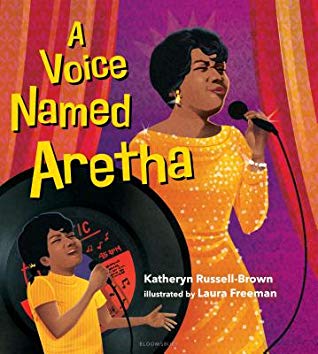
A Voice Named Aretha by Katheryn Russell-Brown

A Voice Named Aretha by Katheryn Russell-Brown

A Voice Named Aretha by Katheryn Russell-Brown, illustrated by Laura Freeman (9781681198507)

Explore the life of one of the greatest singers of all time in this picture book biography of Aretha Franklin. Aretha grew up in a family filled with music and talking. She was a shy little girl, but even from a young age had an incredible singing voice. Her parents left one another when she was a child, and she lived with her father. She adored her time with her mother until her mother died when Aretha was 10. She used music to express her feelings, moving to New York City at age 18. It was the turbulent 1960s where clubs and venues were still segregated for the most part. Aretha made sure to not ever be tricked out of being paid as well as paying attention to venues where everyone was allowed. She was popular but all of her albums flopped until she made some of her most iconic songs and became the Queen of Soul.

Told in a warm and welcoming tone of someone sharing the life story of a beloved family member, this picture book biography captures the way so many people feel about Aretha Franklin and her joyous impact in their lives through her music. The text is accessible and shares the hardships of Franklin’s life and career, displaying her resilience in the face of disappointment as well as her savviness about business and civil rights. The digital art in the book is full of bright and deep colors that pop on the white backgrounds.

A grand picture book biography for the Queen of Soul. Appropriate for ages 6-9.

Reviewed from ARC provided by Bloomsbury.

The Wolf in Underpants Freezes His Buns Off by Wilfrid Lupano

The Wolf in Underpants Freezes His Buns Off by Wilfrid Lupano

The Wolf in Underpants Freezes His Buns Off by Wilfrid Lupano, illustrated by Mayana Itoiz and Paul Cauuet (9781541586949)

This is the second Wolf in Underpants book. Winter has arrived in the woods and everyone is bundled up to play in the snow, enjoying winter activities, and eating cheese fondue to stay warm. Everyone is having a great time, except the wolf. When he walks through town, he declares “They’re freezing!” Everyone gets worried, because he seems quite angry. So they decide that it must be his feet that are cold and have the owl knit him some socks. When they send a small animal to deliver the socks, the animal disappears. The next day, the wolf is still upset and the town decides he must need a hat. But once again the animal delivering it disappears. Meanwhile, the rumors in town are multiplying and it is decided that the wolf has gone rogue! But when they burst into the wolf’s home, they discover something they never expected.

Originally published in French, this picture book is a fascinating look at privilege and need. It also look deeply at assumptions about those who may be more wolf-like than others and accepting differences. That is all packaged in a book that is packed with humor and plenty of witty asides. Younger readers will realize the villagers are making a mistake with their decisions, but still won’t quite be certain what the wolf is up to either. It’s a wonderful dynamic of the story and really makes the book a page turner right to the end.

The illustrations are done in a mix of picture book pages and graphic novel frames. The pages are filled with animals talking, huge stores of food and marvelous details of things like the bakery and cheese factory. The illustrations are detailed and create a vibrant village for readers to explore.

A great picture book about privilege, prejudice and kindness. Appropriate for ages 4-6.

Reviewed from e-galley provided by Lerner.

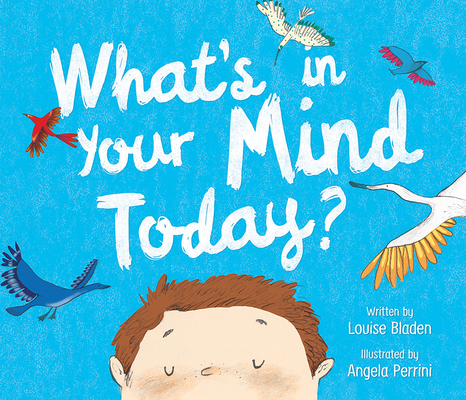
What’s in Your Mind Today? by Louise Bladen

What's in Your Mind Today by Louise Bladen

What’s in Your Mind Today? by Louise Bladen, illustrated by Angela Perrini (9781506463773)

This picture book explores meditation with small children, beginning with sitting still and counting breaths. The book then asks via its rhyming text for children to take a look at what is happening in their minds. Then the book moves away from meditation instruction to looking at what other children are thinking about. Molly’s fluttering thoughts are like butterflies, moving quickly and unable to be caught. Oliver’s thoughts are monsters that melt away when he looks at them. George’s mind is full of troubles that burst like bubbles. Amelia’s thoughts are squirmy like worms. For all of the children, if they look at their thoughts, the thoughts go away, transform and leave them more at peace.

Bladen’s rhyming text is lighthearted and playful, inviting children to explore rather than being a formulaic look at meditation and its impact. Sharing a series of different types of thoughts with children is especially helpful, particularly when we all struggle with different thoughts at different times. The power of sitting meditation is clear here, yet not didactic in tone.

Perrini’s illustrations embrace those various thought patterns, launching visually into them and exploring how they make us and the children feel. There are dark pages, light pages, wriggly and bubbly pages. Each is shown with a sense of lightness and play.

A great addition to meditation books for children. Appropriate for ages 3-5.

Reviewed from copy provided by Beaming Books.

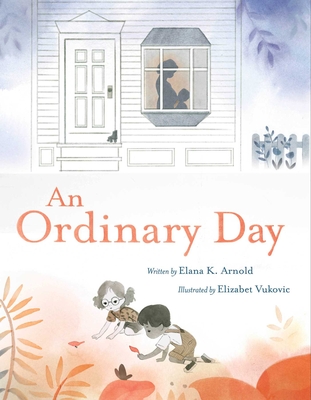
An Ordinary Day by Elana K. Arnold

An Ordinary Day by Elana K. Arnold

An Ordinary Day by Elana K. Arnold, illustrated by Elizabet Vukovic (9781481472623)

It was an ordinary day in an ordinary neighborhood, but two of the houses across the street were unusually quiet. A car pulled up to each of the houses. A doctor got out of each of the cars and each entered a different house. Outside, life in the neighborhood continued to be ordinary. Inside though, it was different. In the house on the left, a golden retriever was on a bed surrounded by her family. Soft music played. In the house on the right, a woman rested on a bed with her family around her and soft music playing. Both doctors say “She is ready” and start to help. One family says goodbye to a beloved pet while another greets a new member of their family. All part of an ordinary and extraordinary day.

This is a gentle and quiet book that looks deeply at both tragic and joyous moments in our regular everyday lives. The pairing of the two together is what makes this book truly sing. The two stories dance together, moving in concert with one another until they diverge in major and minor keys. Arnold’s writing is steady and strong, offering a foundation for these large emotions to build upon. Yet she also soars as appropriate with the moment.

Vukovic’s illustrations are light and airy, almost ready to float off the page. Done in charcoal, pastel,  watercolor, ink and digitally, the art is filled with soft colors that mist and cloud across the page. The diverse neighborhood shines here, on an ordinary day.

Beautifully illustrated and written, this quiet book about death and life is a gem. Appropriate for ages 4-6.

The Secret Garden of George Washington Carver by Gene Barretta

The Secret Garden of George Washington Carver by Gene Barretta

The Secret Garden of George Washington Carver by Gene Barretta, illustrated by Frank Morrison (9780062430151)

George Washington Carver grew up to be a famous botanist and inventor. In 1921, he spoke before Congress, talking about how the humble peanut could be used to make so many different products. This famous man’s connection with plants and the earth came from an early age in the form of his own secret garden. Born into slavery in 1864, he was kidnapped as an infant along with his mother. His mother was never found, but George was brought back to slavery. George and his brother grew up on the farm, even after slavery was abolished. Every day, George headed to the woods and the garden he was growing there. He learned all about plants without being mocked or teased, soon helping people in the area with their sick plants. He grew up, got an education, and became an Agriculture professor at Tuskegee Institute He also traveled the United States working directly with farmers to answer their questions and improve their farms. 

Barretta’s picture book biography of this famous African-American scientist and genius is fascinating and filled with moments of wonder. The frightening kidnapping in his infancy, his start as a slave and then working on a farm for his previous owners, and his incandescent mind finding a way forward to learn and grow all add up to a remarkable life. The text is engagingly written for a compelling read. 

Morrison’s art is phenomenal. The browns of the days of manual labor on the farm contrast with the bright greens, growing shoots, and tall trees of George’s secret garden. The two parts of his life could not appear more different. 

A fascinating look at a remarkable man. Appropriate for ages 6-9.

Reviewed from library copy.

Swim Swim Sink by Jenn Harney

Swim Swim Sink by Jenn Harney

Swim Swim Sink by Jenn Harney (9781368052764)

After three tiny ducks hatch from their eggs: “Crack! Crack! Crack!” “Quack! Quack! Quack!” Their mother leads them down to the pond to swim. The ducklings jump in: “Swim, swim…sink!” Wait, ducks are supposed to float and swim. They try it again, and the duckling sinks every time. Perhaps there’s a solution? Water wings? Scuba gear? A jetski? But nothing seems quite right, until the duckling comes up with a unique solution all their own that involves using their discarded eggshell. Now the story works again and so does the rhyme. 

Harney uses broad comedy in this picture book that just has to be read aloud to be enjoyed to the fullest. The rhyme she creates is wonderfully bouncy and jaunty, offering just the right amount of rhythm and speed to be cleverly derailed by the sinking duckling. The humor here is just right for toddlers who will delight in the surprise of the story shifting right in front of them. 

The art is bright and bubbly with a merry tone. The sinking duckling in the green-blue water is satisfying and abrupt, adding to the humor of the moment. The final solution the duckling figures out is another great visual moment in the story. 

Reading this one aloud will always go swimmingly. Appropriate for ages 2-4.

Reviewed from library copy.

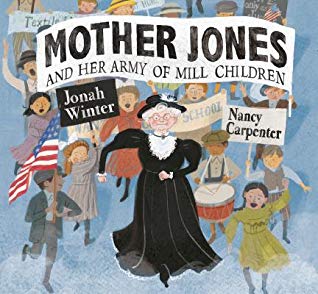
Mother Jones and Her Army of Mill Children by Jonah Winter

Mother Jones and Her Army of Mill Children by Jonah Winter

Mother Jones and Her Army of Mill Children by Jonah Winter, illustrated by Nancy Carpenter (9780449812914)

Mother Jones is mad. She is furious at the treatment of children who work in the mills for a paltry 2 cents an hour to help keep their families from ruin. She saw the issue first hand and called the newspapers. But the newspapers are owned by wealthy men who were friends with the owners of the mills. So Mother Jones came up with a plan to create a protest march from Philadelphia to New York City. The march started on July 7, 1903. They got a lot of media attention, and Mother Jones changed her plan and decided to march to Washington, D.C. Mother Jones presented her arguments in every town and then the children put on a play. It took them fourteen days to reach New York City and six more to reach D.C. They didn’t get to see the President, but the march did its job anyway and laws changed to forbid child labor in the United States. 

Winter tells the complex story of Mother Jones and her fight to stop child labor in the United States. By focusing on the march itself, the picture book stays sharp and fast paced. He uses quotes from Mother Jones in the text as well as on the endpapers which really capture the spirit of Mother Jones and her willingness to fight for others. 

The illustrations center on Mother Jones in her black and white outfit standing out against a pastel world that is almost foggy in its softness. This works very well for this subject, showing the impact of a person willing to make sacrifices and stand up to demand change.

A dynamic look at the unique historical figure of Mother Jones and her continued impact on our world. Appropriate for ages 6-9.

Reviewed from e-galley provided by Schwartz & Wade.

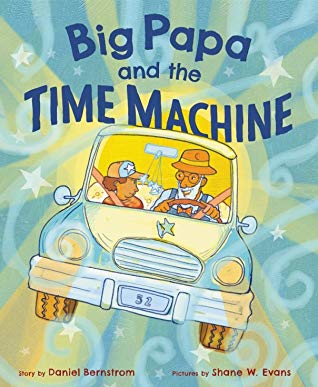
Big Papa and the Time Machine by Daniel Bernstrom

Big Papa and the Time Machine by Daniel Bernstrom

Big Papa and the Time Machine by Daniel Bernstrom, illustrated by Shane W. Evans (9780062463319)

When a child doesn’t want to go to school because he’s scared and nervous, he talks with his grandfather. His grandfather understands exactly how his grandchild is feeling and takes him on a ride in his car which is also a time machine. It takes them both to see when he left his mother back in 1952 and had to be brave himself. They stop in 1955 to see him working up high on buildings, needing to get beyond being so scared. In 1957, Big Papa had to get over his fears to ask a lovely girl to dance, a girl who would eventually marry him. They then head to 1986 when the child was left with Big Papa. He wasn’t sure if he could take care of a baby all on his own. All about bravery in spite of being scared and nervous, this book shows that it is those moments that define a life.

Bernstrom takes readers on a real ride through history through the eyes of this African-American family. Generations appear and their clear love for one another is evident. Even with a baby being left behind for a grandparent to raise is shown as a chance to save a life and find a new way forward. Children in smaller non-nuclear families will recognize the connection between a sole adult and their child in these pages. It’s particularly lovely to see an African-American man in this role.

Evans makes the pages shine with light as he uses bright yellows and mystical swirls and stars to show the passing of time. Every page is saturated in color, glowing with the connection of the two characters. The child is never declared to be a specific gender in either the text or illustrations, making the book all the more inclusive.

A bright and vibrant look at why to be brave. Appropriate for ages 4-6.

Reviewed from library copy.

Almost Time by Gary D. Schmidt

Almost Time by Gary D. Schmidt

Almost Time by Gary D. Schmidt and Elizabeth Stickney, illustrated by G. Brian Karas (9780544785816)

Ethan finds it really hard to wait for the maple sap to start running in the late winter. He knows the signs of the time approaching. It’s when he doesn’t have maple syrup for pancakes or oatmeal. His father explains that the days have to get warmer for the syrup to run as well as the nights getting shorter. Ethan thinks he notices it changing, but sometimes gets too eager like not wearing his winter coat anymore. When Ethan’s tooth gets loose, his father tells him that it should fall out around the same time as the sap starts running. Now Ethan has two things to wait for, but one that he can perhaps make happen a bit faster by wiggling it. Still, it takes some time for his tooth to loosen and for the weather to change. Then one day, it’s finally time both for maple syrup and for his tooth to fall out.

Schmidt and Stickney have created a classic tale about patience and waiting for things to happen. Ethan is wonderfully impatient and yet also able to wait, though not really without asking again and again about it. As the darkness refuses to lessen and the days refuse to warm, readers will understand his anticipation. The use of breakfasts to mark a lack of syrup is clever and homey, just to add even more warmth and love to the book. It’s great to see a book with a caretaker father which is not about the lack of a mother or being in a unique family. It’s particularly wonderful to see such a skillful and loving dad.

Karas’ illustrations capture the dark days of winter, the snow that refuses to disappear, and the slow process of the arrival of early spring. The darkness lurks against the warm yellow of the interior of the home, offering real contrast as the pages turn.

A sweet but not syrupy picture book about fathers, patience and food. Appropriate for ages 3-5.

Reviewed from library copy.