Review: Ghost Cat by Kevan Atteberry

Ghost Cat by Kevan Atteberry

Ghost Cat by Kevan Atteberry (9780823442836)

A little boy thinks that he sees a ghost cat out of the corner of his eye. It reminds him of the cat he used to have but the boy can never get a good look at this ghost cat. The ghost cat seems to sleep on his bed at night, curled up and purring. It plays with cat toys on the stairs. It meows outside of the boy’s door and knocks things off of shelves. But the boy is always too late to see anything more than a blur moving quickly. Then one day, the boy really sees the ghost cat clearly. He chases after it and the cat leads him to something new and very special right outside.

Atteberry tells a wonderfully gentle story here about the loss of a pet and the gap that it leaves. It is also a great ghost story with no scariness at all, just a playful cat ghost doing cat-like things all over the house. The tone is delightfully breathless and wondering, just right for a ghost story. The dashing nature of the bulk of the book slows at the end to allow readers to bask in the new discovery.

The illustrations, done digitally, are filled with warm tones that allow the ghostly form of the cat to really pop. Readers will enjoy seeing the cat fleetingly on the page, moving just away from the boy and the reader.

Comforting and understanding, this book takes ghosts and grief and turns them into something very special. Appropriate for ages 3-5.

Reviewed from copy provided by Neal Porter Books.
Review: One Shoe, Two Shoes by Caryl Hart

One Shoe, Two Shoes by Caryl Hart

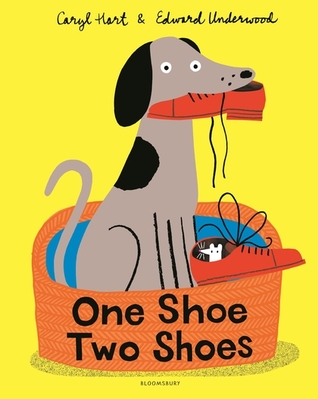
One Shoe, Two Shoes by Caryl Hart, illustrated by Edward Underwood (9781547600946)

With a clear nod to Dr. Seuss and his iconic Red Fish, Blue Fish, this picture book celebrates rhymes, colors and footwear. The book begins with the dog having one shoe and the human having one shoe, then the two shoes are worn for a walk. There are different colored shoes, knotted laces, cowboy boots, and much more. Then a little mouse makes an appearance near the shoes. Could it be that the shoe is a house for a mouse? How many mice? The counting begins and eventually ends at ten. The dog investigates the mice for awhile but then heads out on another walk after fetching some shoes.

Hart’s text is simple with a bouncy rhyme that keeps the book merry. The pace is fast and jaunty, with plenty of action words along the way to make the book wonderfully playful. The concepts of colors and counting are nicely woven into the story. The circular feel of the book beginning and ending with shoes and walks makes for a book that feels complete.

The illustrations are done in a modern flat style in pencil, ink and collage done with computer assistance. The images are large enough to use with a group and guessing games could be played along the way, matching the shoes with their names, counting the mice (who tend to hide) and finding colors.

A happy book about counting and colors. Appropriate for ages 2-4.

Reviewed from copy provided by Bloomsbury Children’s Books.

Review: The Spacesuit by Alison Donald

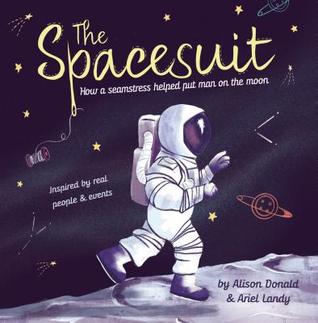
The Spacesuit How a Seamstress Helped Put Man on the Moon by Alison Donald

The Spacesuit: How a Seamstress Helped Put Man on the Moon by Alison Donald, illustrated by Ariel Landy (9781848864245)

A fascinating glimpse at a woman behind the success of the first moon landing. Eleanor Foraker loved to sew even as a young girl. As an adult, she worked for Playtex, sewing clothing for children and women. When a contest opened to design a spacesuit to go to the moon, Ellie entered it at the last minute. Ellie worked tirelessly with a team of seamstresses and engineers, trying to make a spacesuit that was softer and more comfortable than previous designs. The design was made of 21 layers of fabrics, and they used huge sewing machines to get that much fabric under the needle. The precision sewing meant that they had to be within 1/64 of an inch to be successful. The suit was sent off to Texas with a major problem with a broken zipper that they got a chance to fix. In the end, Ellie’s design won the day and made it to the moon.

This nonfiction picture book tells the very interesting story of how the spacesuits for the moon landing were invented and designed. The interplay of engineers and seamstresses where everyone’s ideas were valid is an important piece. The focus on comfort as well as functionality made their suit the winner as well as a willingness to work very hard to get it finished in time.

The art in the book pays homage to sewing by incorporating pins, images that look sewn on, and even a timeline made of thread. The illustrations are bright with throwbacks to the 1960’s too. The combination is bright and hopeful.

Based on the true story, this picture book is “sew” good. Appropriate for ages 5-8.

Reviewed from library copy.

Review: The Feather by Margaret Wild

The Feather by Margaret Wild

The Feather by Margaret Wild, illustrated by Freya Blackwood (9781760124212)

A giant white glowing feather floats down into a dystopian world where the sky is always gray. Two children find it and take it to the village, amazed by how light it is to carry. The children know it doesn’t belong inside. The adults in the village though want to contain its beauty, but before they can, the feather changes. It becomes dirty and dull, absorbing the weight of their ideas and thoughts. The villagers disperse, angry at being tricked. The children carry the heavy feather back with them, caring for it through the night until in the morning it is brilliant once more. The children decide to set it free, and as the feather floats skyward, it leaves behind a promise of blue skies.

Wild’s story is deep and wondrous, rather like the feather itself. The gigantic nature of the feather, its ability to remind people of blue skies and fresh breezes, makes it magical. And yet, it can be squandered by needing to own that magic, to contain it. The dulling of the feather is a profound answer to that selfishness. The children’s own willingness to care for the feather cleanses it once more. It’s a lovely analogy about selflessness, sharing joy, and finding hope together.

Blackwood’s illustrations are glorious. She creates a feather that is both light and weighty, radiant and white. It lights the world around it, then absorbs the darkness into itself in a way that is heartbreaking. Her vision of the gray world is haunting and aching for a brightening, a possibility.

A picture book that will spark discussion about hope, change and making a difference in your world as a child. Appropriate for ages 4-6.

Reviewed from library copy.

Review: Migration: Incredible Animal Journeys by Mike Unwin

Migration Incredible Animal Journeys by Mike Unwin

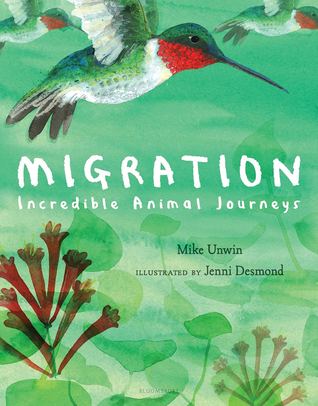
Migration: Incredible Animal Journeys by Mike Unwin, illustrated by Jenni Desmond (9781547600977)

Explore the many animals who migrate each year from all over the world in this nonfiction picture book. The book focuses on each animal’s amazing journey and provides a wide look at migration in general, the various types of animals who migrate, and the specific story of each animal. The animals include birds like the emperor penguin, the Arctic tern, the swallow, and the ruby-throated hummingbird. It also tells the story of mammals like the whales, elephants and caribou. Then there are surprising stories of migrations of crabs, dragonflies, and bats.

The text of the book offers real details of the animal’s lives and their migrations. The book ends with a map of all of the different migration paths shared in the book, nicely covering much of the globe with their travels. The information provided is fascinating and just enough to discover whether you want to learn more about that animal or not.

The illustrations are done in full-page color where the animals take center stage against their various habitats. From the Christmas crabs filling the street with their red color to the beauty of a mother whale and her calf to the woods filled with monarch wings, each of them are unique and just as interesting to explore as the text.

A fascinating and scientific look at migration and the creatures who do it year after year. Appropriate for ages 7-10.

Reviewed from ARC provided by Bloomsbury.

Review: Skulls! by Blair Thornburgh

Skulls by Blair Thornburgh

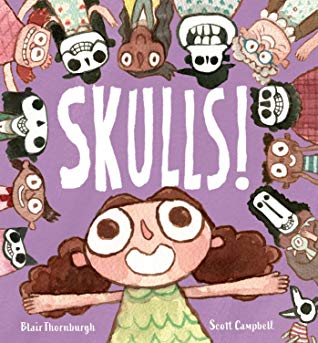
Skulls! by Blair Thornburgh, illustrated by Scott Campbell (9781534414006)

This picture book is a rousing look at your head bones or skull. The book uses clever analogies to allow young children to understand the importance of your skull, such as skulls are “like a car seat for your brain” in the ways that they keep your brain safe. Skulls have your jaws and also your teeth, until they fall out. They have holes for various senses, including eating grilled cheese sandwiches. The book encourages children to not be scared of skulls because they are so very important.

This is Thornburgh’s debut picture book and it’s wonderfully unusual and interesting. She uses repetition cleverly in the middle of the book, almost creating a refrain about the holes in skulls, grilled cheese sandwiches and teeth falling out. Her focus on a child’s understanding is clear, creating scenarios that they will respond to and not making skulls frightening but fascinating.

Campbell’s watercolor illustrations are full of energy. He creates scenes full of life that then turn to full of bones at the turn of the page. His humor and zaniness keep the book from ever being creepy except in the friendliest of ways.

Face this one head on! Appropriate for ages 3-6.

Reviewed from copy provided by Atheneum Books for Young Readers.

Review: Ultrabot’s First Playdate by Josh Schneider

Ultrabot's First Playdate by Josh Schneider

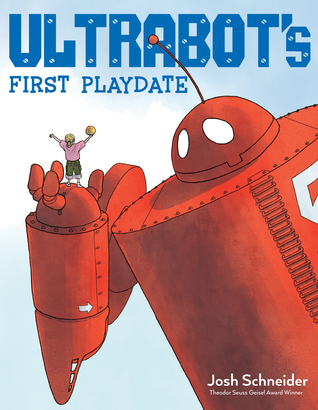
Ultrabot’s First Playdate by Josh Schneider (9781328490131)

When Ultrabot’s professor invites their neighbor Becky to come over for a playdate at their secret lab, Ultrabot is very nervous. He wonders if Becky will share or break his toys. He pictures her as an enormous furry dog-person with barrettes all over. But Becky turns out to be a little human girl. She brings a ball along with her and after some initial shyness, Ultrabot sees that they can share. The two played ball together, drew cats, and had sandwiches for lunch (with the crusts cut off.) They shared all of Ultrabot’s toys too, though afterwards the professor thought it best if they met at Becky’s house next time.

Schneider tells a very touching and funny story of a shy giant robot and his first playdate. Ultrabot’s emotions mirror those of a young child going to their first playdate or meeting a new person. The questions he thinks about, the worries he has and the resolution are all very human.

However, the illustrations show that this is still one giant robot who has toys like real airplanes, eats sandwiches made of girders and diesel tanks, and is able to do wild math calculations. The illustrations are wildly funny and set a perfect tone. I particularly love that the secret lab is ever-so-obvious and out-of-place in their residential neighborhood.

Funny and friendly, this is just right for any reluctant robot in your house. Appropriate for ages 2-4.

Reviewed from library copy.

Review: Can I Keep It? by Lisa Jobe

Can I Keep It by Lisa Jobe

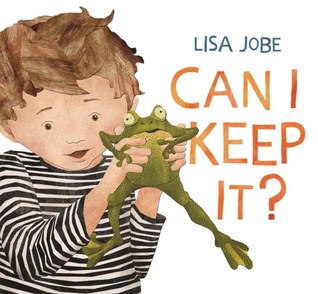
Can I Keep It? by Lisa Jobe (9781624146961)

A little boy finds animals in his backyard and wonders if he can keep them as pets when they “follow” him home. His mother addresses each type of animal by asking her son where he would want to live if he was that animal. When the boy catches a squirrel, his mother points out that squirrels like to climb trees and gather acorns. She helps him realize that the squirrel belongs outside. The frog he catches next likes splashing in water, so the boy releases him too after thinking about how he loves to swim. The bird likes to fly in the sky rather than live in a cage. The boy thinks about swinging high and how much he loves that. Happily, the next animal the boy finds is a stray cat who may just find living with a little boy exactly the right place to live.

Jobe uses a droll sense of humor in this picture book. The little boy says to his mother that the animals are following him home while he is actually trapping them in a variety of ways in the yard. The mother’s responses are clever and thoughtful without being heavy handed at all, allowing the child to figure things out on his own. The rhythm of the book is lovely, with the boy capturing a creature and each dialogue following a pattern.

Jobe’s art is bright and filled with motion. Done in watercolor, gouache, pastel and then digitally collaged, the illustrations are large enough to use nicely with a group of children. In every scenario with an animal’s preferred place to live, the little boy thinks about how he feels when he swings or swims or climbs trees. This is shown through illustrations and works very well.

A great picture book about respecting animals, engaging with nature, and finding the perfect pet. Appropriate for ages 2-4.

Reviewed from copy provided by Page Street Kids.


Review: A Visit to Grandad: An African ABC by Sade Fadipe

A Visit to Grandad An African ABC by Sade Fadipe

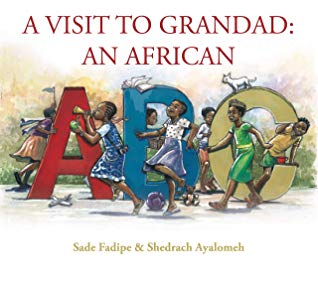
A Visit to Grandad: An African ABC by Sade Fadipe, illustrated by Shedrach Ayalomeh (9781911115816)

On an alphabet adventure, Adanah heads out to visit her grandfather in Modakeke, Nigeria. The book starts in school with Adanah heading on break. She packs her bags and camera. Her Dad drives her to her grandad’s house out in the country with lots of animals around. The two of them spend time together, having lunch that is invaded by insects, drinking juice, and cleaning the kitchen. At night, Adanah sleeps under a mosquito net. Water is fetched in kegs, more work and cooking is done, and stories are told in the evening. Finally, Mom is there to take Adanah back home to share her adventures with her little sister, Zainab.

This alphabet book works really well as it shows life in modern Nigeria. It is that exploration of Nigeria that really shines in this book, allowing readers to see a fascinating mix of modern and traditional parts. The strong structure of the alphabet helps keep the book focused and while X will always be for something like xylophone almost none of the other letters are a stretch at all. The text feels free and unforced, which is impressive in this sort of book.

The art is bright and fresh, filling the pages with color and glimpses of home life and the landscape. On each page, there are other items that start with that same letter of the alphabet. The art is structured so well though, that it is easy to miss that these elements are even there until you are encouraged to look for them at the end of the book.

An alphabet picture book focused on family and Africa. Appropriate for ages 3-5.

Reviewed from copy provided by Cassava Republic Press.