Review: Lubna and Pebble by Wendy Meddour

Lubna and Pebble by Wendy Meddour

Lubna and Pebble by Wendy Meddour, illustrated by Daniel Egneus (9780525554165)

Lubna and her father have come to a refugee camp. As they arrived, Lubna found a smooth pebble. Pebble becomes her closest friend as she and her father make a new home in the camp. Pebble listens to all of Lubna’s stories of the war and her family. Pebble’s drawn on eyes and smile are friendly even in the cold nights. Lubna’s father finds her a box and towel for Pebble, so Pebble is warm at night too. When Amir arrives at the camp, he won’t speak to anyone. But when Lubna shows him Pebble, he introduces himself. Soon Lubna and Amir are close friends, though Lubna assures Pebble that they are still best friends. Lubna’s father finds them a new home in a different country, and Amir is very sad. Perhaps Pebble can help him out.

Meddour gently depicts a very personal side of the refugee crisis. Showing a more universal experience of refugees fleeing a war-torn country, the book really allows readers to deeply feel the loneliness and fright of a young child caught in this situation. At the same time, the book doesn’t go into the personal losses in detail, they are alluded to rather than fully realized, which is ideal for young children. The use of a pebble as a friend is also incredibly moving, showing the poverty and the isolation of a child in a very concrete way.

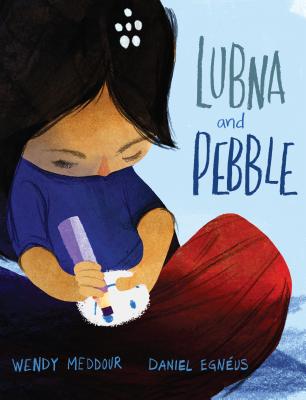
The in the picture book is filled with deep colors and also depicts light shining upon Lubna as she makes her way towards a new life. Throughout the book there is a sense of hope and that is also conveyed in the images in the book, with open skies, deep imaginary worlds, and even the smile of Pebble.

An accessible and heartfelt look at the refugee crisis. Appropriate for ages 4-6.

Reviewed from library copy.
Review: The Little Guys by Vera Brosgol

The Little Guys by Vera Brosgol

The Little Guys by Vera Brosgol (9781626724426)

The Little Guys are very small but when they work together they can do almost anything! Using leaves to float, they cross deep water. In the big forest, they hold hands to stay together and keep from being afraid. They find berries and form a stack to reach them. But as they continue their search for more and more food, they start using their combined strength in a way that upsets the rest of the forest. Chipmunks go flying, owls get forced out of their nests, and they even beat up a bear! Soon they have all of the food in the forest! But have they gone too far?

Brosgol follows her incredible Leave Me Alone! with this clever look at the impact of collective action and what happens when even the smallest of us upset the balance of nature and society. The text is simple and straightforward, told in the voice of the Little Guys as they head out scavenging. They are full of confidence as they make the trek to find food and it’s a stirring picture of the power of community until it goes awry in such a spectacular way.

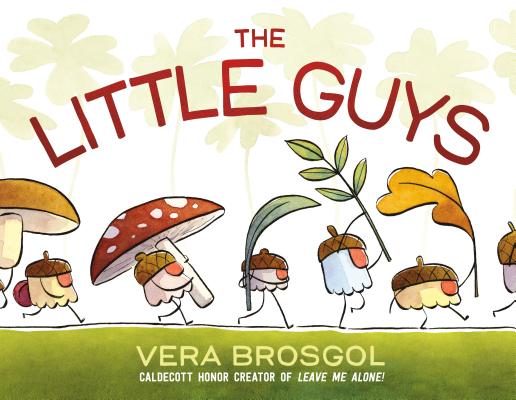
Brosgol’s Little Guys are ever so adorable with their acorn caps and stick-thin limbs. Their orange bulbous noses also add to their appeal. With almost no facial expressions, it is impressive how she gives them emotions with body language. The dwarfing of their size in the forest and beside the other animals is also effectively portrayed.

A delight of a picture book that is an unusual look at sharing with your community. Appropriate for ages 3-5.

Reviewed from copy provided by Roaring Brook Press.

Review: Ojiichan’s Gift by Chieri Uegaki

Ojiichan's Gift by Chieri Uegaki

Ojiichan’s Gift by Chieri Uegaki, illustrated by Genevieve Simms (9781771389631)

When Mayumi was born, her grandfather who lived in Japan built her a garden. It was a garden without tulips or flowers. Instead it was a garden of stones of all sizes. Around the edge, the garden had bushes and trees as well as a space for Mayumi to have a meal with her grandfather. As Mayumi grew up, she learned more and more about taking care of her garden alongside her grandfather. But then one summer, her grandfather could not care for his home or the garden anymore. When they arrived, the house was dusty and the garden was overgrown. Her grandfather had to use a wheelchair now. Mayumi is very angry and takes her anger out on the rocks of the garden, trying to topple the largest over. When she is unable to tip it over, she kicks the smaller rocks around. As her anger subsides, she rakes the garden back into order again and has an inspiration of what she can do to help both herself and her grandfather with this transition.

Uegaki was inspired to write this book by her own father who was a traditional Japanese landscaper and gardener. She captures with nicely chosen details the essence of a Japanese rock garden with its order, natural elements and upkeep. She also shows how a garden can create connections between in a long-distance relationship with a grandparent. She manages to have a strong point of view without being didactic at all, instead allowing the reader and Mayumi to experience the results of the garden without extra commentary.

The illustrations by Simms add to the understanding of the Japanese garden. Done in beautiful details, they offer images of the rocks, the moss, the gravel, and all of the elements. Using different perspectives for her images, she shows views from alongside the garden as well as from above. The same is true of the grandfather’s house as views change from outside looking in to the reverse.

A charming look at the connections between grandfather and granddaughter built through a garden. Appropriate for ages 4-6.

Reviewed from e-galley provided by Kids Can Press.

Review: Hello, I’m Here! by Helen Frost

Hello, I'm Here by Helen Frost

Hello, I’m Here! by Helen Frost, illustrated by Rick Lieder (9780763698584)

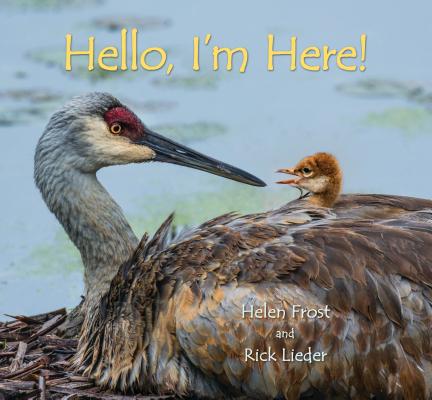
This book looks at a family of sandhill cranes as an egg hatches and a chick is born. The little hatchling is soon standing covered in dry fuzz next to their mother. As the day progresses, the chick discovers their brother who has already hatched. They go for a swim in the water and flee from snapping turtles back to the nest where they are now damp and muddy. They have a snack of an insect and a snail. Then they are tired enough for a rest next to their mother.

Frost writes invitingly brief rhyming couplets that accompany the brilliant photographs in this picture book. Her story emphasizes the gentle care of the parent cranes as well as the ability for the newly-hatched chicks to do a bit of exploring on their own. It’s a lovely mix of freedom and protection. The photographs echo that with their focus on the large cranes that dwarf their fuzzy offspring, the beauty of the natural setting, and the adorable pairing of the sibling baby cranes.

Another winner from Frost and Lieder, this one is just right for spring. Appropriate for ages 2-4.

Reviewed from Candlewick Press.


Review: Hey, Water! by Antoinette Portis

Hey, Water by Antoinette Portis

Hey, Water! by Antoinette Portis (9780823441556)

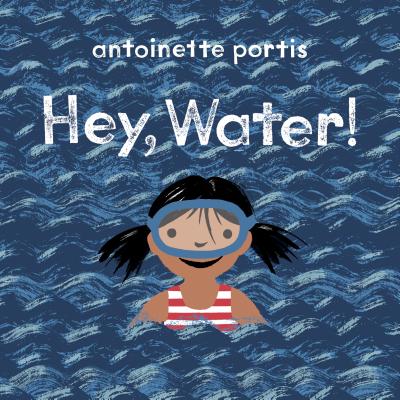
This picture book takes a look at water in our lives. It includes rivers and lakes, puddles and streams. There is water we drink from a glass and water that we bathe in. Water is also in snow and ice, steam, clouds and fog. The little girl who leads readers through the exploration of water also thinks about water being inside of her and making up part of her too. Told in short sentences that make this ideal to use with preschoolers learning about the water cycle, the book ends with deeper looks at water, the cycle and how to conserve water yourself.

The book has a jaunty and energetic tone, inviting readers to explore water around themselves too. The book pairs its short sentences with larger words that tell what is being described and invite young listeners to guess and interact with the images and text. Portis’ illustrations are filled with blues and greens that range from deep lake blue to the lightest of ice blues. White and gray add to the color palette with rain, snow and fog.

A welcome addition to STEM books for preschoolers, this one is a refreshing drink on a hot day. Appropriate for ages 2-4.

Reviewed from copy provided by Neal Porter Books.

Review: Music for Mister Moon by Philip C. Stead

Music for Mister Moon by Philip C. Stead

Music for Mister Moon by Philip C. Stead, illustrated by Erin E. Stead (9780823441600)

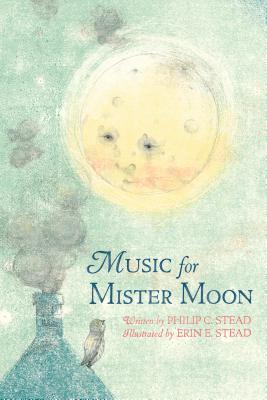
A collaboration between the Steads is always reason for joy. This picture book explores the imagination of Hank, a young cellist who simply wants to play all alone. When her parents suggest that she play in public, she doesn’t think that sounds good at all. So she imagines them as penguins and heads for her room which she imagines is an isolated warm room. But just as she starts to play, an owl hoots outside. Hank eventually tosses a teacup at the owl but then her cozy home starts to fill with smoke. She discovers that the moon has been hit by her teacup and fallen down to sit atop her chimney. Together, Hank and moon have a series of adventures from buying the moon a warm hat to taking a boat ride. Will Hank play her music for the moon? And how will the moon return to the sky again?

This story is intensely whimsical and lovely. From the very first page, the tone is set and readers will realize they are in a different world. This is partly because of the lightness and ethereal beauty of the illustrations. Filled with chalky color, their fine lines show a world populated with animals, coziness and quiet.

The writing is equally delicate, moving through the tale and inviting readers to linger a while and hear the cello music too. Hank is an intriguing character, a girl who loves music but not performing. She is also a girl with an intense imagination, creating teacups and flinging them high enough to tap the moon. She allows her emotions to become items she places around her, and so the journey with the moon becomes all the more beautiful.

A bedtime story that is beautiful, moonlit and filled with music. Appropriate for ages 4-6.

Reviewed from copy provided by Neal Porter Books.

Review: The Book in the Book in the Book by Julien Baer

The Book in the Book in the Book by Julien Baer

The Book in the Book in the Book by Julien Baer, illustrated by Simon Bailly (9780823442430)

This picture book features three nested books, each smaller than the last. Thomas and his parents are on vacation at the beach in the first and largest book. His parents decide to take a nap and Thomas is bored, so he heads off and explores the beach. When he can’t find his parents, he stops and sits down, noticing a small book abandoned in the sand. He opens it and discovers the story of Thomas who is on vacation with his parents in the snowy mountains. His parents take a nap; Thomas wanders off. Thomas can’t find them and notices a book nearby. When he opens it, he discovers the story of Thomas and his family visiting outer space. Each book ends with Thomas finding his family right near him and as the smaller books close, the reader is once again back in the beach story and the family heads home.

Originally published in France, this book is very unique and exploring it for the first time is a remarkable experience. The nesting of the books physically represents the way that the stories nest together, rather like a Russian nesting doll where the smaller ones are on the inside. Still, in these books the stories get wider ranging as the books shrink down. The text is simple and accessible, feeling almost like a vintage tale until the nesting begins.

The art and book design here are fantastic. The nested books even feel right inside the larger images that form a frame around them. Each book has a cover that represents what is inside it, much like the main cover does with the boy in snow gear reading on a beach under a ringed planet.

Clever and funny, this is a rewarding book to explore. Appropriate for ages 3-5.

Reviewed from copy provided by Holiday House.

Review: Predator and Prey by Susannah Buhrman-Deever

Predator and Prey by Susannah Buhrman-Deever

Predator and Prey by Susannah Buhrman-Deever, illustrated by Bert Kitchen (9780763695330)

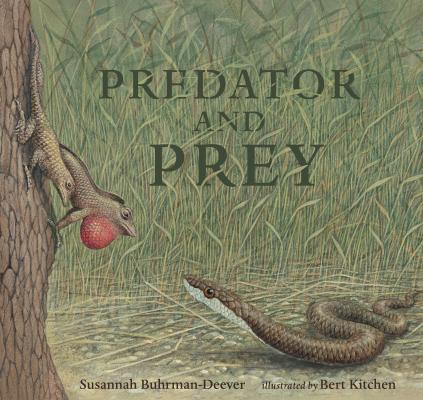
In poems for two voices, this book shows the cunning, evolution and beauty of predators and their prey. From bats to frogs to snakes to hawks to spiders, the poems feature all sorts of animals. Engagingly, often it is sometimes the obvious predator who is actually going to be the prey. That is certainly true in the example of the spider at the center of her web who is being preyed upon by the assassin bug. After each of the poems, there is a section about the animals in nonfiction prose that illuminates the relationship of the two species more clearly.

I was amazed to discover that this is biologist Buhrman-Deever’s first book for children. Her two-voice poems are very effective and could easily be used in classroom activities to be shared aloud by pairs of children who will enjoy being predators and prey since so many of the animals featured are very fascinating. She gives voice to the animals in her poems and then allows scientific information to be shared as well. The end of the book has a lengthy bibliography which is greatly appreciated.

The illustrations by Kitchen are exceptional as well, showing the reader the relationship between the two animals being discussed. They are realistic and dramatic as the animals stand off on the page. Several of the pages also have large gated pages that open to reveal the poem beneath them, allowing Kitchen’s full imagery to be appreciated without words blocking it.

A very successful mix of poetry and science, this one is sure to be preyed upon by hungry readers in classrooms and activities. Appropriate for ages 7-9.

Reviewed from library copy.

Review: Grandpa’s Stories by Joseph Coelho

Grandpa's Stories by Joseph Coelho

Grandpa’s Stories by Joseph Coelho, illustrated by Allison Colpoys (9781419734984)

A little girl visits her grandfather all through the year. In the spring they walk together in the garden. The girl thinks of replanting her grandpa’s birthdays so he won’t get old. In summer, the two of them play together with a secondhand racing track. The cars fly off into space and the girl thinks of their laughter being like shooting stars. In autumn, her grandpa gives her a book he’s made for her to draw in. She’d like to capture all of her bright feelings about him there. In winter, the two stay inside and Grandpa shares his stories with her. But then her Grandpa dies. While cleaning out his room, she discovers reminders of their time together as well as a new blank notebook that he made her for spring. She fills it with her memories of her Grandpa.

The writing in this book is exceptional. Coelho captures seasonal moments of the pair together, weaving in the joy that they feel, the connection that is being maintained and built. He uses imagery of the little girl’s thoughts to really create sincere memories for her to have that are compelling for the reader as well. When the death in the book happens, it is to be expected as one can feel some sadness in the book throughout as Grandpa ages more. It is a gentle moment, one done with care and thoughtfulness.

The illustrations by Colpoys depict a family of color joyfully spending time together and then experiencing and processing their loss. She uses amazingly bright colors on her pages, incorporating neon-poppy red, zinging sunshine yellow, waves of water blues and many more. Those colors never dim throughout the book, offering hope in their cheerfulness even during times of loss.

A beautifully written and illustrated picture book of love and loss. Appropriate for ages 4-6.

Reviewed from copy provided by Abrams.