Review: The Day War Came by Nicola Davies

The Day War Came by Nicola Davies

The Day War Came by Nicola Davies, illustrated by Rebecca Cobb (9781536201734)

Released September 4, 2018.

A little girl explains what happened to her when war came to her city. She started the day with breakfast, kisses, and flowers on the windowsill. Then war came while she was at school. Her town was turned to rubble and she fled with others. She lost her entire family and her home in one moment of war. She made the dangerous journey to another country alone, arriving on a sandy shore. Even in the new country though, she was not accepted. War was there too in the way the people looked at her and made her unwelcome. When she tried to go to school, she was told there wasn’t a chair available for her. It is not until the children of the community come together with chairs in hand to make her welcome that war finally begins to recede.

There are very few picture books that can make me truly weep. This was one of those. The poem by Davies is powerful and starkly honest. She has taken inspiration from several true events and turned it into a tale of the loss and continued rejection that refugees feel even after making it to safer countries. The power of children to make the world welcoming to those who have fled their countries is empowering and refreshing to see on the page.

The illustrations from Cobb take readers on a journey from the brightness of the little girl’s family life before war came to the devastation and darkness of being a refugee. The brightness does not return until the girl sees a classroom again, only to be pushed away and back to the darkness she lives in. This is a tangible look at the impact of war and the transformative power of community.

Have some tissues ready when you read this one for the first time. Appropriate for ages 5-7.

Reviewed from copy provided by Candlewick Press.

Review: The Stuff of Stars by Marion Dane Bauer

The Stuff of Stars by Marion Dane Bauer

The Stuff of Stars by Marion Dane Bauer, illustrated by Ekua Holmes (9780763678838)

Released September 4, 2018.

This breathtaking picture book looks deeply at the Big Bang and how it created all of us. The book begins with darkness where there is no time or space. Until BANG! matter is created and the stars flare to life. The stars burn and eventually explode themselves creating planets. Still, there is no life yet. In our solar system, there is one fragile blue planet where life eventually begins, where dinosaurs and humans live and die. And then finally, you arrive from your own speck and flare into life too.

Newbery Honor winning Bauer has written a poem that takes the science of the Big Bang and adds a feeling of mythology to it without damaging the scientific aspect. Her poem soars through the primordial darkness, journeys directly into the Big Bang, floats beside emerging planets, visits Earth, and welcomes children to life. It’s a big ask for a poem but Bauer’s words create a vehicle to really experience the wonder of the universe. Her poem also celebrates the fact that all of us are made of the same matter as stars.

The illustrations of this picture book defy explanation. They are unique and wondrous, filling the page with swirls of darkness, defining emptiness, creating reality. They are done with collage, marbled paper and combined digitally, but those words don’t capture what they do on the page. Holmes has managed to create a universe before your eyes, one that shines, explodes and manifests right there.

An exceptional picture book that celebrates science and beauty. Appropriate for ages 4-6.

Reviewed from copy provided by Candlewick Press.


Review: We Are All Me by Jordan Crane

We Are All Me by Jordan Crane

We Are All Me by Jordan Crane (9781943145355)

Released on September 4, 2018.

This bright picture book celebrates the many ways that we are all connected to one another. We are all alive in the same world made up of cloud, water and air, earth, sunshine and plants. We are made of bone and meat, our hearts all beat. We are all made of cells and atoms. And we are all alive and aware, all of us together.

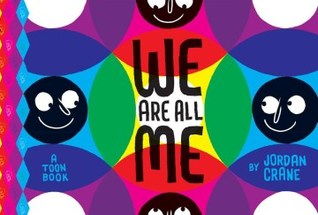
Inspired by an idea his wife had for a holiday called Interdependence Day, this book takes a simple concept and looks deeply at it. The text stays simple but asks readers to think about connectedness in our lives. The text is simple enough to be a poem, using internal rhymes and some repetition to carry it forward. The illustrations use bright colors and pop-art style to invite readers into the rainbow that we all are inside.

Unusual and intriguing, this picture book will be beloved by those who see their own take on human connection on the page. Appropriate for ages 4-6.

Reviewed from copy provided by Toon Books.


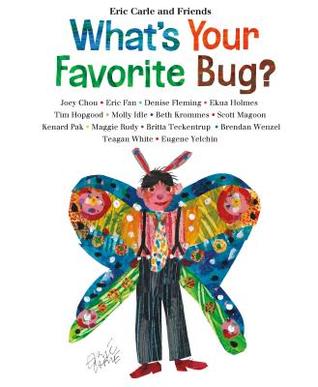
Review: What’s Your Favorite Bug? by Eric Carle

What's Your Favorite Bug by Eric Carle

What’s Your Favorite Bug? by Eric Carle and Friends (9781250151759)

Following the first two picture books in this series, this one focuses entirely on insects. As with the other boos, Eric Carle is joined by other illustrators who draw an image of their favorite insect, tell a little about it and explain why they love it. One of the major treats of this series is never knowing what the page turn will bring, since each double-page spread is done by a different illustrator.

This collection has racial diversity in the illustrators included and also has a nice mix of male and female artists. As with all of the books in the series, there is a wonderful diversity in the art styles as well. The design of the book and the order of the pages works particularly well. There are dark and bright pages that lead readers on a journey of light and shadow that is particularly effective when combined with the crawly nature of bugs.

Another winner in this series that will have you searching out new illustrators to see their full books. Appropriate for ages 4-6.

Reviewed from copy provided by Henry Holt.


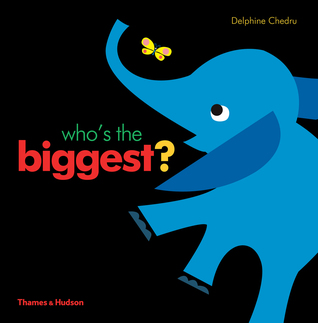
Review: Who’s the Biggest? by Delphine Chedru

Whos_the_Biggest_PLC_Ltd_CC2017.indd

Who’s the Biggest? by Delphine Chedru (9780500651490)

This is a very simple picture book that is all about size and teaches the concepts of bigger and smaller. The book focuses on which animal is bigger, comparing one to another. One each page, one of the animals declares “I am!” There are big things on the page like elephants and trees. Then there are also smaller objects like flowers and bees to compare. The book is just right for very small children to learn the concept in a positive and fast-paced way. As mentioned in the book, with a little creativity, the book can be read to say which one is smallest too.

Chedru’s text is simple, yet she plays with some of the phrases, making sure that each animal speaks in their own distinct way. The illustrations are strong and graphical with deep colors combined with bright ones that burst on the page. Even though the story has a strong structure, there are surprises on each page with the page turn.

A book worth exploring with toddlers. Appropriate for ages 1-3.

Reviewed from library copy.


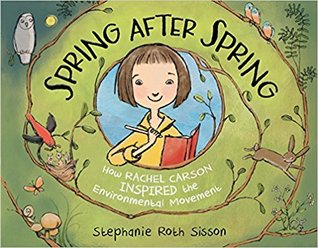
Review: Spring After Spring by Stephanie Roth Sisson

Spring After Spring by Stephanie Roth Sisson

Spring After Spring: How Rachel Carson Inspired the Environmental Movement by Stephanie Roth Sisson (9781626728196)

This nonfiction picture book begins in much the same way that Rachel’s childhood days started: birdsong, insects, forest exploration and insects. Rachel loved to look at the world from the big view and then to kneel down and look very closely at nature. She loved spring days best, returning home after dark to supper and her big family. As the seasons turned, Rachel watched and documented them all, growing bigger herself. She headed off to college to become a writer, until she discovered the microscopic world which led her to science. She worked as a scientist, diving under the sea and then writing books about it. Soon though, she realized that things were changing and species were disappearing. This led to her most important book, Silent Spring, which cautioned about the impact of chemicals on the ecosystem.

Sisson encapsulates Carson’s life in a very approachable way. The first part of the book focuses on Carson’s childhood love of nature and being outside. The text focuses on what Carson sees and experiences. As the book moves to her adult life, the text is about bravery and taking on the unknown. It then moves to her realization of what is happening in nature and her tenacity in figuring out what is going on. Throughout, this is the picture of a girl and woman who loves nature, thinks deeply and writes beautifully enough to change the opinions of a nation.

The illustrations are simple and lovely. They show all of the sounds of nature when Carson is a young child. Those same rich experiences are shown with the ghostly figures of animals that have disappeared due to chemicals. There is no mistaking the warmth of Carson’s home and family and then the strength that it took for her to stand strong in the face of people’s doubts.

A great picture book biography about an amazing woman, this is a timely read. Appropriate for ages 4-6.

Reviewed from copy provided by Roaring Brook Press.


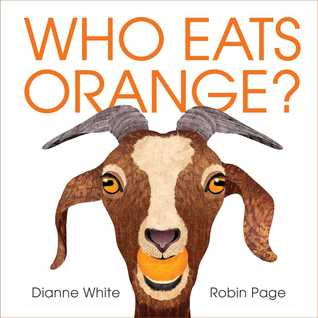
Review: Who Eats Orange? by Dianne White

Who Eats Orange by Dianne White

Who Eats Orange? by Dianne White, illustrated by Robin Page (9781534404083)

Asking which animals eat what colors allows this book to explore both animals and colors at the same time. Starting with the title question, the book looks at bunnies eating carrots, chickens pecking cantaloupe, goats biting oranges, and pigs munching pumpkins. But what about a gorilla? No, gorillas eat green! And the book merrily moves on to that color and then on to other food colors as well. The animals are varied and interesting including turkeys, foxes, quetzals, marmots, reindeer and many more. The book ends asking you about the colors you eat and revealing the rainbow of food that humans enjoy.

White has created an energetic picture book that has a strong structure that young children will find enticing. She has selected the featured animals cleverly, using both familiar animals and exotic animals side-by-side. The book’s structure includes asking about a different animal to move to the new color of food, leading very nicely into the final part of the book as well.

The digital illustrations have a great physicality about them, feeling more like paper collage than digital on the page. Each of the animals has a great light in their eyes, looking back at the reader usually with a playful and inviting glint while not being anthropomorphized at all.

A great book for the youngest set that introduces colors and animals and allows for some guessing games as well. Appropriate for ages 2-4.

Reviewed from copy provided by Beach Lane Books.

Review: Stumpkin by Lucy Ruth Cummins

Stumpkin by Lucy Ruth Cummins

Stumpkin by Lucy Ruth Cummins (9781534413627)

Stumpkin is one of the pumpkins for sale outside a little shop in the big city. He is a nearly perfect pumpkin. He is bright orange, round and large. Unfortunately though, Stumpkin is missing his stem and only has a little stump instead. As Halloween grows closer, one pumpkin after another is selected to be turned into a jack-o-lantern in the neighborhood. They are placed up in apartment windows and look down at the little shop below. Even the gourd is selected before Stumpkin, leaving him all alone. But there is a happy Halloween ending to come!

Cummins’ story written in a simple style. She shows the difference between Stumpkin and the others, explaining why he is left behind. Children listening to the story will protest that they would pick Stumpkin first since he is so lovely. The feeling of being different and left out builds as the story moves ahead and Stumpkin is left alone and sad. The simple art adds to the appeal of the book with its bright oranges, black cat and jack-o-lantern grins. It is impressive how much emotion she can convey with a few dots and lines on a round pumpkin.

Perfect pumpkin pick for those looking for non-scary Halloween and autumn tales. Appropriate for ages 2-4.

Reviewed from copy provided by Atheneum.

Review: Trevor by Jim Averbeck

Trevor by Jim Averbeck

Trevor by Jim Averbeck, illustrated by Amy Hevron (9781250148285)

Trevor is a very lonely canary who knows that he can escape his cage at any time, but stays put for the seeds. He has one favorite kind, sunflower seeds, that he saves for when he is feeling loneliest. When Trevor sees a lemon outside of his window, he tries to get it to sing with him. He even gives it his last striped sunflower seed, but it won’t eat. The lemon doesn’t reply to Trevor at all and doesn’t give him any gifts in return. Still, Trevor builds a nest in the tree for himself and the lemon. Meanwhile, the seed has fallen to the ground below. Eventually, a storm comes and Trevor must try to save the lemon. When he reaches the ground, he discovers the sunflower has sprouted and grown, scattering seeds across the ground. When a group of hungry birds arrives, Trevor quickly realizes what real friendship feels like.

Averbeck keeps the text of this picture book very simple, making it just right for younger listeners and good to share aloud. The emotions that Trevor feels in the book take center stage, from frustration at the lemon to eventual forgiveness to acceptance about their differences. Trevor is a great mix of brave, inquisitive and friendly as he makes his way into the larger world.

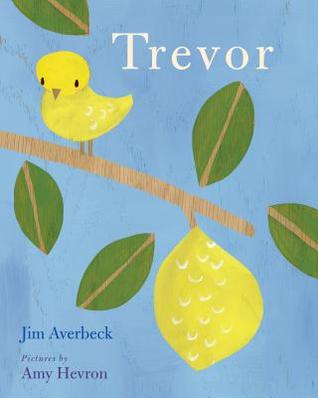
Hevron’s illustrations are painted onto wood. She cleverly allows the wood to show through to create tree branches and leaf spines. Against the pale blue background, the leaves, lemon and Trevor himself pop. One can see the wood grain throughout the book, both covered in color and plain. It makes for a very organic and natural feel.

A lovely quiet picture book about new friends and what to do when life gives you lemons. Appropriate for ages 3-5.

Reviewed from copy provided by Roaring Brook Press.