Review: Stumpkin by Lucy Ruth Cummins

Stumpkin by Lucy Ruth Cummins

Stumpkin by Lucy Ruth Cummins (9781534413627)

Stumpkin is one of the pumpkins for sale outside a little shop in the big city. He is a nearly perfect pumpkin. He is bright orange, round and large. Unfortunately though, Stumpkin is missing his stem and only has a little stump instead. As Halloween grows closer, one pumpkin after another is selected to be turned into a jack-o-lantern in the neighborhood. They are placed up in apartment windows and look down at the little shop below. Even the gourd is selected before Stumpkin, leaving him all alone. But there is a happy Halloween ending to come!

Cummins’ story written in a simple style. She shows the difference between Stumpkin and the others, explaining why he is left behind. Children listening to the story will protest that they would pick Stumpkin first since he is so lovely. The feeling of being different and left out builds as the story moves ahead and Stumpkin is left alone and sad. The simple art adds to the appeal of the book with its bright oranges, black cat and jack-o-lantern grins. It is impressive how much emotion she can convey with a few dots and lines on a round pumpkin.

Perfect pumpkin pick for those looking for non-scary Halloween and autumn tales. Appropriate for ages 2-4.

Reviewed from copy provided by Atheneum.
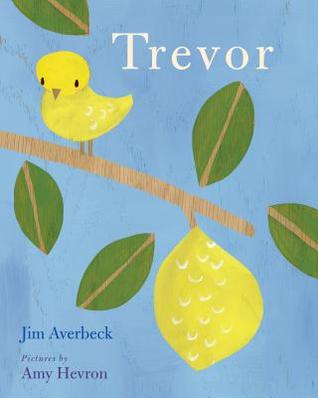
Review: Trevor by Jim Averbeck

Trevor by Jim Averbeck

Trevor by Jim Averbeck, illustrated by Amy Hevron (9781250148285)

Trevor is a very lonely canary who knows that he can escape his cage at any time, but stays put for the seeds. He has one favorite kind, sunflower seeds, that he saves for when he is feeling loneliest. When Trevor sees a lemon outside of his window, he tries to get it to sing with him. He even gives it his last striped sunflower seed, but it won’t eat. The lemon doesn’t reply to Trevor at all and doesn’t give him any gifts in return. Still, Trevor builds a nest in the tree for himself and the lemon. Meanwhile, the seed has fallen to the ground below. Eventually, a storm comes and Trevor must try to save the lemon. When he reaches the ground, he discovers the sunflower has sprouted and grown, scattering seeds across the ground. When a group of hungry birds arrives, Trevor quickly realizes what real friendship feels like.

Averbeck keeps the text of this picture book very simple, making it just right for younger listeners and good to share aloud. The emotions that Trevor feels in the book take center stage, from frustration at the lemon to eventual forgiveness to acceptance about their differences. Trevor is a great mix of brave, inquisitive and friendly as he makes his way into the larger world.

Hevron’s illustrations are painted onto wood. She cleverly allows the wood to show through to create tree branches and leaf spines. Against the pale blue background, the leaves, lemon and Trevor himself pop. One can see the wood grain throughout the book, both covered in color and plain. It makes for a very organic and natural feel.

A lovely quiet picture book about new friends and what to do when life gives you lemons. Appropriate for ages 3-5.

Reviewed from copy provided by Roaring Brook Press.

Review: Adrian Simcox Does Not Have a Horse by Marcy Campbell

Adrian Simcox Does Not Have a Horse by Marcy Campbell

Adrian Simcox Does Not Have a Horse by Marcy Campbell, illustrated by Corinna Luyken (9780735230378)

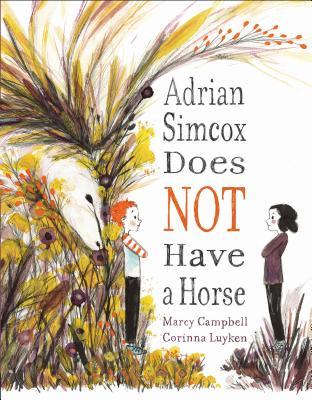
Adrian Simcox is always talking at school about the horse that he owns. But Chloe knows he is lying, since he lives with his grandfather in a small house in town. There is no room there for a horse. She also knows that Adrian’s family isn’t wealthy and a horse costs a lot of money to keep. So Chloe complains to her friends, her mother and eventually to the entire class about Adrian lying. When Chloe’s mother takes her to Adrian’s house, Chloe knows she is going to be proven right. But she doesn’t bargain for what she is actually going to find there.

This beautifully told story will have readers siding with Chloe from the beginning, since her reasons for not believing Adrian are clear and logical. Still, as the story unfolds readers will start to understand what Adrian is doing long before Chloe does and will begin to feel for him and relate to Adrian. The book does this without becoming didactic at all, instead naturally leading children to an empathy before Chloe gets there. The prose is strong and the pacing is just right in this quiet book.

The illustrations by Luyken are done with lots of white space around Chloe and then riotous plants and gardens around Adrian. Even on the playground, there is a sense that Adrian can create his own world out of imagination, filling the white space in a way that the others can’t. It’s an ideal analogy for the story line itself.

A great book to discuss lying and imagination, friendship and support. Appropriate for ages 4-6.

Reviewed from ARC provided by Dial Books.

Review: The Day You Begin by Jacqueline Woodson

The Day You Begin by Jacqueline Woodson

The Day You Begin by Jacqueline Woodson, illustrated by Rafael Lopez (9780399246531)

An award-winning author is joined by an award-winning illustrator for this picture book that celebrates diversity and acceptance. There are many ways for children to feel different from others, particularly when starting a new school. Perhaps it’s their skin, their hair, their clothes or the language they speak. There are school activities that will show them they live differently than other children, like not traveling during summer vacation. Lunches brought from home can be too different for other children to accept. Children can feel excluded from games on the playground too. So what is the answer? Finding your own voice, your own courage and telling your stories to the others without apology.

As always, Woodson prose impresses with its accessibility and depth. She manages to keep to a picture book length but speak about differences and resilience in a way that encourages children to be proud of where they come from and their life experience. Beautifully, children of all backgrounds will find themselves on these pages too, because everyone in different in some way. Woodson manages to be inclusive without minimizing the impact of racial differences, which is quite a feat!

The illustrations by Lopez are exceptional. They glow on the page, showing children of diverse backgrounds illuminated by the light of the world. The illustrations move from realism to more imaginative and playful moments as children grow into self-acceptance right in front of the reader.

A marvelous pick to speak about diversity and acceptance with children. Appropriate for ages 4-7.

Reviewed from ARC provided by Nancy Paulsen Books.

Review: Pass Go and Collect $200 by Tanya Lee Stone

Pass Go and Collect 200 by Tanya Lee Stone

Pass Go and Collect $200: The Real Story of How Monopoly Was Invented by Tanya Lee Stone, illustrated by Steven Salerno (9781627791687)

Explore the story of how the popular board game Monopoly was invented in this nonfiction picture book. Lizzie Magie was a talented woman, someone who was very concerned with fairness in the late 1800s. During that time, wealthy people bought up property in cities and charged high rents for them. Maggie invented the Landlord’s Game, an early version of what would become Monopoly, with two ways to play. One was buying up and owning lots of land and the other was working together and demonstrating how fairness worked better. The game was complicated but popular with different versions being created across the country. When Charles Darrow, a man down on his luck during the Great Depression, was introduced to the game, he worked to improve it. Then he started selling it rather than sharing it the way it had been done. Soon Parker Brothers was interested in selling it. But what of Lizzie?

Stone tells the poignant story of a woman with a real concern for society and the way it was headed. She created a complex game, shared it with others and was taken advantage of by the system that she was working against. Paid a nominal fee to give up her claim to the game, Darrow went on to become a millionaire in contrast. Make sure to read the author’s note at the end that shows how this book was originally about Darrow until Lizzie’s story emerged.

The illustrations have a wonderful vintage quality to them, suiting the period of setting of the book. It is very interesting to see close ups of the different boards of the Landlord’s Game and eventually the very familiar Monopoly board. Even those who don’t enjoy Monopoly, like me, will be fascinated by the complex tale behind the game.

A very intriguing tale that is a mix of women’s rights, ingenuity and economics. Appropriate for ages 8-12.

Reviewed from library copy.

Review: What Do They Do with All That Poo? By Jane Kurtz

What Do They Do with All That Poo By Jane Kurtz

What Do They Do with All That Poo? By Jane Kurtz, illustrated by Allison Black (9781481479868)

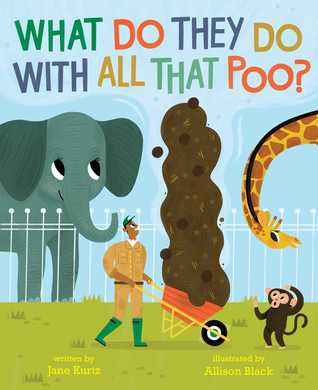
Anyone working with children and books knows that the rather naughty subjects of poop, peeing and farting are some of the most popular. In this book, science is mixed in as well, showing what zoos do with all of the animal poop they have. First the book explains what poo is, then moves into showing different types of animal poop like giraffe, panda, hippo and elephant. The book then goes on to explain that most of the poop heads to landfills after being loaded into trucks. Some poop goes to labs for scientists to examine. Some is made into compost for gardens. And interestingly, sometimes paper is made from elephant poo!

Kurtz explains in a matter-of-fact way the various animals and how they poo and then handle their poop. The hippo splattering its poop around is gross but interesting, something that basically sums up this book. Kurtz doesn’t shy away from the grosser parts, but also keeps her focus on facts and science in the book. The illustrations are bright and friendly, despite all of the poop on the pages. Animals are shown in their zoo habitats and then their poop is also shown with them.

An interesting and scientific look at poos in zoos. Appropriate for ages 3-6.

Reviewed from copy provided by Beach Lane Books.


Review: We Don’t Eat Our Classmates by Ryan T. Higgins

We Don_t Eat Our Classmates by Ryan T. Higgins

We Don’t Eat Our Classmates by Ryan T. Higgins (9781368003551)

Penelope Rex is starting school. As a dinosaur, she was very surprised when her classmates turned out to children! Delicious children! Immediately, Penelope ate all of the children. She did spit them out when her teacher told her to though, but it was not a good start to the school year. Penelope noticed that the other children were make friends with one another but not with her. Her father offered the advice that children and dinosaurs are just the same on the inside, but Penelope could still not control her eating. It wasn’t until Walter, the class goldfish, took a bite of Penelope that she realized what it was like to be someone’s snack. Penelope got a lot better after that, though barbecue sauce incidents were still far too tempting to pass up.

Higgins, the author of the Mother Bruce series, has brought his signature humor to new characters in this picture book. The text moves along briskly with splashes of humor, saliva and sauce adding to the zing. The illustrations will work well with a group. They show a class of human children who are very diverse too. Penelope is a dinosaur who is charming, if at times a little chompy. Readers will adore her and her attempts to fix what she has done and make new friends.

A great pick for a new school year. Appropriate for ages 4-6.

Reviewed from ARC provided by Disney Hyperion.

Review: Vernon Is on His Way by Philip C. Stead

Vernon Is on His Way by Philip C. Stead

Vernon Is on His Way: Small Stories by Philip C. Stead (9781626726550)

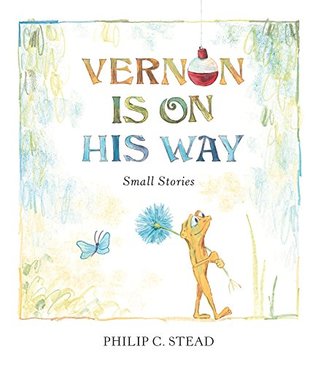
Vernon has returned for a second book following A Home for Bird, along with his friends Skunk and Porcupine. In three short stories, readers get to delight in even more time with these characters. The first story is told almost entirely in images since it’s about waiting. Vernon waits and waits until he suddenly realizes that he’s under way already! In the second story, the three of them head out to go fishing. Porcupine though worries that he is ruining the trip for everyone because he’s never been fishing before. As the story goes on it becomes apparent that none of them know what fishing trips actually are, but their version is a huge success for all of them anyway. In the last story, Vernon creates a special garden for himself filled with things he loves and that remind him of Bird. Porcupine and Skunk want to help Vernon feel better about missing Bird, but they struggle to find the right thing to bring him. Along the way they accidentally find exactly what he needs.

As always, Stead hits just the right notes with this book. The three characters are each unique and interesting. Vernon stays as the focal point of the stories but shares the limelight particularly with the worrying Porcupine this time. These books feel like instant classics, the characters will remind readers of Pooh and Eeyore. They are characters you want to spend more time with as they head out on their small adventures together. The illustrations are classic Stead where he uses the white space on the pages very effectively to create space and sometimes longing.

Another winner from Stead that belongs in every library. Appropriate for ages 4-7.

Reviewed from copy provided by Roaring Brook Press.

Review: A Stone for Sascha by Aaron Becker

A Stone for Sascha by Aaron Becker

A Stone for Sascha by Aaron Becker (9780763665968)

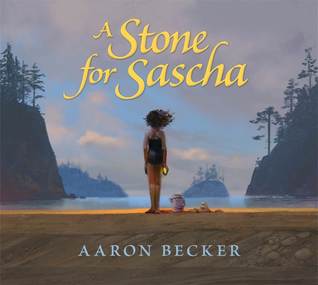
A wordless picture book, this tells the story of a girl’s first summer without her beloved dog at her side. As the family heads off on their camping trip, she finds herself on the lake shore alone. She starts skipping stones and as one sinks, the story turns to one of a crashing meteor and dinosaurs. From that meteor comes a rock that moves through time, starting as a large rough chunk of stone and becoming smaller and smaller as it is redesigned. It is the heart of a large statue, the keystone in an arch for a bridge, an elaborate treasure box, and then it sinks beneath the waves when a ship goes down. It is still there until the girl finds it, yellow and bright in her hand, timelessness and connection in a single stone.

This picture book shines with its strong message about the passage of time, the deep feeling of loss and the resilience to recover. It is a book filled with beauty, one that really comes alive with the turning of time deep into the past. That twist at its center is brave, surprising and is what really makes the book ring so true. As always with Becker, the art is exceptional. He captures emotions so clearly on the page and imbues his images with wonder.

An exceptional read by a master storyteller. Appropriate for ages 3-5.

Reviewed from library copy.