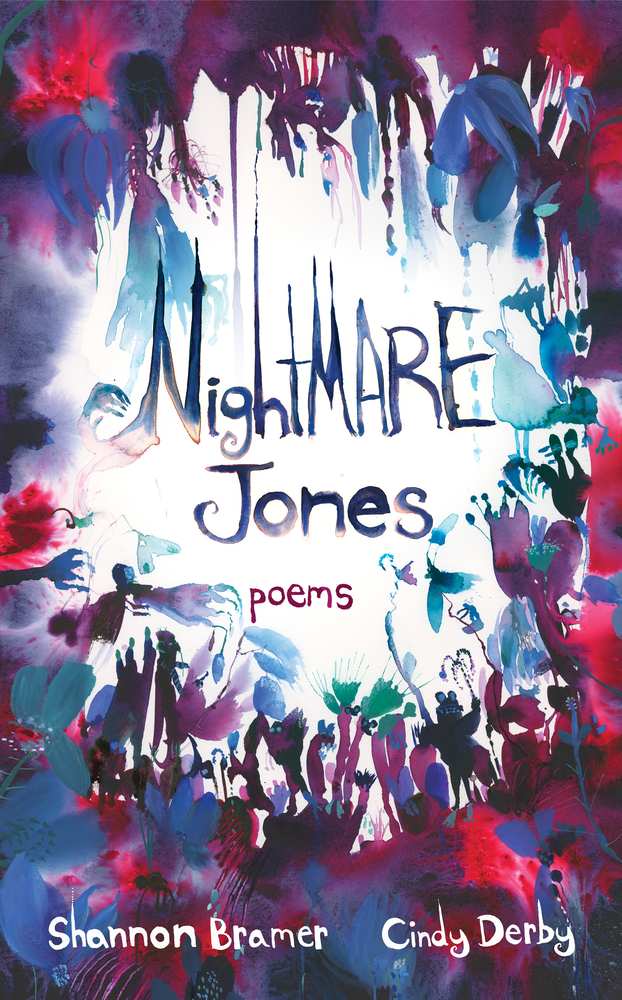
Nightmare Jones by Shannon Bramer, illustrated by Cindy Derby (9781773069463)
First meet Nightmare Jones himself via the poem about him. He has blood on his shoe, a swashbuckler heart and a soul of soot. One after another, monsters appear poem by poem. There are little ghosts who live in shoes. There is the man who collects teeth. You can visit a witch’s garden or find the monster with a hole in her head. Spiders and eyes make several appearances in the book alongside dark emotions. Your monster can be tangible or all in your head, or maybe a bit of both.
So much poetry for children is simplified and this book is marvelously challenging both in content being less than straight forward and poetry structure being played with constantly. The result is a book with lines that are eerie and strange, just right for odd children who enjoy the dark corners of books. My favorite poem is near the end of the collection, “The Strangest One” and the title is just right.
Dark, delightful and dangerously good. Appropriate for ages 8-12.
Reviewed from e-galley provided by Groundwood Books.
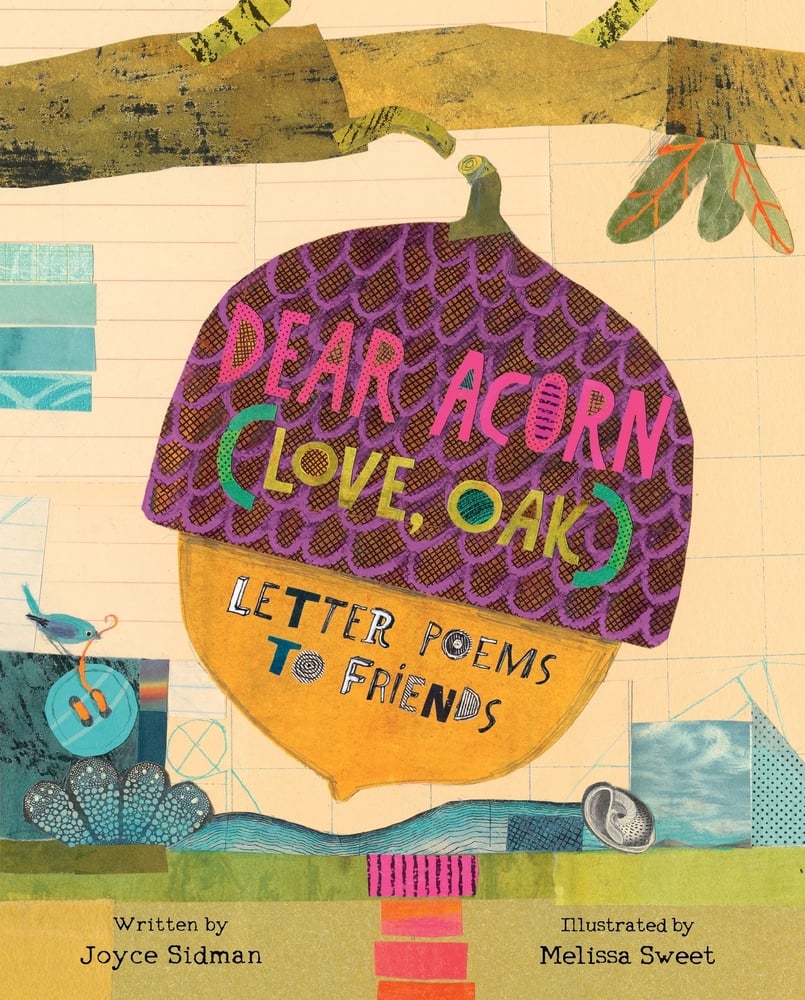
An award-winning children’s poet collaborates with an award-winning illustrator in this book of nature poetry for children. Each poem is written as a letter between two things from nature. Oak and Acorn exchange letters as do Bubble and Sky and River and Pebble. As each writes a letter, the connection between the two is made all the more clear and profound.
Readers will enjoy the pairs of poems and could be inspired to write their own nature letters from other pairs that they see in their own experiences. The poems are beautifully accessible to young children while also demonstrating great skill and not being childish. The illustrations by Sweet are done in her signature style of collage and filled with varying colors from page to page to show the different natural aspects. The result is a spectacular marriage of poem and art.
A great book of poetry for children that belongs in every library. Appropriate for ages 5-9.
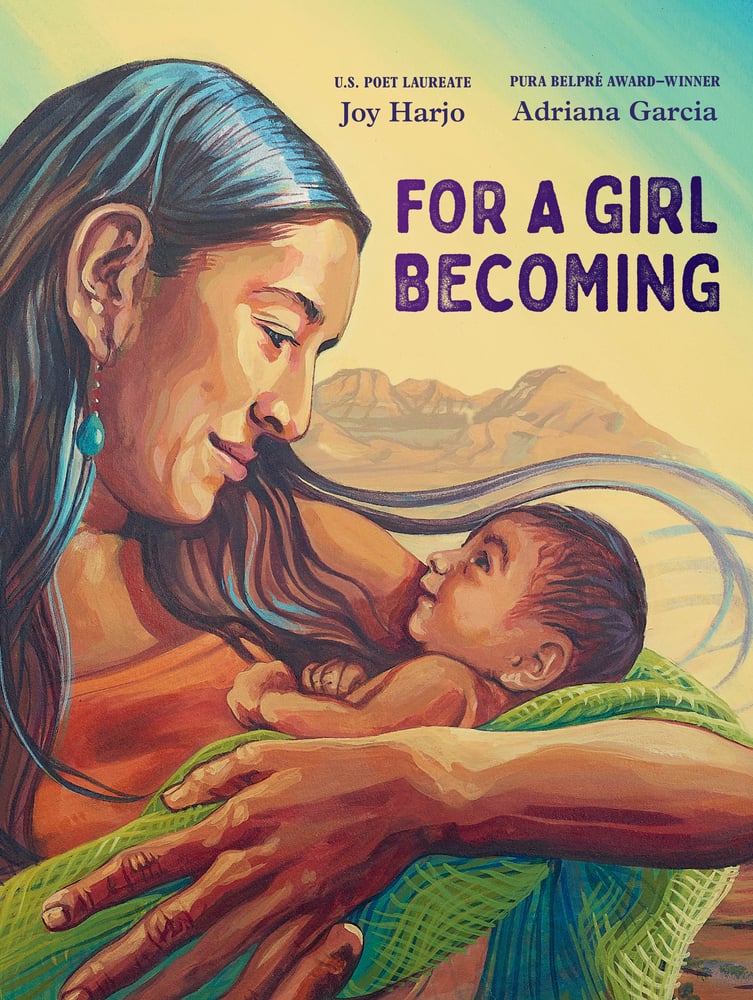
For a Girl Becoming by Joy Harjo, illustrated by Adriana Garcia (9781324052241)
From the U.S. Poet Laureate comes a picture book that celebrates the birth of a little girl. From the birth itself and the baby in its “spirit house,” to those that gathered to celebrate your birth, to the gifts given to you by the halves of your family. Breathe and walk, remembering the source of your breath, the source of your walking and running. Horses ran the land when you were born, remember. It’s impossible to encapsulate Harjo’s poem with any clarity. It is the celebration of a birth, the speaking to all of us about where we came from, and a thunder of a poem. The illustrations by Garcia flow on the page, forming horses, children, families and weaving an interconnection.
A great book for a baby gift and one that celebrates the poetry of life. Appropriate for ages 4-8.
Reviewed from e-galley provided by Norton Young Readers.
Dear Treefrog by Joyce Sidman, illustrated by Diana Sudyka (9780358064763)
When a girl moves to a new home, she hides in the garden and discovers a treefrog there. When she watches how still the frog is, she slows down too. Looking closely at the frog, she notices his sticky toes and long feet. Iin order to find the frog, she has to take deep breaths and look closely. The frog helps her feel less lonely. He hides when a group of kids visits, something that the girl is thankful for since they were loud and trampled the garden. When a storm blows through, the frog not only survives it but is refreshed by the water. Heading to school, the girl curls up like a frog on her yoga mat. That’s when she meets a classmate who is quiet too, someone she can trust to show the treefrog, another friend.
Told in a series of poems, this picture book is a stellar mix of verse, exploring nature, and treefrog information. The verse is from the little girl’s perspective and readers get to know her quiet well as she is worried at first about the move, finds solace in the treefrog in her garden, and eventually is brave enough to make a new friend who is thoughtful too and wants to spend time outside watching. The treefrog facts are offered in the corner of the page, supported by each poem and celebrating the unique elements of this creature.
The illustrations by Sudyka are lush and full of green. They show a wild garden by the house with plants taller than the girl herself. The frog is there for readers to know on the first pages. The garden frames the girl and frog with plants and greenery, offering them an almost tropical paradise in which to form their friendship.
Fantastic froggy friendship and facts. Appropriate for ages 4-8.
Reviewed from e-galley provided by Houghton Mifflin Harcourt.
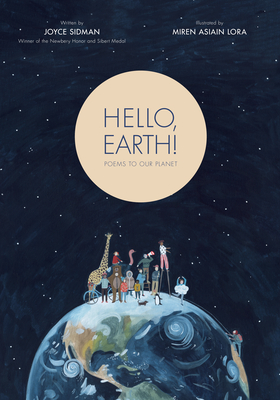
In poems that speak directly to Earth, the planet, herself, this collection of poems explores a variety of scientific concepts. The poems speak to the wonder of walking on the earth’s surface, of trying to imagine its actual size. They look back in time to the dinosaurs, to volcanoes and earthquakes and the continents themselves. Poems explore the various ecosystems on earth from jungles to mountains to deserts. They look deep into the water of the planet and the creatures who dwell there. Then the text circles around to our own role as humans in caring for the earth and making sure it stays well for millennium to come.
As always, Sidman’s poems are both accessible for young readers but also expansive, asking us to look beyond the surface of the subject to the wonders within. In the poems in this book, her innate curiosity about the subject is infectious, giving space for young minds to dream and consider how they feel and think about the subjects Sidman writes about. The final pages of the book offer more information about the earth as well as resources to explore and ways to take action to save the planet.
The illustrations are mostly landscapes, sharing volcano eruptions, storms, wind and quiet moments on small islands. The horizons often line up as the pages turn, offering a feeling of continuity from one natural wonder to the next even if they are far apart on the planet. Beautifully painted, the images are joyous celebrations of our world.
A great poetry collection that invites exploration. Appropriate for ages 6-10.
Reviewed from copy provided by Eerdmans Books for Young Readers.
This book of refreshed feminist nursery rhymes takes the classics and turns them into rhymes that inspire all children to not follow gender norms. Little Baby Bunting’s mother heads out to find a job so they can pay for college. Georgie Porgie is taught a lesson on consent. Jill repairs Jack’s scooter so he can keep going down the hill. Girls welcome spiders to their gardens and picnics. Throughout the book, girls and women appear as doctors, mechanics, and scientists. They are invariably confident and in control of situations. These rhymes are a far cry from the originals and long overdue.
Willis takes clever aim at each of these familiar nursery rhymes. She keeps their structure and rhymes in place for the most part, inserting the feminist twist without losing the connection to the original. Some of the rhymes change just a little while other become almost entirely new. This makes for interesting reading as one realizes how sexist and outdated the originals truly are.
Follath’s illustrations fill the pages with strong women and girls of all races. As written in the rhymes, the girls get messy, get wet, insist on being treated properly, and in general take charge of the pages. This is done with a merry sense of humor in the illustrations, ensuring that the tone remains light.
A great book for little feminists of all genders. Appropriate for ages 2-5.
School Library Journal has announced the selected books for the annual list from the NCTE Excellence in Children’s Poetry Award Committee that are their picks for the best poetry books and verse novels of 2020. The list contains 25 books of poetry and 13 verse novels. The list focuses on ages 3-13 and feature books that are notable for their use of language and poetic devices. Here are the notable titles:
Here are my favorite five poetry books from 2020. I found it more difficult to enjoy poetry on a screen. There’s something about poetry on the paper page that really connects for me, so I read less of it this year than previous years.
“Perhaps Nye’s greatest quality is her refusal to speak down to children or to simplify her poetry for them. She asks them to stretch to understand them, but not in confusing ways or using esoteric language. “
In the Woods by David Elliott, illustrated by Rob Dunlavey (9780763697839)
“Elliott chains his poems together leading readers steadily through seasonal changes as each animal appears on the pages.”
A Place Inside of Me by Zetta Elliott, illustrated by Noa Denmon (9780374307417)
“Elliott’s poetry is marvelous, using imagery that children will understand to express all of these complex emotions, laying them clear and bare.”
Whoo-Ku Haiku by Maria Gianferrari, illustrated by Jonathan Voss (9780399548420)
“Through her series of haiku poems, Gianferrari creates moments that build on one another into a full story of the first months of egg laying and owlets growing up.”
In this companion book to One Last Word, Grimes explores the legacy of Black women writers from the Harlem Renaissance. Grimes has selected poems from these little-known female poets that speak to themes of heritage, nature and activism. Each of the poems in this collection is accompanied by a poem from Grimes that uses the “Golden Shovel” technique of taking a line from the Harlem Renaissance poem and using that line as the last words in each line of Grimes’ poems. In addition, each pair of poems is also matched with a work of art from female Black illustrators, creating an exciting and energizing grouping with every turn of the page.
Once again Grimes amazes with a poetry collection. Grimes has an astute eye for selecting poems for her collections that young readers will enjoy, understand and connect with. When she then creates her magic of using those poems as inspiration for her own, she demonstrates such poetic skill in both the poem construction but also in managing to pay tribute to what the poem is about and translate that into modern day poems for young readers.
Reading this collection is like finding one treasure after another. New poets are discovered. The art is beautiful, clearly inspired by the pair of poems that it is matched with. This collections serves to show Black poets and artists speaking in their own rich voices, offering a look at the women who paved the way for today.
Another astounding collection from Grimes that belongs in every library serving children. Appropriate for ages 9-12.