Review: The Wild Book by Margarita Engle

wild book

The Wild Book by Margarita Engle

Told in poems, this is the story of Engle’s maternal grandmother and her struggle with dyslexia.  Known as Fefa, her grandmother was diagnosed with “word blindness” and told she would never read or write.  Luckily, Fefa’s mother has an idea.  She gives her daughter a blank book to fill with words, as if she is scattering wildflower seeds on the ground.  At first Fefa’s words are hesitant and stilted, like seedlings.  But steadily her writing and reading improve as she learns to take her time and gains confidence.  And that reading is what saves her and her siblings from being kidnapped in the chaos following Cuba’s fight for independence.

Engle writes a gripping series of poems that range from celebrating the written word to the difficulties of dyslexia to the triumph of overcoming.  Over the entire book the threat of violence and kidnappings hangs low and dark.  It is clear that this is not a modern story from the very beginning and Engle cleverly reveals the extent of the chaos the family is living in the midst of through Fefa herself and her own growing knowledge.

As always, Engle’s verse is exceptional.  Often her individual poems could be read one their own.  Yet it is as one complete story that they really show their beauty.  There are many exceptional stanzas to share, but one of my favorites comes early in the novel:

Frog Fear


My little brothers love

to frighten me

by hiding lizards,

bugs, and spiders

in my bloomers.


Today it’s a frog,

but they tell me it’s a snake,

so I scream and tremble

until I can clearly see

that the little creature

jumps around

like jittery letters

on a blinding

page.


The skin of a frog

feels just as slippery

and tricky as a wild

inky word.

Engle traces the love of words and poetry Fefa’s own mother, who shares poems with her family.  It’s a beautiful celebration of that history and those words.

This novel in verse is a powerful look at Cuba’s history and also at dyslexia and overcoming challenges.  Appropriate for ages 9-12.

Reviewed from library copy.

Review: Last Laughs by J. Patrick Lewis and Jane Yolen

Last Laughs: Animal Epitaphs by J. Patrick Lewis and Jane Yolen, illustrated by Jeffrey Stewart Timmins

Perfect to pull out around Halloween time, this book features a series of very funny epitaphs for dead animals.  After the introductory poem to the pet cemetery, readers will discover short poems about specific animals.  There are farm animals like chickens and cows (the cow one happens to be one of my favorites) and more exotic fare like barracuda, iguana and eels.  All dead, for a variety of wild and domestic reasons to hilarious effect.  The poems are riddled with puns, something that I adore.  They are sure to be hits with children when shared aloud or read in person.

Timmins’ art has the same dark humor as the poems themselves.  Make sure you notice the sheep pooping into the river the dead horse just drank out of.  It’s exactly what children will find funny.

Dark and fiercely funny, these poems are not for the preschool set, but will be giggled at galore by elementary aged children.  Appropriate for ages 5-8.

Reviewed from library copy.

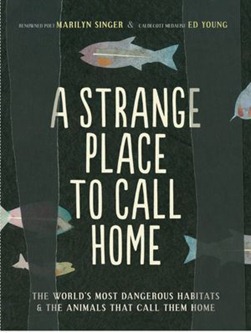
Review: A Strange Place to Call Home by Marilyn Singer

strange place to call home

A Strange Place to Call Home: the World’s Most Dangerous Habitats & the Animals That Call Them Home by Marilyn Singer, illustrated by Ed Young

Through evocative poetry, this book explores habitats that you would never guess something could even survive in.  But they do!  There are creatures who live in places with no water, no warmth, little food.  And those are the creatures that star in this book, each of them celebrated in verse.  There are penguins, mountain goats, and camels, which may be the animals that came to mind.  But Singer looks deeper than that and introduces unlikely creatures to readers, including petroleum flies that hatch in oil, ice worms that live in glaciers, and blind cave fish from Texas and Mexico.  She takes these creatures, known and unknown, and gives us a glimpse of them and their habitat in a variety of poetry forms.  Each page is a discovery of a new animal and a new type of poetry.

Singer excels at creating poetry that is artistic and has depth and yet offers young readers an approach to verse that is welcoming.  She writes at their level yet doesn’t ever play down to them.  Since some of the haikus and other forms are quite brief, it’s nice that she offers paragraphs of information at the end of the book on each creature.  At the very end of the book, she also speaks to the variety of poetic forms she has employed in the book.

Young’s illustrations add another layer of beauty into the book.  Through his layered paper art, he creates a red forest of flamingo legs, a swirl of desert sands, foaming rivers, and an urban landscape among many others.  His work embraces the diverse habitats, recreating the harshness and the often subtle richness of these unknown worlds.

A great pick for poetry units or units on habitats, this book offers a perfect blend of verse, science and art.  Appropriate for ages 7-10.

Reviewed from copy received from publisher.

Review: Cat Tale by Michael Hall

cat tale

Cat Tale by Michael Hall

This is an exceptional picture book that I’m not sure I will be able to explain well enough.  If I bungle this, just take my word for it that this is a book you want to get your hands on.  Told in a rollicking verse, this is the story of three cats: Lillian, Tilly and William J.   The three of them head out on some adventures that are driven by the words in the lines.  I think it will work best if I just pull a few of the early verses:

They pack some books and kitty chews.

They choose a spot.

They spot some ewes.

They use a box to hide from bees.

And so it goes on, each line pulling the last word from the line before to create a new situation.  But even better, these are homophones rather than the exact same word.  Best of all, the story is fun and engaging.  This is word play at its best.

Hall has also created engaging artwork to go along with his playful verse.  Done in bright colors and big shapes, the art has an appealing texture.  Created from acrylic paint and paper cut outs that were combined digitally, it is eye-catching and cheerful.

Bravo for a book that invites children to look closely at the words they are reading and just may be the best way ever to introduce homophones to children.  Appropriate for a variety of ages.  Younger children will enjoy the art and verse while slightly older children will understand the word play best.

Reviewed from library copy.

Review: Lies, Knives and Girls in Red Dresses by Ron Koertge

lies knives and girls in red dresses

Lies, Knives and Girls in Red Dresses by Ron Koertge, illustrated by Andrea Dezso

Just for teens, Koertge has created subversive poems based on fairy tales that look at what happens after “Happily Ever After.”  You will meet a Little Red Riding Hood who wanted to be swallowed whole just to see what it felt like inside a wolf.  There’s also a Beast who longs for the days of wild abandon rather than being a prince again.  What happens when the boy who said the emperor had no clothes is pressured to fit in with the crowd?  Hansel and Gretel may just have been a lot closer and a lot more disturbed than readers thought.  And could Rapunzel long for the days when the witch thought only of her rather than her prince who is distracted?  Koertge plays with the idea of “ever after” and works in the same darkness and sexuality that is already in the stories if you just look at them differently.

This is not a poetry collection to hand to younger readers who are interested in fairy tales.  Rather, this is a dark delight for teens who remember the stories.  There are more obscure tales included in the book, a couple of which I had never read.  I enjoyed those poems as well, since Koertge works in backstory in his poems.  In most of the poems there is an adroit twist about them, sometimes involving the modern world and other times looking at the story in a new and twisted way.

Deszso’s illustrations are done entirely in black and white.  They are paper cutouts that have astonishing details cut into them.  The mood of the illustrations matches that of the poetry, there is a playfulness about them but also a terrific darkness too.

This entire book was like a box of the darkest chocolates.  They held surprises inside and you simply can’t stop reading them.  Appropriate for ages 14-17.

Reviewed from library copy.

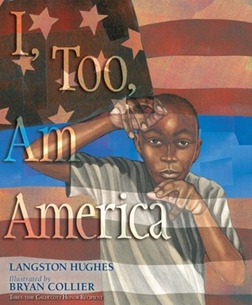
Review: I Too Am America by Langston Hughes

i too am america

I, Too, Am America by Langston Hughes, illustrated by Bryan Collier

Collier marries the famous poem by Hughes with the story of the African-American Pullman porters, who served the wealthy white patrons aboard trains.  The poem speaks to the dream of freedom and equality that we are moving towards but have not yet attained in America.  It tells of servants sent to eat in the kitchen but also that in the future that will change and no one will again be sent to eat separately.  Collier’s illustrations depict the real work of the Pullman porters and the rhythm of the train seems to appear in Hughes’ poem too.  These men who worked in a racist world long after slavery was abolished are a fitting match to this strong poem that sings.

Hughes was able to write with such spare poetry, that it gives a strong vehicle for illustrations.  Collier built an incredible story around those lines, one of porters and a small boy who has new chances in the modern world.  He wraps his illustrations in the flag, playing with stars and stripes and the blue of the open sky throughout the book.  There is a gravity, a seriousness to his work that is truly fine.  It lifts up to the level of the poem, creating a harmony that is very special.

This is an extraordinary picture book about freedom, African Americans, and the struggle that still goes on every day for equality.  Appropriate for ages 7-10.

Reviewed from library copy.

Review: Forgive Me, I Meant to Do It by Gail Carson Levine

forgive me i meant to do it

Forgive Me, I Meant to Do It: False Apology Poems by Gail Carson Levine, illustrated by Matthew Cordell

Based on William Carlos Williams’s “This Is Just to Say” poem, these poems borrow the form and the apology but build upon it with a wild array of situations.  In each poem, an apology is offered, but all of them are done conditionally and many are completely insincere.  There is an apology for eating all of the ice cream and replacing it with anchovies.  There is an apology for turning a bully into a fly and having a swatter ready to go.  Then there are many apologies based on fairy tales or songs that children will enjoy seeing from a new and inventive perspective.  This is a book to pick up and read out of order, unless of course you stumble upon one of the apologies the author has included that might make you reconsider that approach! 

I’m always on the look out for funny poems to share with children, since I’ve found that Prelutsky and Silverstein make a great ice breaker when talking with groups.  Even the jaded upper elementary class can be caught off guard by a charmer of a poem, especially one that elicits guffaws and merriment.  I can see these very short poems being shared in groupings as part of a class visit.  Perhaps interspersed with information about the library and its offerings.

The entire work is very funny, though some of the poems work better than others.  The illustrations hearken to Silverstein’s work with the ink drawings done without additional color.  They have a wonderful frenetic energy to them and also a delight at the situations. 

This will be a welcome addition in elementary classrooms that are working with poetry.  It also makes for a great giggly bedtime read.  Appropriate for ages 7-10. 

Reviewed from library copy.

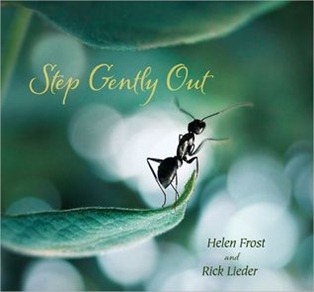
Review: Step Gently Out by Helen Frost

step gently out

Step Gently Out by Helen Frost, illustrated by Rick Lieder

This picture book celebrates looking closely at the small things in the world around us.  Through a poem that focuses on the insects that you can notice if you slow down and take the time, Frost quietly reminds us all that there is another world beside our own that we often ignore.  Ants are climbing up stems, honeybees buzz past, crickets leap and spiders spin webs.  Children will get to see these insects up close, larger than life in the gorgeous photography that accompanies the poem.  It’s a perfect invitation to take a closer look.

Focusing on the more common insects in our gardens, the poem celebrates the ants, bees and moths that surround us.  Frost speaks about them very poetically, bathed in golden light or shining with stardust. 

Her gentle poem pairs beautifully with the artistic photography that features close ups of the insects in the poem.  The images are stunning and lovely, each focusing closely on an insect.  The morning dew image alone is a breathtaking photograph, but there is one after another that are exceptional.

Combining nature and poetry, this book celebrates both.  It also inspires mindfulness and a slower pace, so that children can make discoveries like this of their own.  Appropriate for ages 4-7.

Reviewed from library copy.

Review: North: The Amazing Story of Arctic Migration by Nick Dowson

north

North: The Amazing Story of Arctic Migration by Nick Dowson, illustrated by Patrick Benson

This poetic look at the amazing Arctic starts with the deep winter and the few animals who survive there year round.  Then spring comes to the Arctic and the sun comes back along with some warmth.  Plants start to appear from under the snow.  Soon more animals will arrive.  The first to head out on their journey are the gray whales, that swim from Mexico to the Arctic Circle.  Birds head north too in flocks.  Herds of pregnant caribou journey north, followed closely by the gray wolves looking for weakness.  Walrus, narwhal, schools of fish, all of this life crowds the Arctic summer until the weather turns cold and brutal again, and once more they head back around the world.

Dowson’s words are poetry in this book.  Not only written in verse form, they also speak to the soul of the Arctic, the beauty of the place and the glory of the creatures who live there.  At the same time, the words are scientific and filled with information about the place and the animals.  It is an elegant combination of poem and fact.

Benson’s art is striking.  He created paintings that are both natural and accurate but also have a sense of artistry.  Much of the art is about the landscape, the place itself and the grand amount of space there.  The illustrations of bitter winter are cold and bleak with dim, gray light.  Then the reader turns the page and it is spring with its lemony light and sprigs of green.  The change is striking to the reader and beautifully captured.  There are moments like this throughout the book.

A striking mix of poetry, art and science, this book will speak to a range of different children looking to understand their world a little better.  Appropriate for ages 5-7.

Reviewed from library copy.