Review: Take What You Can Carry by Kevin C. Pyle

take what you can carry

Take What You Can Carry by Kevin C. Pyle

This graphic novel explores connections between generations and across races, in an innovative way.  It is the story of two teenage boys.  One is a Japanese American who is sent to the internment camps during World War II.  His part of the story shows the displacement of his family, the loss of their rights, and the realities of the camps.  In alternating chapters, we also get the modern story of a teenage boy who moves to a new community and gets in with the wrong group of boys.  Soon he is robbing stores and eventually ends up in real trouble.  The man whose store he robs was the Japanese teen, who also resorted to stealing in the camps. 

At first, readers are not sure how the two stories will ever come together into one, or if they ever will.  They seem so remote and separate from one another.  Then when they do, there is a great satisfaction is realizing why the modern boy is given a chance to remedy what he has done.  It is a story that deals with two very personal stories, but that also has a more universal message about displacement, theft and redemption.  Both of the teen boys find ways to make things right in their lives, to accept their conditions, to rise above. 

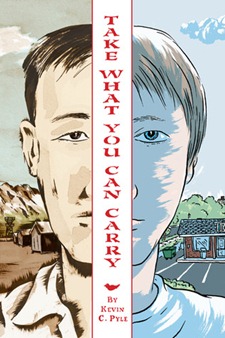
Pyle’s two stories are shown in different color palettes as you can see from the cover.  The sepia tones work well for the historical story, also emphasizing the wasteland of the internment camps.  The blues of the modern story give it a cool feeling that suits a story where a boy is not making the right choices and where his world is devoid of warmth. 

This intriguing graphic novel is a compelling read that will show young readers not only about history but also about themselves and their own choices.  Appropriate for ages 12-14.

Reviewed from copy received from Henry Holt.

Review: The Year of the Beasts by Cecil Castellucci

year of the beasts

The Year of the Beasts by Cecil Castellucci and Nate Powell

Told in chapters that alternate Castellucci’s writing with Powell’s graphics, this is the story of two sisters.  When the summer carnival comes to town, Tessa, her younger sister Lulu and her best friend Celina get to go to the carnival without their parents for the first time.  After meeting up with a group of boys they know, the three girls and the boys head to the sideshow tent with its darkness and opportunities.  But Tessa’s plans don’t quite work out, and the boy she has a crush on, Charlie, ends up entering the tent with Lulu instead.  Tessa is left to go in with Jasper, a boy who is known as a strange loner.  When they exit, Tess has rebuffed Jasper’s attempts to kiss her, but something has obviously happened between Charlie and Lulu that has sealed them together as a couple.  Now Tessa has to deal with her jealousies and their dark results.

Castellucci’s prose is lush and wild.  The emotions in the book sizzle, coming right off the page.  On page 97, there is a great example of this:

If there were such a thing as a dark cloud over someone’s head, Tessa had one.  It was a stormy little thing.  With hail and lightning and thunder.  And no silver lining.

She explores the feelings of confusing lust and potential love, the ability for those same feelings to alienate and discourage, and the intensity of sisterhood.  The book is character-driven with Tessa at its center in all of her confusion, desperation to not be jealous, and constantly feeling as if she is second best.  There are no easy answers here, nothing is let go of easily, and emotions twist and turn.  It is a beautiful storm of a book.

Then you have the other chapters done in graphic novel format that show Tessa as Medusa with her nest of snake hair.  The graphic portion moves along in advance of the text portion, foreshadowing things that are yet to come.  Medusa finds that her school is also filled with other monsters, her best friend is a mermaid, and Charlie is a centaur.  She has turned her parents to stone with her gaze and now must live with the consequences of that unless she is able to reawaken as a human again. 

The pairing of these two makes this book even more original and powerful.  It also makes the book much more welcoming for reluctant readers or those who have discovered Castellucci through her graphic novels. 

An emotional ride of a teen novel done with beauty and power, this book has an innate appeal thanks to its graphic novel portion and the dynamic writing.  Appropriate for ages 13-16.

Reviewed from copy received from Roaring Brook Press.

Rating Teen Reads – A Rant

No, this isn’t about me starting a system on my blog to rate the books I read with a series of stars.  Instead it’s about the insidious suggestion by Brigham Young professor, Sarah Coyne, that books for teens should have rating labels on them.  It’s enough to make my librarian skin crawl.

Coyne checked teen novels for profanity in five different categories.  All but five of the books she looked at had at least one instance of profanity.  (Though I must point out that “hell” and “damn” are included in her list of profane words.)

First, let me say that I’m opposed to labeling books at all.  But really, profanity??  Not sexual acts, not violence?  But instead the damns and the hells and the transient but powerful words we use to express emotions?  What the…

Second, I have to relate my own story of reading a Judy Blume book.  I loved Judy Blume as a pre-teen and read book after book by her in a single summer.  I found Deenie and loved the storyline of a girl who wanted to be a model and had to deal with being in a back brace.  But as a younger reader, I completely (and I mean completely) missed the section on masturbation.  I missed it so thoroughly that when I later heard about that being in the book, I was confused and baffled.  I reread it as a teenager, and by golly, there it was!
No labels necessary, no parent needing to intervene.  Books are special that way.  They are patient, waiting for you to be the right age and then they change along with you.

And for those of you who think that the four letter words are different, I was an voracious reader and still needed to have someone on the school bus draw what the F-word meant.  Then I got to teach her the medical terms my mother used for those parts of the body.  We all learned something that day.

Another wrinkle is what we do with the adult books that teens are also reading.  I read Stephen King as a teen, hauling his huge tomes along with me.  I read adult romance novels that my mother didn’t approve of at all and that the librarians in my small town library also frowned at but let me check out.  I read Ivanhoe, Gone with the Wind, Something Wicked This Way Comes, and any book that caught my fancy.  And I would have read them despite any labels, and perhaps even because of labels.

And what happened to me?  I became a lover of books, a librarian, a book blogger, and a mother who would let her teenage son read anything that he wanted.  Labels or not, he can read it.  Just like I did.  If it makes him into a reader, especially one who takes risks and learns about the way others think and feel, then I say: Hell Yes!

Review: Grave Mercy by Robin LaFevers

grave mercy

Grave Mercy by Robin LaFevers

Hated by her father since the day she was born, Ismae had survived her parents’ attempt at abortion and was left permanently scarred.  Sold into the brutality of an arranged marriage, she manages to escape into the hands of the convent of St. Mortain.  There she is offered the chance to become what she has always wanted to be: a woman with choices and power.  In the case of Mortain, it is the power to kill.  Ismae discovers that she is tolerant of poisons, allowing her to work closely with them and learn all of their secrets.  She is sent to the court of Brittany to do the work of Mortain, killing those she is instructed to and reporting her political findings back to the convent.  She must pose as the mistress of Duval, bastard son of the dead Duke.  Ismae quickly becomes embroiled in the politics and betrayals of the court: the many men vying for the promised hand of the young Duchess, and the French pressuring for capitulation or war.  And of course, there is also a romance blooming.  This adventure in 15th century Brittany will be sure to please historical fiction and fantasy fans alike.

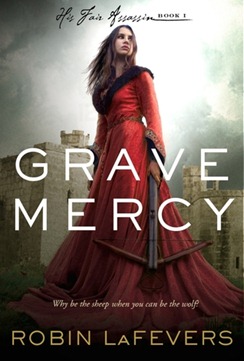
First, I have to take a moment to mention this cover.  Even better, it is a cover that is not only beautiful but wonderfully in sync with the storyline.  This is Ismae, an incredibly strong and vibrant heroine.  She has little interest in the more womanly pursuit of needlecraft and even less in flirtation.  Instead she turns into a disturbingly eager assassin, ready to dole out damage where required.  That is until things are not quite so clear as she had thought.  Then the book turns and becomes deeper and even more magnetic.  LaFevers allows her young heroine to guide this book, telling her own strange, amazing story.

The characterizations here are compelling and original.  The setting is just as much so.  And the setting here is a large part of the storyline itself.  The high court of Brittany is a place of dangers and yet wonders.  The political pressures add organically to the dynamic storyline.  The use of the old gods and ancient religion as a backbone to the story also works very well.  It adds yet another dimension to the story, creating great depth.

Highly recommended, this book is a luminous gem of a book.  Get this into the hands of older teens who will wait breathlessly for the next in the His Fair Assassin series.  Appropriate for ages 15-17.

Reviewed from library copy.

Review: The Obsidian Blade by Pete Hautman

obsidian blade

The Obsidian Blade by Pete Hautman

This is the dazzling first book in a new trilogy by veteran author, Hautman.  It is the story of Tucker, a teen boy from Hopewell, Minnesota who sees his minister father suddenly disappear into a disk that hangs in mid-air.  His father returns an hour later, changed.   He looks older, his clothes are worn, and his feet are covered in odd blue boots.   But the most significant change is that he no longer believes in God.  After his father returns, Tucker’s mother begins a slow descent into madness.  She stops cooking, stops getting dressed, and her hair turns from red to pure white.  Tucker longs to return to the days when his family was not falling apart, but before he can even begin to hope for that, his father disappears with his mother.  Tucker knows they have both entered the disk again, looking for a cure for her.  This book blends family relationships, technology, time travel and religion into one intoxicating mixture that is impossible to sip slowly.

This book would definitely be categorized as science fiction, but that definition does not fit quite so easily here.  With its detailed look at modern life and families, the audacity with which it explores faith and religion, and the wrenching take on modern technologies, this book is far more than that narrow genre might imply.  Hautman has created a work that transcends simple definition, reaching quickly beyond them. 

Hautman whirls readers through time, creating places that read like Narnia, others that seem more like an Indiana Jones film, and then slows down to take in the crucifixion.   It is a trip through our shared past and future, dancing back and forth across the line until the reader is unsure which is which.  Hautman excels at asking impertinent questions, taking great risks, and exploring the lines that teens themselves like to toy with. 

The book is beautifully written.  The character of Tucker is well done, though others may need time in the upcoming books to come more fully to life.  The book is plotted tightly, picking up pace until by the end, you simply cannot read fast enough to figure things out.  And the final trick is the end of this first book, which is just like stepping through a diskos of your own.  

A triumph of a first book in a series, this reminds me strongly of the wonder of Chaos Walking by Patrick Ness.  I’d suggest getting it into the hands of teens who enjoyed that series which had the same complexity both in terms of storyline and ethics.  Appropriate for ages 14-17.

Reviewed from ARC received from Candlewick Press.

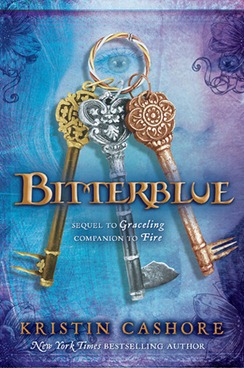
Review: Bitterblue by Kristin Cashore

bitterblue

Bitterblue by Kristin Cashore

Released on May 1, 2012.

A sequel to Graceling, this book takes place 8 years later.  Bitterblue has been queen of Monsea for some time, struggling to undo the evil that her father wrought throughout the country.  Her duties seem to consist of mountains of paperwork, pardoning those influenced by Leck’s powers and the occasional appearance at court.  Spending days at work, indoors with only her aging advisors around her, who seem to go blank mentally when she mentions her father, wears upon her.  So she starts to sneak out and visit her city.  She visits the amazing bridges her father had created.  Underneath one, she finds a story room where there is warmth, drinks and stories are shared.  It is there that she meets Saf and his friend Teddy, two thieves who only steal what is already stolen.  As the queen learns about her city, she discovers strange things, puzzles that add to the questions she already has.  It is this that she has to solve, if she is to be the queen she needs to be.

Cashore brings back beloved characters in this book, including Po and Katsa who are continuing their love affair, their stormy fights, and their wrestling.  In Bitterblue, she has created yet another amazing female character.  Bitterblue has not only the future of her kingdom to decide, but also the terrors of her past to overcome.  She is a survivor rising from the wreckage of her childhood, the manipulation of her father, and the devastating loss of her mother.  Readers get the exquisite pleasure of watching her become a queen and a woman before their eyes.  The growth shown in this book is gradual and organic, beautifully told.

Cashore excels at writing readable books and elaborate worlds.  Her world building is done carefully and consistently, the reader secure in the knowledge that this is a vibrant, strange world, but one that they can count on.  Her characters all make sense, living their lives in the complexity of the political world that Cashore has built.  Even if their actions make no sense at first glance, be sure that Cashore knows more than she is showing at that moment and all will be revealed.  These books are layered, complex and riveting.

I fell hard for Bitterblue and her struggles.  She is the sort of heroine who speaks to me, one who is faced with overwhelming challenges but by staying true to herself and discovering who she is deep inside, manages to come through in the end.  She is immensely human, something that Cashore makes sure all of her amazing heroines are.

If you loved Graceling and Fire, you are sure to love Bitterblue as well.  This book took four years to write, and I’m happy to give Cashore all the time she needs to create her next book too.  Appropriate for ages 15-18. 

Reviewed from ARC received from Dial Books.

Review: The List by Siobhan Vivian

list

The List by Siobhan Vivian

At Mount Washington High School, the same thing always happens just before homecoming.  The List comes out.  It gives the names of two girls in each grade: one is named the prettiest in that grade, the other the ugliest.  Being on the list can change your life at Mount Washington, and it does for all of the eight girls on this year’s list.   Abby is ecstatic to be on the list as prettiest freshman, especially with her brainy older sister looking down at her all the time.  Danielle, the other side of the freshman pair, sees the list take a toll on her relationship with her boyfriend.  Lauren, prettiest sophomore, was previously homeschooled and finds that the list can help her make new friends.  Candace, named the ugliest sophomore, isn’t unattractive at all, instead it’s her attitude that is horrid.  Bridget, celebrated for losing so much weight, knows that she’s started something very dangerous.  Sarah is a rebel and immediately writes UGLY across her forehead in permanent ink.  And then there are the seniors, two girls who used to be best friends and who now are strangers, one whose path to homecoming queen seems clear and the other who has been on the list as ugliest all four years. 

Vivian sets the wheels of this story in motion and her characters take over.  It is a trick to create eight characters unique enough to read as individuals throughout an entire book, and Vivian does that very well.  She explores the relationship between beauty and self-esteem, beauty and popularity, and the perception of beauty and its impact.  Some of the girls are robbed of that feeling while others have never felt it.   But it’s not just about the “ugly” girls.  The perception of beauty haunts the “pretty” girls as well, creating rifts in friendships, questions about values, and eroding self-esteem in much the same way as being labeled ugly.

Vivian does not shy away from this complexity, instead she embraces it.  This is foreshadowed by the reaction of the principal to discovering the list where she warns the girls that they have all been hurt by being placed on the list. 

Here we have a book that is deep, complicated, and riveting reading.  It’s a book that takes on some “truths” of our society and turns them on their head, in a pretty beautiful way.  Appropriate for ages 14-17.

Reviewed from ARC received from Scholastic Press.

Review – Curveball: The Year I Lost My Grip by Jordan Sonnenblick

curveball

Curveball: The Year I Lost My Grip by Jordan Sonnenblick

Peter has always loved baseball and excelled at it.  About to start high school, he looks forward to being a pitching star and playing alongside his best friend AJ.  But when he ignores the pain in his arm and continues to pitch, disaster happens and he is told he can no longer pitch, ever.  Peter’s mother talks him into taking a photography class in school, inspired by his grandfather who is a well-known photographer in their community and whom Peter loves to spend time with.  Peter reluctantly agrees, but the class is too easy and he is moved to an advanced photography class along with another freshman, a beguiling girl, Angelika.  As their relationship starts thanks to photography, Peter notices that his grandfather is starting to forget things.  Peter keeps the truth about his grandfather from his parents, just as he doesn’t tell the whole truth about his arm to his best friend.  How long can he balance the lies he’s been spinning before they all fall?

Sonnenblick has created a book that is smart and charming.  He effortlessly blends the worlds of sports and photography, plus a dash of strong romance too.  Peter is a great character: a jock who is bright, funny and endearingly unsure.  A great sense of humor runs through the book as well, making the book a fast read despite the heavier issues at its heart.  The book grapples mightily with truth telling and relationships.  Readers get to see just enough of the grandfather before he starts to lose his memory to understand just how strong the relationship between the two of them is.  Though there are many issues at hand in the book, they are all balanced on strong storytelling and vivid characters.

With its blend of topics this book should appeal to many readers, get it in the hands of teens who enjoy John Green and are looking for more smart, funny books.  Appropriate for ages 14-16.

Reviewed from ARC received from Scholastic Press.

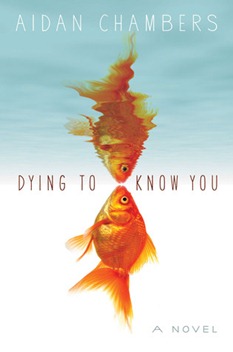
Review: Dying to Know You by Aidan Chambers

dying to know you FINAL

Dying to Know You by Aidan Chambers

When Karl’s girlfriend Fiorella asks him to write down his feelings about their relationship and answer a list of questions, he turns for help to a famous writer who lives in their town.  Karl is dyslexic which makes writing very difficult for him, as was the author who suffered as a child from minor dyslexia.  The author agrees to help Karl as much out of loneliness as a willingness to help.  He is drawn to Karl, who is similar in many ways, bright and eager.  He insists that Karl meet with him and give his own answers to the questions which the writer will in turn polish into something worthy of Fiorella’s attention.  As the two spend time together, their relationship deepens slowly into a true friendship.  When Fiorella finds out about the truth of the letters, it impacts the relationship not only of her and Karl but also of Karl and the author.

Chambers has created an amazing book here.  I found it nearly impossible to summarize because so much of the book is the growing connection between the two male characters.  It happens slowly and believably during fishing, quiet moments of driving, and conversation.  It is a look at how we choose connections in our lives and how they impact the life we lead.  While the book may be a quiet one, it also is daring in its own way, revealing the inner world of a young adult, written with truth and honesty.

The two men both face previous losses that have colored the way they face the world.  Karl lost his beloved father at a young age, and still struggles with his connection to his father and with disconnecting from that loss.  The author has recently lost his wife.  The two of them both struggled with depression and grief, sinking lower into a dangerous place with thoughts of suicide. 

Chambers also weaves in the role of art in our lives, the power of that to connect us to the world and the drive to create and be imaginative.  With Karl, who is a plumber, this connection to art is not an obvious one.  It takes time, just like their budding friendship, for the reader to come to understand Karl more deeply. 

I wish I could easily capture this book in paragraphs, since I feel like I have danced around the edges and not captured its heart here.  Let me say that this is a book that is powerful, quiet and filled with revelations about life.  It is honest, beautifully written and deep.  It is a book where you miss the characters for days after finishing it, because you too have befriended them.  Appropriate for ages 16-18.

Reviewed from ARC received from Amulet Books.