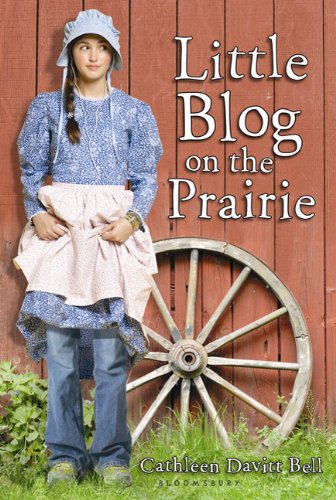
Little Blog on the Prairie

Little Blog on the Prairie by Cathleen Davitt Bell

When Gen’s mother signs the family up for Camp Frontier, they don’t know what they are getting into.  Now they must live like they are 1890s pioneers.  Which means wearing authentic clothing, cooking on a wood burning stove, milking cows, raising chickens, and living in a tiny cabin in the woods with an outhouse.  All of their electronics are confiscated when they enter camp, but Gen manages to sneak in her cell phone.  From there, she texts her best friends one of whom turns her texts into a blog for an assignment.  All is not dull work on the prairie, there is handsome Caleb who seems interested in Gen but might like Nora, the daughter of the owners better, and then there is the competition between the families and the drive to not keep being in last place.  Maybe this family bonding thing isn’t so bad after all.

Bell has created a book with a sharp wit and yet a homely warmth.  Gen is a great protagonist whose texts are fun to read.  Bell also has a feel for humor with the killer chickens and the cow milking scene.  Both are worth reading the novel for.  She writes best when dealing with modern teens juxtaposed with the world of 1890.  Bell’s writing is stilted in other scenes where there isn’t humor.  Her scenes with Nora and Caleb don’t flow with the same effortlessness as her humor.

Another issue is her characterization of the secondary characters.  Caleb, the love interest, is rather dull and quite normal though nice.  I don’t see why Gen who is bright, funny and complex would be entranced by this boy.  Nora, the homeschooled daughter of the proprietors, is also a disappointment.  Left to be rather cardboard and mean, she could have been a great example of a homeschooled kid.  Instead, she is envious and lonely.  What a missed opportunity she was a character!

One of the big successes of the book is that it never becomes a moral story about the dangers of modern technology and the isolation of modern family life.  Just as the book was approaching that, it veered into an unexpected direction that kept the novel fresh and interesting.

Despite the issues with the book, I could not put it down.  The humor and Gen kept me reading.  Recommended for readers who enjoyed Little House on the Prairie but also modern teens who wonder what would happen if their cell phones, iPods and computers were taken away.  Appropriate for ages 12-14.

Reviewed from ARC received from Bloomsbury.

Also reviewed by Semicolon.

Birth Marked

Birthmarked by Caragh M. O’Brien

This debut novel is an enthralling dystopian fantasy.  Gaia’s mother is a midwife and now at age 16, so is she.  Each month, the first children born must be advanced to behind the wall of the Enclave, escaping the poverty outside the wall.  It is Gaia’s duty to turn those children over just as her two older brothers were turned over.  Gaia herself was no advanced because of her scarred face.  But now Gaia’s parents have been seized by the Enclave and no one knows why.  When they do not return, Gaia decides to sneak inside the wall and see if she can find out what has happened to them.  Through her journey, Gaia learns that the lies being told to her and the others outside the wall are many and complex, but that one girl can still make a difference with one heroic act.

It took me some time to read this novel because I was savoring it.  The world building that O’Brien has done here is based on our own familiar world, but one that has suffered a climate catastrophe.  O’Brien offers just enough details about the world to make it clear, but concentrates more on the human situation than the environmental one.  Her society is complicated, fascinating and well rendered.  The same can be said of the heroine, Gaia.  She is bright though uneducated, defiant, clever and brave.  She is a great lens to view the society and her situation through.

There is adventure and romance in this novel, all told through the eyes of the girl who is a loner and outsider because of her disfiguring scar.  Get this into the hands of those who enjoy Tamora Pierce, because they will love this heroine and wait impatiently along with me for the next in the series.  Appropriate for ages 13-16.

Reviewed from copy received from Roaring Brook Press.

Stolen

Stolen by Lucy Christopher

In a Bangkok airport on her way to Vietnam with her parents, sixteen-year-old Gemma stops for a cup of coffee to take a break from arguing with them.  It was then that her life changed.  She was drugged and taken to the outback of Australia where Ty, the man who took her, had created a self-sufficient home for both of them.  Gemma fought back as best she could when the drugs wore off, tried to escape multiple times, but the outback itself kept her bound at home with Ty.  Ty is handsome, well-built, and deeply in love with Gemma, whom he has been watching for years.  Readers get to experience their strange, disturbing, but captivating relationship grow and change through the form of a letter from Gemma to Ty. 

Christopher’s book explores what freedom really is, what love means, and how relationships can morph and change despite ourselves.  In Gemma, Christopher has created a strong modern female that readers will instantly relate to.  She has domineering but distant parents, close friends, and much to miss.  But the most remarkable character Christopher created is Ty.  Ty the monster, the angel, the wronged, the wrong-doer.   He is so complex yet so simple to understand.  And readers will come to understand him, and perhaps like Gemma love him in the end.  The writing masterfully takes readers on the same course as Gemma, loving Ty despite themselves.

The third character in the novel is the setting itself.  The Australian Outback is vividly rendered from its incredible heat to the redness of the sand to the plants and animals that make their home there.  It forms the walls of Gemma’s prison, beautiful and horrible at the same time.  Christopher weaves imagery from the setting into much of her writing, further tying the book closely to the setting.  She does it with skill and subtlety.

Highly recommended, this book is one that twists underneath you, bringing you to a place you never expected to reach.  Beautifully written, this book is appropriate for ages 14-18.

Reviewed from ARC received from Scholastic.

Also reviewed by Melody’s Reading Corner.

2010 Lammy Award Finalists

4bb10c3da239f

School Library Journal has the story that the 2010 Lammy Award Finalists have been announced.  The Lambda Literary Award is given to books that show excellence in the field of gay, lesbian, bisexual and transgender literature.  The nominees for children’s and teen literature are:

Ash by Malinda Lo

How Beautiful the Ordinary edited by Michael Cart

In Mike We Trust by P. E. Ryan

Sprout by Dale Peck

The Vast Fields of Ordinary by Nick Burd

Reblog this post [with Zemanta]

The River

The River by Mary Jane Beaufrand

Ronnie has moved from Portland to rural Oregon with her parents.  They now live at the end of a dead-end road and run an inn.  Ronnie is not happy at all to have moved to this very isolated area where she can hear the river running.  Ronnie has taken up running and people along her route time her run, including the local ranger and a family with lots of children.  Ronnie quickly learned to follow one of those children, because Karen was always up for an adventure.  But when she is on her run one day, Ronnie glimpses something along the river and discovers Karen’s body.  Now the sinister and gloomy feel of the area comes to fruition as Ronnie is obsessed with figuring out who would kill Karen and what Karen may have discovered in one of her adventures along the river.

Beautifully atmospheric, this novel excels at bringing the world of rural Oregon to life.  Filled with sensory information like the sounds of the river, the feel of the rain, and the small details of life at the inn, readers are surrounded by Ronnie’s world.  The book also does well in building tension through the slow storytelling in the beginning.  The details and the pace help build the eeriness of the novel.

However, the book does fall short despite the great writing.  Ronnie’s character is well-developed and interesting, but others around her are not as well defined.  Her foster brother Tomas is not even introduced in the first couple of chapters and suddenly appears.  When their relationship becomes more involved, it is done suddenly and with little build up which was jarring.  Additionally, the slow pace of the beginning of the novel turns into a rushing speed where the lovely details are forgotten and the mystery is solved far too quickly.

I would have loved this novel if the pacing was more consistent and the characters better defined.  But even with these shortcomings, the novel will be enjoyed by teen readers who will find a contemporary mystery set in an evocative place.  Appropriate for ages 14-16.

Reviewed from library copy.

Also reviewed by Words World and Wings, Katie’s Bookshelf, Sarah’s Random Musings, The Reading Zone, Wordbird, and Katie’s Book Blog.

Hex Hall

Hex Hall by Rachel Hawkins

When Sophie’s love charm goes horribly wrong at prom, she is sentenced to Hex Hall, a reform school for witches, shapeshifters, fairies and vampires.  Having been raised by a non-gifted mother, Sophie knows little about the magic world which gets her into trouble at Hex Hall.  In her first day, she is rooming with the controversial vampire, Jenna, she has angered three powerful dark witches, and she has a hopeless crush on one of the dark witch’s boyfriend.  Could it get any worse?  Throw in detention time spent cataloging garbage in a cellar, a strange spirit who won’t leave her alone, and family secrets and you have a wild ride of a book that is sure to please.

Hawkins has managed to write a story filled with witches, magic, vampires and other fantasy elements but also not to take herself too seriously.  The writing has a lot of humor, much of it pitched directly at current fantasy novel tropes.  Sophie herself is a character filled with sarcasm and a biting wit.  Without this writing style, the book could have suffered from the over dramatic and serious tones of many of these novels.  Here the lightness works well, creating a very funny and readable novel.

At the same time, the book is not just light.  There are dark themes here, real dangers and delightful diversions.  I quite enjoyed the mix of light and dark, humor and tension.  It kept the pages turning quickly.

Recommended for fans and non-fans of Twilight, both will find reasons to enjoy this novel and to look forward to the rest of the series.  Appropriate for ages 13-15.

Reviewed from library copy.

Also reviewed by Tempting Persephone, Whimsical Whamsical Whumsical, My Life Uncensored, Wondrous Reads, Frenetic Reader, The Compulsive Reader, Beyond Books, and many more.

The Firefly Letters

The Firefly Letters by Margarita Engle

I have adored Engle and her poetry since first reading her Poet Slave of Cuba.  This historical novel told in verse tells the story of early Swedish feminist Fredrika Bremer and her travels in Cuba.  While in Cuba she inspires and changes the lives of two women, a slave named Cecilia and a wealthy young woman named Elena.  At first amazed and shocked by the freedom Fredrika demonstrates, Elena warms to her as she begins to understand that the future could be different than just an arranged marriage.  Cecilia finds in Fredrika a woman who looks beyond her slave status and a role model for hope.  Told in Engle’s radiant verse, this is another novel by this splendid author that is to be treasured.

As with all of her novels, Engle writes about the duality of Cuba:  the dark side and the light, the beauty and the ugliness.  Once again she explores the horrific legacy of slavery without flinching from its truth.  Against that background of slavery, she has written a novel of freedom.  It is the story of a woman who refused to be defined by the limitations of her birth and her sex, instead deciding to travel and write rather than marry.  Fredrika is purely freedom, beautifully contrasted with the two women who are both captured in different ways and forced into lives beyond their control. 

Beautifully done, this book is an excellent example of the verse novel.  Each poem can stand on its own and still works to tell a cohesive story.  At times Engle’s words are so lovely that they give pause and must be reread.  This simply deepens the impact of the book.  Engle also uses strong images in her poems.  In this book, fireflies are an important image that work to reveal light and dark, as well as freedom and captivity.

Highly recommended, this author needs to be read by those who enjoy poetry, those who enjoy history, and those who simply are looking for great writing.  Appropriate for ages 11-14.

Reviewed from library copy.

Finally

Finally by Wendy Mass

Mass returns to Willow Falls, the setting of 11 Birthdays.  This time it is Rory’s turn to have a birthday and she is finally turning twelve.  Her entire life her parents have told her that she could do things when she turned twelve.  She can have a pet, shave her legs, go to a girl/boy party, have a cell phone, get her ears pierced, and much more. But hours before her birthday, she finds herself stuck in a drainpipe and rescued by a little old lady who has surprising strength.  That women tells her, “You won’t get what you want, Rory Swenson, until you see what you need.”  Rory though is sure that her list of promises from her parents are exactly what she both wants and needs.  As Rory works her way through the list, her efforts meet with disaster.  It is especially bad when they start filming a movie at her school and all of her disasters could force her to give up her new job as an extra.  It just may take a gold allergy, an evil murderous bunny, and loss of skin on both legs for Rory to see what she needs.

Written with a strong voice in the first person, Rory’s take on life is wry, funny and always upbeat.  She is a great character whose disasters make for laugh-out-loud moments that are perfect for the tween age group.  Her personal wants may not match those of readers, but they will easily see themselves in her.  She is utterly understandable, completely accident prone, and simply delightful to spend time with.

This book reads quickly as readers move from one of her wishes to the next with Rory, each resulting in if not surprising, then very funny events.  Rory’s family members are just as vividly written.  Her parents are busy but involved and caring if a little overprotective.  Her toddler brother offers just the right amount of distraction and silliness too. 

Take humor, a zing of some sort of magic, and an accident prone tween, and you have this winning book.  The cover is bright, friendly and will invite children to pick it up and read it quickly.  Appropriate for ages 10-13.

Reviewed from Advanced Reader Copy (ARC) received from publisher.

Also reviewed by Kate Messner on her blog.

Nothing

Nothing by Janne Teller

Before you open this book, make sure your schedule for the next few hours in clear.  Seriously.

Pierre Anthon left school abruptly after announcing, “Nothing matters.” Instead of going to school, he climbed into a plum tree and called to the other teens in his class, mocking them for still trying to conform to a world where nothing actually matters.  After awhile, the others in his class decided that they must prove him wrong and demonstrate that there are things in life that matter.  So they built a heap of meaning, filled with items that meant a lot to them.  At first they volunteered to put items onto the pile, but when that stopped working, it was decided that the last person to put something on the  pile would decide what the next person must add.  As this progresses, the tension mounts as one student must decide for the next just how far this will go and just how much meaning their effort will have.

Written in stark, haunting prose, this novel starts with a slow buildup and then becomes impossible to put down as one character after the other makes horrific decisions.  It is a story about what matters in life, but also about the meaningless that becomes imbued with too much meaning as well.  The book is heartbreaking, strange and completely riveting. 

Translated from Danish, this book is markedly not set in America and keeps its Danish place names and other touches.  The translation is done with great skill, allowing readers to realize that it is set elsewhere but also keeping the all-important connection with the characters alive. 

The novel is told from the point of view of Agnes, a girl who only has to give her new sandals to the pile.  This perspective is perfectly rendered as Agnes is witness to the horror, completely involved, but remains apart and an observer because it does not affect her as deeply as some of the other students.  Teller creates characters that we all recognize, but they surprise us with their reactions, their strength, and their fragility.  She puts the characters in a mix of peer pressure, violence and existential crisis, revealing much about each of them.

Highly recommended, this is one of the deepest, cruelest, most remarkable books I have read recently.  It is filled with beauty, tragedy and horror but offers meaning and plenty of fodder for discussion.  Appropriate for ages 13-16.

Reviewed from copy received from publisher.