Leviathan

Leviathan by Scott Westerfeld

Released in October 2009.

The talented Westerfeld turns to steampunk in this first book in a new series.  Set in an alternate history on the eve of World War I, this book offers large walking mechs vs. man-made creatures that can be combined to form enormous flying and living blimps.  In this setting are two young people, Alek and Deryn.  Alek, son of Archduke Franz Ferdinand, is the sole surviving person in his family now that his parents have been killed.  He just may be considered the heir to the Austro-Hungarian throne if he can survive long enough.  Deryn is a girl who has always loved to fly, but in 1914 girls are not allowed to become pilots.  So Deryn becomes Dylan, a tall, lean boy and proves she is born to fly.  The reader experiences the action through the eyes of both characters living completely separate lives until history brings them violently together.

Gorgeously imagined and written with a flair for battle and a sense of wonder, this book is a winner.  The pacing is fast, the action whirling, and the history deftly placed so that even teens and youth unaware of World War I’s basic timeline will understand the implications and importance of what they are witnessing in this alternate history.  Westerfeld’s characters are caught in the vortex of history and war and spend little time offering deeper insights about their psyches, but that is part of the pleasure here.  This book is more about the incredible war machines and creatures, the awe of flying, the amazement of running in a mech, and the biological magnificence of an enormous flying creature.  As readers, we too are swept up in the imagination on the page, happily believing in the most incredible creations.

Teens will pick this novel up simply because it is a Westerfeld novel, and happily this book will also offer an entry point for younger readers to enjoy Westerfeld’s work.  While much of Westerfeld’s work is for teens, this book could be offered to 5th and 6th graders without concern.  It is a rip-roaring and gripping look at both the future and the past that readers of all ages will have trouble putting down.

Reviewed from an ARC received at ALA Annual Conference.

Also reviewed by Karin’s Book Nook.

The Ask and the Answer

The Ask and the Answer by Patrick Ness (Book 2 of Chaos Walking)

Released September 2009.

Starting up exactly where the first book, The Knife of Never Letting Go, left off, readers are once again launched directly into the story of Todd and Viola.  Todd has been captured by Mayor Prentiss and regains consciousness as he is being interrogated.  Viola has disappeared after being shot.  Todd finds himself in the city he fought the entire first book to find, but it has been overtaken and surrendered to Mayor Prentiss without a fight.  Now Todd and readers must navigate the ever-changing power of the community, heroes who are villains, villains who are heroes, and some who are both at the same time. 

The complexity of this novel is awe inspiring.  Yet the story manages to remain unencumbered and move forward at a brisk pace.  The tension of the novel will have readers either unable to put it down or forced to put it down with shaking hands.  It is truly a gripping piece of writing.  As with the first book, it is also a very dark story.  Here torture is explored very completely, not hidden from the reader.  A risky choice for a YA novel, but one that definitely pays off.

In the two main characters, Ness has created heroes with faults.  They are both wonderfully drawn and complete characters.  Even the villains of the story are complicated and well developed.  It is this complexity that makes the book work so well.  As more and more is revealed, the story shifts and ripples into something different and new. 

Set aside time when you start this novel.  It is impossible to not think about when you are not reading it and definitely could be devoured in a single sitting.  Enjoy!  And then join me in eagerly awaiting the third.  While you are waiting, check out the short story on BookTrust that is about Viola before she lands on the planet.

(Reviewed from galley copy received at ALA Annual Conference)

Team Jacob Cheers!

Little, Brown has released the book cover of the movie edition of New Moon. 

Team Edward loses.  Team Jacob wins.

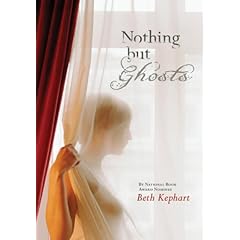
Nothing but Ghosts

Nothing but Ghosts by Beth Kephart

After her mother’s death, Katie lives alone in their big old house with her father who is a bit of a mad genius.  Her summer job is to work in the gardens at the estate of Miss Martine, a recluse who hasn’t been seen by the public in decades.  As the gardeners are told to dig for a new gazebo, Katie realizes that something else may be going on.  They just may be digging for something in particular.  She begins to do research at the local library, hoping to solve the mystery of why Miss Martine disappeared.  Just like her own mother disappeared after her death.  Will solving this mystery help Katie cope with the sorrow and loss of her mother?

There are many ghosts in this book, hovering at the edges of the story, never fully viewed, but felt in every line.  Kephart’s background as a poet shows through her exquisitely written prose.  She manages to create nuance, pain, grief and wonder through her writing, capturing emotions at their most poignant.  Here is one of my favorite lines of the novel, describing the estate they are working at:

Miss Martine’s is quiet as the stones down in the stream, quiet as the robin’s nest that Danny found the other day, which had been lived in, then abandoned.

What imagery, evoking a world unmoving in the river of life, empty, still and immovable.  Yet paired with the fragility and hope of a bird’s nest.  Just this one line offers multiple readings.  The entire novel is like this.

Kephart has also created a mystery that is not a mystery.  The mystery of Miss Maritine is not what this book is about.  It is instead about Katie herself, her personal loss, her mother, her father and how she will find a way to continue beyond her paralysis of grief.  So the mystery is secondary, another ghost in the story, that is useful to chase after but not the real reason we are here.

Katie is a great heroine.  A girl who works as hard as the men, unafraid of dirt, who flies down dark roads on her bike without incident, and who is as brave as anyone could be when surrounded by the past.  She breaks into unique territory as a heroine, a girl who is strong but not masculine, grief-stricken but not tragic.  As a character, she is a testament to the delicacy of Kephart’s writing.

Highly recommended, this book is exceptional.  It is one of the most well-written books of the year, worthy of National Book Award and Printz attention.  Appropriate for 15-18 year olds.

Also reviewed on Charlotte’s Library and The Compulsive Reader.

Goodbye Season

The Goodbye Season by Marian Hale

Released September 2009.

This is Hale’s third historical novel.  Set during the 1918 epidemic, it follows young Mercy.  The member of a sharecropper’s family, she is so poor that her family is forced to send her away to work for someone ten miles from them just to have her fed.  Mercy works hard and soon bonds with the couple she serves and their two hired men.  But after one trip to town, one hired man is dead and Mercy is sent away for her own safety.  She returns home to her family, finding the house empty and her mother and three siblings buried near the house.  Mercy is now alone and penniless.  She finds a job taking care of a woman and her two small children.  But something is strange about the family and Mercy finds herself drawn to the older stepson who may know the answer to the mystery.

An intricate tale of loss, grief, mystery, and love, this book is well plotted and filled with surprises.  Mercy is a heroine who never despairs, works incredibly hard, and makes her own way.  She is gentle, sweet and yet strong and resilient.  At the same time, she is conflicted and unsure often.  She is a character worth spending time with in her complexity.  The 1918 epidemic will fascinate teens who are hearing about swine flu around them.  The devastation of the epidemic is clearly evoked without becoming graphic or overwhelming.

One quibble I have is with the cover art.  Why, why, why is Mercy wearing lipgloss and mascara?!  Love the hair, the face, the look, the setting.  But the makeup just doesn’t work.

An historical novel that is sure to please, this book while about a 17-year-old character would be appropriate for readers as young as 12.

Fire

Fire by Kristin Cashore

Released in October 2009.

What a great book to be surprised by in the mail just when you have a couple of days of vacation.  I savored this read over the course of several days, teasingly reading only a small taste at a time so that it would linger longer.  That is until I reached about 3/4 of the way through and simply could not put it down. 

Fire is the prequel to Cashore’s Graceling.  There is only on character who appears in both books.  Set in the Dells as the kingdom heads towards war, readers will feel the dramatic tension not only of impending battle but also of romance.  Fire is a monster, born so beautiful that she either mesmerizes, creates desire or drives people to anger.  Her hair is the color of flame, not red but all of the other colors of fire entwined together into a sunset of hair.  Fire can speak in other people’s minds and can control their minds.  Her father was truly a monster, abusing his power and his relationship with the king.  Now with both her father and the king dead, Fire lives in a remote and quiet area until a mysterious archer with a foggy mind attempts to assassinate her.

This book is a wonderful fantasy, bringing depth to Cashore’s world in this neighboring kingdom, offering unforgettable characters, deep and fulfilling romance like Katsa and Po, and impossible choices that must be made.  This is a story of power, its abuse, its necessity, its application, and its release.  And it is the story of one amazing heroine, who readers will love despite her beauty, crave because of her spirit, and want to spend ever more time with.

Highly recommended, I expect every library will have a copy of this on their shelves.  It is a worthy successor to Graceling, equally enchanting and perhaps even better written.  Glorious as its heroine, this book is a monster of a book.

The Summer I Turned Pretty

The Summer I Turned Pretty by Jenny Han

Han, author of Shug, a perfection of a tween novel, returns with a beauty of a summer read.  Belly has always summered at the beach house with her brother, her mother, her mother’s best friend, Susannah and her two sons, Conrad and Jeremiah.  She has also always had a crush on Conrad who is years older than she is.  Belly is the lone girl in the group, and the youngest, often left behind while the three boys head out to swim, go to parties, and ignore her in general.  But this summer the boys are reacting differently to Belly.  This is her summer, the summer where she can be the center of things, where they will notice her, and where she can feel she is really part of their group.  But things don’t always work out as planned, there are huge things happening in the family, that may just change things forever.

Han’s writing is so effortless that it is easy to read this book in a single sitting.  She captures the lightness of a summer read, but never loses depth and realism.  Her characterization is complex and often revealing far more than the characters would want.  It is a delicious read in this way.  There is also the sweetness of young love, the drama of a crush, and the sudden realization of how brief summers are.  All of this is done without losing pacing and interwoven into the very activities that make summers so special.

I grew up in a resort area where I was one of the few kids who lived there year round.  As someone who has deeply experienced the seasonal community, this book captures it down to its very core.  Belly’s realization that the family she stays with are wealthier than her own family was also one that struck me at about that age when I realized that the families who summered there were living in their second homes.  Seems obvious, but it really isn’t to children who have grown up with that as the norm.  The fact that Han used that little realization made this read so real.

The perfect beach read of the summer, take this one, dip your toes in the water and enjoy!  Appropriate for ages 13-17.

Confused YA Lit Article

Why should I be surprised, really?  Isn’t it just the norm to have a look at teen literature that is shallow, dismissive and uninformed?  This time it is the Wall Street Journal that has an article like this.  The title alone should have warned me away:  It Was, Like, All Dark and Stormy.

The author of the article, Katie Roiphe, manages to minimize The Hunger Games, Thirteen Reasons Why, Wintergirls, and If I Stay in a single article.  Quite the accomplishment!  All of them are lumped together into proof that the pink and purple world of teen books (when was that?!) has morphed into a frightening rollercoaster ride straight to doom. 

She shows a remarkable confusion about why teens read darker fiction:

Unsettling as it is, there is a certain amount of comfort to be gleaned from the new disaster fiction; it makes its readers feel less alone. What is striking in the response to these books is how many teenagers seem to identify with their characters, even though their experiences (suicide, car crashes, starvation, murder) would seem to place them on the outer fringes of normal life.

The one redeeming feature is that by the end of the article she seems to start to get it.  She calls these books “more uplifting” than light teen books.  And she concludes her article with:

As alarming as these books are, there is in all of this bleakness a wholesome and old-fashioned redemption that involves principles like triumph over adversity and affirmations of integrity.

Too bad she didn’t go back and use that insight to fix the beginning of the article!

The Orange Houses

The Orange Houses by Paul Griffin

Mik has moderate hearing loss, helped by her aging hearing aids, but she prefers to use them to muffle the sounds around her instead by wearing them turned off.  Her greatest joy is creating her art, cityscapes empty of any life.  Jimmi Sixes in a teen from her neighborhood who at age 18 is already a war veteran.  He is also a drug addict and a street poet, seeing the world through his own distinct lens.  Fatima is a refugee newly arrived in New York who can create angels out of the newspapers she sells.  The three teens come together in a unique friendship that transcends their differences.  But the book will not let things be that easy.  Starting before even the first chapter, readers know that Jimmi will be hung.  Each chapter has a countdown to the hanging, keeping it central in readers minds even as they watch these three characters come closer and closer together.

The countdown effect is jarring and riveting at the same time.  When the reader gets too caught up in a chapter, it is there at the next one to remind them what will happen.  It is a cloud, a threat hanging over the book, yet each chapter manages to escape from the cloud.

The characterizations here are very well done.  All three of the main characters are complex individuals, each with their own form of deafness, each with their own problems, cares and worries.  Each tied together in this story, both loosely and very tightly.   Griffin also writes with a poetic sense, especially when writing about Jimmi.  Though written in prose, the sentences have the beat and pace of poetry about them.  He also uses metaphor nicely throughout the novel, placing them in unexpected but effective places.  His writing style perfectly fits the subject matter.

This tense and beautifully written book offers a piercingly violent yet connected and supportive view of urban teens.  Appropriate for ages 14-17.