Review: Camp Tiger by Susan Choi

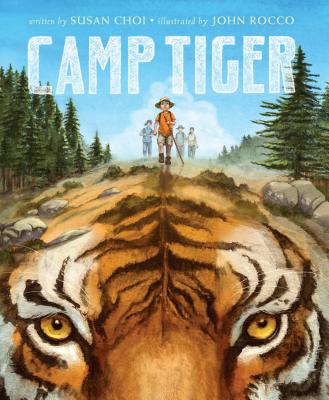
Camp Tiger by Susan Choi

Camp Tiger by Susan Choi, illustrated by John Rocco (9780399173295)

A remarkable picture book about saying goodbye to summer with one final September camping trip that just happens to involve a tiger. A boy heads out on a camping trip with his older brother and his parents. He is dreading the end of summer and going to first grade. They arrive at Mountain Pond, filled with lots of quiet and nature. But as they are setting up the tents, a tiger enters their camp. It’s a real tiger who talks. The tiger asks if they have another tent that he could use as he feels cold now even in his cave. The family sets it up and the boy climbs in along with the tiger. They nestle together for a time. The tiger stays all weekend with the family, going on hikes, heading out in the canoe, even helping with the fishing. But then, the tiger is gone. The family heads back home, but it’s a trip that no one will ever forget.

I am trying not to simply gush in superlatives about this book. Choi captures the tension of growing up, of wishing time would stand still, of hating the new responsibilities of chores, and longing for kindergarten again. She writes of that with a clarity and ease that honors the child’s feelings. Then the tiger enters, realistic and bold, and at first readers try to puzzle out if the talking tiger is real or not. By the end of the book, it doesn’t matter. Just knowing the tiger, experiencing the tiger was enough. It doesn’t have to be answered as they head back to school and home.

Rocco’s illustrations are just as well done as the text. His illustrations make the tiger almost more realistic than the humans in the story. The tiger swims, sits in firelight, snuggles close, and weighs down the canoe. The final night they have together is filled with starlight and quiet that Rocco captures so beautifully.

Surreal and realistic in the best possible mash-up. Appropriate for ages 4-6.

Reviewed from ARC provided by G.P. Putnam’s Sons Books for Young Readers.

Review: The Second Sky by Patrick Guest

The Second Sky by Patrick Guest

The Second Sky by Patrick Guest, illustrated by Jonathan Bentley (9780802855206)

A little penguin wants to learn to fly, but he is more fuzz than feathers and doesn’t have very long wings. So when he tries to flap and fly, he ends up falling onto his bottom. His parents try to explain that he is a penguin and not a goose, but Gilbert won’t give up. He wants to reach the stars and fly above mountains. When Gilbert’s feathers come in, he tries some more to fly, but still can’t leave the ground. Inspired by an albatross flying above him, he heads to a cliff and jumps off. Instead of flying though, he tumbles down the side and into the sea. It is there, in the deep water, the Gilbert realizes that penguins can fly too, just in their own way.

Shortlisted for the 2018 Early Childhood Book of the Year by the Children’s Book Council of Australia, this picture book combines incredible illustrations with a strong story of finding your own way to reach your dreams. Gilbert is a hardy and fearless little fellow, determined to fly. The moment when he is at the top of the cliff is a huge turning point in his story and readers will be holding their breath to see what happens. The result is exceptionally satisfying.

Bentley’s illustrations are lovely. They capture the vistas of the frozen landscape, have the solid black figures of the other penguins. Yet they also soften around Gilbert and his fuzz, showing a rotund little penguin with big dreams. That softness plays nicely against the ice and snow. When Gilbert enters the water and the pages fill with blues and greens, the colors seem even more intense and vivid.

A little penguin with big dreams whose story is worth reading. Appropriate for ages 3-5.

Reviewed from copy provided by Eerdmans Books for Young Readers

Review: The Great Gran Plan by Elli Woollard

The Great Gran Plan by Elli Woollard

The Great Gran Plan by Elli Woollard, illustrated by Steven Lenton (9781250186034)

Reviewed June 18, 2019.

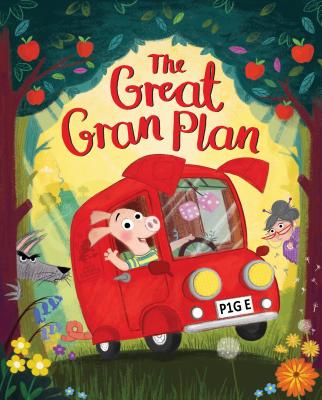
This fractured fairy tale mixes the story of the Three Little Pigs together with Little Red Riding Hood into one wild caper. When the wolf is unable to blow down the house of bricks, the pig finds the wolf’s next plot: to gobble down Little Red Riding Hood’s grandmother! So pig sets off to save her. But first, he must gather supplies. He shops for a superhero cape, but all they have is a shawl. He puts that on and tries to find binoculars, but all they have are red eyeglasses on a chain. He wears those with the shawl and finds a lack of rope, which he substitutes yarn for. So when he heads into the woods to save Granny, he looks rather like a grandmother himself!

Woollard has managed to create a rhyming picture book that avoids being too sing-songy or stilted. Instead she merrily plays with rhymes both internal and at the ends of lines, creating a jaunty feel that reads aloud beautifully. Her fractured tale is filled with plenty of action and readers will realize that pig is starting to look like a grandmother long before he does in the book. That adds to the merriment factor immensely. Add in the anything-but-frail Granny and this book is a lot of fun.

Lenton’s illustrations are bright and bold. Filled with touches like the pig-shaped vehicle that pig drives, the three bears selling items in three different sizes, and even a store called “Rope-unzel’s.” This is a world filled with other stories that are hinted at in the illustrations and are entirely delightful.

A fun fractured fairy tale with one big bad wolf, who is sure to lose. Appropriate for ages 3-6.

Reviewed from e-galley provided by Henry Holt & Co.

Review: Aurora Rising by Amie Kaufman and Jay Kristoff

Aurora Rising by Amie Kaufman and Jay Kristoff

Aurora Rising by Amie Kaufman and Jay Kristoff (9781524720964)

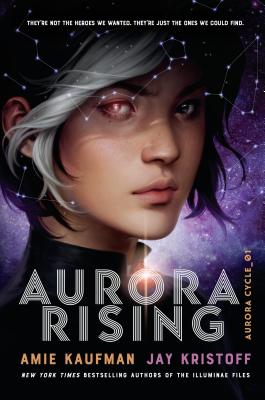
Just as Tyler Jones is about to recruit the perfect squad, having been the top student at Aurora Academy, it all goes sideways. Hoping to burn off some of his nerves, he takes a short ride into The Fold where he discovers a girl, Aurora, who has been asleep for over 200 years. Rescuing her, means he loses his ability to recruit his squad. He is left with the dregs of the academy plus his sister and her best friend who refused to join any other squad. Their first mission is dull and boring, until suddenly they discover that Aurora has stowed away with them and brought the attention of ruthless forces bearing down on them all. As Aurora starts to show her powers, they realize she is not what she seems and that the future of the galaxy may be in their hands.

This novel is pure science fiction joy. The cast is quirky and very funny, the plot is fast moving and cleverly built, and the aliens are believable. As I read it, I kept on thinking of the first time I read a Miles Vorkosigan novel with their mix of humor and space drama that was intoxicating. This novel has that same feel, that same bubbling humor, wildly dramatic space battles, and enough character development to make it all worthwhile. Kaufman and Kristoff have created a great space opera for teens.

The wit and humor of the book is particularly noteworthy. A large part of that success is in the crew and the way they all interact together. There is the warrior with a huge heart and a grief-stricken past. The diplomat who charms but also cuts with sarcasm. The pilot who is the best around but who can’t keep her eyes off the captain. The scientist who loves firing guns a bit too much. The technician whose big brain can’t match the size of his attitude. Put them all together with a captain who loves to lead and a girl who is still coming into her own, and you have an incredible story.

One of the best science fiction novels for teens, you will not be able to put it down. Appropriate for ages 14-17.

Reviewed from e-galley provided by Knopf Books for Young Readers.

Review: It Feels Good to Be Yourself: A Book about Gender Identity by Theresa Thorn

It Feels Good to Be Yourself A Book about Gender Identity by Theresa Thorn

It Feels Good to Be Yourself: A Book about Gender Identity by Theresa Thorn, illustrated by Noah Grigni (9781250302953)

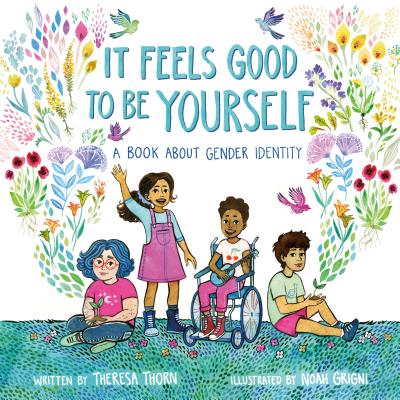
With a diverse cast of children, this picture book deftly explains gender identity. Ruthie, the first character we meet, is a transgender girl. Identified as a boy at birth, she explained to everyone that she was actually a girl. Her little brother is a cisgender boy, and the book explains that term as well. Transgender and cisgender are explained frankly with neither given extra weight in the text. The term non-binary is then explained with two of its variants shown by characters in the text. There is Alex, who is both a boy and a girl, and JJ, who is neither boy nor girl. The book goes on to explain that even with all of these terms, some people don’t feel they fit in any of them, and that feeling that way is just fine.

The emphasis here is on children being allowed to be themselves, no matter what that means. Feelings about gender are real and valid. Families shown in the book are accepting and supportive of their children, no matter what gender they may identify as. The tone of the text is frank and friendly, explaining the terms and offering immense support for all children. It is positive through and through.

The art is great with skies filled with watercolor washes of blue. The cast is diverse in many ways including race, faith, sexuality, and a person who uses a wheelchair. The art is filled with color, evoking the same positive feel as the text.

A great book to use to explore children’s own gender identity or introduce gender identity concepts to young children. Appropriate for ages 4-7.

Reviewed from copy provided by Henry Holt & Co.

Review: Great Job, Mom! by Holman Wang

Great Job, Mom! by Holman Wang

Great Job, Mom! by Holman Wang (9780735264083)

The co-creator of Cozy Classics returns with a felted family. The three-person family has a mom who almost a hero for her children. As the story progresses, she is given different jobs in the family. She is a carpenter when she repairs things. She’s a general when the troops get marched to bed. She is a doctor when the children are sick. She’s an actor when they pretend together. This charmer of a picture book offers a glimpse of the many roles that mothers play in families, celebrating their myriad skills.

Wang’s text is simple and straight forward. Done in rhymes, they have a jaunty rhythm that makes the book great to share aloud. But the real winner here are the illustrations that life the book to new heights. At the end of the book, the process for creating the felted characters and their scenes is shown, not taking away any of the immense skill that Wang has as an illustrator. The small touches and the lifelike characters are delightful, making each image worth looking at closely.

A celebration of mothers, this picture book is a joy. Appropriate for ages 2-4.

Reviewed from library copy.

Review: Lubna and Pebble by Wendy Meddour

Lubna and Pebble by Wendy Meddour

Lubna and Pebble by Wendy Meddour, illustrated by Daniel Egneus (9780525554165)

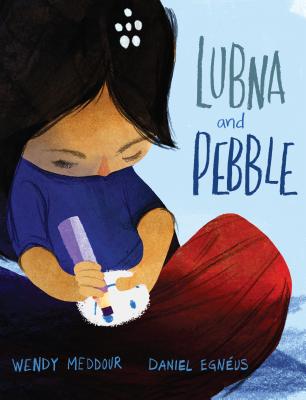
Lubna and her father have come to a refugee camp. As they arrived, Lubna found a smooth pebble. Pebble becomes her closest friend as she and her father make a new home in the camp. Pebble listens to all of Lubna’s stories of the war and her family. Pebble’s drawn on eyes and smile are friendly even in the cold nights. Lubna’s father finds her a box and towel for Pebble, so Pebble is warm at night too. When Amir arrives at the camp, he won’t speak to anyone. But when Lubna shows him Pebble, he introduces himself. Soon Lubna and Amir are close friends, though Lubna assures Pebble that they are still best friends. Lubna’s father finds them a new home in a different country, and Amir is very sad. Perhaps Pebble can help him out.

Meddour gently depicts a very personal side of the refugee crisis. Showing a more universal experience of refugees fleeing a war-torn country, the book really allows readers to deeply feel the loneliness and fright of a young child caught in this situation. At the same time, the book doesn’t go into the personal losses in detail, they are alluded to rather than fully realized, which is ideal for young children. The use of a pebble as a friend is also incredibly moving, showing the poverty and the isolation of a child in a very concrete way.

The in the picture book is filled with deep colors and also depicts light shining upon Lubna as she makes her way towards a new life. Throughout the book there is a sense of hope and that is also conveyed in the images in the book, with open skies, deep imaginary worlds, and even the smile of Pebble.

An accessible and heartfelt look at the refugee crisis. Appropriate for ages 4-6.

Reviewed from library copy.

Review: How It Feels to Float by Helena Fox

How It Feels to Float by Helena Fox

How It Feels to Float by Helena Fox (9780525554295)

Biz can float through her life, realizing that she is part of a larger universe and leaving her current troubles behind. But every time, she is drawn back to her body and back to her life. She does have great people in her life, including her mother and the twins. Plus her best friend Grace. She also has her father, who died when Biz was young, but stays with her, reminding her of his love for her. But when something happens on the beach, things start to spiral out of control. Grace loses her boyfriend over it, and they both lose their larger friend group. When Grace reacts with fury, her family moves her away. Biz’s father disappears and she stops being able to go to school, almost unable to leave her bed. When she eventually does get help via therapy, Biz doesn’t tell the entire truth, figuring out how to build bits of her life back until they tumble over once again.

This is a remarkable debut novel. Set in Australia, the book explores mental illness with a tenderness that is haunting. The beauty of the world Biz’s mind creates for her is a mix of tantalizing promises and real dangers. Even as readers know that Biz is unwell, they too will be caught up in her visions, understand her desire to keep floating, to enter the sea, to find connections. The setting of Australia is just as lovingly depicted with details of the landscape, the stunning coastline and a trip into the heart of the continent.

In Biz, readers will find a very intelligent teen who is struggling as her mental illness continues to impact her life in profound ways. Biz is warm and funny, a person first and her illness second. Her sarcasm draws people to her. After she loses most of the support structure in her life, she meets new people who love her, accepting her as she is, though she continues to search for what she has lost.

Aching and heart wrenching, this teen novel is an honest and profound look at mental illness and being human. Appropriate for ages 13-18.

Reviewed from ARC provided by Dial Books.

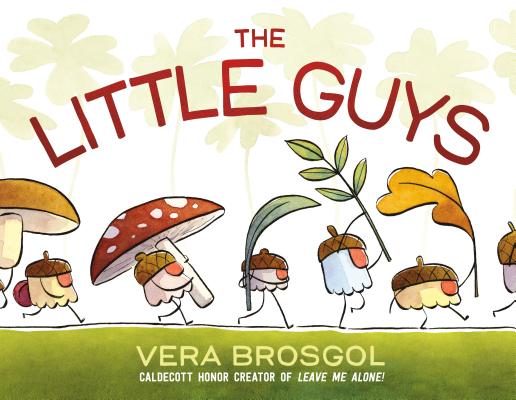
Review: The Little Guys by Vera Brosgol

The Little Guys by Vera Brosgol

The Little Guys by Vera Brosgol (9781626724426)

The Little Guys are very small but when they work together they can do almost anything! Using leaves to float, they cross deep water. In the big forest, they hold hands to stay together and keep from being afraid. They find berries and form a stack to reach them. But as they continue their search for more and more food, they start using their combined strength in a way that upsets the rest of the forest. Chipmunks go flying, owls get forced out of their nests, and they even beat up a bear! Soon they have all of the food in the forest! But have they gone too far?

Brosgol follows her incredible Leave Me Alone! with this clever look at the impact of collective action and what happens when even the smallest of us upset the balance of nature and society. The text is simple and straightforward, told in the voice of the Little Guys as they head out scavenging. They are full of confidence as they make the trek to find food and it’s a stirring picture of the power of community until it goes awry in such a spectacular way.

Brosgol’s Little Guys are ever so adorable with their acorn caps and stick-thin limbs. Their orange bulbous noses also add to their appeal. With almost no facial expressions, it is impressive how she gives them emotions with body language. The dwarfing of their size in the forest and beside the other animals is also effectively portrayed.

A delight of a picture book that is an unusual look at sharing with your community. Appropriate for ages 3-5.

Reviewed from copy provided by Roaring Brook Press.