This Week’s Tweets

Here are the tweets I shared this week:

CHILDREN’S LIT

After 150 Years, ‘Little Women’ Still Resonates |

Picture Books about Mighty Girls Who Love Math – https://t.co/YUMAD6VZs9

LIBRARIES

Can We Talk? Librarians Lead New Push for Civics Education, Focusing on Discourse

The last storm-damaged public library branch in New Orleans has finally reopened, more than a decade after it was flooded by Hurricane Katrina.

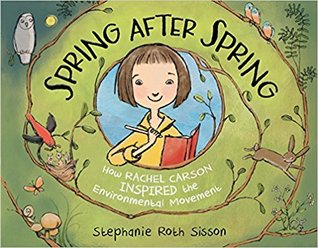
Review: Spring After Spring by Stephanie Roth Sisson

Spring After Spring by Stephanie Roth Sisson

Spring After Spring: How Rachel Carson Inspired the Environmental Movement by Stephanie Roth Sisson (9781626728196)

This nonfiction picture book begins in much the same way that Rachel’s childhood days started: birdsong, insects, forest exploration and insects. Rachel loved to look at the world from the big view and then to kneel down and look very closely at nature. She loved spring days best, returning home after dark to supper and her big family. As the seasons turned, Rachel watched and documented them all, growing bigger herself. She headed off to college to become a writer, until she discovered the microscopic world which led her to science. She worked as a scientist, diving under the sea and then writing books about it. Soon though, she realized that things were changing and species were disappearing. This led to her most important book, Silent Spring, which cautioned about the impact of chemicals on the ecosystem.

Sisson encapsulates Carson’s life in a very approachable way. The first part of the book focuses on Carson’s childhood love of nature and being outside. The text focuses on what Carson sees and experiences. As the book moves to her adult life, the text is about bravery and taking on the unknown. It then moves to her realization of what is happening in nature and her tenacity in figuring out what is going on. Throughout, this is the picture of a girl and woman who loves nature, thinks deeply and writes beautifully enough to change the opinions of a nation.

The illustrations are simple and lovely. They show all of the sounds of nature when Carson is a young child. Those same rich experiences are shown with the ghostly figures of animals that have disappeared due to chemicals. There is no mistaking the warmth of Carson’s home and family and then the strength that it took for her to stand strong in the face of people’s doubts.

A great picture book biography about an amazing woman, this is a timely read. Appropriate for ages 4-6.

Reviewed from copy provided by Roaring Brook Press.


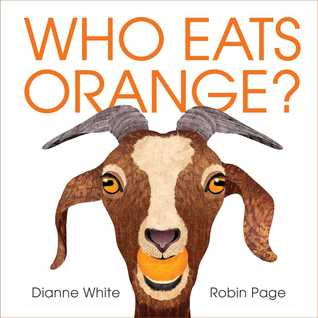
Review: Who Eats Orange? by Dianne White

Who Eats Orange by Dianne White

Who Eats Orange? by Dianne White, illustrated by Robin Page (9781534404083)

Asking which animals eat what colors allows this book to explore both animals and colors at the same time. Starting with the title question, the book looks at bunnies eating carrots, chickens pecking cantaloupe, goats biting oranges, and pigs munching pumpkins. But what about a gorilla? No, gorillas eat green! And the book merrily moves on to that color and then on to other food colors as well. The animals are varied and interesting including turkeys, foxes, quetzals, marmots, reindeer and many more. The book ends asking you about the colors you eat and revealing the rainbow of food that humans enjoy.

White has created an energetic picture book that has a strong structure that young children will find enticing. She has selected the featured animals cleverly, using both familiar animals and exotic animals side-by-side. The book’s structure includes asking about a different animal to move to the new color of food, leading very nicely into the final part of the book as well.

The digital illustrations have a great physicality about them, feeling more like paper collage than digital on the page. Each of the animals has a great light in their eyes, looking back at the reader usually with a playful and inviting glint while not being anthropomorphized at all.

A great book for the youngest set that introduces colors and animals and allows for some guessing games as well. Appropriate for ages 2-4.

Reviewed from copy provided by Beach Lane Books.

Review: Stumpkin by Lucy Ruth Cummins

Stumpkin by Lucy Ruth Cummins

Stumpkin by Lucy Ruth Cummins (9781534413627)

Stumpkin is one of the pumpkins for sale outside a little shop in the big city. He is a nearly perfect pumpkin. He is bright orange, round and large. Unfortunately though, Stumpkin is missing his stem and only has a little stump instead. As Halloween grows closer, one pumpkin after another is selected to be turned into a jack-o-lantern in the neighborhood. They are placed up in apartment windows and look down at the little shop below. Even the gourd is selected before Stumpkin, leaving him all alone. But there is a happy Halloween ending to come!

Cummins’ story written in a simple style. She shows the difference between Stumpkin and the others, explaining why he is left behind. Children listening to the story will protest that they would pick Stumpkin first since he is so lovely. The feeling of being different and left out builds as the story moves ahead and Stumpkin is left alone and sad. The simple art adds to the appeal of the book with its bright oranges, black cat and jack-o-lantern grins. It is impressive how much emotion she can convey with a few dots and lines on a round pumpkin.

Perfect pumpkin pick for those looking for non-scary Halloween and autumn tales. Appropriate for ages 2-4.

Reviewed from copy provided by Atheneum.

Review: Speak the Graphic Novel by Laurie Halse Anderson

Speak The Graphic Novel by Laurie Halse Anderson

Speak: The Graphic Novel by Laurie Halse Anderson, artwork by Emily Carroll (9780374300289)

The original novel Speak came out almost twenty years ago and is such a masterpiece of teen writing that I hesitated to read it in graphic novel form. Somehow though, the graphic novel captures the novel with a darkness that is beautiful and troubling at the same time. It has the same tone, the same damage on the page. Sadly it is just as relevant today during the #metoo movement as it was two decades ago.

Removing the bulk of Anderson’s skilled text had to be a gargantuan task in itself. The result is a pared down book that loses nothing of the powerful story. The imagery of trees plays throughout the book as does the use of dark and light on the page. It is a haunting and haunted book of a girl unable to speak about what happened to her. This new version will make the story more accessible for those teens who enjoy a great graphic novel rather than a great text novel. Either way, you can’t go wrong.

It’s a groundbreaking novel made into one of the most powerful graphic novels I have read. Get your hands on this one, get it into the hands of teens. Appropriate for ages 13+.

Reviewed from copy provided by Farrar Straus Giroux. 


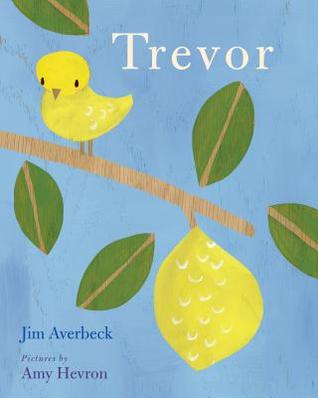
Review: Trevor by Jim Averbeck

Trevor by Jim Averbeck

Trevor by Jim Averbeck, illustrated by Amy Hevron (9781250148285)

Trevor is a very lonely canary who knows that he can escape his cage at any time, but stays put for the seeds. He has one favorite kind, sunflower seeds, that he saves for when he is feeling loneliest. When Trevor sees a lemon outside of his window, he tries to get it to sing with him. He even gives it his last striped sunflower seed, but it won’t eat. The lemon doesn’t reply to Trevor at all and doesn’t give him any gifts in return. Still, Trevor builds a nest in the tree for himself and the lemon. Meanwhile, the seed has fallen to the ground below. Eventually, a storm comes and Trevor must try to save the lemon. When he reaches the ground, he discovers the sunflower has sprouted and grown, scattering seeds across the ground. When a group of hungry birds arrives, Trevor quickly realizes what real friendship feels like.

Averbeck keeps the text of this picture book very simple, making it just right for younger listeners and good to share aloud. The emotions that Trevor feels in the book take center stage, from frustration at the lemon to eventual forgiveness to acceptance about their differences. Trevor is a great mix of brave, inquisitive and friendly as he makes his way into the larger world.

Hevron’s illustrations are painted onto wood. She cleverly allows the wood to show through to create tree branches and leaf spines. Against the pale blue background, the leaves, lemon and Trevor himself pop. One can see the wood grain throughout the book, both covered in color and plain. It makes for a very organic and natural feel.

A lovely quiet picture book about new friends and what to do when life gives you lemons. Appropriate for ages 3-5.

Reviewed from copy provided by Roaring Brook Press.

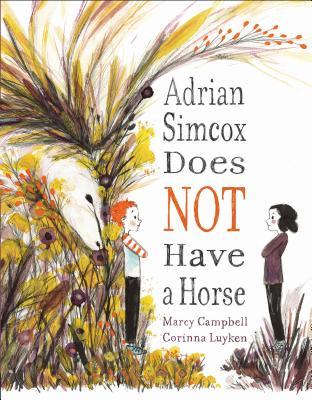
Review: Adrian Simcox Does Not Have a Horse by Marcy Campbell

Adrian Simcox Does Not Have a Horse by Marcy Campbell

Adrian Simcox Does Not Have a Horse by Marcy Campbell, illustrated by Corinna Luyken (9780735230378)

Adrian Simcox is always talking at school about the horse that he owns. But Chloe knows he is lying, since he lives with his grandfather in a small house in town. There is no room there for a horse. She also knows that Adrian’s family isn’t wealthy and a horse costs a lot of money to keep. So Chloe complains to her friends, her mother and eventually to the entire class about Adrian lying. When Chloe’s mother takes her to Adrian’s house, Chloe knows she is going to be proven right. But she doesn’t bargain for what she is actually going to find there.

This beautifully told story will have readers siding with Chloe from the beginning, since her reasons for not believing Adrian are clear and logical. Still, as the story unfolds readers will start to understand what Adrian is doing long before Chloe does and will begin to feel for him and relate to Adrian. The book does this without becoming didactic at all, instead naturally leading children to an empathy before Chloe gets there. The prose is strong and the pacing is just right in this quiet book.

The illustrations by Luyken are done with lots of white space around Chloe and then riotous plants and gardens around Adrian. Even on the playground, there is a sense that Adrian can create his own world out of imagination, filling the white space in a way that the others can’t. It’s an ideal analogy for the story line itself.

A great book to discuss lying and imagination, friendship and support. Appropriate for ages 4-6.

Reviewed from ARC provided by Dial Books.

Review: The Day You Begin by Jacqueline Woodson

The Day You Begin by Jacqueline Woodson

The Day You Begin by Jacqueline Woodson, illustrated by Rafael Lopez (9780399246531)

An award-winning author is joined by an award-winning illustrator for this picture book that celebrates diversity and acceptance. There are many ways for children to feel different from others, particularly when starting a new school. Perhaps it’s their skin, their hair, their clothes or the language they speak. There are school activities that will show them they live differently than other children, like not traveling during summer vacation. Lunches brought from home can be too different for other children to accept. Children can feel excluded from games on the playground too. So what is the answer? Finding your own voice, your own courage and telling your stories to the others without apology.

As always, Woodson prose impresses with its accessibility and depth. She manages to keep to a picture book length but speak about differences and resilience in a way that encourages children to be proud of where they come from and their life experience. Beautifully, children of all backgrounds will find themselves on these pages too, because everyone in different in some way. Woodson manages to be inclusive without minimizing the impact of racial differences, which is quite a feat!

The illustrations by Lopez are exceptional. They glow on the page, showing children of diverse backgrounds illuminated by the light of the world. The illustrations move from realism to more imaginative and playful moments as children grow into self-acceptance right in front of the reader.

A marvelous pick to speak about diversity and acceptance with children. Appropriate for ages 4-7.

Reviewed from ARC provided by Nancy Paulsen Books.

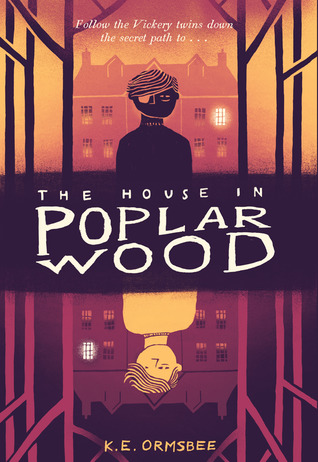
Review: The House in Poplar Wood by K.E. Ormsbee

The House in Poplar Wood by K. E. Ormsbee

The House in Poplar Wood by K. E. Ormsbee (9781452149868)

Released August 28, 2018

After their parents made an Agreement with Death, the Vickery twins had to live with it. It meant that Felix had to serve Death alongside his father, witnessing healing and dying every day. Felix was not allowed to go to school and could not ever see his mother. His father could not see his brother Lee or his mother ever again. Lee in turn lived with his mother on the other side of the house serving Memory. He took bottled memories, labeled them and placed them on shelves. Both brothers had errands in Poplar Wood, Lee to dispense of the memories and Felix to gather herbs. Their life was terrible but steady until Gretchen entered it, determined to figure out how Essie was killed. From a family of Summoners, Gretchen is second born and unable to conduct the Rites. Still, she insists on untangling what is happening in their small town as Death, Memory and Passion let their rivalry get out of hand.

Just writing that summary demonstrates how unique this book is, yet it also plays with existing myths about shades and summoning. The book makes Death, Memory and Passion into figures that are non-human but still have human desires like revenge and dominance. The book is constructed so that the reader learns more about this fictional world alongside the characters. Each brother knows separate elements and Gretchen brings her own understanding of the other part of the relationships with Shades to the book. The organic way that it plays out via the story itself makes it immensely satisfying.

The characters are definitely worth noting as well. Gretchen is the most compelling character. She is wonderfully curious, prickly and determined. There is no way to tell her no that she will accept and her tenacity drives the story forward. The two brothers are unique from one another as well, one who goes to public school and the other who doesn’t. Their lives are as different as can be, each raised by not only one parent but also influenced deeply by the Shade too. These factors play out in their personalities in a way that is subtle but also clear.

A great fantasy Gothic novel with a mystery at its heart. Appropriate for ages 9-12.

Reviewed from ARC provided by Chronicle Books.