The Moon’s Almost Here by Patricia MacLachlan

The Moons Almost Here by Patricia MacLachlan

The Moon’s Almost Here by Patricia MacLachlan, illustrated by Tomie dePaola (InfoSoup)

A collaboration between a Newbery medalist and Caldecott Honor and Newbery Honor winner, this picture book is a dreamy bedtime read. As two people get ready for the moon to arrive, the animals around them are also preparing for bed. A hen gathers her chicks close and safe in their pen. The ducks head to the shore. Horses and cows head inside. Fireflies blink in the meadow. The dog and cat fall asleep. Then the moon has arrived, big and bright in the sky, just as the child falls asleep in the adult’s arms.

MacLachlan’s text is a poem that leads readers around the farm, from one animal to another as they prepare for bed. The animals are not anthropomorphic at all, but nicely realistic. She adds in touches of butterflies as well as the fireflies that echo the stars above. The entire effect is of tranquility and a slowing down as the evening arrives. It feels entirely natural and organic as it gets sleepier.

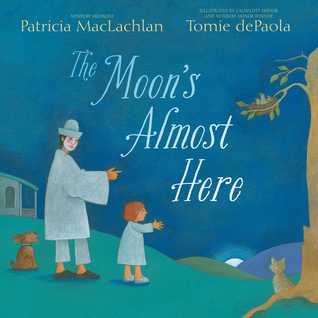
The illustrations by dePaola are filled with teals and blues, but also lit with moonlight. The adult character wears white with a white clown face as well that evokes Pierrot. It creates a surreal and dreamlike effect in the picture book, but is not frightening at all. The deep colors add to the nighttime quiet and sleepiness.

A superb bedtime picture book that works because of the virtuoso blend of poetry and illustration. Appropriate for ages 2-4.

Reviewed from copy received from Margaret K. McElderry Books.
The Storm by Akiko Miyakoshi

The Storm by Akiko Miyakoshi

The Storm by Akiko Miyakoshi (InfoSoup)

A little boy heads home after school, excited about a trip to the beach the next day with his family. His teacher did warn that a storm was coming and as the evening goes by, the sky gets darker. His parents prepare for a storm and reassure him that even if they can’t go to the beach the next day, they will go another weekend. Soon rain starts to fall and then the wind picks up and blows hard. When it gets too loud, the boy jumps into his bed and pulls his covers over his head. Soon he is dreaming about being on a ship with big propellers that help to drive the storm away. Finally the storm moves off and his ship can sail higher into the sky. When the boy wakes up the next morning, he discovers a lovely day. Just right for a visit to the beach!

Miyakoshi’s picture book is filled with tension. Not only of the storm itself but of the waiting for the storm to arrive and then the concern about how it will impact their plans for the next day. It is a tension that children will understand, whether about weather and storms or about big plans being disrupted. It is also a picture book that speaks to the power of nature and the way that children can have plans with little control over them.

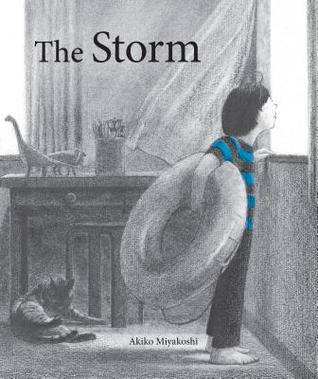
The illustrations in the book are black and white with small touches of color like the blue sky after the storm. The charcoal style has a lovely texture throughout. Light and dark play on the page with one storm page filled with rain showing the falling water as bright zings of light in the darkness. There is both a feeling of drama and also one of safety throughout, particularly during dinner and at bedtime.

This stormy picture book is one that children will relate to on a variety of levels. Appropriate for ages 3-6.

Reviewed from e-galley received from Kids Can Press and Edelweiss.

This Week’s Tweets, Pins & Tumbls

Here are the links I shared on my Twitter, Pinterest, and Tumblr accounts this week that I think are cool:

 :

CHILDREN’S BOOKS

13 Children’s Books That Break Racial Stereotypes

2016 Caldecott Medal Acceptance by Sophie Blackall — The Horn Book Gorgeous speech.

2016 Newbery Acceptance by Matt de la Peña — The Horn Book – A must-read speech for everyone.

The Audacious Choice of Sophie Blackall — The Horn Book

Bringing diversity and brown faces to children’s books

GeekDad Charts a Course With Hope Larson and ‘Compass South’ – GeekDad

Jerry Pinkney and the Power of Story: Profile of 2016 Wilder & CSK–Virginia Hamiliton Award Winner – The Horn Book

On the Importance of Creepy Kids’ Books  – https://t.co/TalwbiLOQC 

One Mom’s Fond Farewell to the Beloved Elephant & Piggie Series

Raquel D’Apice’s Open Letter To The Female Hat-Wearing Dog in “Go, Dog. Go!”

Silent and Strong: 14 Books for Introverted Kids and Teens | Brightly

‘Swallows and Amazons’ Forever: Why a now-obscure children’s novel is great summer reading

Tween Pride Reads – ALSC Blog

Which is why there ALWAYS have to be books in the playroom, between the toys ;-):

LIBRARIES

“An Evening to Paint” at North Carolina Wesleyan College’s Pearsall Library:

Libraries that Listen | American Libraries Magazine

Officials break ground on $115 million Enoch Pratt renovation

TEEN READS

Out of the Box – Transgender lives — The Horn Book

RT : From The Hub: Booklist: YA Alternate History

A Safe and Sacred Space – Guest Post by Benjamin Alire Saenz –

Finding Wild by Megan Wagner Lloyd

Finding Wild by Megan Wagner Lloyd

Finding Wild by Megan Wagner Lloyd, illustrated by Abigail Halpin (InfoSoup)

Two children set off to discover the wild, leaving their urban world and heading into a nearby park filled with trees, ferns and birds. There are moments of wonder and some shivers too. Wild smells different from the city too and demands that you breathe it in deeply. Wild can be dangerous, prickly and poisonous, but it can also be filled with softness and soothing. It can be hot and cold. It is filled with secrets to explore and even discoveries to eat and savor. Even in large cities where there doesn’t seem to be room for wild to exist, you can see it if you follow the subtle clues.

Lloyd’s writing is a poem about wilderness and the importance of it in our lives. She doesn’t lecture about it in any way, allowing nature itself to invite readers in more deeply. She allows nature to sing on the page, showing its many sides. She does not shy away from showing that nature can be slightly frightening but balances that nicely with more positive sides of being outside and enjoying the outdoors.

Halpin’s illustrations are done in watercolor and colored pencil. She creates a wild that is filled with huge trees, large leaves, flowers and shadow. It is also full of water, places to swim and berries too. Her art covers the entire page at times, filling it to the brim with nature. Other times, the wild is surrounded by white space on the page, allowing young readers to both feel immersed in green wonder but also able to glimpse it from a distance at times too.

A lovely encouragement to find your own wild in your neighborhood, this picture book should be wildly successful. Appropriate for ages 3-6.

Reviewed from e-galley received from Penguin Random House and Edelweiss.


Painting Pepette by Linda Ravin Lodding

Painting Pepette by Linda Ravin Lodding

Painting Pepette by Linda Ravin Lodding, illustrated by Claire Fletcher (InfoSoup)

Josette lives in 1920s Paris with her toy rabbit, Pepette. At home, their great room’s walls were covered with paintings of the family, including Josette and her sisters as well as their dog. But there was no picture of Pepette! So the two of them set off to Montmartre where the best artists painted. Josette finds one famous painter after another to paint her toy bunny, but none of the paintings is quite right. Picasso gives the bunny too many ears and noses. Salvador Dali makes him too droopy. Chagall has Pepette flying in the clouds. Matisse painted him in the wrong colors. Finally, Josette heads home, realizing that it is up to her to create an appropriate portrait of her beloved rabbit.

Lodding’s glimpse of the wonder of Paris and the incredible artists at work all at once at Montmartre is very enticing. It will help for the adults reading the book to guide children through the artists afterwards, allowing them to understand who the artists were and how their signature styles are reflected in their portraits of Pepette. It is a lovely introduction to those painters for young children and may be ideal before a visit to a museum. Josette herself is a wonderful young character as well, showing real determination to get the right portrait of her toy and yet also showing respect to the artists and their unique vision.

The watercolor illustrations by Fletcher are a huge success. They have their own artistic quality and also capture the styles of the other artists as well. The watercolors have a vintage style that works particularly well in showing 1920s Paris, allowing the light to play across the colors of the city where Josette stands out with her red bow, polka dot dress and striped stockings.

A lovely historical picture book that invites readers to explore Paris and art. Appropriate for ages 4-6.

Reviewed from copy received from Little Bee Books.

Cloth Lullaby by Amy Novesky

Cloth Lullaby by Amy Novesky

Cloth Lullaby: The Woven Life of Louise Bourgeois by Amy Novesky, illustrated by Isabelle Arsenault (InfoSoup)

Louise grew up alongside a river that wove through her life. Her mother restored tapestries and from age 12, Louise helped too by drawing in the missing bottom edges of tapestries. At her mother’s side, Louise learned about weaving and patterns. Louise eventually went to school in Paris and studied mathematics and cosmography at university. While at college, her mother died and Louise turned to art to express her feelings. She created enormous spiders out of metal and stone, naming them “Maman.” She took the fabrics of her life and cut them apart, working to put them back together in new ways. It was a tribute to her mother and her childhood expressed in art.

Novesky’s picture book biography keeps the magic of Bourgeois’ childhood intact. The book ends with an image of the artist and one of her spiders as well as a quote that speaks to her never having lost touch with the magic of her childhood. That quality weaves throughout the book where both the river and the restoration work create moments of inspiration and amazement. There is such beauty in the quiet work of restoration as well as the knitting activities of spiders. Readers will immediately understand the connection of wool and web in her art.

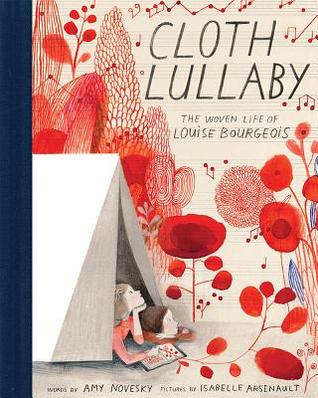
Arsenault’s illustrations are alight with that same magic and inspiration. In one image of Louise’s mother, there is a certain spider-ness there, subtle but also clear as she works with her black wool. All of the illustrations in the book celebrate pattern and weaving. There is a limited palette of reds, blues and grays that evoke the richness of tapestries and the excitement of art.

A top pick for picture book biographies, this book pays homage to a female artist that many may not know. Appropriate for ages 5-8.

Reviewed from library copy.

Ms. Bixby’s Last Day by John David Anderson

Ms. Bixby's Last Day by John David Anderson

Ms. Bixby’s Last Day by John David Anderson (InfoSoup)

Topher, Brand and Steve know that they have one of the best teachers in Ms. Bixby. She is the sort of teacher that everyone hopes to have. But then she announces that she is sick and will have to leave without finishing the school year. She tells the class when her last day is, however her health worsens and she doesn’t make it to her planned final day. That’s when the three friends decide that they must follow through and give Ms. Bixby the final day she has dreamed of. Even if it means skipping school, taking the city bus, buying a very expensive dessert, finding a perfect book, and even illegally buying some wine. Ms. Bixby would do that and more for them, so they must do this for her. As the boys tell their stories of what Ms. Bixby did for each of them, readers too will see that this is the sort of teacher you break all the rules for.

Wow. This book is incredible. It is one that teachers will adore, showing how one teacher can impact so many of her students on a personal level. It is one children too will love, showing their own dedication, bravery and heart. It is a book that skirts along the line of heartbreak and hope, allowing readers to soar at times, fall down and smash like a backpack filled with cheesecake, and then soar once more. It’s a wonderful roller coaster of a book filled with so much emotion and connection.

The three lead characters are all wonderfully depicted. Their voices are unique from one another and stay separate and distinguished. Though they are friends, they have secrets from one another, ones that Ms. Bixby is part of and they all have connections to her that the others don’t know about. It’s a look at the harshness of childhood, the ways that adults can help and the importance of one teacher.

A powerful read that calls on all of us to be heroes in each other’s lives. Appropriate for ages 8-12.

Reviewed from copy received from Walden Pond Press.


The Artist and Me by Shane Peacock

The Artist and Me by Shane Peacock

The Artist and Me by Shane Peacock, illustrated by Sophie Casson (InfoSoup)

Told from the point of view of a child in Arles, France, this book looks at how unique people in the world have their own way of viewing things. The boy joins with the adults in the town to mock and bully painter Vincent van Gogh. Van Gogh was seen as a wild man, living in poverty who wasted his days creating art that didn’t sell and that went against everything that people knew about art. Yet he just kept on painting. The boy eventually finds himself in a field with the artist, suddenly seeing the world as something amazing and vibrantly colored rather than the same place it has always been. The artist offered the boy his painting but the boy refused, only to see it years later on the wall of a museum.

Peacock has created a picture book about bullying but also about so much more. It is about the way that society reacts to a genius who refuses to follow their rules, who walks his own path through the fields, painting as he goes. The child is clearly following what the adults around him are saying. He is also intrigued in many ways by the strange artist and the way he lives. Plus he is drawn in by the paintings that he can glimpse. It’s a lovely balance of rejection and attraction that makes the book surprising and effective.

The art by Casson uses vibrant colors to capture the French countryside. The golden of the wheat fields, the purple of the sky, all tied together with reds and blues and add depth and even more color. The result is a different style than Van Gogh, but a nod to his use of color and sense of freedom.

A book that works on many levels, this picture book looks at bullying, genius, art and the power of connection. Appropriate for ages 4-6.

Reviewed from library copy.


The Long Dog by Eric Seltzer

The Long Dog by Eric Seltzer

The Long Dog by Eric Seltzer (InfoSoup)

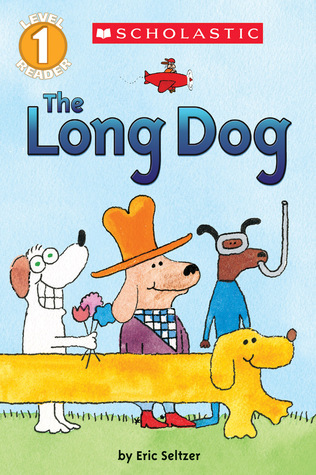
Dog after dog appear in this easy reader that is reminiscent of the classic Go, Dog. Go! The very simple text shows opposites. There are hot dogs and cold dogs. Wet dogs and dry dogs. Dirty dogs and clean dogs. Each shown with a simple illustration that will help new readers decode the words. Throughout the book, a particularly long dog appears again and again, adding a touch of whimsy and humor. This is a simple yet very engaging beginning reader with tons of appeal.

Seltzer uses very simple sentences throughout his book, appealing directly to new readers. The use of opposites also helps with new readers figuring out the words as well as the repeating simple sentence structure. The illustrations have a winning cartoon style that is simple as well. Each sentence is clearly matching to a corresponding image aiding in new reader skills. The added touches of humor throughout make for a book that is fun to read as well.

A nice pick for beginning reader collections, this is simple, easy and full of humor. Appropriate for ages 4-6.

Reviewed from library copy.