Review: I Am Henry Finch by Alexis Deacon

I Am Henry Finch by Alexis Deacon

I Am Henry Finch by Alexis Deacon, illustrated by Viviane Schwarz (InfoSoup)

The finches live all together in a flock making a huge racket and not thinking at all. They all say good morning, good afternoon, good evening and good night each day, starting over again each day. The only thing that changed their routine was when the Beast came and ate one or more of them. After that, the flock would shout about the Beast and fly higher in the tree. But then something different happened. Henry woke up and heard a thought in his head. He thought and thought, and realized that someone had to stop the Beast and that he could be a hero! But when he tried to best the Beast, it did not go as planned. Can thinking some more save Henry?

I am a fan of strange picture books and this is certainly one of them. It has a philosophical feel to it, changing from what is at first a look at the cacophony of the modern world and the lack of thinking happening in mobs to then the power of thought, the importance of ideas, and the way that thinking alone can change the world. This is a book that is not pat. It will instead inspire discussion. If you are looking for a picture book to inspire a metaphysical discussion with children, this is it. Clever and smart, it allows children themselves to start to think too.

Using thumbprints as the finches is a fascinating choice. Fingerprints are unique but these birds are anything but. The book then moves to darkness where Henry is inside the Beast. The pages black with white lines, all deep and dark and filled solely with silence and thought. It’s a powerful visual transition.

Not for everyone, this picture book will delight some and confuse others. I hope it delights you like it did me! Appropriate for ages 5-8.

Reviewed from library copy.
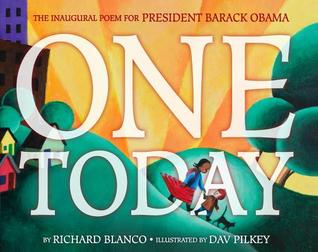
Review: One Today by Richard Blanco

One Today by Richard Blanco

One Today by Richard Blanco, illustrated by Dav Pilkey (InfoSoup)

This picture book version of the inaugural poem for President Obama’s second term is a beautiful example of how poetry can reach young and old alike. Blanco’s poem stretches across the country, speaking to the diversity of our country, the universal things that bind us together, and the aspirations that we all hold dear. Faith, earth, sky, moon and more form a foundation for us all to relate to. This poem uses imagery that children will understand but also makes it bigger and larger and asks readers to see our country as a whole. Beautiful.

Blanco’s language is simple. He writes of “pencil-yellow school buses” and “the day’s gorgeous din of honking cabs.” He ties our every day experiences to larger efforts, to living with a dream, hearing symphonies in the city sounds, giving thanks, feeling praise. Just like with all the best poetry, it begins simple and then reaches up and beyond to the vision that inspires.

Pilkey’s illustrations are lush and lovely. Filled with deep colors, they show diverse people walking the same city streets, feeling the same things, worshiping in their own ways, and being one united country despite our differences. Each page has a young girl and boy witnessing together, seeing how united we can be if we try.

A poem that calls us to be better than we are now by being united and seeing the small things in life that are meaningful to us all. Appropriate for ages 8-11.

Reviewed from library copy.


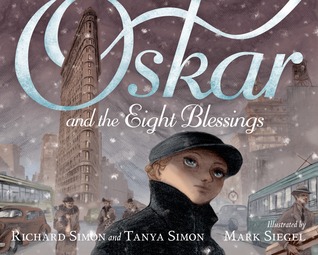
Review: Oskar and the Eight Blessings by Richard Simon

Oskar and the Eight Blesssings by Richard Simon

Oskar and the Eight Blessings by Richard Simon and Tanya Simon, illustrated by Mark Siegel (InfoSoup)

Oskar survived Kristallnacht in Nazi Europe and has been sent by his family to live with his aunt in New York City. When he arrives, he has to walk over 100 blocks down Broadway to reach her, hopefully before she lights the menorah at sunset. Along the way, Oskar is reminded again and again about looking for blessings in life. He is given bread by a woman feeding the birds, a comic book by the man who runs the newsstand, mittens by a boy in the park. But most of all in his long walk in the cold, he is given hope once again that he is somewhere safe.

The authors have created a picture book that speaks to the horrors of the Holocaust only in passing. Instead it is much more focused upon feeling embraced by a city even as a newly-arrived immigrant. It is about the small things that we do in kindness each day and the way that those small things build to something larger and more important for someone. This book celebrates New York City and the shelter and home that can be found there.

The illustrations are interesting for a book set in the past. They incorporate comic-like panels on the page that really work well. The illustrations have a sense of wonder about them. They capture small pieces of New York, allowing the snow and city to swirl around the reader just as they do around Oskar himself.

A lovely holiday book that is about more than either Christmas or Hanukkah but about home and hope. Appropriate for ages 3-5.

Reviewed from copy received from Roaring Brook Press.

Review: You Can’t See the Elephants by Susan Kreller

You Cant See the Elephants by Susan Kreller

You Can’t See the Elephants by Susan Kreller, translated by Elizabeth Gaffney (InfoSoup)

Mascha has been sent to spend the summer at her grandparent’s house. Their neighborhood is perfect in many ways with neat yards, gardens and neighborly gatherings. When Mascha meets Julia and Max at the playground, she is desperate for friends. There’s not a lot for a 13-year-old to do. Soon though Mascha realizes that something is wrong and then witnesses for herself Julia and Max being abused by their father. Mascha tells her grandparents and even other neighbors, but no one is willing to do anything. So Mascha decides to step in herself and stop the abuse.

This German novel has already won several international awards. The writing is haunting and beautiful. My quibble with the translation is that I wish it had maintained its German setting rather than being moved to the United States. It reads as a European book and I’m not sure the story works as well with an American setting. But that is a minor factor in such a powerhouse of a book.

First, the setting in an upper-class community focused on image rather than real warmth is a cunning choice. It reveals the thin veneer of neighborliness, the unwillingness to look deeper at what could be happening, and the ability to turn away from the ugly truth to see only the good. Mascha herself is a brilliant heroine. Facing the death of her mother and sent to stay long term with her grandparents, she is not connected to this community at all. She sees the truth, speaks the truth and then is forced to find her own solution. And what a solution it is. It is clever but flawed, a plan only a child could produce. It is entirely believable and therefore a truly riveting read.

A great book, this novel about abuse, friendship and the importance of protecting the vulnerable in our world is one of the best of the year. It is startling, provocative and timely. Appropriate for ages 10-13.

Reviewed from copy received from G. P. Putnam’s Sons Books for Young Readers.

This Week’s Tweets, Pins and Tumbls

Here are the links I shared on my Twitter, Pinterest, and Tumblr accounts this week that I think are cool:

Reading <3:

CHILDREN’S BOOKS

9 Hanukkah Picture Books For Children That Adults Will Love, Too http://buff.ly/1OOlhaG #kidlit #hanukkah

21 Children’s Books Every Black Kid Should Read http://buff.ly/1N9V8QY #diversity #kidlit

Bringing books to children in Thailand’s remote mountain districts http://buff.ly/1ID1j1b #kidlit

C.S. Lewis’ Greatest Fiction: Convincing American Kids That They Would Like Turkish Delight http://buff.ly/1XMwM82 #kidlit

Meet the Artist Behind the Animorphs Covers That Destroyed Your Mind as a Kid | VICE | United States http://buff.ly/1lMJtOJ #kidlit

A Piggle-Wiggle for a New Generation http://buff.ly/1NY8tzo #kidlit

Publishers Crack Coding for Kids http://buff.ly/1NIS93w #kidlit

A Roundup of 2015’s Best Book Lists for Kids and Teens http://buff.ly/1QyrQ0L #kidlit #yalit

Top 10 unlikely friendships in children’s books http://buff.ly/21RFSQp #kidlit

What are the best children’s books to read at Christmas? http://buff.ly/1TzheOH #xmas #kidlit

Why I want more disabled characters in books http://buff.ly/1ID1sls #kidlit #diversity

Wisconsin School Board Member Tries to Ban Muppets Book http://buff.ly/1TDjX9U

Read:

LIBRARIES

Artist in Residence Program at Appleton Public Library http://buff.ly/1NXOWPG #libraries

How to Make 3D Printed Stuff Without Owning a 3D Printer http://buff.ly/1jQIBaF #libraries

N.Y. Public Library to Host a Reading Recommendation Booth #daily #feedly http://buff.ly/1NFDgLc #libraries

WATCH: 600 People Pack Wisconsin Library for Reading of ‘I Am Jazz’ http://buff.ly/21CAaBP #lgbt #libraries

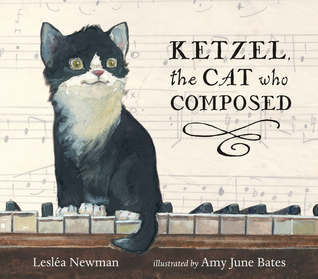
Review: Ketzel the Cat Who Composed by Leslea Newman

Ketzel the Cat Who Composed by Leslea Newman

Ketzel, the Cat Who Composed by Leslea Newman, illustrated by Amy June Bates (InfoSoup)

Moshe Cotel enjoyed his noisy apartment since he heard all of that sound as music that he added to his musical compositions. Each day, Moshe would compose in the morning and then he would head out into the city for a walk to listen to all of the noises outside. One day, he discovered a tiny kitten and took it home. There he discovered that the cat loved music. When he got notice of a contest at The Paris New Music review, Moshe despaired since each composition could be no more than sixty seconds long. It was then that Ketzel walked across the keyboard, creating a song that took only 21 seconds to play. Moshe and Ketzel received a Special Mention in the contest and both of them attended and even took a bow together on stage.

Based on a true story, this picture book shows the beautiful bond that a composer had with his very talented cat. More than that though, it shows a very special man who could hear music everywhere even in his cat stepping on keys. The story is written in a very engaging way, allowing the reader to fall for both Moshe and Ketzel. The Author’s Note at the end offers more information, including what CD has the song on it so readers can hear it.

Bates’ illustrations are done in watercolor, gouache and pencil. They have a subtle coloring and distinct warmth to them. From the cluttered apartment of Moshe with coffee cups, papers and his glasses strewn about to the vibrant streets outside, this book is like entering a memory. Ketzel herself is a rich ball of black-and-white fur who owns each page she is on, filling it with her personality if not her size.

An engaging true story, this picture book is an inspiring look at the gifts that animals bring to all of our lives. Appropriate for ages 4-6.

Reviewed from library copy.

The BFG – The Movie Trailer

Disney has released a trailer for their film version of The BFG.

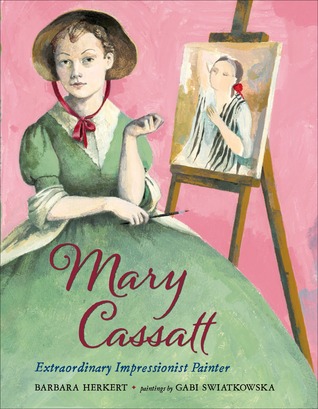
Review: Mary Cassatt by Barbara Herkert

Mary Cassatt by Barbara Herkert

Mary Cassatt: Extraordinary Impressionist Painter by Barbara Herkert, illustrated by Gabi Swiatkowska (InfoSoup)

In 1860, girls did not become artists, but Mary knew exactly what she wanted to do. She enrolled in art school and then moved abroad despite her father’s protests. She copied the masters in The Louvre and lingered outside gallery windows. Art judges disliked her style, but she found herself welcomed to the group of independent artists by Degas himself. Soon she was painting exactly the way she liked and capturing life around her in her art.

Herkert tells the story of Mary Cassatt’s life with such poetic brevity. Her brief lines add to the energetic feel of the book, capturing the tremendous focus and passion of Cassatt herself with their tone. Herkert says things simply as they were and are. She states frankly the expectations of women in that time period, the way that the art institutions rejected Cassatt and the place the Cassatt found support and her own voice.

The illustrations by Swiatkowska pay homage to Cassatt’s own work. Done in a variety of media with gouache, watercolors, acrylics, enamel and tempera, the illustrations have a richness that has a vintage feel about it and focuses on capturing the society that Cassatt lived in and moments in her life.

A beautiful nugget of a picture book biography, this is an inspiring look at a woman who refused to be defined by society and instead lived a life all her own. Appropriate for ages 7-9.

Reviewed from copy received from Henry Holt and Co.

Review: I Used to Be Afraid by Laura Vaccaro Seeger

I Used to Be Afraid by Laura Vaccaro Seeger

I Used to Be Afraid by Laura Vaccaro Seeger (InfoSoup)

Explore things that are frightening in this picture book and then see that you can turn it all around and not be frightened any more. Spiders are creepy but also very cool. Shadows can be scary, but you can also create shadow puppets. The dark is frightening, but change your perspective and you can see the stars. One after another, this book takes a fear and then looks at it in a fresh way. From moving to a new home to being alone, each fear is shown and then re-examined. This is a good book to start a conversation about what a child is afraid of and then talking about how that too can be seen from a different perspective.

Seeger brings her clear understanding of the child’s perspective to this picture book. Die cuts and sturdy pages add to the toddler appeal here. The words are simple with only half a sentence on each double-page spread. Yet the concepts explored here are large and beg for deeper exploration on a personal level. The book will work with a group or one-on-one.

Seeger’s illustrations add to the appeal. Her use of acrylic paint and collage creates illustrations that are bold and bright. The die-cut aspect creates a delight with each turn of the page, physically moving something scary to a new view.

A fresh look at fears, this picture book will inspire conversations and that’s nothing to be afraid of! Appropriate for ages 2-4.

Reviewed from copy received from Roaring Brook Press.