Reading to Children – Medically Proven to Change Brains!

for-reading-813666_1280

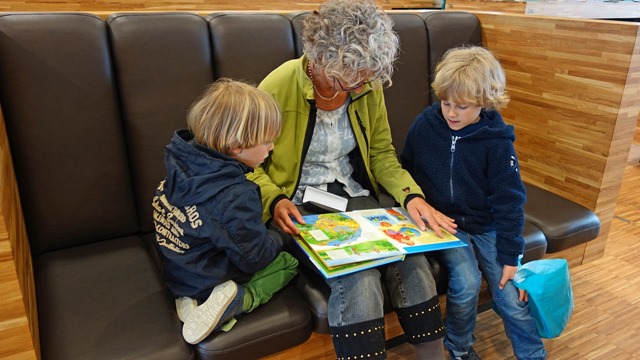
Researchers have conducted MRIs to prove that reading to children sparks changes in their brains. Specifically, reading aloud to preschoolers helps with “mental imagery and understanding narrative” which are both keys to emerging literacy.

Researchers looked at the brains of 19 3-5 year olds using MRI, scanning their brains while they listened to recordings of stories being read aloud. The results showed that children who were from homes where there was more reading had greater activity in the key brain areas than children who did not.

"This is a small and very early study, but the exciting thing it was able to demonstrate is that early reading does have an impact on the parts of the brain that are fundamental for developing literacy early on," DeWitt said. "It’s biological evidence that transcends empirical studies.

Read more at Huff Po and Web MD.

This Week’s Tweets, Pins & Tumbls

Here are the links I shared on my Twitter, Pinterest, and Tumblr accounts this week that I think are cool:

12 Great Animal Sound Books for Toddlers

CHILDREN’S BOOKS

25 Multicultural Chapter Books for Kids http://buff.ly/1eT3hMJ #kidlit #diversity

Cece Bell: how I made El Deafo – in pictures http://buff.ly/1SO3wLI #kidlit

Common Core increasing popularity of children’s history http://buff.ly/1eSRTR2 #kidlit

Hobbies & Crafts 2015: Kids, Unplugged http://buff.ly/1HmOnF9 #kidlit

The Most Anticipated Children’s and YA Books of Fall 2015 http://buff.ly/1KU1Wns #yalit #kidlit

Q&A with children’s author Chris Barton http://buff.ly/1hg0SgS #kidlit #authors

Q & A with Ursula Vernon – Author of Harriet the Invincible – http://buff.ly/1hm3Lgn #kidlit

Banned books socks...love these!

LIBRARIES

Campaigners plan protest at Liverpool town hall over changes to libraries http://buff.ly/1eVtPwR #libraries

Grand Forks leaders seek inspiration from other cities for new… http://buff.ly/1eOg7fb #libraries

How Print-Era Libraries Are Becoming Centers of Digital-Era Community Life http://buff.ly/1eSOTUF #libraries

Libraries need a deeper online presence – The Boston Globe http://buff.ly/1eTNzky #libraries

What’s the Most Visited Part of your Library? http://buff.ly/1IMNJX1 #libraries

TEEN READS

The CW Is Remaking ‘Little Women’ As A ‘Gritty’ Dystopian Series http://buff.ly/1MHUawj #kidlit #classics

Holly Black Inks Deal for Young Adult Trilogy http://buff.ly/1JMykqu #yalit

Sisterhood, Body Image, and Sexual Abuse | Carol Lynch Williams on “Never Said” http://buff.ly/1Dv4eGO #yalit

Top 10 LGBTQ for Youth, by Michael Cart | Booklist Online http://buff.ly/1E8FmPW #kidlit #yalit

Violence in LGBTIQ Fiction for Young Adults, a guest post by Rob Bittner — @TLT16 Teen Librarian Toolbox http://buff.ly/1g58x0D #yalit

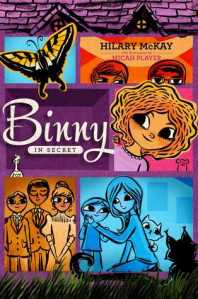
Review: Binny in Secret by Hilary McKay

Binny in Secret by Hilary McKay

Binny in Secret by Hilary McKay (InfoSoup)

This second book in the series about Binny is another charmer. Binny has to start school in her new town now that summer is over. She doesn’t know anyone at all and the only child she has met she managed to knock into and spoil her mother’s birthday gifts while Binny was pursuing a butterfly. When a storm hits their small town, Binny and her family find that the roof of their house has caved in and they have to move to a rental house out in the country. At school, Binny is mercilessly bullied by the girl she knocked into and her friends. They call her “grockle” and make fun of the way she talks and acts. Binny finds herself taking solace in her family, helping her little brother James with his chickens. Then one of the chickens is taken by a “jagular” and Binny discovers a paw print that might lead her to figure out the puzzle of what animal took the hen. Tied together with Binny’s story is that of Clarry, a girl who lived in the house during World War I and who found herself drawn to the natural world in the same way that Binny does. It may just take the two of them together to solve the mysteries that Binny has discovered.

McKay has such a way of writing. It exudes warmth and humor. It’s rather like the cinnamon cake that appears in this book, something to be both savored and lingered over, but also one to be devoured with delight. If I could leave the house with a book like this tucked in my pocket to munch on each day, I’d be very happy indeed. The dual story lines of Binny and Clarry work particularly well. Clarry too is an intriguing character, a girl interested in an education in a time when that simply wasn’t done. Readers find out fairly soon in the book that Clarry lived to be 100 years old, but there are questions about how long others in her story lived which add to the mysteries of the book.

McKay creates characters who are their own people. There is Binny who is complicated both in the ones she loves and her own interests. She finds things on the fly and feels deeply about everything. Her younger brother James is also a delight. His way of greeting people, his vague general statements, his inquisitive nature. They all combine to one little boy with a huge personality. Clem, Binny’s older sister, has depths that are hinted at but not yet revealed. All of the characters are robust and personable. Those who seem one way upon first meeting them develop into intriguing full characters by the end of the book, and even the adults are treated this way.

Another wonderful read by the incredible Hilary McKay. I can’t wait to see what Binny gets up to next! Appropriate for ages 8-11.

Reviewed from copy received from Margaret K. McElderry Books.
Reading and Well Being

Reading Agency Logo

The Reading Agency, a nonprofit in the UK, has released new research from a study they had conducted. The study shows that reading for pleasure can have extended benefits in life.

Among the benefits it finds are improved social capital for children, young people and the general adult population; better parent-child communication and reduction of depression and dementia symptoms among adults.

This is the first part of a larger project that includes reading charities, libraries and education. They hope to create an outcomes reading framework that will allow those organizations to evaluate the impact of the work they do.

Waking Brain Cells Turns 12!

birthday-492375_1280

I’ve been blogging about kids books for 12 years as of today!

I was an early blogger, the strange librarian wandering ALA Exhibit booths and talking about blogging and getting lots of blank looks from publishers. That has certainly changed! And I am happy to see that blogging, particularly blogs that review books, have reached a new level of respectability from publishers and readers alike. We change the conversation at times, bring diversity to the forefront, discuss hard topics, insist on progress being made.

So thank you everyone. Thank you readers for following my blog and reading my reviews and my rants alike. Thank you publishers for the books you send and the respect you show. Thank you librarians for all you do for your communities but mostly for being a voice for reading and literacy always.

I am so proud to have been part of the flourishing blogging community for 12 years. Thank you for including me with such openness and kindness.

Review: Wait by Antoinette Portis

Wait by Antoinette Portis

Wait by Antoinette Portis (InfoSoup)

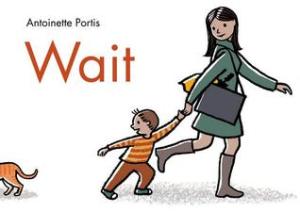
As a boy and his mother move through an urban setting rushing to get on the train, the little boy just wants to slow down and look at things. There are ducks to feed, an ice cream truck to linger near, a butterfly to try to touch, and much more. Each little item has the boy saying “wait” while the mother says “hurry.” It’s a dance that parents will immediately recognize. A rain storm has them hurrying to put on a raincoat. Just as the pair are about to catch their train successfully though, the rain ends and there is a rainbow that stops them both and has them waiting together.

This very simple book has only two words throughout: wait and hurry. It’s one of those books that will allow very young children to try to read it to themselves once they can identify the two words. Children and parents alike will also see their own morning rush in the book. While they may not catch a train, they will have to wear coats, try to get ice cream, and see neat animals almost every morning themselves.

Portis’ illustrations are friendly and large. Done with thick black lines with lots of texture using charcoal, pencil and ink, the illustrations perfectly capture the tug of slowing down with the need to hurry. The urban setting is done in the friendliest of ways and the various distractions are too. These are the merry things that slow toddlers and young children to a crawl even as time ticks away.

Toddlers will love this book about how important it is to stop and see the rainbows, the ducks, the butterflies, and everything else! Appropriate for ages 1-3.

Reviewed from copy received from Roaring Brook Press.

Review: Leo: A Ghost Story by Mac Barnett

Leo a Ghost Story by Mac Barnett

Leo: A Ghost Story by Mac Barnett, illustrated by Christian Robinson

Released August 25, 2015.

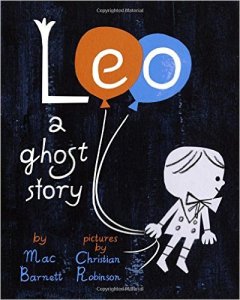
Leo has lived for a long time alone in his house. Most people can’t see Leo, because he’s a ghost, but if you are reading this book you are one of the special people who can see Leo. When a new family moves into the house, Leo tries to be welcoming by bringing them tea, but the family is frightened of the floating tray. After hearing how much they dislike him because he’s a ghost, Leo leaves his house and roams the city. He is invisible to everyone until he meets Jane, a little girl with a lot of imaginary friends. She thinks that Leo is just another of them and since Leo was so hated because he was a ghost, he doesn’t correct her. The two of them have a grand time playing together and she even gives him a sheet and pillow to sleep by his side. Leo is so happy that he can’t sleep. So he heads downstairs and that’s where he meets the robber who has entered Jane’s house. But what is an invisible ghost to do to stop a robber?

Barnett immediately invites readers into his world by allowing them to suddenly “see” Leo with the first page turn. It creates a real connection with the story and makes Leo all the more tangible to the reader. Barnett excels at creating a simple story but one that has strong implications to real life running throughout. This is a delight of a light ghost story, but it is also about acceptance, honesty and embracing who you really are.

Robinson’s illustrations are light hearted. Her art is done with acrylics and construction paper. Leo himself is see-through and rendered in what looks like crayon, making him very childlike and welcoming. While Leo is pale or completely transparent, the others are all rendered in deep blue construction paper except for the pale-skinned thief.

A book about acceptance and the power of a strong imagination, this picture book will be a welcome addition to Halloween story times. Appropriate for ages 4-6.

Reviewed from copy received from Chronicle Books.

Review: The Moon Is Going to Addy’s House by Ida Pearle

The Moon Is Going to Addy's House by Ida Pearle

The Moon Is Going to Addy’s House by Ida Pearle (InfoSoup)

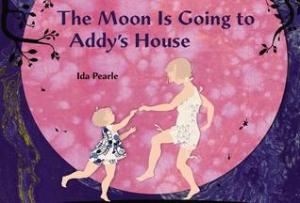
When Addy’s play date is finished, she is taken home in a car by her father and mother. Her little sister is along for the ride too and the moon shines outside of their windows. It is sometimes high in the sky, other times low under a bridge. It follows them over a bridge, through the hills. It is sometimes so close that you would think you could catch it in your hands. The moon goes all the way to their home with them, waiting outside during their bath and then celebrates along with Addy during her nighttime dance. It’s even there when she finally goes to bed.

Pearle has written a poem to the moon, celebrating the way that it shines on all children from up above. She captures the way that the moon seems to shift positions as you drive, the joy of open windows and wind, and the peek-a-boo that the moon plays with clouds and objects. The text is simple and poetic, creating a mood of joy and universal pleasure in heading home at night.

The illustrations here are stunningly beautiful. Done in cut-paper collage, they are astonishing. Pearle captures the feel of a dog’s fur, the play of moonlight across large buildings, the deep purple of the night as it arrives. She also changes the color of the moon as the journey continues, allowing it to take over the final pages with its splendor.

This moonlit book is gorgeous and just right for a bedtime read. Appropriate for ages 3-5.

Reviewed from copy received from Dial Books.

Review: Baba Yaga’s Assistant by Marika McCoola

Baba Yagas Assistant by Marika McCoola

Baba Yaga’s Assistant by Marika McCoola, illustrated by Emily Carroll

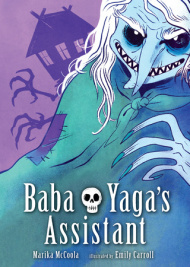
A modern teen meets the legendary Baba Yaga in this graphic novel that mixes traditional Russian folklore with modern-day mixed families. Masha was raised primarily by her grandmother who told her stories of her own time with Baba Yaga in her house that walks on chicken legs as well as stories of other children who lived with the old witch. So when Masha sees an ad in the paper for an assistant, she sets off to take the job with some confidence, a lot more than she feels about her father’s new girlfriend and her daughter. Baba Yaga sets Masha through a series of tests like outwitting a huge bear, cleaning the filthy house, and even getting inside in the first place. But when the daughter of her father’s girlfriend shows up as one of the children ready to become Baba Yaga’s dinner, Masha intervenes and saves all of the children, even if they don’t want her help. But that act alone may have cost her the assistant position and her adventures with Baba Yaga.

McCoola’s story is a dark and dangerous tale, one that does not laugh at the legends of Baba Yaga, but instead makes her all the more frightening. Still there is a great sense of humor throughout. The story closely relates to other tales of Baba Yaga and her house. In fact, the characters refer to other tales, other adventures and use that knowledge to escape their situation. It’s a clever use of traditional stories to create a robust modern tale of adventure and magic.

The illustrations by Carroll embrace the darkness of the story. My advanced reader copy was entirely in black and white, so I can’t speak to the colors of the final version, but the drawings have a modern edge to them that makes them exciting and fresh. A different style is used when there are flashbacks to the other stories, making sure that readers know that it is a different tale. The final pages of my copy contain some character studies for the illustrations that make for fascinating reading too.

Dark, dramatic and great fun, this graphic novel is a memorable mix of old and new into something amazing. Appropriate for ages 9-12.

Reviewed from ARC received from Candlewick Press.