2014 Guardian Children’s Fiction Prize Winner

The Dark Wild

Publisher’s Weekly has the news that Piers Torday has won the 2014 Guardian Children’s Fiction Prize for the second book in The Last Wild trilogy: The Dark Wild

The Guardian Prize is a UK children’s book prize.  The Dark Wild will be published in the US in January 2015.

Review: Buried Sunlight by Molly Bang

buried sunlight

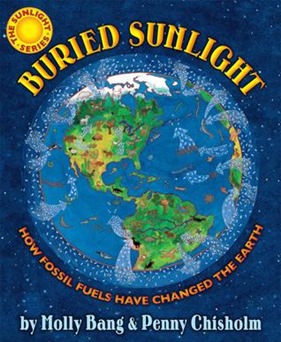
Buried Sunlight: How Fossil Fuels Have Changed the Earth by Molly Bang & Penny Chisholm

Everything needs energy in order to grow and we also need energy to run machines.  This energy comes from the sun though it may be stored as fossil fuels underground.  The fossil fuels have stored that energy inside them and it is released when they are burned.  This book looks at how sunlight energy is stored in fossil fuels, explaining photosynthesis and the balance of oxygen on the planet.  It speaks to the way that oxygen was first released to the atmosphere and the millions of years that it took to create fossil fuels.  The book then informs readers about the impact of carbon dioxide on the planet and the resulting climate change.  In the end, the book lets readers know that the choice for the future of the planet is theirs.

Bang worked with Chisholm, an award-winning MIT professor on the information in the book.  Told from the point of view of the sun, the book takes a clear and scientific tone throughout, enhanced by the more personal point of view.  The information is compellingly presented and interesting.  The final pages of the book offer even more details about the fossil fuel process for those looking for more in-depth information.

Bang’s illustrations capture the information of graphs along with an artistic feel.  She manages to keep it scientific but also speak to the wonder of the process and the beauty of the captured sunlight energy. 

This fourth book in their Sunlight series continues the combination of science, beauty and natural wonder.  Appropriate for ages 5-9.

Reviewed from library copy.

Review: Wall by Tom Clohosy Cole

wall

Wall by Tom Clohosy Cole

When the Berlin Wall was built, a boy was separated from his father who was on the other side.  His mother told him that his father was in a place where life was better.  They were not allowed to leave their side of Berlin.  The boy dreamed of his father coming and rescuing them, but he knew that was unlikely to happen.  So he started to plan ways to get past the wall himself.  Other people tried to get past the wall, many of them died in their attempts.  But it was worth the risk to see his father once again, so the boy started digging out in the woods near the wall.  When the tunnel was ready, the boy led his family to it, but along the way they were stopped by a soldier.  Would this be the end of their brave journey to reunite their family?

Cole captures the separation and division caused by the Berlin Wall.  He also clearly shows the fierce drive of a family to reunite and be together once again.  Told in very simple sentences, the book relies on its fine artwork to carry the story.  It is the art that conveys the danger, the deaths and the risks that people took to see loved ones again or to attain freedom. 

The art here is exceptional.  Cole uses lighting on his pages to show the hope of the West versus the darkness and gray of the other side of the wall.  The illustrations are atmospheric and dramatic.  They convey the feeling of isolation and the fear. 

A strong picture book about the Berlin Wall and the power of family and hope.  Appropriate for ages 4-6.

Reviewed from library copy.

Review: Phoebe and Her Unicorn by Dana Simpson

phoebe and her unicorn

Phoebe and Her Unicorn by Dana Simpson

When Phoebe skipped a rock (four times!) across a pond, she accidentally hit a unicorn in the nose, distracting the unicorn from gazing at her amazing reflection.  The unicorn was bound to offer Phoebe a wish and though Phoebe tried to wish for more wishes and things like that, she wasn’t allowed to.  So Phoebe wished that the unicorn, Marigold Heavenly Nostrils, be her best friend.  The two become inseparable, much to Heavenly Nostrils’ dismay at first.  Soon they truly became the best of friends, dealing with bullies in unexpected ways, having slumber parties, and playing games together. 

This friendship between a girl and a unicorn is filled with great humor, including lots of biting sarcasm which helps offset the cuteness factor.  It is not the traditional unicorn and girl relationship either, both of them have unique personalities and sometimes they just don’t get along.  It’s those moments of reality that keeps the relationship honest and makes this a graphic novel to celebrate.

Simpson’s illustrations have strong ties to Calvin & Hobbes.  Readers will immediately find themselves right at home in the world she creates, one where unicorns are real but sheltered by a Shield of Boringness that keeps others from realizing how special the unicorn is.  These plot devices are brilliant and funny.

I brought this book home and my 17 year old immediately rejoiced since she reads the comic online.  So you will have fans in your library for this book already.  Get it on the shelves for kids and into the hands of adults who will also enjoy it immensely.  Appropriate for ages 9-12.

Reviewed from library copy.

Review: Fox’s Garden by Princesse Camcam

foxs garden

Fox’s Garden by Princesse Camcam

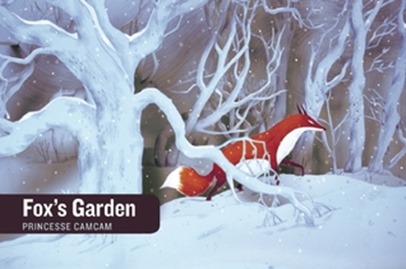
Gorgeously illustrated, this wordless picture book invites readers into a snowy world.  A fox finds her way into a village, warm lit against the cold snow that is falling.  She is shooed away by several people but discovers an open greenhouse.  A little boy sees her enter and brings her a basket of food.  Now there is a fox with four baby foxes nursing.  Soon after, the mother fox leads her kits to the boy’s room where they plant flowers from the greenhouse into his rug which he discovers in the morning.  The five foxes disappear back into the woods.

Done in cut-paper illustrations, the images have a beautiful 3-D quality to them.  You want to stroke the page and think that you will be able to lift flaps, so strong are the images. Against the white and gray snow and woods, the characters pop.  The fox gloriously orange in the snow and the little boy wearing red. 

Camcam lights her paper work beautifully as well, almost as if it were a stage.  She conveys the welcoming warmth of the light in the village, the yellow of the windows lit against the storm.  More subtly, she plays with shadows and underlighting in specific scenes, showing the cold and the night clearly.

This is a haunting picture book, done with an immense delicacy and skill.  Simply beautiful.  Appropriate for ages 3-5.

Reviewed from copy received from Enchanted Lion Books.

Review: Iridescence of Birds by Patricia MacLachlan

iridescence of birds

The Iridescence of Birds: A Book about Henri Matisse by Patricia MacLachlan, illustrations by Hadley Hooper

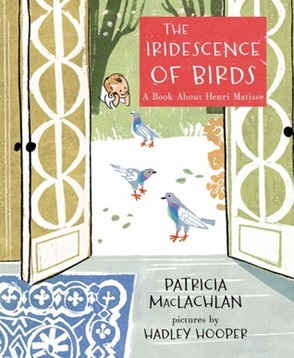
Henri Matisse grew up in a town in northern France that was cold, gray and dreary.  But his mother filled their world with color with the plates that she painted with nature scenes.  She also let Henri mix the paint colors.  He was also the person who arranged the fruit and flowers that they bought in the market, on the blue and white tablecloth.  Red rugs adorned the walls of their house, filling it with color too and making the whole world turn red.  Henri also raised pigeons with their iridescent feathers.  And all of these elements of his childhood came together in his work as an adult, reflecting the color that one can see in the dreariest of towns.

MacLachlan has written this picture book in an unusual second person, inviting the reader to feel the environment just as Matisse himself did as a child.  The slow reveal of the richness of his childhood at home plays beautifully against the original gray and dullness of the outside.  It is as if he was given another world to grow up in, one of colors and delight.  Though when readers really look at it, it is about small things, tiny touches, being surrounded by paint, and of course the brilliance of pigeons too.

The illustrations by Hooper are rich and saturated with color.  Done in a combination of relief printmaking and digital formats, the book has a grounding in the solidity of printmaking that gives it texture and a feeling of tradition.  Playing against that is the modern lightness of the little boy, surrounded by the color and delight of his home.  It’s an exquisite pairing.

Rich, detailed and delightful, this picture book biography of the inspiration that Matisse found in his childhood home is sure to invite young readers to find their own sources of inspiration around them.  Appropriate for ages 4-6.

Reviewed from copy received from Roaring Brook Press.

Review: Give and Take by Chris Raschka

give and take

Give and Take by Chris Raschka

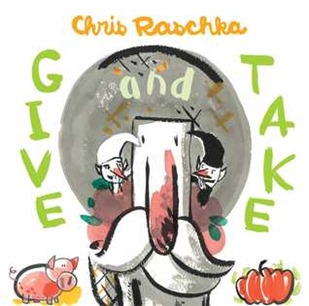
A farmer who grows apples discovers a strange little man out in his orchard just as his apples are ready to pick.  The little man is named Take and he encourages the farmer to listen to him so that he can have a fine life.  Though the farmer already has a fine life, Take promises to make it better.  So the farmer goes through his day taking everything.  He takes all of his neighbors pumpkins when she offers him some.  He takes her advice to make pumpkin soup, and he takes a long hike.  Left wishing he had some apples to eat, he kicks out Take the next morning.  Then when he visits his orchard that morning, he meets another little man named Give.  Give promises to make his life sweeter, so once again the farmer tries.  He gives everything away, including his apples and all of his opinions.  He is left hungry another night and kicks Give out.  But in the morning, he discovers the two little men fighting with one another.  Can a farmer outwit these two battling forces?

Raschka has written this picture book with the tone of a fable.  Readers will immediately see Take as a selfish force and then think that Give is the angelic voice.  But Raschka’s take is more nuanced than that, showing the harm in being too giving with everything in your life and how it can turn toxic and harmful too.  He then goes about having his farmer propose a balance of giving and taking in life.  The result is a book that has balance, a folkloric rhythm and tone, and is a great read aloud and opportunity for discussion.

Raschka’s illustrations are his trademark flowing and free style.  He uses watercolors contained with thick black lines.  The bright red of the farmer’s nose and the apples pop on the page along with the pink pig and the orange pumpkins.  As always, his book is art, changing with each turn of the page as the story is told.

Perfect for discussions about balance, generosity and greed, this picture book is a great balance of art and folklore itself.  Appropriate for ages 4-6.

Reviewed from copy received from Atheneum.

Goodreads Choice Awards 2014

2014 Goodreads Choice Awards

Goodreads has announced the semifinalists in their Best Books of 2014.  There are categories for genres, young adult fiction, young adult fantasy, middle grade & children’s, and picture books.  Each category has 20 semifinalists. 

If you are a Goodreads user, make sure to cast your vote for your favorite.

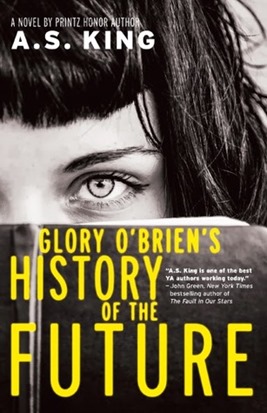
Review: Glory O’Brien’s History of the Future by A. S. King

glory obriens history of the future

Glory O’Brien’s History of the Future by A. S. King

Glory can’t see a future for herself.  She has no plans once she graduates from high school, not applying to any colleges.  Perhaps she is just like her dead mother, who committed suicide four years ago.  It’s the reason that Glory has only eaten microwaved food years, since her father won’t replace the oven her mother used to kill herself.  Glory can’t even seem to get along with her best friend who lives across the road in a commune.  It was there that they found the desiccated bat that they mixed with water and drank.  It was a decision that changed Glory’s life because now when she looks at other people she can see their future, and it’s a future that is filled with civil war, hate of women, and horror.  As Glory sees everyone’s future but her own, she starts to slowly explore the family secrets that surround her and even her own way forward.

King is amazing.  While the cover may compare her to John Green, she is has a voice that is entirely unique and her own.  King has created here a book that mixes photography with philosophy.  Glory speaks the language of film, pre-digital and more physical and tangible.  She uses light meters and ties the numbers she uses directly to her life:  “By shooting the darkest areas three zones lighter, you turned a black, lifeless max black zone 0 into a zone 3.  I think, in life, most of us did this all the time.”  King also embraces a fierce and beautiful feminism in this book.  It’s the feminism that we all viscerally crave, one that speaks to the power of girls and women, a feminism that can save us from ovens.

Glory is such a strong character.  I love that she is cool and real, and yet she feels that she is the most awkward, unsexy and unreal person in the world.  That is such a teen feeling, a feeling of hiding and being masked and fake.  King captures it beautifully.  Glory grows throughout the book, emerging from behind all of the barriers that she has set up for others before they can meet who she really is.  The problem is that she is also hiding from herself. 

Strong, beautiful, feminist and fierce, this book is one inspiring read for all of us who hide and need to be found by ourselves.  Appropriate for ages 15-18.

Reviewed from library copy.