
I’ll be taking a break from blogging. Thank you to all of my readers and the publishers who have supported my little corner of the Internet over the years.
I’ll be taking a break from blogging. Thank you to all of my readers and the publishers who have supported my little corner of the Internet over the years.
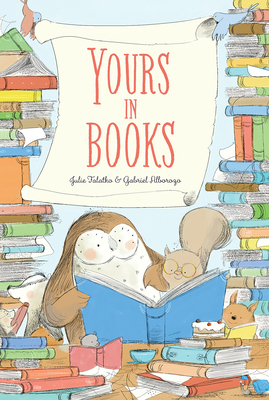
Yours in Books by Julie Falatko, illustrated by Gabriel Alborozo (9781951836207)
Owl is looking for peace and quiet to be able to read his books. So he reaches out to a local bookshop to get titles that might help. After getting the store’s catalog, he asks for titles like “How to Soundproof Your Forest Dwelling” and “The Can-Do Guide to Moving to a Remote Tropical Island.” However, the store doesn’t have those titles, instead sending other books, ones that are helping as the youngsters of the forest begin to listen to Owl read stories aloud, bake treats together, and make crafts. Happily, the books selected by the cheery squirrel are just what Owl actually needs.
Told entirely in the letters being exchanged, the emerging relationship between Owl and Squirrel is a joy. At first businesslike, the accurate assessment by Squirrel of the book that Owl truly needs leads to exchanges of jokes and invitations to tea parties and visiting the bookshop. The entire book is about accepting a changing neighborhood complete with young and eager visitors who may also be exactly what Owl needs in his life.
The simple illustrations evoke the warm and lovely life in the woods. From the book-filled shop to the often spattered Owl looking surprised that some things are actually working out well. Readers will want to join in on their tea party and also head out to visit the bookshop and have Squirrel pick a tome just for them.
Full of friendship, letters, books and baking. What a treat! Appropriate for ages 3-5.
Reviewed from library copy.
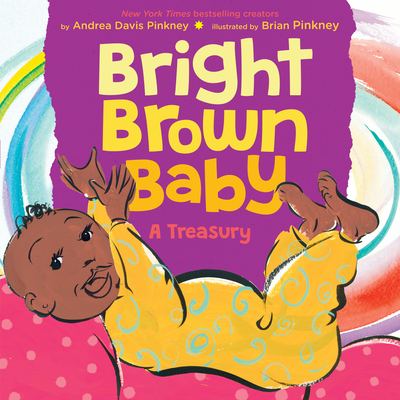
Bright Brown Baby by Andrea Davis Pinkney, illustrated by Brian Pinkney (9780545872294)
Spending happy time together with a baby is made simple with this new offering from the prolific and marvelous Pinkneys. Starting each chapter with a quotation from a major Black figure sets the tone for this treasury, ensuring that each story celebrates being a Black baby. Some of the stories focus on counting, others play peek-a-boo, and they all speak to self esteem and love.
The text is simple enough for the youngest of children, each page looking more like a board book. That makes sense when you know that each of the chapters in the treasury are going to be released in board book format as well with one of them out already. Still, there is a beauty in seeing them all together in one book, because the movement from one chapter to the next works well and keeps the lap time going.
The illustrations are bright and full of warmth. They are filled with families and little ones of different genders and sizes all hugging, playing and spending time with one another.
Lots of love for brown and Black babies and families. Appropriate for ages 1-3.
Reviewed from e-galley provided by Orchard Books.
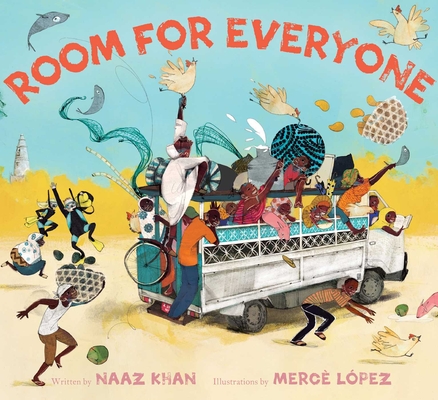
Room for Everyone by Naaz Khan, illustrated by Mercè López (9781534431393)
Musa and Dada take the daladala to the shore, but the bus stops for a lot of others along the way. How many people can they fit inside? First there is one old man and his bicycle. Next a herder with two little goats. Then vendors with their three baskets of fruit. And on it goes counting upwards until it gets to ten swimmers with snorkels and fins. Somehow everyone fits into the daladala and everyone gets to the beach successfully. Though it takes a lot of wiggling and giggling along the trip.
This picture book offers a glimpse of life in East Africa, filled with kindness and care for one another as people squeeze together to make sure there is room for everyone. The counting structure of the book works well, but it is the boy’s response to each person and his doubt that they will fit that adds to the humor of the book. The rhyming is well done, adding to the pace of the book and the building pressure inside the daladala.
The illustrations are full of bright, hot colors that make heat of the day apparent to the reader. There is a playfulness to the illustrations with lots of stacking, moving, shifting and wiggling to make room as each new stop is made.
Funny and full of community kindness, this is a great trip to the beach. Appropriate for ages 2-4.
Reviewed from e-galley provided by Atheneum.
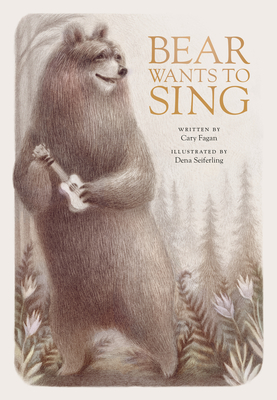
Bear Wants to Sing by Cary Fagan, illustrated by Dena Seiferling (9780735268036)
This is a follow up to King Mouse from the same creative team. Out on a walk, Bear discovers a ukulele in the grass. Bear plucked a string and thought of a song. Mouse was there on a stump, all ready to listen. Then a crow arrived an found a tambourine in the grass. She immediately sang her song for Bear and Mouse. Snake arrived next and discovered a drum, which she used to sing her own song before Bear could start his. Tortoise was next with a horn and a song. Then Fox appeared and thought they should start a band and she could be their manager. Finally, it was time for Bear to sing his song. When the others didn’t praise it, he headed away. But one friend isn’t ready to let him leave entirely.
There is a beautiful delicacy to the story and the illustrations that work deliciously together as a whole. Fagan uses repetition in the story with the series of interruptions before Bear can sing his song. There is a wonderful tension that readers and the bear feel as he is preempted again and again. It’s also a treat to have a moment of such humor in the center of this thoughtful book which then returns to its previous tone but retains a wry grin.
The illustrations are done in graphite and colored digitally. The digital color is so pale that it is a whisper of color at the edges of the scenes with pale green leaves, a brown bear, and some flowers with a glimmer of pink. They are subtle and lovely, offering space for song and performance.
Thoughtful and lovely, this book explores friendship, sharing the limelight, and being true to yourself.
Reviewed from e-galley provided by Tundra Books.
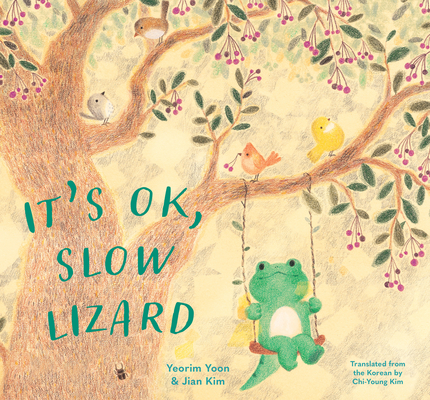
It’s OK, Slow Lizard by Yeorim Yoon, illustrated by Jian Kim, translated by Chi-Young Kim (9781632062772)
Slow Lizard lives in the forest with Bird, Elephant, Rabbit and Monkey. He likes to take things slow, just like his name. So when Little Bird is fretting about not having enough time to get things done, Slow Lizard invites her to share some tea. When Elephant gets angry, Lizard asks him to look at the clouds together. When Rabbit is sad, Lizard sits with her until she feels better. Lizard shares a quiet book with Monkey when his pranks get out of control. When a storm threatens, the other friends display their strengths too, using their generosity, planning, cleverness and humor to get everyone home safely.
Using repeating structures, this picture book beautifully shows the power of slowing down and giving your emotions the ability to be felt and then to pass. Lizard demonstrates various approaches to handling frustration, anxiety and other qualities in your life, showing both the characters in the book and the reader these skills. Just as the book feels like it might end, Yoon also shows the positive qualities that the others characters have. This pivot in the story is particularly effective as it show that all of us have struggles and strengths within us.
Kim’s illustrations are full of fine details but will also work well with a group. The forest setting comes alive with fan-like flowers, dandelions, clover and many small plants. The illustrations also show the characters’ emotions clearly.
A perfect book to share along with some tea under the sky. Appropriate for ages 2-4.
Reviewed from e-galley provided by Yonder.
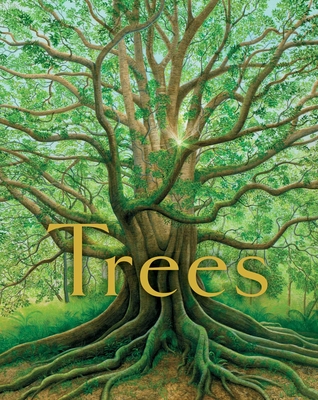
Trees by Tony Johnston, illustrated by Tiffany Bozic (9781534475175)
This picture book explores trees from their own point of view. Beginning with the line, “Trees love sky,” the book goes on to show how integrated trees are into the environments around them. From holding out their limbs for songbirds to celebrating the clouds above them by reaching tall, the trees help form the world around them. As trees burst into blooms or offer a sheltered place to read, time spent alongside trees in nature is always worthwhile.
Told in very simple poetic words, this picture book is ideal for the youngest children to see trees as something special and valuable in our world. The Author’s Note clearly ties trees to helping our climate crisis and also shares some of the amazing things that trees can do.
The illustrations of the book are particularly impactful. All painted on wooden panels, they have an incredible richness, sharing a wide variety of trees and habitats around the world including dreamy green wetlands, golden fields of wheat, and stirring details of the rough bark and the moss that is part of it.
A book that will have you headed outside to hug trees. Appropriate for ages 2-4.
Reviewed from e-galley provided by Simon & Schuster Books for Young Readers.
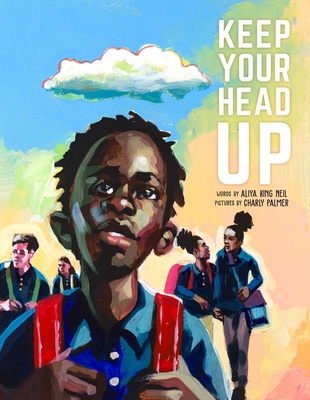
Keep Your Head Up by Aliya King Neil, illustrated by Charly Palmer (9781534480407)
A bad day starts for this boy when he wakes up late. He can’t move fast and his sister has used his sparkly toothpaste to make slime. Still, he knows he can try to make it a good day. But things just keep on going wrong. He has forgotten his gym uniform plus he doesn’t get the class job that lets him take a walk. His face starts to show his frustration. He gets the last laptop in writing class, the one with the sticky space bar. He forgets to raise his hand in math class, even though his answer was right. He manages to get paint all over his uniform. He’s been trying to avoid a meltdown all day, but it doesn’t work. He gets sent to the principal’s office. The quiet there helps, but the day won’t get much better until he decides to keep on trying to keep his head up.
Neil captures all of the emotions of a bad day in her picture book. The steady drum of small things going wrong throughout the day is something that many kids will recognize. They will also relate to the emotions of anger, frustration and the final loss of control after trying so hard. There is a lot of empathy in this book and yet also no easy answers other than to keep on trying, be gentle with yourself.
The illustrations by the Coretta Scott King Award winner Palmer are rich and beautiful. He shows all of the emotions that the protagonist feels using a cloud that follows the boy everywhere. The cloud changes color as the boy’s emotions get darker and angrier too. Throughout there is a sense of a strong Black family unit and larger Black community.
An emotional look at a bad day that just might turn out OK. Appropriate for ages 4-6.
Reviewed from e-galley provided by Simon & Schuster.
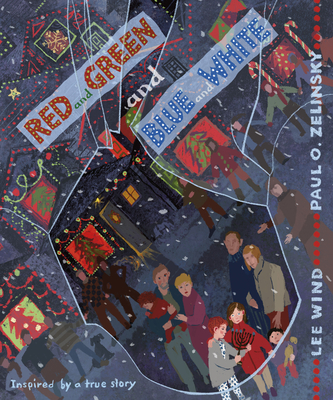
Red and Green and Blue and White by Lee Wind, illustrated by Paul O. Zelinsky (9781646140879)
Based on a true story, this picture book explores hate crimes and what a community can do to stand up for what they believe in. Isaac lived in the one house in town decorated in blue and white for Chanukah rather than red and green for Christmas. Teresa lived across the street in a house with a big Christmas tree. The two were best friends. They both loved playing in the snow, being creative, and lots of sprinkles. One night, a shadow approached Isaac’s house and threw a rock through their front window. Isaac’s family considered not lighting the menorah that night, but lit it after all. Teresa made a picture of a menorah to support them, one that glowed with white and blue light. Soon others in the neighborhood joined them, then the school and library, then more and more. Finally, 10,000 windows lit with a combination of red and green and blue and white, standing in solidarity against hate.
Inspired by events that happened in 1993 in Billings, Montana, this picture book shows how one act of hatred cannot stand before a community committed to being there for one another and standing in unity together. The book shines with hope and love, the moment of darkness at its center an important opportunity for a community to show who they really are. It’s a book of inclusion and community, an important story for our volatile times.
Zelinsky’s illustrations are filled with light and darkness. From the glowing holiday lights spilling out of homes to the darkness of the act of hatred, there is a distinct insistence not to fear the darkness but to make it one’s own. The final image of the mixture of holiday lights is profoundly moving and sets just the right tone for all of our winter holiday celebrations.
Important, beautiful and inspiring. Appropriate for ages 5-7.
Reviewed from e-galley provided by Levine Querido.

