Review: What If…? by Anthony Browne

what if

What If…? by Anthony Browne

Joe is headed to a birthday party and its the first one that he’s ever gone to.  He’s very nervous about what is going to happen at Tom’s party and whether he will enjoy it or not.  Joe’s mother walks him to Tom’s house.  They know what street it is on but not the house number, since Joe lost the invitation.  So along the way they peek into windows to see which is the correct house.  But the things they see in the windows don’t help Joe feel better at all.  There are old people with a staring dog.  There’s an elephant.  And then there are a couple of houses where the people are being very strange indeed.  By the time they find Tom’s house, Joe and his mother are both worried.  Will the party be fun?

This is a book that is permeated by Browne’s signature style.  I love the idea of finding a party by peeking into windows.  Even better, Browne takes it as an opportunity to create wild flights of fancy in each window, each of which is unique and strange.  Most of the text of the book is the discussion between Joe and his mother as they walk down the street, with her trying to persuade him that he will have fun at the party. 

Browne’s art really tells a lot of the story on the page.  The discussions between Joe and his mother are shown in panels with speech bubbles.  They are shown in only blues while what they see in the windows are done in full color.  This makes the different windows pop on the page, in stark contrast to the limited palette of the main characters.  By the end of the book though, Joe and his mother are full color once the party is over. 

Another wondrous book by Browne, this is perfect for getting children worried about new experiences to be creative and even a bit wild about how they think about them.  Appropriate for ages 4-6.

Reviewed from library copy.

Review: Daytime Nighttime by William Low

daytime nighttime

Daytime Nighttime by William Low

A simple and lovely introduction to the creatures that children can see around their houses in both day and night.  The book starts with daytime and the question “What do you see in the daytime?”  The large images throughout show animals like butterflies, rabbits, beavers, and more.  In the middle of the book, a new question is posed about the nighttime.  Now the animals shown are bats, frogs, fireflies and raccoons.  The book ends with the final animal, a teddy bear held by a little girl as she falls asleep in bed. 

Ideal for toddlers, this book only has two full sentences and the rest of the text are single words that identify the animal on the page.  Adults can make it into a game where the child names the animal on the page.  The illustrations of the animals are large and vibrant.  They capture the feel of light and dark in a way has elements of both a photograph and a painting. 

A great pick for bedtime reading, this book will be enjoyed by very small animal lovers.  Appropriate for ages 1-3.

Reviewed from library copy.

Review: Alice Waters and the Trip to Delicious by Jacqueline Briggs Martin

alice waters and the trip to delicious

Alice Waters and the Trip to Delicious by Jacqueline Briggs Martin, illustrated by Hayelin Choi

A follow-up to Farmer Will Allen and the Growing Table, Martin continues to focus on food creators in this new book about Alice Waters.  It follows Waters from her studies in France where she learned about food.  When she returned home, she wanted to share her food finds with her friends but her home was too small to accommodate all of them.  So she created a new kind of restaurant that was like eating in someone’s home, Chez: Panisse.  The book follows Waters on her quest to find fresh, locally-grown foods and produce.  It finishes with her focus on children learning to grow their own foods in schoolyards across the country.  This is a picture book biography that will inspire young readers to grow, eat, and discover their own trip to delicious.

Martin’s text reads as verse on the page, the stanzas unrhymed but spare and filled with moments in Waters’ life that are worth lingering over.  Martin explains in simple terms what the goals of Waters are, but she also manages to inspire and let the ideas soar upwards on the page.  She invites young readers to dream their own dreams, offering them a book about how one person accomplished theirs. 

Choi’s art has a great feel to it with a mix of bright colors and a strong organic feel that is entirely appropriate to Waters.  Throughout the illustrations, readers will see how important people are to Waters’ accomplishments from her friends to her team at the restaurants to the children who plant their school gardens. 

A dynamic and delicious look at the life of Alice Waters, filled with all of the mouth-watering moments of her life.  Appropriate for ages 6-9.

Reviewed from ARC received from Readers to Eaters.

Review: Take Away the A by Michael Escoffier

take away the a

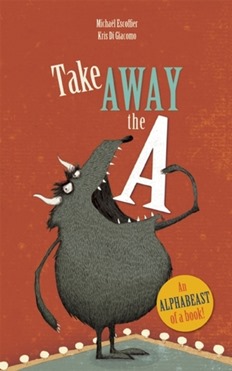
Take Away the A by Michael Escoffier, illustrated by Kris Di Giacomo

A delightful new approach to the alphabet book, this picture book goes through the alphabet and offers words where you take away a letter and get a new word.  So, for example, for letter A, “beast” becomes “best” when you take the A out.  The concept is a simple one, but handled superbly throughout so that it never becomes repetitive or dull.  Instead there is a wonderful humor that pervades the entire book.  Look forward to the end of the alphabet where the simple premise of the book becomes much trickier to pull off, and of course the Z is not to be missed. 

This is the first book by this French author/illustrator team that was not translated from French.  This book with its word play was written in English and offers art and text that is entirely original.  Still, the book has that certain French flair to it that marks their collaborative work.  Escoffier’s word play makes it all look so easy, but young readers will quickly learn that it is not as they try to come up with their own, particularly certain letters.

Di Giacomo’s art is a large part of the European feel of this book.  Her illustrations here tell a story on the page, as if the reader has interrupted a scene in motion by opening the book to that page.  The animals seem to be relating to one another more than to the reader, just waiting for them to go away so that they can begin speaking again.

Clever and deceptively simple, this is a great alphabet book for youngsters who have been read too many as well as elementary children who enjoy word play.  Appropriate for ages 4-6.

Reviewed from copy received from Enchanted Lion Books

Review: brown girl dreaming by Jacqueline Woodson

brown girl dreaming

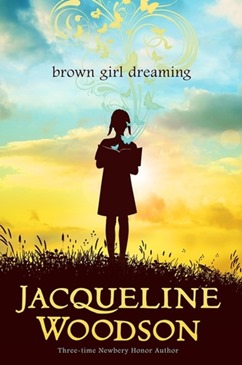
brown girl dreaming by Jacqueline Woodson

Told in verse, this is Woodson’s memoir of her childhood.  Woodson shows the different influences in her life, from both South Carolina and New York City.  There is the richness of southern life, from the heat to the food to the family.  But it is not all sweetness as Woodson shows her family fracturing as she is raised by her grandparents for some of her childhood.  She also shows the racism and discrimination clearly on the page, never flinching in her powerful verse.  When Woodson and her siblings move to New York to live once again with their mother, the dynamic changes and the flavor is urban as the Civil Rights Movement becomes a focus in her life.  Taking place in the 1960s and 1970s, this book captures a time of change in the United States and is also a compelling look at what forces build a writer.

Woodson’s poetry is a gorgeous and lush mix of powerful voice and strong memory.  Her writing is readable and understandable even by young audiences, but it also has depth.  There are larger issues being spoken about as Woodson tells about her own childhood and family.  There are universal truths being explored, as this book is as honest as can be, often raw and unhealed too.  It is a book that begs to be read, shared and then reread.

One of the things I always look for in a novel in verse is whether the poems stand on their own as well as how they combine into a full novel.  Woodson manages to create poems that are lyrical and lovely, that stand strongly about a subject and could be read alone.  As a collection, the poems are even stronger, carrying the story of family and iron strength even more powerfully.

Rich, moving and powerful, this is one of the best novels in verse available for children.  Appropriate for ages 9-12.

Reviewed from ARC received from Penguin.

Review: Telephone by Mac Barnett

telephone

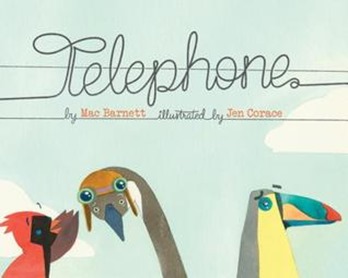
Telephone by Mac Barnett, illustrated by Jen Corace

A mother bird wants her son Peter to come home for dinner, so she sends the message down the telephone line, literally.  It moves from one bird to the next, but the message immediately gets garbled as each bird adds their own take.  Readers will notice that each bird has its own interests that are added to the message and that the illustrations give hints about the topics that will be included that time.  This is a clever twist on the children’s game of telephone, one that has hilarious results and a resoundingly satisfying ending.

Barnett takes a simple concept in this picture book and makes it extraordinary.  His humor is great, making sure that each statement passed along by the birds rhymes but also taken huge liberties with the subject matter.  When the ending comes with a silly bird where the message becomes much longer and incorporates all sorts of things from earlier messages, it makes for a brilliant break in the pattern that sets the final message up perfectly.

Corace’s art is wonderful.  She shows the birds in silhouette on the wire, indicating early to readers what the story will be about.  The illustrations range from close ups of the birds on the wire to more distant shots that show the human neighborhood beneath the wire.  It is all done with great energy, humor and bright colors.

A winning picture book that is clever, funny and simply wonderful.  Appropriate for ages 3-5.

Reviewed from copy received from Chronicle Books.

Review: Nine Open Arms by Benny Lindelauf

nine open arms

Nine Open Arms by Benny Lindelauf

Translated from the original Dutch, this book is the story of Fing and her family.  Fing’s mother died years ago and since then her father and her grandmother have taken care of them.  They are a big family, with Fing’s three older brothers and her two sisters, Muulke and Jess.  Fing’s father has decided to start a cigar business, so they move out of town to a big old house that has something very strange about it that Fing can’t quite figure out.  They call it Nine Open Arms, because that is how far across it is.  The house is near a cemetery, the front door is at the back, and there is a bed in storage that looks like a tombstone.  As the girls start a new school, they slowly begin to discover the secrets of Nine Open Arms and of their own community and family.

Delightfully wild and incredibly quirky, this book is one of a kind.  From the family that moves constantly, to the cemetery next door where they go to get their water each day, to the crocodile purse that is used to tell family stories, to the controlling grandmother who is dominant but deeply loving in her own way, to the one old story that is the key to understanding it all.  This is a richly rewarding read, one that you have to head out on before you even know what journey you are on.  It is a book that meanders but each turn is essential to the book in the end, where it all clicks into place. 

Told in the first person by Fing, the book unfolds before you, each reveal another piece of the family, another story, another moment that is meaningful.  It is a perfectly crafted book that has a plot that moves in its own time, another time, a less modern pace.  It ties to the pace of the family, one where things are revealed in their own space.  It’s incredibly well done.

Beautifully written, magnificently crafted, this Dutch novel is like nothing you have read before, and that is wonderful!  Appropriate for ages 9-12.

Reviewed from library copy.

Review: Little Green Peas by Keith Baker

little green peas

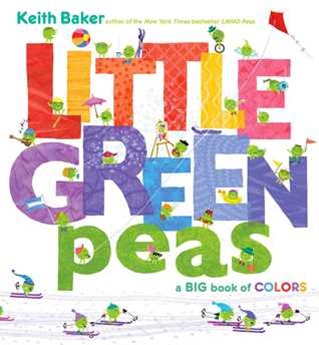
Little Green Peas: A Big Book of Color by Keith Baker

The peas return for their third book, this time focusing on colors.  Peas play on each page, surrounded by a specific color that also shows up in huge letters across the double page spread.  Told in rhyme, the colors are named and objects that are that color are named too.  Young readers can find those objects on the page.  Turn to the next and you get to see even more little green peas enjoying themselves with that color.  Then on to the next.  This colorful read has a great playfulness to it that will keep the youngest readers giggling as they learn their colors.

Baker knows just when his rhyme and structure have reached their limit and then turns it just slightly to make it fresh again.  His little peas are doing all sorts of things on the page and part of the fun of the book is lingering and just seeing what is happening to each little pea.  The illustrations are big and bold, the colors deep and strong.  Yet the little peas and their detailed big fun make this a book best shared one on one.

A great pick for learning colors, children will enjoy the little peas on each page.  Appropriate for ages 1-3.

Reviewed from library copy.

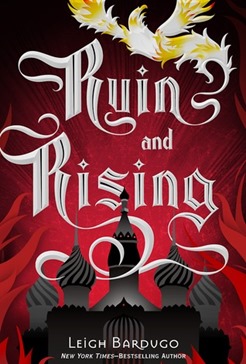
Review: Ruin and Rising by Leigh Bardugo

ruin and rising

Ruin and Rising by Leigh Bardugo

The final book in the Grisha trilogy, this is an amazing ending to an incredible series.  After her failed battle with the Darkling, Alina has been hiding in the White Cathedral, slowing healing from the damage of the fight.  But Alina has lost much of her power and must rely on trickery to display the light of the Sun Summoner.  She is surrounded by those who believe her to be a saint, but also by those who would control her for their own means.  It is soon time for Alina to escape, but in her battered body and mind, planning such a thing is insurmountable.  Luckily, she still has some of her faithful friends around her, who are only too pleased to free her and themselves from the protection of the Cathedral.  Now Alina must figure out how to find the final amplifier that will allow her to complete the set and access her full power.  But the Darkling is still hunting her, and he will not stop until she is under his control.

This is one of those books that you read at breakneck pace, turning the pages quickly.  Bardugo has created such a rich world in this series that it is one that is hard to leave behind, and when you do it continues to call to you as a reader to finish the story.  Mixing Russian aspects into the story makes this very unique, but she also has a world that has its own rules, ones that make sense and hold true throughout the books. 

Rife with romance, the book also offers different choices in future lives to Alina.  There is the ever-steady Mal who is the only one who can track the final amplifier for Alina.  There is the prince who is charming and funny, giving Alina freedom but also making her a queen.  And of course, there is the choice of the Darkling himself, destructive and evil but so alluring.  Alina is a wondrous mix of delicacy and steel.  She is a stunning heroine.

Make sure to start this trilogy from the beginning, but also make sure to read it through to this riveting, dark and sun-streaked ending.  Pure bliss!  Appropriate for ages 14-17.

Reviewed from library copy.