Review: Lifetime by Lola M. Schaefer

lifetime

Lifetime: The Amazing Numbers in Animal Lives by Lola M. Schaefer

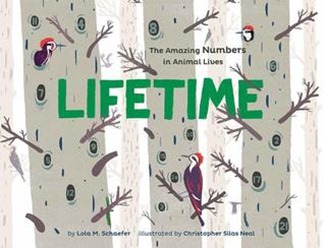
Take a unique look at what animals will do in a single lifetime in this book that combines counting, math and fascinating scientific facts.  The book focuses on how many times a single animal will do a behavior during their life.  The facts are based on estimations and opens with a description of how the numbers were figured out and explaining that each individual animal will be different than the estimate.  The book opens with one spider’s egg sac, the sole one she will create in a lifetime.  It then goes to the ten antlers that a caribou will grow and shed and moves on by tens.  The book ends with one thousand tiny baby seahorses, the number a single male seahorse will carry and birth. 

This is a spectacular way to introduce averages to children and estimation.  It is a celebration of the information that mathematics can provide to us about nature.  Schaefer has selected a wide variety of animals and intriguing facts about each of them.  Readers can find more in-depth information on the animals at the back of the book.  They will also find more information on averages and math there. 

Schaefer’s art adds to the appeal of this book.  Her illustrations have a boldness to them, a graphic quality that really works.  They are flat and vibrant, clearly laying items on the page for counting.  The book is a joy to page through since each page offers a new animal, a new habitat to see.

One of the most visually stimulating and smart concepts for a nonfiction picture book, this one is sure to beat the averages and be read more than once.  Appropriate for ages 4-6.

Reviewed from copy received from Chronicle Books.
Review: How To by Julie Morstad

how to

How To by Julie Morstad

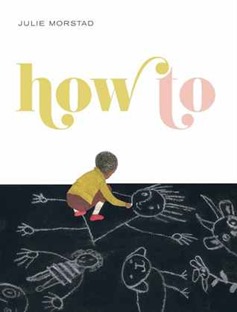
This “how to” book does not describe mechanical endeavors, instead it is a luminous look at an eclectic collection of activities.  They include how to look like a mermaid, how to see the wind, and how to go slow.  Others are straight-forward ideas but the image shows a more inventive solution.  How to wash your socks has children dancing in a puddle wearing socks.  How to make friends is the cover image of a child drawing people with chalk.  The result is a book that is an elegant and lovely exploration of the creative.

Morstad creates beautiful books and this is no exception.  Here again she mixes a quiet sense of wonder into the book and combines it with gorgeous illustrations.  She uses fine lines, particularly when drawing the children on the pages.  Their hair and faces shine with the attention she has given them.  The ideas in the book are all creative and inviting.  This is a book that will entrance some children while others will be looking for more action.

Ideal for creative children who look at the world from a more whimsical point of view.  They will make friends in these pages.  Appropriate for ages 3-5, perfect for adults too.

Reviewed from library copy.

Review: The Misadventures of Salem Hyde by Frank Cammuso

misadventures of salem hyde

The Misadventures of Salem Hyde: Spelling Trouble by Frank Cammuso

This is the first book in an upcoming graphic novel series for children in elementary school.  Salem Hyde is a witch, so sometimes she misunderstands what the other kids at school are talking about.  She insists she is a good speller and goes on to prove it by casting a spell.  Unfortunately, the spell turned a teacher into an enormous dinosaur.  After that, Salem’s family decide that she needs an animal companion.  Salem thinks a unicorn would be perfect, but she gets a cat instead: a cat named Percival J. Whamsford III.  As his name indicates, he has a very different personality than Salem.  Let the fun begin!

Done in black and white illustrations, this graphic novel has the feel of a traditional comic strip rather than a graphic novel.  That is not a complaint, in fact I enjoyed the more Calvin and Hobbes feel to the book with moments that stood on their own and the whole telling a full story.  Cammuso’s art has a traditional vibe to it, one that will have mass appeal.  The humor is slick, funny and age appropriate offering silly moments galore.

A strong beginning to a new series, Salem Hyde should be welcome at all libraries as long as she doesn’t try to “spell.”  Appropriate for ages 7-9.

Reviewed from ARC received from Amulet Books.

Review: Hello, My Name Is Ruby by Philip C. Stead

hello my name is ruby

Hello, My Name Is Ruby by Philip C. Stead

Ruby is a little bird who is eager to make new friends.  So she introduces herself to every animal she meets.  She’s also eager to learn all sorts of things so she asks all sorts of questions.  Along her journey, she meets different birds who travel in different ways, a giraffe, and many more.  Finally, she meets a bird who doesn’t sing like Ruby does, but he has heard Ruby’s name before.  So he takes her there and suddenly Ruby fits in, but a little bird like Ruby is completely unique so she manages to stand out anyway.

Filled with the same solid writing and art as his previous books, Stead has created a shining new protagonist here in little Ruby.  She is so similar to many children who are fearless when meeting strangers and eager to have conversations about anything at all.  There are many children who will see themselves and their energy in Ruby.  Stead puts page breaks at wonderful points in the story, creating stand-alone moments of flight and friendship that are exceptional.

As always, Stead’s art is stellar.  He manages in just a few lines and the tip of a head to capture Ruby’s spirit and vibrancy.  In the end, the range of Ruby’s friends is shone as a group and the image just sings.

A tiny but oh so impressive little bird will steal your heart in this vibrant picture book. Appropriate for ages 3-5.

Reviewed from copy received from Roaring Brook Press.

Judging the Cybils

cybils

I am ecstatic to be joining the Round 2 Judging Panel for Young Adult Speculative Fiction at the 2013 Cybils.  Having done Round 1 in previous years, I have the utmost respect for the vast amount of reading the first round judges have to accomplish.  I am also very pleased that the amazing Sheila Ruth is once again the coordinator for the category. 

Here are the other judges.  I look forward to working with all of the others in Round 2!

Round 1

Sheila Ruth, Wands and Worlds
http://blog1.wandsandworlds.com
@sheilaruth

Tanita Davis, Finding Wonderland
http://writingya.blogspot.com

Hallie Tibbets,Undusty New Books
http://www.undusty.com
@hallietibbetts

Leila Roy, Bookshelves of Doom
http://bookshelvesofdoom.blogs.com
@bkshelvesofdoom

Karen Jensen Teen, Librarian’s Toolbox
http://www.teenlibrariantoolbox.com
@tlt16

Patrice Caldwell, Whimsically Yours
http://whimsicallyours.com/
@whimsicallyours

Sarah Gross, The Reading Zone
http://thereadingzone.wordpress.com
@thereadingzone

Round 2

Sam Musher, Parenthetical
http://www.parenthetical.net
@MsParenthetical

Tasha Saecker,Waking Brain Cells
http://wakingbraincells.com
@tashrow

Tirzah Price,The Compulsive Reader
http://thecompulsivereader.com
@compelledtoread

Kimberly Francisco,Stacked Books
http://www.stackedbooks.org
@kimberlymarief

Karin Perry, Karin’s Book Nook
http://www.karinsbooknook.com
@kperry

Review: This Is the Rope by Jacqueline Woodson

this is the rope

This Is the Rope: A Story from the Great Migration by Jacqueline Woodson, illustrated by James Ransome

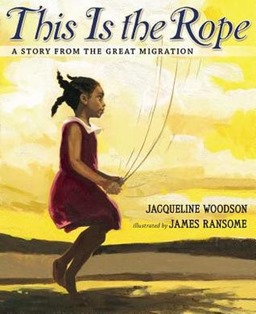
Based on Woodson’s own family, this is the story of how one piece of rope serves as a symbol for the changes that came during the Great Migration of African Americans from the rural south to northern cities.  One little girl tells the story of how her grandparents moved to New York City, using the rope to tie their things to the top of the car.  The rope was used to tie up the drying flowers from their window boxes that reminded them of home.  It was used by the little girl’s mother to tug her toys and play jump rope.  It tied her mother’s belongings to another car when she went off to college.  Then it was used for more jump rope with the little girl and in the end to support the banner for their family reunion.  In the end, it was returned to the original grandmother in exchange for a new rope to jump with. 

Woodson adheres to a strict structure in this book that really makes it feel like folklore, connecting it verbally to other histories, other migrations, other families.  Each page begins with “This is the rope…” and then moves on to tell the next thing that the rope was used for in this changing family.  Turning the pages, readers can see the time change and the opportunities progress. 

Ransome’s illustrations are lovely.  His paintings capture light and its movement as well as the family as they change.  Most of them catch those fleeting moments of life, each connected by the symbol of rope.  The result is a rich and warm series of memories.

Beautifully written and illustrated, this book captures a period of time not seen in most picture books and a story of one family’s history.  Appropriate for ages 5-7.

Reviewed from copy received from Nancy Paulsen Books.

National Book Award Longlist for Young People’s Literature

The National Book Awards announced its first longlist today with the ten finalists for the 2013 award for Young People’s Literature.

Here is the list:

Boxers & Saints Boxed Set Far Far Away Flora and Ulysses: The Illuminated Adventures

Boxers & Saints by Gene Luen Yang

Far Far Away by Tom McNeal

Flora & Ulysses by Kate DiCamillo

Picture Me Gone The Real Boy The Summer Prince

Picture Me Gone by Meg Rosoff

The Real Boy by Anne Ursu

The Summer Prince by Alaya Dawn Johnson

A Tangle of Knots The Thing About Luck

A Tangle of Knots by Lisa Graff

The Thing about Luck by Cynthia Kadohata

The True Blue Scouts of Sugar Man Swamp Two Boys Kissing

The True Blue Scouts of Sugar Man Swamp by Kathy Appelt

Two Boys Kissing by David Levithan

Review: The Book of Lost Things by Cynthia Voigt

book of lost things

The Book of Lost Things by Cynthia Voigt

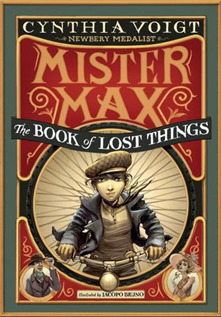
  Max’s parents who were both well-known actors had been invited to Kashmir, India to start a theater troupe there.  They planned to take Max along with them but then they disappear.  The ship they were meant to take does not exist and they are simply gone.  That left Max with just his grandmother to care for him, but Max knew that if he was well-cared for, his grief would be too much to bear.  Instead he moved back to his family home, across the garden from his grandmother, and had to find a way to earn his keep.  It was through that that he stumbled upon a job at which he was exceptionally good:  being a detective or as Max preferred, a “solutioneer.” 

Set around the turn of the 20th century, this novel has a strong, brisk pace that is invigorating.  Max is a character who is bright, curious and always thinking.  Voigt populates his life with many other interesting characters, including is wonderful librarian grandmother, the various people he helps find solutions for, and even one demanding baby.  The entire book is a vibrant historical fiction that will have great appeal. 

One of my favorite aspects of the novel is the use of painting and creativity as a way to allow your brain space to think and figure things out.  Max is a painter, creating watercolors of the sky during different seasons.  It is this artistic outlet that is a big key to his success and creative thinking.  Voigt ties the two together clearly and also gives other characters creative outlets that make them even more well-rounded.

The first book in a new series, this book is a delight of mysteries, solutions, theater and historical fiction.  Appropriate for ages 10-12.

Reviewed from ARC received from Knopf Books for Young Readers.

Review: Mr. Tiger Goes Wild by Peter Brown

mr tiger goes wild

Mr. Tiger Goes Wild by Peter Brown

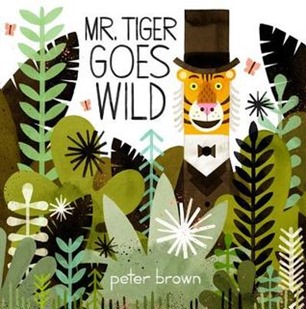
Mr. Tiger was bored with the proper life he was living.  Filled with tea and stilted conversation each day, he longed to get wild.  Then one day, he does just that by starting to walk on four legs instead of two.  He felt better immediately.  And each day, got wilder yet: roaring, casing people, bounding across rooftops.  Then he took it one more step and left his clothes behind.  The other disapproved and sent him off to live in the wilderness unless he could change back and act properly.  So Mr. Tiger headed off.  The wilderness was glorious and Mr. Tiger went completely wild.  However, he also missed the people he left behind in town.  When he headed back to society though, he found that he’d had quite an impact without even knowing it.

This is a stellar picture book.  Brown tells a story that all children can relate to, that of being too wild and too loud and not acting appropriately.  The storytelling is exemplary with perfect pacing and plenty of humor.  That story is well-matched with the bright and bold illustrations.  From the get-go the orange of Mr. Tiger pops from the page, particularly when everything else is dirty sepia toned.  There are glorious moments, including the one where Mr. Tiger is wearing no clothes at all. 

This picture book is a welcome antidote to books on manners.  After all, we all need more wild in our lives.  Appropriate for ages 3-5.

Reviewed from library copy.