Review: Listening for Lucca by Suzanne LaFleur

listening for lucca

Listening for Lucca by Suzanne LaFleur

Siena and her family move to Maine from Brooklyn to help her little brother Lucca.  He doesn’t speak, using only gestures to communicate with them.  Siena isn’t sad to move, since she didn’t have lots of friends to leave behind.  Maine should be a new start for all of them.  When they arrive at their big old house on the beach, the family gets to work fixing it up.  But both Lucca and Siena believe that the house is haunted by a family that used to live there.  Siena finds a pen on a high shelf in her closet that seems to connect her to a young girl who used to live in the house.  She also dreams about the girl’s brother Joshua as he fights in World War II.  The stories of the two families have striking similarities that give Siena the idea that she may be able to not only fix the present but also the past.

I adored this book.  LaFleur tells a story of mystery and ghosts where the past is just as alive and changeable as the present.  Throughout the book has a sweetness and wistfulness to it that makes it a pleasure to read.  I also appreciated the way that Siena has a tie to the past through her collection of lost items.  LaFleur builds her story carefully, so that each element makes an innate sense as it happens.  Beautifully done.

The characters are strongly written.  Siena is a heroine who can be prickly at times, but has the courage and talents to make a difference.  She is an incredible older sister, loving and attentive, but is much more critical of herself.  Her parents and younger brother are just as fully realized in the story.  The friends that Siena makes in town all also have touches that make them whole as people.

This lovely book transcends genres with its mix of mystery, historical fiction, and fantasy.  It’s a winning combination.  Appropriate for ages 9-12.

Reviewed from digital galley received from Edelweiss and Wendy Lamb Books.

Review: Little Owl’s Orange Scarf by Tatyana Feeney

little owls orange scarf

Little Owl’s Orange Scarf by Tatyana Feeney

Little Owl lived with his mother on the edge of Central Park.  He loved lots of things like ice cream and riding his scooter, but he did not like his new scarf.  First of all, it was orange.  Second, it was itchy.  Third, it was way too long.  So Little Owl avoided wearing it whenever he could, but his mother kept on finding it and having him wear it anyway.  Nothing worked!  Then Little Owl took a class trip to the zoo and came back without his scarf.  It was lost for good this time.  So Little Owl helped his mother make his new scarf.  He loved it.  First of all, it was blue.  Second, it was soft.  Third, it was just the right size.  It was even perfect for visits to the zoo.

Feeney has struck just the right tone with this picture book.  Happily, it does not come off as whining but as a child who just does not like an article of clothing.  His attempts to lose the scarf or at least give it away are clever and cute.  The working together with his parent to create a new scarf is a smart turn in the story that leads to satisfaction for everyone.  When the little twist at the end is revealed, the story is entirely satisfying.

The art is kept very minimal and simple.  I must mention that the orange in the hardcover version I have is much more bright and intense than the cover above shows.  The entire book is done in black lines, orange and teal, making the colors very important.  The black lines are done with curls and playfulness that add to the light touch of the story as a whole.

Light and fun, this is a book that will work well at toddler story times, especially on winter days with scarves of their own.  Appropriate for ages 2-4.

Reviewed from copy received from Random House Children’s Books.

The Kissing Booth–The Movie

The Kissing Booth

ScreenDaily has the news that Random House Children’s Screen Entertainment has optioned the worldwide film and TV rights for The Kissing Booth by Beth Reekles.  Originally self-published online, the book was then issued as an e-book and finally as a print book. 

Review: Starglass by Phoebe North

starglass

Starglass by Phoebe North

Terra lives with her abusive, drunken father aboard the Asherah, a spaceship the size of a city.  Hers is the generation that will finally arrive at their destination planet after traveling for over 500 years in space.  Terra’s mother died of cancer, a disease completely unknown on the ship before her death, leaving Terra with her absent older brother and cruel father.  Terra is now 16 and assigned to a job, botanist, though she had wanted to be an artisan because she loves to draw.  Her father doesn’t approve of her art and Terra does not enjoy her dull work as a botanist.  Soon Terra is being courted by her father’s apprentice and is drawn into a mutinous scheme to change the hierarchy aboard the ship.  Her work as a botanist is also getting more interesting.  What more could a girl want than romance and a good job?  Terra definitely wants more, she wants answers.

Out of a standard spaceship story foundation, North has crafted something very special.  This small city-sized spaceship is filled with secrets, ones that spell freedom but also ones that can kill.  Yet the story is less about the endless travel and the claustrophobia of a closed society and much more about one young woman, her choices and the way in which an individual can impact the community around them.  It is a story of opportunities both good and bad, choices that are impossible to make, and a responsibility beyond oneself. 

North has woven Jewish traditions into the story and carefully changed them as if the passage of time had both torn at them but also strengthened parts of them.  The community on the ship is cohesive but deeply fractured.  It is this society that makes the book very compelling.  It is also Terra herself too, a young woman deeply grieving the loss of her mother and seemingly without any choices in life.  Yet she finds strength to fight back, to choose and to love on her own terms. 

Startling, beautiful and richly written, get this one into the hands of science fiction readers.  Appropriate for ages 15-17.

Reviewed from digital galley received from Edelweiss and Simon & Schuster Books for Young Readers.

Review: Toys in Space by Mini Grey

toys in space

Toys in Space by Mini Grey

A group of toys are left outside overnight for the first time.  There is Wonderdoll, a robot, a cowboy and horse, a dinosaur, a sheep, and a rabbit.  All of them left in the dark, gazing up into the starry sky.  They are all scared, but then Wonderdoll starts to tell a story.  It is a story of seven toys left out at night under the stars, but then one star gets bigger and bigger until they can see that it is actually a spaceship!  The seven toys are beamed aboard the spacecraft and meet a glove-shaped alien who is missing his own favorite toy.  He has gathered toys from all around the world and kept them, but has not found his toy yet.  The seven toys help the alien figure out that he has to return the toys to earth and even throw him a party to cheer him up.  But will the alien ever find his own Cuddles again?

This picture book has the winning touch of Mini Grey.  She is always fearless in her storytelling and deeply understands the connection between child and toy as shown in her Traction Man books as well.  It also has the great combination of toys and aliens!  The story is wonderfully playful and children will wonder if it really happened right up to the very end. 

Grey’s art adds to the playful feel.  Each toy has its own personality visually but the seven together make quite the team.  She nicely incorporates speech bubbles into the story, giving it a comic feel that works well with the light-hearted art. 

Sure to be a hit with its combo of aliens and toys, this book will work well at a story time, or for cuddling after all the favorite toys are tucked in too.  Appropriate for ages 3-5.

Reviewed from copy received from Random House Children’s Books.

Review: Papa’s Mechanical Fish by Candace Fleming

papas mechanical fish

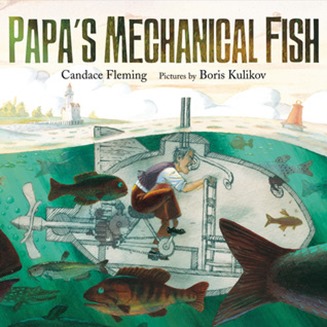
Papa’s Mechanical Fish by Candace Fleming, illustrations by Boris Kulikov

Based on a true story, this picture book reads more like a far-fetched fantasy.  Papa is an inventor but has never made anything that works.  All he needs is one incredible idea, but they don’t come easily.  So the family takes a trip to the lake where one of the children, the narrator of the book, asks what it is like to be a fish.  That gives Papa the incredible idea he was looking for.  The first version of his mechanical fish is so small that Papa himself can barely fit into it.  It almost works.  The second version is bigger and has a fin and a propeller and seats two people.  It almost works.  Whitefish III is even bigger, seats three, and is covered in copper.  It almost works too.  The fourth version is huge, fits the entire family, and…  Well, you just have to read the story to see how it ends.

The whimsy of these inventions is a large part of what makes this book so successful.  From the slow progress of the machines from one version to the next to the joy of seeing them tried out in the story, this is a book where you must find out what happens next.  Fleming has also written a charming story of a family that supports the inventor.  There is a rhythm to the story that makes it a pleasure, each attempt and failure met with similar satisfying responses from his family.  This makes the book work for a larger age range and makes reading it all the more fun.

Kulikov’s illustrations are a mix of realistic illustrations, huge fish that float past as inspiration in the water, and blueprints that let you glimpse the inside of each version of the submarine.  The entire book has a wonderful frantic quality to it, engaging the reader right in the moment of Aha! and then through the different trials. 

A treat of a book, this book will be inspiring to young engineers and inventors.  Appropriate for ages 5-8.

Reviewed from library copy.

Review: When Stravinsky Met Nijinski by Lauren Stringer

when stravinsky met nijinsky

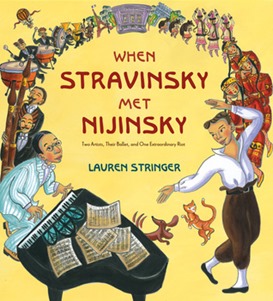
When Stravinsky Met Nijinsky: Two Artists, Their Ballet and One Extraordinary Riot by Lauren Stringer

This is the story of how two Russian artists collaborated to create a revolutionary new ballet, The Rite of Spring.  When the two artists met one another, each of them started to change.  Stravinsky’s music changed and Nijinsky’s dance changed.  They inspired one another to try something entirely new and created a ballet based on Russian folk dances and folk songs.  Even at rehearsal, some of the musicians walked out, but enough stayed so that the show could go on.  When the ballet was first performed, the crowd was split.  Some people loved the new music and dancing, others were shocked and hated it.  The crowd took to the streets to continue to express their anger and appreciation.  This is a great picture book biography that captures the magic of creativity that results when two masters collaborate on something brave and new.

Stringer’s writing takes a complicated story and distills it to the most important points.  Young readers will quickly understand that the two men brought new ideas out of one another, finding each other inspiring.  Her art also speaks to the collaboration of these two men, using flowing lines and deep yet soft colors.  She inserts elements from the art of the time, referencing movements like cubism in both her text and art.  The end of the book has photographs of the two artists and dancers in the ballet.  It also has a longer look at their collaboration. 

A great choice for art and music classes, I’d recommend listening to The Rite of Spring with the group too.  Appropriate for ages 6-8.

Reviewed from library copy.

Review: Crankee Doodle by Tom Angleberger

crankee doodle

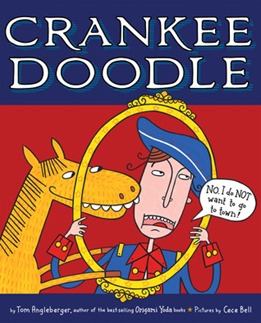
Crankee Doodle by Tom Angleberger

Brace yourself for a picture book that is entire silliness and proud of it!  In a riff on Yankee Doodle, this story tells readers that it was all the pony’s idea.  Yankee Doodle is bored and goes off on rants about how he doesn’t want to go to town or go shopping.  Then the pony suggests a feather for his cap, which starts another rant.  The pony finishes with a suggestion to call it macaroni.  After that rant, he explains that macaroni is another word for fancy, and that Yankee Doodle may want to call it lasagna instead.  In the end, the two of them head off to town, just like the pony wanted all along.

Angleberger writes with such a wry sense of humor here.  The rants by Yankee Doodle are a hoot to read aloud, the text heavy with indignation and exclamation points.  The sly pony seems to know just what he is doing as he lets Yankee Doodle blow off steam but gets his own way in the end.  The book ends with a historical note about the real history of the song.

The illustrations are done in gouache with a thick black line and bold colors.  The entire book pops visually and will work with larger groups of children thanks to its clarity and strong shapes. 

This one is a winner for story times.  Expect guffaws from children who know the song!  Appropriate for ages 4-6.

Reviewed from library copy.

Review: Becoming Babe Ruth by Matt Tavares

becoming babe ruth

Becoming Babe Ruth by Matt Tavares

This biographical picture book takes a look at Babe Ruth’s formative years.  It is the story of a small boy named George Herman Ruth who gets into lots of trouble, so much that his father puts him into Saint Mary’s Industrial School for Boys.  There he has to follow the rules and work hard.  Happily, there is also baseball and George gets to play it almost every day.  Best of all, there is Brother Matthias who serves as an inspiration and mentor for George’s baseball game and life.  As George gets better and better, he is finally whisked into the world of major league baseball, but he never forgot the school and the man who got him there. 

Tavares writes in such an engaging way that the pages fly by.  The sudden sternness of the school is told in short, abrupt sentences that enforce the martial feel of the establishment.  That contrasts directly with the long sentences that talk about the beauty of baseball.  Readers can almost feel themselves taking a big gulp of freedom on those pages. 

The joy Tavares feels about his subject is also palpable.  From eating ice cream with the boys from the school, to tipping his hat to them as he walks on the field, to the pleasure of hitting a ball, all are captured with a fondness and pleasure in the paintings that are the illustrations in the book. 

This is a baseball biography that children will find accessible and fascinating.  Play ball!  Appropriate for ages 6-9.

Reviewed from library copy.