Rating Teen Reads – A Rant

No, this isn’t about me starting a system on my blog to rate the books I read with a series of stars.  Instead it’s about the insidious suggestion by Brigham Young professor, Sarah Coyne, that books for teens should have rating labels on them.  It’s enough to make my librarian skin crawl.

Coyne checked teen novels for profanity in five different categories.  All but five of the books she looked at had at least one instance of profanity.  (Though I must point out that “hell” and “damn” are included in her list of profane words.)

First, let me say that I’m opposed to labeling books at all.  But really, profanity??  Not sexual acts, not violence?  But instead the damns and the hells and the transient but powerful words we use to express emotions?  What the…

Second, I have to relate my own story of reading a Judy Blume book.  I loved Judy Blume as a pre-teen and read book after book by her in a single summer.  I found Deenie and loved the storyline of a girl who wanted to be a model and had to deal with being in a back brace.  But as a younger reader, I completely (and I mean completely) missed the section on masturbation.  I missed it so thoroughly that when I later heard about that being in the book, I was confused and baffled.  I reread it as a teenager, and by golly, there it was!

No labels necessary, no parent needing to intervene.  Books are special that way.  They are patient, waiting for you to be the right age and then they change along with you.

And for those of you who think that the four letter words are different, I was an voracious reader and still needed to have someone on the school bus draw what the F-word meant.  Then I got to teach her the medical terms my mother used for those parts of the body.  We all learned something that day.

Another wrinkle is what we do with the adult books that teens are also reading.  I read Stephen King as a teen, hauling his huge tomes along with me.  I read adult romance novels that my mother didn’t approve of at all and that the librarians in my small town library also frowned at but let me check out.  I read Ivanhoe, Gone with the Wind, Something Wicked This Way Comes, and any book that caught my fancy.  And I would have read them despite any labels, and perhaps even because of labels.

And what happened to me?  I became a lover of books, a librarian, a book blogger, and a mother who would let her teenage son read anything that he wanted.  Labels or not, he can read it.  Just like I did.  If it makes him into a reader, especially one who takes risks and learns about the way others think and feel, then I say: Hell Yes!
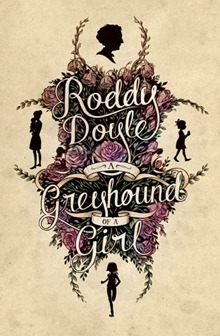
Review: A Greyhound of a Girl by Roddy Doyle

greyhound of a girl

A Greyhound of a Girl by Roddy Doyle

Four generations of a Dublin family come together in this ghost story.  Mary is a modern Dublin pre-teen who finds herself moving away from her childhood rituals but also wanting to cling to them too.  One day on her way home from school, she meets Tansey, a woman who wants her to give a message to her grandmother.  Mary forgets, distracted by visiting her grandmother in the hospital with her mother.  So it isn’t until later that she mentions the woman to her mother, who pales at being told the name, Tansey, because that was her own grandmother’s name.  Soon Mary is having her mother meet Tansey and her relationship is revealed as is her status as a ghost.  The three of them conspire to get Tansey and her daughter together again, even though Tansey can’t survive the harsh lighting of the hospital.  The result is a road trip filled with hellos, memories, family stories, and goodbyes.  Richly layered, this slim volume holds a grand tale.

Doyle plays with the format of a ghost story here, at first starting with a little shiver and danger and then turning the story into that of a family that has dealt with an early death for generations.  It is a story of maternal love and the connections of women in a maternal line.  It is also the story of loss, death and above all, life.  Doyle creates fascinating characters, particularly in the two older women, Tansey and Emer.  Their stories have a pastoral beauty, a vivid warmth, and yet are damaged by death.  It is poignant, lovely and tragic.

The story is character driven and told in a slow, transformational way.  It takes its time, filled with small moments of lives, hands wrapped around tea cups, children on laps, slow steps up stairs for the last time.  Yet it is not a slow story, it is engaging, rich and builds a mood that is inescapable and memorable.

I loved this little book and the world that it created that seemed just for me.  Doyle’s writing is confident and beautiful, meticulously crafted.  This is a ghost story but so much more as well.  Appropriate for ages 11-13.

Reviewed from ARC received from Amulet Books.

2011 Andre Norton Award Winner

The 2011 Nebula Winners have been announced.  As always, teens will enjoy many of the science fiction and fantasy winners for adults, but happily there is also a category just for young adult books: The Andre Norton Award for Young Adult Science Fiction and Fantasy.

The winner is:

The Freedom Maze by Delia Sherman

Other books on the shortlist were:


Akata Witch by Nnedi Okorafor

The Boy at the End of the World by Greg van Eekhout

Chime by Franny Billingsley

Daughter of Smoke and Bone by Laini Taylor


Everybody Sees the Ants by A.S. King

The Girl of Fire and Thorns by Rae Carson

Ultraviolet by R. J. Anderson

Review: The Conductor by Laetitia Devernay

conductor

The Conductor by Laetitia Devernay

This wordless picture book is tall and narrow, just like the trees featured within.  A man enters a forest of trees that are shaped like lollipops with long trunks and round tops.  He climbs to the very top of one tree and raises his hands.  Suddenly, birds start to appear, formed from the leaves of the trees.  They fly off leaving holes in the tree leaves shaped like them.  The leaf patterns are on their wings and they fly above the conductor in a variety of formations.  Until eventually they are gone, and all that are left are the blank trees.  The man climbs down and plants a seed that quickly grows into a tree.  As he is planting, the birds return to the trees, covering them once again in leaves.  The man leaves the forest just as he has found it, but with one more small trees.  It’s a beautiful look at the environment and the impact humans can have if they choose.

The art here is wonderfully done.  It has a limited palette of just yellow, green, black and white.  The juxtaposition of tree leaves and flying birds is spectacular visually and surprising at first.  It lifts the book to a more surreal place, a world where you are unsure what could possibly happen next.  The fine lined art, the scale of the book and the gentle theme all work well together, creating a memorable whole.

A surprising wordless picture book that is a work of art, this book would work well in art curriculum or as a quiet, beautiful book to share.  Appropriate for ages 3-5.

Reviewed from copy received from Chronicle Books.

Review: Hippopposites by Janik Coat

hippopposites

Hippopposites by Janik Coat

This clever board book takes a hippo and runs through a variety of opposite pairs with him.  There are light and dark hippos, dotted and striped hippos, soft and rough hippos, small and large hippos.  Then there are the more intriguing opposites like opaque and transparent, positive and negative, clear and blurry.  My favorite opposite pairing is the front and side, which made me laugh out loud with surprise.  Something that rarely happens with board books!  This is truly a modern, hip board book that will be enjoyed not only by young children but also their parents.

Coat makes this book dynamic and modern with her very solid graphic skills.  She has a wonderful quirky sense of humor that is on display throughout the book and that combined with the strength of the simple illustrations makes this book a winner.  I also like the limited color palette and the simplicity of the page design, which will work particularly well with infants.

Have a cool friend expecting a baby?  This book would make an ideal gift.  It will also be a great addition to the myriad of pastel board books on library shelves.  Appropriate for ages birth-2.

Reviewed from copy received from Abrams Appleseed.

This Week’s Tweets and Pins

Here are the links I shared on my Twitter and Pinterest accounts that you might find interesting:

You can also see more library and e-book related posts here on my Sites & Soundbytes blog.

1 in 10 Million: PW Talks with Garth Nix http://j.mp/IZJPvd #yalit

Bedtime rituals: Where the wild things still are http://j.mp/KhP5b6 #kidlit

Fresh Approaches: Happy Anniversary! Celebrate Favorite Characters with New Editions http://j.mp/Jas4eb #kidlit

In A Glass Grimmly (A Tale Dark & Grimm #2) by Adam Gidwitz – Squee! So looking forward to this one! http://j.mp/Jaqw3P #kidlit

Laurel Snyder » Blog Archive » A meditation on my fierce love of picture books… http://j.mp/IZJ99e #kidlit

Newbery Winner Jean Craighead George Dies at 92 http://j.mp/LTbywV #kidlit

Of pigeons and naughty kids http://j.mp/KnrEkv #kidlit

So thrilled to see that SON by Lois Lowry is coming out this fall! And with a starred review from Kirkus too! http://j.mp/JanjkP #kidlit

Summer reading recommendations — The Horn Book – great summer reading suggestions for all ages – http://j.mp/Ji8tDj #kidlit

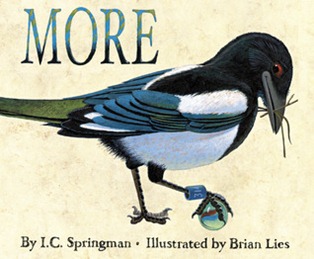
Review: More by I. C. Springman

more

More by I. C. Springman, illustrated by Brian Lies

The book opens with a dejected magpie who has nothing at all.  Then a mouse gives him a marble that he takes to his nest.  Soon the marble is joined by a few other toys.  Then more and more, until there are so many things that the magpie has filled all sorts of nests in the tree with them.  Finally, the magpie adds one little penny to a nest and the branch cracks.  He has much too much now!  Everything tumbles to the ground, burying the poor magpie in his treasures.  The mice appear to dig him free and the pile becomes less and less as they work.  In the end, the magpie selects a few items to keep and lets the rest go, leaving with just enough.

This book is written in very spare language with only a few words per page.  They are all concept words, moving from nothing to everything to enough.  In between, there are terms like more, much, and less.  The dynamic illustrations really carry the story.  The magpie’s facial expressions range from greed to shock to satisfaction, all playing out nicely just in the shine of an eye and the curve of a bill.  Space is also played with in the images, speaking to the freedom of having just enough and the clutter of having too much.

This picture book deals directly with the idea of downsizing or having just enough toys and not too many, something that many children struggle with.  It is also a creative concept book that will work to teach those concepts through humor.  Appropriate for ages 2-4.

Reviewed from library copy.

Review: That’s Not a Daffodil by Elizabeth Honey

thats not a daffodil

That’s Not a Daffodil by Elizabeth Honey

When Tom’s neighbor gave him something that looked like an onion and said it was a daffodil, Tom was very skeptical.  Mr. Yilmaz told him to plant it to find out.  So they planted it in a large pot and Tom waited, and waited, and waited with nothing happening at all.  When Mr. Yilmaz asked how the daffodil was doing, Tom answered that it was not a daffodil, it was a desert.  So the two watered the pot.  Later, Mr. Yilmaz asked again and Tom said that the small green point sticking out of the dirt was a green beak, not a daffodil.  The beak slowly began to open.  Soon the daffodil looked more like a hand, hair, and even a rocket!  It even survived being toppled over by a dog.  Until finally, Tom gets to show Mr. Yilmaz exactly what that onion turned into.

Not only does this book perfectly capture the wonder of gardening with children with the impossibly long wait for results, but it also offers a beautiful zip of creativity along with it.  As Tom learns about patience with his daffodil, he also incorporates it into his playing.  The writing is simple and straight forward, yet has a sense of playfulness too.

Honey’s illustrations appear to be a mix of watercolor and pastels that have a homey warmth.  They also have a great texture that works well for the rough ground, dirt in the pot, and sweater knit.  At the same time, the watercolor smoothness plays against that. 

A sweet book about patience, gardening and creativity, this book would make a great addition to springtime story times.  Appropriate for ages 3-5.

Reviewed from library copy.

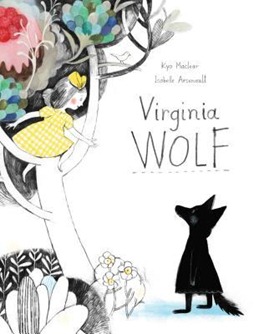
Review: Virginia Wolf by Kyo Maclear

virginia wolf

Virginia Wolf by Kyo Maclear, illustrated by Isabelle Arsenault

This picture book is loosely based on the life of Virginia Wolf and her sister.  Adults will enjoy the tie-ins, but they are not necessary for children to understand in order to enjoy the book.  It is a story told from Vanessa’s point of view.  Virginia was having a “wolfish” sort of day where nothing pleased her and any sort of noise bothered her.  Vanessa tried to talk with her and discovered that Virginia was dreaming of a far-away perfect place to be.  So Vanessa snuck away and found art supplies and paper to create that world for her sister.  Soon her walls were covered in birds, butterflies, flowers and color.  There was even room for a wolf to wander.  Virginia’s mood lifted and she was ready to play once again. 

This book takes a direct look at depression but can also be used for more transient moods of children.  The author’s writing is rich and beautiful.  When Virginia first gets depressed, she explains it this way: “The whole house sank.  Up became down.  Bright became dim.  Glad became gloom.”  When Vanessa paints the garden it is described this way: “I painted leaves that said hush in the wind and fruit that squeaked and slowly I created a place called Bloomsberry.  I made it look just the way it sounded.”  This is a book that not only has art as a solution and an escape, but also has art in the writing itself.

Arsenault’s illustrations have a wonder to them that is astonishing.  Done in mixed media of ink, pencil, watercolor and gouache, the images play with darkness and light with a fearlessness.  Color is used sparingly at first, then when the art appears it is lush and vibrant.  One completely understands the way that art can lift a person.  Perhaps my favorite small detail is that the art at first when seen through Vanessa’s eyes is adult, lush and fine lined.  Later when glimpsed in retrospect, it has a childlike quality to it instead. 

This picture book is a small work of art that speaks to the power of creativity and art to lift moods.  Appropriate for ages 5-7.

Reviewed from copy received from Kids Can Press.