Review: The Herd Boy by Niki Daly

herd boy

The Herd Boy by Niki Daly

Malusi looks after his grandfather’s sheep during the day, taking them grazing and also protecting them from predators.  Malusi has to be able to work in the heat of the sun, keep the sheep away from the ravine, and keep close watch for snakes and baboons.  His friend Lungisa is also a shepherd but he has his own dog, something Malusi wishes for.  He also dreams of becoming something more than a herd boy, maybe even president! 

Daly weaves in African details to create a setting and society in this picture book.  The details are small but vibrant such as the food, the animals out in the wild, the landscape, and language.  She uses a few words and phrases of throughout the book, just enough to add some African spices to the tale.  Using poetic language, she draws the strong character and large dreams of Malusi clearly.  He is a young hero with large responsibilities and a willingness to lead.

Daly’s art embraces the landscape of Africa with ravines and hills framing the page, eagles soaring in the sky, and distinctive plants in the foreground.  There are full color images but also sepia toned ones that show small touches of the story as well.  The large format of the full-color images make this book good for sharing with a group.

Thanks to the beauty and depth of Daly’s writing, this picture book trends a little older than many.  It will also lead to interesting discussions with slightly older children.  Appropriate for ages 6-8.

Reviewed from copy received from Eerdmans Books for Young Readers.

Review: Laugh with the Moon by Shana Burg

laugh with the moon

Laugh with the Moon by Shana Burg

After her mother dies, Clare’s father takes her to Malawi where he had worked as a young doctor.  Clare is determined to never speak to her father again.  She has lost not just her mother, but her best friend and the potential for her first boyfriend at school.  Now she is stuck in Africa where there is little hot water, mosquito netting over the bed, and monkeys screaming outside.  As Clare starts to relax into life in Africa, she begins to make incredible friends at her new school.  Memory, a girl from the local village, quickly becomes her closest friend.  Memory too has lost her mother, though the girls don’t speak of their losses together.  Memory makes sure that Clare has things that she can eat, explains the school day to her, and even warns her of the bully in class.  As Clare faces her new school with its new language, visiting chickens, and scurrying insects, her relationship with her father starts to get better.  Clare still has big issues to face, including teaching English, putting together a play, and another large loss in her life.

Burg truly brings Malawi to life with its strong culture, the stark differences between America and Africa, and the warmth of the people.  Her writing is an invitation to explore Africa.  She celebrates both the differences in cultures and the universal aspects of life, filling the book with details that paint a full picture. 

Clare is a complex character, grieving from the loss of her mother, at first she seems remote and difficult to relate to.  Happily, she soon grows past that, becoming a vivacious personality with opinions and skills.  Her art forms a connection between her and other people who may not speak the same language, but it is her open personality that does the rest. 

The book would make a good choice for reading aloud in a classroom setting since it explores so many themes and topics.  There is plenty to discuss from death and grieving to dealing with living in another part of the world.  The glorious cover will get this moving from the shelf into young hands directly too.  Appropriate for ages 9-12.

Reviewed from copy received from Delacorte Press.

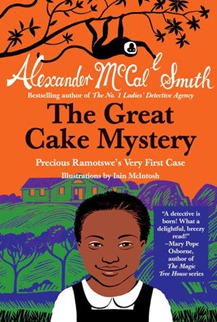
Review: The Great Cake Mystery by Alexander McCall Smith

great cake mystery

The Great Cake Mystery by Alexander McCall Smith, illustrations by Iain McIntosh

The author of The No. 1 Ladies’ Detective Agency series has written his first children’s book.  This one too stars Precious Ramotswe and is the story of her very first mystery as a child in Botswana.  When her father tells her a favorite story about when a lion got into their village, he notices that she has several characteristics of a detective: she asks a lot of questions and she can tell when people are telling the truth.  So when food starts disappearing at Precious’ school, she gets involved in solving the mystery.  She is shocked when one of her friends accuses another boy of being the thief because he has sticky fingers, literally.  It makes her even more determined to figure out exactly who is stealing the food. 

Told in very simple prose, sometimes a bit too simple, this story has a certain charm about it.  The book begins in a rather stilted way thanks to the wording, but quickly moves on to a more natural cadence that works much better.  I am pleased to see a mystery set in Africa with a young female protagonist who manages to solve the mystery without any adult help.  Smith captures the differences between societies as well as the special setting of Botswana.

McIntosh’s illustrations are block prints done in a limited color palette of red, black and gray.  They have a quality about them that speaks to the setting clearly.  They have a delicate and yet unfinished quality that is very appealing.

This book for young readers has plenty of mystery, detective work and an appealing heroine.  Appropriate for ages 6-9.

Reviewed from library copy.

Review: The Mother of Monsters by Fran Parnell

mother of monsters

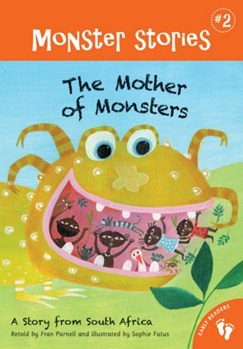
The Mother of Monsters: A Story from South Africa by Fran Parnell, illustrated by Sophie Fatus

This second in a series of monster tales features a story from South Africa retold for young readers.  It is the story of Ntombi, the mischievous and brave daughter of the chief, who is determined to see the dangerous Ilulange River with her own eyes.  Her father allows her the trip to the river as long as she takes the other girls along with her.  When they finally reached the legendary river, the girls are disappointed.  Instead of danger, they have found a river that looks perfect for swimming.  Leaving their clothes on the bank, the girls splash in the water.  Then they discover that their clothes are missing.  It could have been the Mother of Monsters who took them!  One-by-one the girls pled with the monster to return their things, and the monster does.  But Ntombi is not willing to beg for her clothing, so the monster swallows her whole.  But that is not the end of the story!  You must read this book to find out how Ntombi survives the Mother of Monsters.

Parnell has broken the story into chapters, making it all the more pleasant for beginning readers who can take the story a bite at a time.  The chapters are short and filled with action.  The star of the book, Ntombi, is both brave and foolish, often at the same time.  Throughout the story, she learns about humility but also about love.  The book is clearly from another culture, which makes it all the more interesting to read.

Filled with bright colors, the paintings by Fatus have an intriguing folk quality to them.  The scenes of the girls without clothing are handled with skillfully placed leaves, hands and flowers.  The illustrations have humor to them, which makes the book very playful, something that is welcome with a monster devouring people.

A welcome addition to folktales, this is a story I had never heard before and really enjoyed.  Appropriate for ages 6-8.

Reviewed from copy received from Barefoot Books.

Review: My Heart Will Not Sit Down by Mara Rockliff

my heart will not sit down

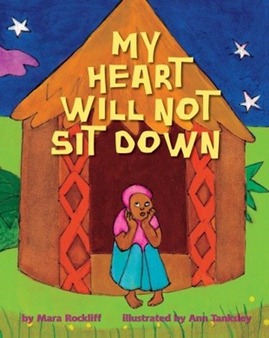
My Heart Will Not Sit Down by Mara Rockliff, illustrated by Ann Tanksley

Inspired by the true story of a village in Cameroon donating $3.77 in 1931 to the city of New York to help feed the hungry during the Great Depression.  In this picture book version of the story, the main character is Kedi, a girl who learns from her American teacher that people in his hometown of New York City were going hungry due to the Depression.  Kedi could not stop thinking of the hungry children in America, even though they lived so far away.  Her heart would not sit down until she did something.  So she talked with the grownups in her village and all of them told her at first that nothing could be done, they had no money to spare.  But then, one by one, all of the adults gave coins to help the hungry children. 

The author’s note at the end of the book, tells more about the Depression and about the donation too.  It explains that even in the Depression, this small amount of money would not have had a large impact.  But for the villagers who sent the funds, it would have been a fortune.  This book is a lesson in following your heart, finding compassion for others, and making an important difference in the world, even if it is just $3.77. Children will easily understand both the sacrifice made by the villagers and the meager amount that was raised.  It makes the story all the more haunting.

Tanksley’s illustrations have a roughness and organic quality that really grounds this story in reality.  Done in watercolor, pen and ink, and oils, they are filled with rich color and show the poverty and the beauty of Cameroon.

Throughout the book, the phrase “my heart would not sit down” is used.  It evokes a yearning, a calling, an inner distress that could only be quieted by doing something to help.  It’s that feeling that we need to cherish in both ourselves and our children.  It would also make a very good discussion book about what makes children’s hearts “not sit down.”

Based on a true story, this book is a call to follow our unquiet hearts.  Appropriate for ages 5-8.

Reviewed from copy received from Alfred A. Knopf.

Review: Under the Baobab Tree by Julie Stiegemeyer

under the baobab tree

Under the Baobab Tree by Julie Stiegemeyer, illustrated by E. B. Lewis

Brother and sister, Moyo and Japera, travel to a neighboring village to gather under the baobab tree, the tree of life.  Different people gather under the baobab at different times.  Sometimes the market wagon is there selling pots, pans and cloths.  Other times, the elders are gathered there talking.  Sometimes it’s a storyteller sharing stories.  As the children walk to the tree, they see all sorts of wildlife like weaver birds, gazelle, and a termite mound.  The siblings reach the baobab tree and more and more people join them, along with the minister and his Bible for church under the tree.

The setting of this book is clear from the very moment you open it.  For some people, from reading the title.  The setting stays true throughout the story, as details about Africa are woven into the story.  The children pass all sorts of creatures as they travel.  The different people under the baobab tree are shared in detail as well.  Clues about what will happen under the tree today are also shared in the text, so religion is tied nicely throughout as well.

Lewis’ art really make this book appealing.  He uses soft lines and almost gauzy colors to tell the story.  The watercolors seem to shimmer in the heat of Africa.  At times there is clarity in the images and great detail, other times the reader is moved further back and the scene itself is captured in its vastness and heat.

A picture book that embraces religion with a gentle touch, this book is a heartfelt welcome to Africa.  Appropriate for ages 4-6.

Reviewed from library copy.

Review: The Boy Who Harnessed the Wind by William Kamkwamba

boy who harnessed the wind

The Boy Who Harnessed the Wind by William Kamkwamba and Bryan Mealer, illustrated by Elizabeth Zunon

This picture book version of the nonfiction book manages to translate the story of William Kamkwamba with clarity and inspiration.  When a drought hit his village in Malawi in 2001 and 2002, 14-year-old William and his family were in real danger of starving.  William had always through about machines and even after he was forced to leave school due to the drought, he kept reading books about them.  He thought about what could be done with a windmill in his village, bringing light and water.  So he hunted through the junk yard and found pieces to use.  Built entirely out of scraps, his first windmill and its electric wind brought electricity to the valley.   The afterword gives more details about William’s story and how it took him longer years to bring his dream of pumping water to fruition. This inspirational story speaks to the inventor, the doer, and the dreamer in all of us.

The writing here is lovely.  The imagery is impressive, such as comparing the windmill to a “clumsy giraffe” and giving William’s sorrow at having to leave school a physical sense: “alone with the monster in his belly and the lump in his throat.”  The book carefully captures what life in Malawi was like and what little could be done to make a difference before transforming into a book where dreams create change.  

Zunon’s illustrations are exquisite.  They are a captivating mix of painting and collage.  Filled with texture, the textiles of the clothing come to life and the objects have weight and feel.  The most impressive are the faces of the people, filled with light.  The faces become the place your eyes go first, making the message of the book just that much stronger in a subtle but powerful way.

A luminous picture book version of a compelling real-life story, this book should inspire others to not only dream but to make those dreams happen.  Appropriate for ages 7-10.

Reviewed from copy received from Dial Books for Young Readers.

Review: Promise the Night by Michaela MacColl

promise the night

Promise the Night by Michaela MacColl

Beryl Markham was the first person to fly solo from England to North America.  She also had a remarkable childhood, growing up in British East Africa.  Here the story of her childhood is interwoven with her perilous journey across the ocean to set the record.  Her younger years reveal the birth of her independent, rebellious spirit.  She could ride the fieriest stallion on her father’s horse farm in Africa, match wits with the boys of the local tribe, unsettle the most stern governess, and even survive attacks by lions.  This is a book about a girl who refused to become a lady and instead became a heroine.

MacColl’s work of historical fiction reads as such an adventure story, that readers will spend the entire book wondering what is true.  Happily after reading the author’s note at the end, all of the best parts of the story are real.  The astounding parts of the story are true!  The book is a result of detailed historical research and reveals much about this celebrated pilot who set her own pace. 

Beryl is a wonderful protagonist.  She could have been portrayed as a very harsh young girl, but instead we see her doubts, her resolve, and finally her ability to overcome any adversity.  It is a story of bravery but also one with lots of heart.  MacColl’s writing never gets in the way of the story she is telling.  Instead she writes evocatively of the African setting and this amazing girl.

If you are looking for an inspiring real-life heroine for children, look no further.  But best of all, it’s a rip-roaring tale too.  Appropriate for ages 9-12.

Reviewed from copy received from Chronicle Books.

Also reviewed by:

Review: Anna Hibiscus’ Song by Atinuke

anna hibiscus song

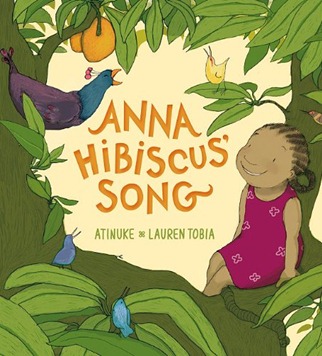
Anna Hibiscus’ Song by Atinuke, illustrated by Lauren Tobia

Anna Hibiscus returns in a picture book!  Anna Hibiscus lives in Africa with her extended family and they are very happy.  In fact, Anna Hibiscus is so happy that she almost floats out of the mango tree she is sitting in.  She doesn’t know what to do with herself, so she asks her grandparents, aunties, uncle, cousins and parents what they do when they feel so very happy.  Though Anna Hibiscus tries their techniques, she has to figure out what her own reaction to pure happiness is. 

This jolly picture book captures the essence of the chapter books featuring Anna Hibiscus.  Though the story is by necessity less detailed and shorter, it does a good job of setting the African stage for the story and revealing the deep love and connection that this family has.  The character of Anna Hibiscus is also shown clearly and concisely, neatly packaging her in a smaller form but losing none of her charm and wit.

Tobia’s illustrations also echo the chapter books closely.  They celebrate the African setting and the warmth of this home.  They also embrace the different skin colors of members of the family.  In the entire series, I have appreciated how frankly and naturally this is handled. 

This happy, merry story would be a great addition to units on emotions or a joyful read in any story time.  Appropriate for ages 3-5.

Reviewed from copy received from Kane Miller.

Also reviewed by The Artful Parent and Jean Little Library.