Review: After the Kill by Darrin Lunde

after the kill

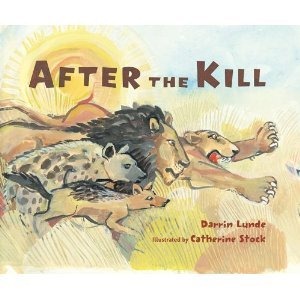
After the Kill by Darrin Lunde, illustrated by Catherine Stock

Explore what happens after the lioness kills a zebra on the Serengeti Plain.  While the hunt and the kill are part of the story, they are only the beginning.  After the zebra is killed, the lion pride comes to eat and then other species start to gather.  There are the vultures who share with the lions.  Then the hyena clan that is able to drive the lions away and claim their share.  Jackals use trickery to grab some food for themselves.  The lions reclaim the carcass and continue to eat until they are sated.  Other vultures arrive.  The small scraps of flesh that remain are eaten by meat-eating beetles until the bones are white in the African sun. 

Lunde, a mammalogist at the Smithsonian Institute, creates a compelling story here.  There is no shying away from predator and prey, just a frank description of the food chain.  Nicely, Lunde injects his narrative with plenty of detail, noises, and an obvious love of his subject.  He paints a verbal picture of what is happening, helping young readers better understand what is actually happening.  The pieces of the book in the smaller font have additional scientific information that readers will find fascinating. 

Stock’s illustrations have a bright, hot quality to them thanks to the yellow tones throughout.  The heat of Africa is built into every page.  She also embraces the kill, the scavenging, and the story, creating a book filled with action-filled images.

An unflinching look at the battle for food on the Serengeti Plain, this book will be riveting for young readers.  Appropriate for ages 5-8, though this is a book that some children may find upsetting, so it is important to be aware of the sensitivity of the child you are sharing it with.

Reviewed from copy received from Charlesbridge.
Book Review: Akata Witch by Nnedi Okorafor

akatawitch

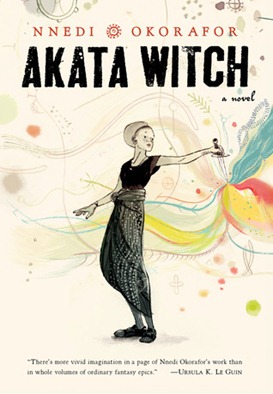
Akata Witch by Nnedi Okorafor

Sunny is a 12-year-old who lives in Nigeria.  She was born in the United States, but that isn’t what makes her so different from her classmates.  Her albino skin and hair does that.  Sunny is also a great athlete, but she can’t play because her sun reacts so strongly to the sun.  She only gets to play when her brothers agree to play with her in the evening.  Sunny isn’t sure she will ever fit in, but after meeting Orlu and ChiChi, the three of them figure out why Sunny is so special.  She’s a free agent, a member of the Leopard People, allowing her to do juju or magic.  Happily, Orlu and ChiChi are also Leopard People, though not free agents.  Suddenly Sunny is immersed in a new dual life.  Her old life of school and family and her new life learning about juju.  But there is also darkness in her life, as a serial killer preys upon children in Nigeria: a killer who has a special connection to Sunny.

This book is incredible.  Okorafor has created a completely unique and entirely formed world within a world.  She brings modern Nigeria to life and then within it creates an entire society that makes sense, wields magic, and continually surprises and delights.  The construct of the magical society doesn’t linger on the how, rather it is presented as a fully-formed world complete with its own laws, own priorities, and a matter-of-fact relationship to death.

The characters of the four young people in the book are well written and play nicely off of one another.  I particularly enjoyed when they would depart from roles that could have been stereotypical and instead revealed themselves to be very well-rounded characters.  Sunny serves as an ideal person for the readers to learn about the magical world alongside.  She is interested, questioning and frank.  She is a very strong female protagonist who can play soccer better than the boys. 

If you have teens or tweens looking for magical reads that break into a whole new territory, this book is for them.   It celebrates Nigeria, magic and learning.  Appropriate for ages 11-14.

Reviewed from copy received from Viking Publishing.

Also reviewed by:

Anna Hibiscus Series Continues to Offer a Charming Glimpse into Africa

goodluckanna havefunanna

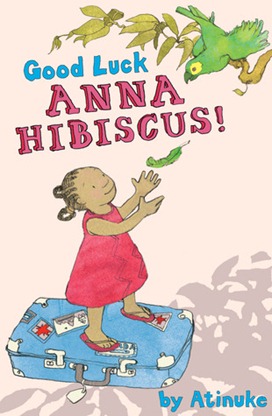
Good Luck Anna Hibiscus by Atinuke

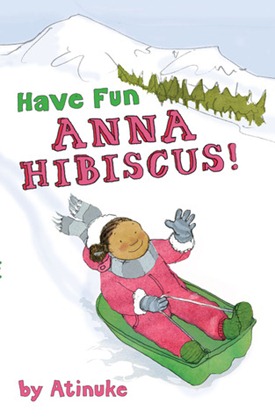
Have Fun Anna Hibiscus by Atinuke

In the first two books about Anna Hibiscus, readers were treated to a glimpse into life in Africa among a large extended family.  But Anna Hibiscus has even more family, a grandmother who lives in Canada.  Book three in the series tells the story of Anna Hibiscus’ preparations for heading to Canada for the first time.  The first few stories reintroduce Anna Hibiscus’ family, including her baby brothers who get into all sorts of trouble.  The other stories tell of trying to find warm clothes suitable for a Canadian winter in Africa and how her family gives her a send off.  Book Four follows Anna Hibiscus to Canada starting with her plane trip.  Those of us in North America will see snow with fresh eyes, enjoy Anna Hibiscus’ first attempt at ice skating, and will enjoy getting to know her grandmother’s dog too.  This series continues to be a celebration of family, expanding now to far-flung families and new adventures.

Atinuke tells all of her stories with a storytellers structure and tone.  There is repetition that echoes throughout the series, tying them all together nicely.  At the same time, her structure remains easy and friendly, offering an inviting cadence to old and new readers alike. 

The entire series is illustrated by Lauren Tobia.  The illustrations weave throughout the book, creating a window into the cultures shown in the stories.  They make the book welcoming for newer readers who will find a great friend in Anna Hibiscus.

If you were a fan of the first two Anna Hibiscus books, make sure to check out these two as well.  They are just as lovely as the first.  Appropriate for ages 6-9.

Reviewed from copies received from Kane Miller.

Gumption!

gumption-233x300

Gumption! by Elise Broach, illustrated by Richard Egielski

When Peter’s favorite uncles asks him to join him on an African safari, Peter is eager to accept.  Once in Africa, Uncle Nigel decides that they will search for the Zimbobo Mountain Gorilla.  Their trek takes them through a dense thicket.  When Peter has trouble, Uncle Nigel declares that all it takes is “a bit of gumption.”  While Uncle Nigel pulls out his knife, Peter is helped out of the thicket by a friendly snake.  Uncle Nigel then notices a snake skin on the ground and tells Peter to “look sharp” there are snakes about!  This pattern continues through the book as they reach one obstacle after another, gumption is needed, Peter is helped by another animal, and Uncle Nigel remains fairly oblivious to it all.  Children will delight in the clueless but brave adult and the hijinks he is missing out on. 

Broach has captured just the right feel with her text, hearkening back to the days of exploration with little phrases like “I say!” “That’s ace!” and “Are you zonked?”  Her prose has a nice bounce and style, demanding to be read aloud.  Egielski’s illustrations are bright colored and filled with action.  The places where the animals help Peter are done in almost wordless two-page spreads that have four picture panels to show the action.  Egielski has incorporated borders on the illustrations made from twining vines that bloom by the end of the book.

Add this one to your preschool storytime stack right away.  It’s a natural fit with any adventure story time, and can also be used for gorillas, elephants, crocodiles, and snakes!  Oh my!  Appropriate for ages 4-7.

Reviewed from copy received from Atheneum.

Enhanced by Zemanta

The 3 Little Dassies: An African Twist on The Three Little Pigs

Capture47-271x300

The Three Little Dassies by Jan Brett

This fresh version of the classic The Little Pigs tale is set in Namibia and features cuddly, cute dassies instead of pigs.  Dassies are also known as rock hyraxes or rock rabbits.  In this book, the dassies wear bright  colored dresses and Namibian headwear.  The story starts out with the three dassies heading out to find their own place to live.  The three sisters reach the feet of the mountains after crossing the Namib Desert and decide that it is a perfect place for their homes.  A friendly agama lizard welcomes them.  One sister builds her house of green grasses.  Another builds hers out of driftwood.  The third builds hers from rocks.  The wolf is replaced by an eagle intent on eating the dassies, who not only knocks over the grass and wood houses but takes the dassies up to his nest to be eaten.  The rock house stays up despite being buffeted by the wind of the eagle’s wings.  And the other two dassies find a unique way back to safety.  But the eagle does not give up easily, allowing Brett a great way to explain why eagles are black in Namibia.

Brett has created another of her trademark books.  The text reads aloud very nicely, with the rhyming names of the dassies, the rhythm of the classic tale, and the use of just enough detail to bring the Namibian setting to vivid life.  Of course Brett uses her illustrations to great effect here as well in creating Namibia on the page.  Readers will glimpse vistas across the desert sands and to the mountains.  Brett’s illustrations are finely detailed.  She uses images on either side of the main illustration to tell readers what is happening to others in the story.  Brett has framed the images with African textiles, beads, and native plants.  These are illustrations to spend time with an enjoy.

A clever take on a classic story, this new version will be a welcome addition with its feisty heroines and interesting setting.  Appropriate for ages 4-7.

Reviewed from copy received from Putnam.

Enhanced by Zemanta

12 Days of Christmas

November82010156pm12daysofchristmas

12 Days of Christmas by Rachel Isadora

I have been a fan of Isadora’s retellings of classic European fairy tales with an African flair and this is no exception.  Isadora takes the Christmas carol and turns it into a celebration of both the holiday and Africa.  While the words remain the same as the traditional carol, Isadora interprets them in a new way.   The five gold rings are around a woman’s neck like women in South Africa.  Eight maids a-milking are milking goats rather than cows.  9 ladies dancing was inspired by women from Swaziland.  Isadora builds in the repeating section of the carol with a rebus that refers back to previous illustrations with clear numbers.  You can see the images used for the rebus on the cover of the book.  This adds an ease to the book that could have been overwhelmed with all of the text otherwise.  Isadora has created a global celebration with this book.

Isadora’s illustrations are really what makes this book unique.  Her African interpretations of the carol are engaging and refreshing.  Isadora uses collage to create her images.  Her use of painting effects on the paper she uses to make her collages add a definite texture and line to the illustrations.  She has created a book that has the hot sun and the glowing colors of Africa.

A very nice addition to library Christmas collections, this book will offer a glimpse of another part of the world through a familiar lens.  Appropriate for ages 3-5.

Reviewed from copy received from G. P. Putnam’s Sons.

Anna Hibiscus – Brilliant New Series

Anna Hibiscus by Atinuke

Hooray for Anna Hibiscus! by Atinuke

Anna Hibiscus lives in Africa in a great big house filled with relatives, including her parents, her little twin brothers, her grandparents, her many aunts, her many uncles, and all of her cousins.  She is never lonely because there is always someone to play with, share stories with, and have fun with.  In the first book in the series, Anna Hibiscus discovers that it’s not so easy to have a family vacation with just your small family.  She meets her Aunt Comfort who lives on the other side of the ocean, though she frets that Aunt Comfort will have forgotten how to be African.  Anna Hibiscus also learns about hard work and dreams of seeing snow for the first time.  In the second book in the series, Anna Hibiscus sings before a crowd, refuses to get her hair braided,  loves the quiet of nights without electricity, and travels to the other side of the city. 

Obviously written by a storyteller, these books are unique and offer American children a fascinating glimpse of life in Africa that is guaranteed to break stereotypes.  The stories are all set definitively in Africa and all of the stories have a focus on things that make Africa special.  Another positive for the books is how the simple pleasures of life are the best, something that so many children in America need to learn. 

Anna Hibiscus is a great protagonist.  She is still learning herself about the differences between her own life and that of the poor children she sees around her.  She learns about this in very concrete and tangible ways that children in any country can relate to.  Nicely, Atinuke has created books for children that instead of shying away from difficult subjects like poverty embrace them and focus attention about them.

Atinuke’s use of rhythm and repetition in her stories adds to the feeling of them being written by a storyteller.  There is also a powerful tie to the oral traditions of Africa thanks to these storytelling phrases.  Beautifully written and wonderfully simple and straight forward, these books are something very special.

Highly recommended, these books belong in all public and school libraries.  They are a wonderful modern look at Africa and the people who love her.  Appropriate for ages 5-7.

Reviewed from copies received from Kane Miller.

Also reviewed by Fuse #8.

The Lion and the Mouse

The Lion & the Mouse by Jerry Pinkney

In this almost wordless book, readers revisit Aesop’s tale of the lion who spares the life of a mouse only in turn to be rescued by the mouse.  The only words on the page are animal noises that bring the African setting to life.  Readers follow the mouse right into the lion’s paws, sigh in relief at the release, and will be riveted as the capture of the lion plays out. 

Pinkney shows readers the world in focused images, revealing the view of the land the mouse has, the perspective of the lion, and foreshadowing the capture of the lion in the poacher’s net.  Each image is beautifully done, filled with details that bring the story to life and invite you to linger over them.  His pacing is done with such skill that he can create suspense with a single page turn.  From the moment of opening the cover, readers are in the hands of a master story teller who speaks through his art.

One of the best wordless picture books I have ever read, this book should be on every library’s shelf.  And with that cover, it is not going to sit there long!  Make sure you face this one out!

Reviewed from copy received from publisher.  Copy will be placed in library collection.

Also reviewed by Collecting Children’s Books, 100 Scope Notes, A Patchwork of Books, Pink Me, and Fuse #8.