Catching a Storyfish by Janice N. Harrington

catching-a-story-fish-by-janice-n-harrington

Catching a Storyfish by Janice N. Harrington (InfoSoup)

Moving away from Alabama is hard for Keet. She is moving closer to her beloved grandfather though, which helps. The two of them spend days together fishing, something that Keet used to find challenging because she loves to talk and tell stories. But at her new school, she is teased for her accent and suddenly her words start to dry up. She finds it hard to make friends and even at home she isn’t talking much. Slowly though, Keet starts to find her voice again and makes a new friend. Just as she starts to talk though, her grandfather suffers a stroke and struggles with the slow recovery. Keet though has just the solution, showing him the way forward with stories.

Harrington’s verse novel is pure loveliness. Throughout she plays with various poetic forms, delicately moving from haiku to concrete poems to narrative form with many others included too. She nicely lists them at the end of the book, talking about their difficulty and what makes a poem that form. Her skill is evident throughout with all of the forms as she tells the story of Keet and her progress from losing her confidence and her voice to finding it again. The voice of Keet’s new friend is including in the poems as well, often playing against ones in Keet’s voice.

The characters here are given time to grow and stretch on the page. Keet is a wonderful character filled with a great energy and drive, but also stuck in a lack of confidence that hits her out of nowhere. It is a book about quiet and both its power and the ability to drown in being silenced. It is a book about friendship, about family and the importance of finding your place and your voice.

Beautifully written and strikingly gentle, this book is a celebration of the individual and their ability to speak their own stories. Appropriate for ages 8-12.

Reviewed from library copy.
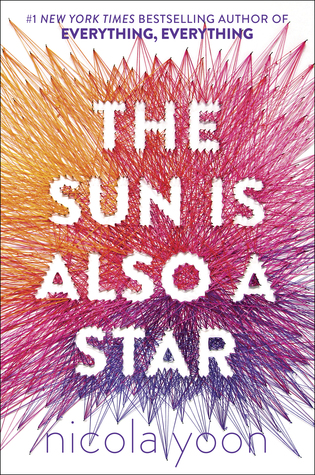
 

The Sun Is Also a Star by Nicola Yoon

the-sun-is-also-a-star-by-nicola-yoon

The Sun Is Also a Star by Nicola Yoon (InfoSoup)

A finalist for the National Book Award, this book for teens is exceptional. It is the story of two teens, Daniel and Natasha who meet one another through a series of events. Daniel, a poet, firmly believes in love at first sight and destiny bringing them together. Natasha though does not, believing in science and what is provable. The day is a big day for both of them. Natasha’s family is being deported back to Jamaica that night unless she can figure out a way to stop it. Daniel is being interviewed for Yale, a school and a career path that his Korean parents have chosen for him. When the two meet, the chemistry is palpable, but the timing is horrible. Daniel decides that he can prove to Natasha that love is real and measurable, but can he do it in time with their deadlines working against them both?

I can see why this book is getting all of the attention and praise that it is. It’s an amazing read, filled with possibility and the sense that the universe may just be on our side sometimes. It’s filled with romance and chemistry. The prose has a lightness that is exceptional, creating space for these two amazing characters to meet, breathe, and tumble head over heels in love with one another.

Meanwhile, it is also a story of New York City. It’s a story of immigration and illegal immigrants, of losing a culture and then losing the dream of America as well. It’s a story of overt racism and the new generation of teens who see beyond that and into hearts. It’s a story of profound loss, of parental betrayal, of hope that manages to rise again and again.

A book perfect for today, this teen novel is a voice of hope despite our challenges and loving through it all. Appropriate for ages 14-17.

Reviewed from library copy.

Things Too Huge to Fix by Saying Sorry by Susan Vaught

things-too-huge-to-fix-by-saying-sorry-by-susan-vaught

Things Too Huge to Fix by Saying Sorry by Susan Vaught (InfoSoup)

Dani’s grandmother suffers from Alzheimer’s and is slowly reaching the end of her life cared for by Dani and her parents. So when her grandmother sends Dani on a mission to find a letter and key, Dani isn’t sure that it’s real. She discovers both the letter and key, then has to follow the trail of clues her grandmother left in her writing to discover the truth of a feud that her grandmother had with Avadelle Richardson, a novelist who wrote about a riot that happened at Ole Miss. It’s a riot that both Dani’s grandmother and Avadelle actually were caught up in. As Dani gets closer to the end of the trail, she finds more and more secrets and history and modern life begin to collide.

Vaught has written a taut novel that takes readers on a journey through Civil Rights history in Mississippi. Told through the eyes of Dani, the book is accessible to modern children and shows that racism is far from over. With our recent election, it is also a timely book that speaks to the deep-seated racism still at work in our country today. Vaught uses excerpts from Avadelle’s fictitious novel to show the historical context that the riot took place in. It does show how far we have come, but also speaks to how far we have to go.

The complex friendships of middle grade children are captured here, with Dani and her best-friend Indri sharing the adventure while her “not-friend” Mac, grandson of Avadelle continues to also be a part of it though at times the two are not speaking, just like their grandmothers. This modern division is a clever way to show how friendships change, shift and fall apart, something that mirrors what is seen in the novel and in the grandparents’ relationship.

A rich look at Civil Rights, racism and the decisions too big to be unmade, this novel is a timely look at today and our shared past. Appropriate for ages 9-12.

Reviewed from copy received from Simon & Schuster.


March: Book 3 by John Lewis

march-book-3-by-john-lewis

March: Book 3 by John Lewis, Andrew Aydin and Nate Powell (InfoSoup)

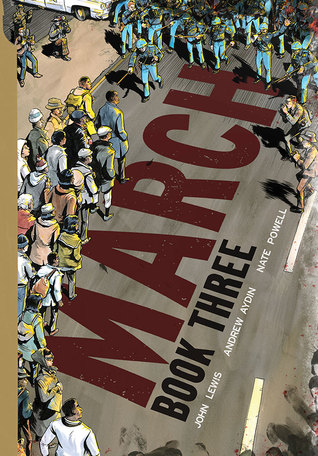
This is the final book in this amazing graphic novel trilogy. Congressman John Lewis concludes his story of the Civil Rights marches, providing real context to the Black Lives Matter movement of today. This book begins with the bombing of the church in Birmingham, Alabama that killed four young girls. It shows the fight for the ability to vote in Alabama for African Americans who were forced to take tests or just ignored as they tried to register to vote. The book culminates with the march in Selma and the violence that accompanied it and most importantly the changes it created.

I can’t say enough good things about this series. It brings critical Civil Rights history directly to teens in a format that is engaging. There is no way to turn away from the violence of the response of those in power as blood flows in the images on the pages. It makes it all the more powerful that the marches stayed nonviolent and focused on pacifism. Lewis himself voices again and again how much pressure there was at times in the movement to react more violently and how that was managed by himself and others. It is a testament to people willing to put their own bodies and lives at risk for progress.

The illustrations are riveting. Done in black and white, they effectively play darkness and light against one another, adding to the drama of the situations they depict. At times they are haunting and blaze with tragedy. The opening scenes of the Birmingham church are filled with tension and sadness that make it difficult to turn the pages and witness what happens.

These are the books our teens need right now. Every public library should have this series, no matter what races are represented in your community. This is our shared history and one that we cannot deny or turn away from. Appropriate for ages 12-15.

Reviewed from library copy.


Unbound by Ann E. Burg

Unbound by Ann E Burg

Unbound by Ann E. Burg (InfoSoup)

This novel-in-verse tells the story of Grace, a girl living as a slave on a plantation. Grace is selected to start work in the Big House, leaving her mother, stepfather and two little brothers behind. Grace is warned by everyone that she has to keep her eyes down and her opinions to herself, not even allowing them to show on her face or in her eyes. But Grace realizes that things are very unfair on the plantation where some people work in the fields from dawn to dusk and white people aren’t even expected to dress themselves. Grace finds it impossible to keep these thoughts deep inside her, and puts her family at risk. So they all flee to try to find freedom, heading deep into the Great Dismal Swamp where the men and dogs hunting them can’t track them.

The author of All the Broken Pieces returns with another verse novel just as stunning as her previous ones. Here she shares a piece of history that many don’t know about, slaves who found freedom by living deep in the Great Dismal Swamp in Virginia and North Carolina. The entire book is fraught with dangers from whippings and punishments as a slave to the dangers of reaching possible freedom to the real dangers of the swamp itself.

Told in verse, the poems are in Grace’s voice and it rings with authenticity but also a righteous anger at what is being done to people because of the color of their skin. Readers hearing Grace’s voice will understand her situation and spirit on a deep level. That is the power of poetry, to cut past exposition right to the heart of the person speaking. Burg does this with a simplicity that adds to that power, cutting right through to the core.

Beautifully written, this powerful story tells of the importance of freedom for all people. Appropriate for ages 9-12.

Reviewed from ARC received from Scholastic.


Steamboat School by Deborah Hopkinson

Steamboat School by Deborah Hopkinson

Steamboat School by Deborah Hopkinson, illustrated by Ron Husband (InfoSoup)

A young boy is sent to Candle School by his mother, though the truth was the he was not very excited to go. His older sister Tassie almost has to drag him there, because he wanted to stop and see everything along the way. They headed down into the dark basement of a church where there were no windows. The school was run by Reverend John who shared his own story of being born a slave and then working to earn the freedom of himself and those he loved. Then one day men came to the Candle School and declared it closed since the State of Missouri had changed the law and no children of color could be taught to read or write. The school closed, but Reverend John did not give up and soon had his school floating in the middle of the Mississippi on a steamboat where the Missouri law could not impact them.

This picture book is based on the true story of Reverend John Berry Meachum whose story is given in more detail in the Author’s Note at the end of the book. The picture book is told through the eyes of a young boy who attends Meachum’s school and then works to reestablish it on the steamboat and pass the quiet word of the school reopening. Throughout the book there is a strong sense of purpose, of the importance of learning to read but also the importance of standing up for what is right.

The illustrations by Husband are exceptional. Using muted colors and fine lines, they capture the darkness of the school and the light on the children’s faces. They show the sorry of losing the right to learn and then the joy of growing up educated and looking to the future.

A luminous look at the harrowing life of African Americans even if they were free in the 1800s, this picture book is beautiful and filled with strength. Appropriate for ages 7-9.

Reviewed from library copy.


As Brave As You by Jason Reynolds

As Brave As You by Jason Reynolds

As Brave As You by Jason Reynolds (InfoSoup)

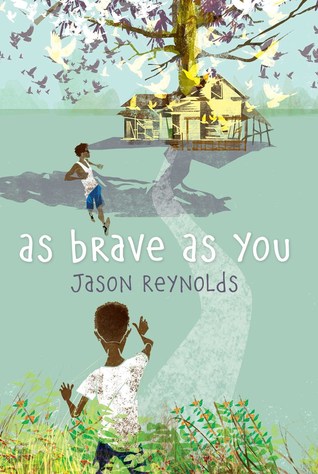
Genie and Ernie are heading to Virginia to stay with their paternal grandparents for the very first time. Though they have met their grandmother before, this is the first time that Genie has met him. The difference between their lives in Brooklyn and their grandparents’ home in rural Virginia are huge. But that’s not the only thing that surprises Genie. He is shocked to find out that his grandfather is blind. Genie is a kid who is full of questions to ask all of the time and so he immediately asks his grandfather questions about his blindness. Genie knows that his older brother Ernie is braver than he is, always taking up fights for Genie and protecting him. He also knows that his grandfather is immensely brave too. When something goes wrong though, Genie will have to rethink what it means to be brave.

Reynolds is so amazingly gifted as a writer. He astounded me with this departure from his more urban writing. He captures the rural world with a beautiful clarity, using the natural world around as symbols for what is happening to the humans who live there. It is done both subtly and overtly, creating a book that is multi-layered and gorgeous to read. Throughout Reynolds speaks to real issues such as guns and disabilities. They are dealt in their complexity with no clear point of view stated, giving young readers a chance to think things through on their own.

Reynolds has created a fabulous protagonist in Genie, a boy filled with so many questions to ask that he has to write them down to keep track of them. He is smart, verbose and caring. Yet at the same time, he agonizes over mistakes, trying to fix them on his own and thus creating a lot of the tension of the book. The depiction of the grandparents is also beautifully done, allowing them to be far more than elderly figures. They are often raw, sometimes wise, and also dealing with life.

A brilliant read for the middle grades, this book is filled with magnificent writing and great diverse characters. Appropriate for ages 9-12.

Reviewed from copy received from Atheneum.


The Steep and Thorny Way by Cat Winters

The Steep and Thorny Way by Cat Winters

The Steep and Thorny Way by Cat Winters

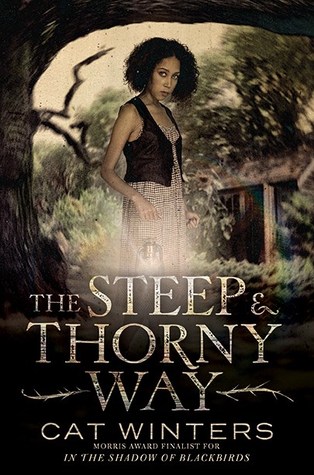
Hanalee has always stood out in her hometown in Oregon in the 1920s. She is half African-American and so has very few rights under the law. Her father died a year ago, hit by a drunk driver. A neighbor has told Hanalee that her father is now a “haint,” a ghost traveling the road where he died. Hanalee also discovers that Joe, the boy found guilty for her father’s death is out of jail and back in town, hiding from everyone. The community is also ruled by the KKK, which is certainly not safe for someone like Hanalee. As Hanalee starts to piece together how her father may have died in a different way than a car accident, she also takes a tonic to see her father’s ghost. Joe also tells Hanalee his own secret, why his family has refused him shelter and why the KKK is after him as well.

Winters writes a gripping novel in this reworking of Shakespeare’s Hamlet. Set in a time period that is often forgotten, this is a novel of Prohibition, the Klan and the lack of civil rights for people of color. Winters also ties in the loss of rights for LGBT people and how they also lived in the shadows and in desperate fear of being discovered. There is an additional layer of fear as eugenics was being done at the time, a danger for both people of color and LGBT people. With that level of societal pressure and fear, this novel soars and unlikely truces are made in a search for the truth.

Winters’ writing is piercing and honest. She allows Hanalee to figure out the various dangers in her life and somehow at the same time Hanalee is brave enough to not go into hiding or run away but to continue in her search for the truth. Hanalee is an amazing character, filled with love for her best friend, caring for Joe and an adoration of her dead father. Meanwhile she has to handle the dangers around her, and even face them head on with her simple presence in the community.

Brilliantly written, this is a stunning historical novel filled with ghosts and also a firm truth about the risks of the time. Appropriate for ages 14-17.

Reviewed from ARC received from Abrams.

The Book Itch by Vaunda Micheaux Nelson

The Book Itch by Vaunda Micheaux Nelson

The Book Itch: Freedom, Truth & Harlem’s Greatest Bookstore by Vaunda Micheaux Nelson, illustrated by R. Gregory Christie (InfoSoup)

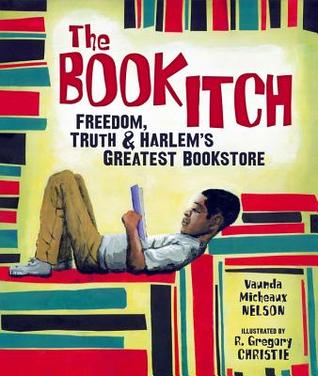
This book is about the National Memorial African Bookstore and how it became a center for black culture in the 1960s. Told from the point of view of the son of Lewis Michaux, the owner of the store, this book looks at the figures like Malcolm X and Muhammad Ali who come to the store. It is also the story of how Michaux fought to have a store, selling books out of a pushcart at first and being denied a business loan from banks. Michaux was known for his slogans which he shouted on the street, told to his son and painted on the front of his store. The book continues through the assassination of Malcolm X. Readers must look to the note at the end to discover what happened to the store.

This nonfiction picture book speaks to the power of bookstores to inform and to keep a culture strong. One man’s vision comes to life thanks to his own determination and also the way that it spoke to others. The choice location near the Apollo Theater also helped get African-American celebrities to come to the store. The choice to have the story told from a child’s point of view was what makes this book appropriate and understandable for children.

The illustrations by Christie are filled with deep color and thick paint. They directly show the effort and intensity of determination of running a book store like this one. Some pages light with oranges and yellows while others are darkened by death.

A powerful book about an important book store and the vital need for information and books as part of a movement. Appropriate for ages 6-9.

Reviewed from library copy.