Review: Black Enough edited by Ibi Zoboi

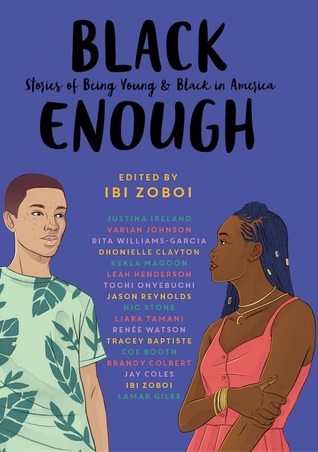
black enough edited by ibi zoboi

Black Enough edited by Ibi Zoboi (9780062698742)

This short story collection for teens contains writing from the best African-American writers for teens. The list of authors is awe inducing. One after another is a thrilling author to read, particularly in short story format. Each of the stories is a winning entry too. Some are lighthearted like the story by Jason Reynolds. Others are more serious, looking deeply at issues in the African-American community. Many of them deal with intersectionality, offering characters who are also LGBTQ or of different faiths. The array of stories speaks to the diversity of the African-American experience, often playing directly against stereotypes to look more closely at being a teen of color in America.

Incredible authors come together to create an anthology that is very impressive. The interplay of the stories as edited by Zoboi makes for a fascinating journey through the various facets and aspects of being an African-American teen. Teens of various levels of wealth and poverty, interests and hobbies appear in the anthology often interacting with one another in the stories. There is such richness in these stories, many of which could be used in classrooms to start discussions but all of them can be simply enjoyed by teen readers.

This is a must-read and must-have for all libraries serving teens. Appropriate for ages 14-17.

Reviewed from e-galley provided by Balzer + Bray.

Review: Genesis Begins Again by Alicia D. Williams

genesis begins again by alicia d. williams

Genesis Begins Again by Alicia D. Williams (9781481465809)

Genesis keeps a list of things that she hates about herself. Some of it is the color of her skin and the way that others tease her about how dark she is, unlike her light-skinned mother with good hair. Some of it is about the way that their family keeps getting kicked out of the houses they live in because they don’t pay the rent. Some of it is the way her father speaks about her when he is drunk. Some of it is based on her grandmother’s hurtful comments about Genesis. So after being kicked out of yet another house, Genesis’ family moves to a more affluent neighborhood outside of Detroit. Genesis discovers that she likes her new school and even finds herself making real friends for the first time. The house is the nicest they have ever lived in too. But other things aren’t any better. Her father keeps on drinking. Genesis is still as dark-skinned as ever, but she has plans to try to lighten her skin, thinking that will make her entire life better. As Genesis discovers her own talents, she must learn that learning to accept herself is a large piece of moving forward in life.

In this debut novel, Williams writes with a strong voice, taking on difficult topics including verbal abuse, racism, skin tone, alcoholism and co-dependency in an unflinching way. Williams reveals the deep pain and lasting scars that cruel words and verbal abuse can have on a young person, particularly when it is about a physical characteristic that is beyond their control. With Genesis’ parents caught in a marriage filled with anger and substance abuse, Williams offers other adult figures and also young peers who model a way forward for Genesis.

Genesis’ growth is organic and well paced. She learns things steadily but has set backs that end up with her damaging herself. She is a complicated character who looks at life through a specific lens due to her upbringing. She is constantly judging others before they can judge her, placing distance where there could be connections, and making poor decisions when offered compliments. Still, she is a good friend, someone willing to look beyond the surface and see what others can’t. But only when she allows herself to do that. Her complexity is what makes this book really shine.

Strong and vibrant, this book takes on the subject of skin tone in the African-American community as well as other heavy topics. Appropriate for ages 11-13.

Reviewed from ARC provided by Atheneum.

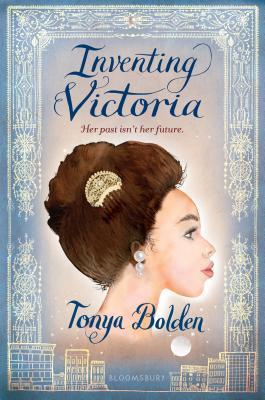
Review: Inventing Victoria by Tonya Bolden

Inventing Victoria by Tonya Bolden

Inventing Victoria by Tonya Bolden (9781681198071)

Set in the 1880s, this novel explores the world if Essie, a young African-American woman who grew up with a neglectful mother and was rescued from poverty and prostitution by a kindly cleaning woman. Determined to keep learning even though she left school at an early age, Essie continued to read everything she could get her hands on. While working at a boarding house, Essie meets Dorcas Vashon, a wealthy African-American woman who sees potential in Essie and offers her a way to transform her life. Taught etiquette and new manners by Dorcas over several grueling months, Essie becomes Victoria and takes on the persona of Dorcas’ niece. As Victoria enters the social elite in Washington, D.C. she must hold to the lie that she is living until she can’t manage it any longer.

Bolden captures a period in American history that is rarely seen in books, much less teen novels. It is the period after Restoration gave African-Americans new rights but before the Jim Crow laws came stripped them away. It is a dazzling time to be a member of society and Bolden gives us details about the books, the manners and the dresses that make up that world. The setting of Washington, D. C. society is beautifully depicted as well.

Essie/Victoria makes for a wonderful set of eyes to view this world through. While she is taken with her new lifestyle and the opportunities it brings, Essie wrestles with the lies she must tell to keep it that way. Her strength of character is particularly evident when she is pressed such as learning etiquette and at the end of the book when she must make a moral decision. It is then that Essie fully steps into her own.

A fascinating look at a neglected piece of American history. Appropriate for ages 12-16.

Reviewed from ARC provided by Bloomsbury.

Review: So Tall Within: Sojourner Truth’s Long Walk Toward Freedom by Gary D. Schmidt

So Tall Within Sojourner Truth's Long Walk Toward Freedom by Gary D. Schmidt

So Tall Within: Sojourner Truth’s Long Walk Toward Freedom by Gary D. Schmidt, illustrated by Daniel Minter (9781626728721)

Isabella grew up in slavery, sold away from her mother when she was nine. She did hard labor for years, sometimes with no shoes in the winter and other times with no sleep at night because of the work expected of her. One year after she had been forced to marry a man and had five children, she was promised her freedom. But freedom didn’t come and so she escaped with her baby. She arrived at the home of two kind people, who stood by her in her escape and paid for the freedom of Isabella and her baby. When her son was sold away by her old master, Isabella went to court to have him returned to her. As time went by, she took the name Sojourner Truth and started to speak publicly against slavery. She fought many battles for equality, standing tall and speaking the truth.

This book aches with pain, loss, and grief. The book is broken into sections, each starting with an evocative phrase about slavery, that shows what is ahead. These poetic phrases add so much to Sojourner Truth’s biography, pulling readers directly into the right place in their hearts to hear her story. Schmidt’s writing doesn’t flinch from the damage of slavery and its evil. He instead makes sure that every reader understands the impact of slavery on those who lived and died under it.

Minter’s art is so powerful. He has created tender moments of connection, impactful images of slavery, and also inspiring moments of standing up for what is right. The images that accompany Schmidt’s poetic phrases are particularly special, each one staring right at the reader and asking them to connect.

A riveting biography of one of the most amazing Americans in our history. Appropriate for ages 7-10.

Reviewed from copy provided by Roaring Brook Press.

Review: Africville by Shauntay Grant

Groundwood Logos Spine

Africville by Shauntay Grant, illustrated by Eva Campbell (9781773060439)

A girl visits the historical site of Africville, in Halifax, Nova Scotia. She imagines what the community was once like, how the children would play together. She imagines lunch on the tables, picking blueberries over the hill. She imagines playing games, going rafting, and bonfires by the water. Her great-grandmother had lived in Africville before it was destroyed in the 1960s after surviving for over 150 years. But the black community of Africville never received the same services as the rest of Halifax despite paying taxes. The community was eventually relocated from the site and moved to public housing. Africville is now a park where former residents and their descendants return to remember the community that had once stood there.

Grant gives us a glimpse of what Africville once was. The picture book keeps descriptions short and the focus on children and their lives in the community. There is an author’s note at the end of the book that offers more context for what Africville was and what happened to its residents. The use of a modern child to dream about what might have been in Africville is a great lens through which to look at life there. The peacefulness and sense of community pervade the entire read.

Campbell’s illustrations are filled with deep colors. The bonfire pages glow with reds of fire and sunset. There is lush green everywhere and the houses pop with bright paint colors. She creates the warmth of a real community on the pages, illustrations that seem to have sunlight shining from them.

A gorgeous tribute to a piece of Canadian history. Appropriate for ages 4-6.

Reviewed from library copy.


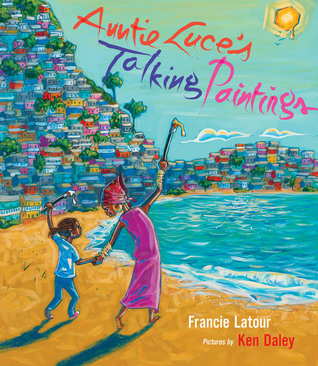
Review: Auntie Luce’s Talking Paintings by Francie LaTour

Print

Auntie Luce’s Talking Paintings by Francie LaTour (9781773060415)

A little girl heads to Haiti from her home in America to visit her Auntie Luce, a painter. The girl has sat for a painting year after year since she was seven and first visited. She leaves the snow and cold behind for the tropical world of Haiti with its heat, bright buses, pink cathedral and green hills. She asks her aunt why she never left Haiti, and her aunt explains that she wants to stay in Haiti her entire life and that she is simply different than the girl’s mother who moved to America. There are many things different in Haiti, including the paintings that cover the walls of Auntie Luce’s small home. The girl sees portraits of national Haitian heroes as well as generations of her own family. As her portrait is finished, Auntie Luce encourages the little girl to see herself as both Haitian and American, not one or the other.

This picture book cleverly incorporates small pieces of the history of Haiti into the story line. The little girl has many questions about Haiti in particular but also about why some family members choose to stay while others leave. Small bits of Haitian life are also mentioned, showing the differences between Haiti and America very clearly. The book also looks at art and the way that it offers a chance to speak in a different way about difficult things. Even the paintings themselves are described in gorgeous language that will have readers seeing even more details than they might have.

LaTour’s illustrations turn this picture book into a real look at Haiti through the eyes of someone who clearly loves it. The images come alive as they show a bustling street, the mountain home of Auntie Luce, and the images of ancestors and heroes from Haiti.

A vibrant look at Haiti in a picture book. Appropriate for ages 4-6.

Reviewed from e-galley provided by Groundwood Books.

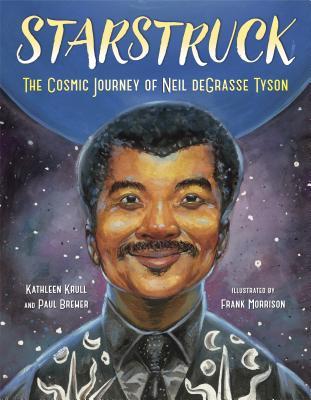
Review: Starstruck by Kathleen Krull

Starstruck The Cosmic Journey of Neil DeGrasse Tyson by Kathleen Krull

Starstruck: The Cosmic Journey of Neil Degrasse Tyson by Kathleen Krull and Paul Brewer, illustrated by Frank Morrison (9780399550249)

This book rightfully starts with the Big Bang and then moves on to a young Neil Degrasse Tyson being inspired by the Hayden Planetarium. At age nine, Tyson was inspired to start investigating the stars and the universe around him. He began with binoculars and in a few years had his own telescope. He worked to get a better telescope and also started to build his library of science and astronomy books. In sixth grade, Tyson attended a class at the Hayden Planetarium, often one of the youngest people there. At fourteen, after drawing the attention of the education director at the planetarium, Tyson was taken on a journey to northwest Africa to view a rare solar eclipse. He attended the Bronx High School of Science and went on to start speaking publicly about astronomy. His hero, Carl Sagan, tried to get Tyson to attend Cornell University, but Tyson chose Harvard instead. Eventually after getting a PhD, he returned to the planetarium that had originally inspired him, becoming the director. It was there that the controversial but scientific decision to eliminate Pluto as a planet gained Tyson public attention, leading to him becoming one of the foremost speakers and authorities on astronomy in the nation.

Krull, a master nonfiction author, writes an inspiring story here, showing that from a single experience, a lifetime of enthusiasm and knowledge can be born. Throughout the book, Tyson’s drive and wonder at the universe is clear. Tyson’s willingness to be visible as an authority on astronomy is clearly depicted as he understands the power of media to reach people and demonstrate that people of color can be scientists too.

Morrison’s illustrations also demonstrate the wonder and awe that Tyson feels for the universe. The illustrations have a wonderful vibe to them with people frozen in action and Tyson shown as the heart of the book. There are shining pages filled with black sky and brilliant stars that are particularly striking.

A strong biography of a national science hero, this book will lead young people to dream and wonder. Appropriate for ages 5-8.

Reviewed from e-galley provided by Crown Books for Young Readers.


Review: Finding Langston by Lesa Cline-Ransome

Finding Langston by Lesa Cline-Ransome

Finding Langston by Lesa Cline-Ransome (9780823439607)

After Langston’s mother died, he and his father moved from rural Alabama to Chicago. Langston misses his mother and grandmother as well as their way of life in Alabama. In Chicago, it’s hard for him to make friends and lonely in the apartment when his father is gone. Even the food that his father provides is nothing like the skilled cooking of the women who raised him. But there is one part of Chicago that makes up for all of the changes. The public library branch in his neighborhood is not whites-only like the one in Alabama. Hiding from bullies after school, Langston soon discovers the beauty of poetry, particularly that written by a man with the same name, Langston Hughes.

Cline-Ransome is best known for her picture books and this is her first novel. The skilled writing here would never lead anyone to believe that this is a debut novel though. The prose has the flow and rhythm of poetry as it plays out on the page. The connection to Alabama is also strong in the prose, the way that Langston speaks and the way he sees the world. Somehow Cline-Ransome makes all of that clear in her writing alone.

Langston is a fascinating character living in a very interesting time in American history, the Great Migration when African Americans left the south and headed north to cities like Chicago. Langston’s love of reading and books is not only a way for him to find a home in the local library branch but also eventually a way for him to connect with peers over a love of the written word.

Skilled story telling and a strong protagonist make this book a very special piece of historical fiction. Appropriate for ages 9-12.

Reviewed from library copy.

Review: Dactyl Hill Squad by Daniel Jose Older

Dactyl Hill Squad by Daniel Jose Older

Dactyl Hill Squad by Daniel Jose Older (9781338268812)

Magdalys Roca lives at the Colored Orphan Asylum in New York during the year 1863. It is a different world than the one we know, with dinosaurs still roaming the earth. While on a field trip to see a theater performance, riots break out in New York City. Magdalys and her fellow orphans are caught in the situation. As she helps her fellow orphans survive, Magdalys discovers that she has a strange ability to communicate with the dinosaurs around her. Discovering that the orphanage has been destroyed in the riots, Magdalys and several other orphans are taken in by New York freedom fighters in the Dactyl Hill neighborhood where people of color have created a place of safety. Magdalys and her friends are soon involved in saving the other children from being taken into slavery.

Based loosely on real history, this novel has just enough historical reality to keep it grounded. Add in the dinosaurs and you have a wonderful novel of alternative history that will keep children enthralled. The pace is fast and becomes almost wild during fight and battle scenes. The children face real horrors of slavery, including a lynching, mobs of people intent of capturing or killing them, and a network of men working to send free people into bondage. The setting of a historical New York City is deftly woven into the story line as well.

It’s not often that you have children’s fantasy books that offer alternative takes on history. It is even more rare that those books have children of color as the main characters in the novel. Magdalys is a great heroine, full of bravery and a sense of purpose as she joins those trying to change the world. She is a natural leader though she views herself as a loner, something that others won’t allow her to be.

A rip-roaring read that will have children longing for a dactyl to ride. Appropriate for ages 9-12.

Reviewed from ARC provided by Arthur A. Levine Books.