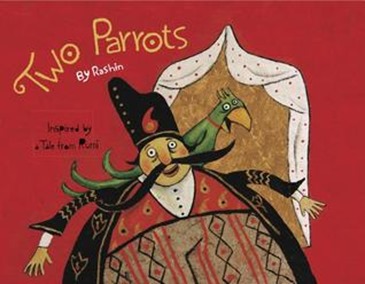
Two Parrots by Rashin Kheiriyeh

two parrots

Two Parrots by Rashin Kheiriyeh

Inspired by a tale by Rumi, this picture book takes an allegorical look at imprisonment and freedom.  A Persian merchant receives a parrot as a present and places him in a golden cage.   When the merchant heads out on a trip to India, he asks the parrot what gift he can bring back.  The parrot asks him to find his parrot friend and explain that the parrot would love to see him but is unable to due to his cage.  The merchant does as is asked and when he tells the parrot of his friend in the cage, the parrot falls down dead.  The merchant returns home to his parrot and has to tell him about the death of his friend.  At which point the parrot in the cage falls down dead too.  The merchant lifts the dead bird out of the cage and the bird promptly comes back to life and flies out the window to freedom.  The merchant is forced to admit the importance of freedom to living things.  Now he enjoys the beauty of the parrots free in his garden, uncaged.

This is not a straight-forward picture book, rather it is a moral and ethical tale that unwinds in a more traditional way for the reader.  It is a book that is best discussed with others who may see different aspects and different views in the story.  Many children may not have experienced this sort of story before, one that is not difficult in terms of vocabulary but instead presents a more challenging subject in an allegorical way.  Welcome to Rumi!

The art in the picture book is done by a young artist from Iran who has illustrated over 45 books for children.  His work is bright colored and full of texture.  The various papers used in his art have different textures and the colors are so strong and vibrant.  They have a great mix of quirky modern and traditional style. 

A delightful mix of traditional and modern storytelling, this picture book will get readers discussing and thinking about freedom and civil rights.  Appropriate for ages 6-9.

Reviewed from library copy.
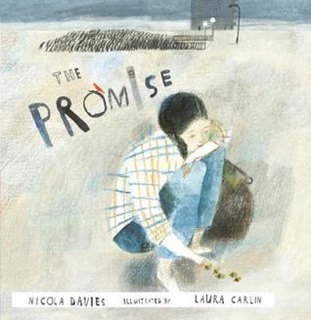
Review: The Promise by Nicola Davies

promise

The Promise by Nicola Davies, illustrated by Laura Carlin

In a gritty city filled with dust and yellow wind, a girl survives by stealing from other poor people.  Her life was just as dust filled and ugly as the city around her.  Then one night, she saw an old frail woman with a fat bag walking along.  She would be an easy mark, so the girl tried to get the bag away from her.  The old woman held on tightly, but eventually asked the girl to promise to plant them and she could have the bag.  The girl promised.  In the bag were only acorns, nothing to eat, no money to spend, but a wealth of trees.  So the girl started planting them one by one, and nothing changed for a long time.  Then green sprouts started to appear, then trees grew and green returned to the broken city.  But the girl had already left, going to other cities that needed a forest too.  Until one night she had her fat bag of acorns with her, and a young person tried to steal it from her.  All it took was another promise and she let them have the bag.

This allegory is lovely.  The setting is hauntingly familiar, a war zone where all that is left behind is the dust and rubble of war and people who cannot escape the city or see a future beyond it.  The transformation of the theft of property into a promise is stunning.  Simple and profound, it is courage, passion and change all wrapped into a single act.  I also love the moments before the trees appear, the anticipation, the question of whether it will work, the effort before the payoff.  And then the fact that the girl leaves to go to other cities, makes this entire story less about her than about her deeds.  It’s one intelligently written book that works so well.

Carlin’s illustrations are done in muted grays and sands, they are images that suck the color out of the day, cover you in their dust.  And yet, they are also filled with hope.  When that first green hits the page, it’s like you can smell it in the air.  Then the transformation that is so colorful, so fresh. 

This radiant allegory would be appropriate for classrooms learning about allegories or about peace.  Appropriate for ages 7-9.

Reviewed from library copy.