March: Book 3 by John Lewis

march-book-3-by-john-lewis

March: Book 3 by John Lewis, Andrew Aydin and Nate Powell (InfoSoup)

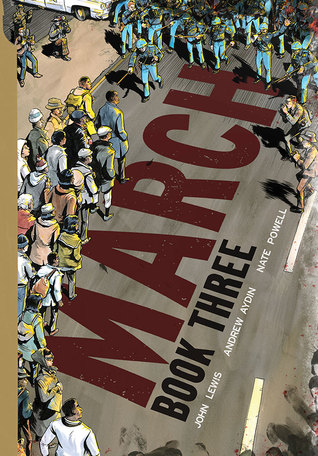
This is the final book in this amazing graphic novel trilogy. Congressman John Lewis concludes his story of the Civil Rights marches, providing real context to the Black Lives Matter movement of today. This book begins with the bombing of the church in Birmingham, Alabama that killed four young girls. It shows the fight for the ability to vote in Alabama for African Americans who were forced to take tests or just ignored as they tried to register to vote. The book culminates with the march in Selma and the violence that accompanied it and most importantly the changes it created.

I can’t say enough good things about this series. It brings critical Civil Rights history directly to teens in a format that is engaging. There is no way to turn away from the violence of the response of those in power as blood flows in the images on the pages. It makes it all the more powerful that the marches stayed nonviolent and focused on pacifism. Lewis himself voices again and again how much pressure there was at times in the movement to react more violently and how that was managed by himself and others. It is a testament to people willing to put their own bodies and lives at risk for progress.

The illustrations are riveting. Done in black and white, they effectively play darkness and light against one another, adding to the drama of the situations they depict. At times they are haunting and blaze with tragedy. The opening scenes of the Birmingham church are filled with tension and sadness that make it difficult to turn the pages and witness what happens.

These are the books our teens need right now. Every public library should have this series, no matter what races are represented in your community. This is our shared history and one that we cannot deny or turn away from. Appropriate for ages 12-15.

Reviewed from library copy.


Elizabeth Started All the Trouble by Doreen Rappaport

Elizabeth Started All the Trouble by Doreen Rappaport

Elizabeth Started All the Trouble by Doreen Rappaport, illustrated by Matt Faulkner (InfoSoup)

This nonfiction picture book looks at all of the women critical to the suffrage movement in the United States. From Abigail Adam’s plea in 1776 for her husband to “remember the ladies” to Sojourner Truth’s attendance at a meeting to remind the white women of the  movement that African-American women deserved the vote too, this book looks at the many voices of the movement with a particular focus on Elizabeth Cady Stanton who started the called on women in the mid-1800’s to fight for the right to vote. It is a dynamic book that will remind young readers that the right of women to vote in our country only happened in 1920.

Rappaport captures the tremendous tenacity that it took for women to fight actively for the right to vote for nearly 75 years. Moving in a vibrant way from one historical figure to another, Rappaport highlights not just those who were suffragists but also women who broke female stereotypes by becoming doctors and starting schools where women learned the same subjects men did. This global look at the movement demonstrates the number of ways it took to get changes made that would allow women to voice their own opinions through elections.

The illustrations have a humorous quality to them with near-caricatures of each of the women. There is a feel of a political cartoon to them which is particularly appealing given the subject matter. Their bright colors also help show the passion of the women and their drive to make change.

A great addition to public libraries, this book offers a neat package showing the full history for women’s right to vote. Appropriate for ages 7-10.

Reviewed from library copy.

The Secret Subway by Shana Corey

The Secret Subway by Shana Corey

The Secret Subway by Shana Corey, illustrated by Red Nose Studio (InfoSoup)

Released March 8, 2016.

This amazing nonfiction picture book takes a look at New York in the 1860s and the lack of options for transportation on the crowded and dirty streets. Everyone knew that something needed to be done, but no one could agree on exactly what that was. Then Alfred Ely Beach had an idea to build a railroad powered by forced air. Beach knew though that he couldn’t propose to create a railroad under the streets, so instead he proposed that he’d build a tube to carry mail. Even Boss Tweed agreed with the plan. So Beach set to work creating a railroad to carry people and not mail. But it was not going to be as easy as just building the machine. He still had Boss Tweed and above ground politics to deal with!

Corey writes with great energy in this picture book. While nonfiction and historical, the book is fascinating and one immediately roots for Beach as he begins to plan and then dig under New York City. The slow digging under the earth is tantalizingly told. Then the rush of opening and the speed of the train are offered with a breathless tone and fast pace. The ending is sad but also hopeful, since everyone knows that air-driven trains are not the way subways were designed. There is a feeling of remembrance at the end, of one man’s amazing dream that led to other opportunities to tunnel under New York City.

It is always a joy to see work by Red Nose Studios. The book opens with a look at how the illustrations are done with figures made from wire and foam and then polymer clay for the faces. There is such attention to detail throughout with the gorgeous tube-shaped subway car appearing like magic. Done with serious flair for the dramatic and a great sense of style, this picture book’s illustrations are noteworthy and wonderful.

A great pick for fans of machines and inventions, this is also a book just right for dreamers of all sorts. Appropriate for ages 6-9.

Reviewed from e-galley received from Penguin Random House and Edelweiss.

The First Step by Susan E. Goodman

The First Step by Susan E Goodman

The First Step: How One Girl Put Segregation on Trial by Susan E. Goodman, illustrated by E. B. Lewis (InfoSoup)

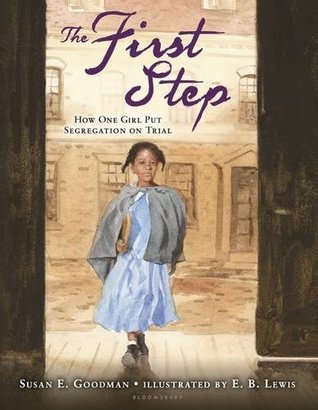
This picture book biography tells the story of Sarah Roberts. Sarah was attending school in Boston in 1847 when she was told that she would have to stop. Instead she would be required to attend the school for African American children across town where there were fewer books and the subjects were not as robust. Sarah’s parents decided not to accept this decision and instead decided to fight for change in the courts. Two lawyers agreed to take Sarah’s case, Robert Morris the second African-American attorney in the United States and Charles Sumner known for his way of orating about justice. Though they lost this first court case challenging school segregation, it set other events in motion and in 1855, Boston became the first major American city to integrate its schools.

Goodman writes an inspiring book about how even losses can begin to change the way people view laws. She does not stop with the longing for change and the case itself, continuing to tell the story of Boston’s changes and then the way that this case led to more cases which resulted in the end of segregation in the nation. This book demonstrates many things to young readers. First that they themselves can create change in the world around them. Second that a loss does not mean the end, it means the fight continues in a different way.

Lewis’ illustrations are done in watercolor and gouache. They echo with historical significance, showing the power of a dream for change, the sorrow of one little girl, and the determination that it takes to make society better. The illustrations range from the subtlety of black and white photographs to the bright colors of change and hope.

A powerful and important story of how children change their world, this picture book is inspiring. Appropriate for ages 7-9.

Reviewed from ARC received from Bloomsbury.

Review: Sharing the Bread by Pat Zietlow Miller

Sharing the Bread by Pat Zietlow Miller

Sharing the Bread: An Old-Fashioned Thanksgiving Story by Pat Zietlow Miller, illustrated by Jill McElmurry

Released September 22, 2015.

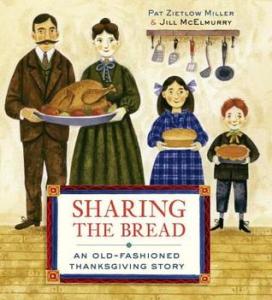
Told in rhyme, this picture book is a celebration of a family preparing Thanksgiving dinner together. The nineteenth century American traditions echo our modern ones closely. Readers will see the turkey go into the wood-burning oven. Dough for the bread is kneaded and allowed to rise. There is cranberry sauce made on the stove and a pumpkin pie with hand-whipped topping. Mashed potatoes are added to the feast as well as a jug of cider. Soon everyone is gathered around the table and prayers are said together. It’s an American Thanksgiving done in true traditional style.

The rhyming stanzas evoke a feeling of a jaunty folksong as they tell the story of a family making their Thanksgiving dinner. The rhymes create a great rhythm to the book, that will have toes tapping if they are read with enough snap and vigor. The rhyme and rhythm combine to create a strong framework for the book, one where there is a building anticipation for the meal and for the family to all arrive. There are extended family present, including adult siblings, aunt, uncle and grandparents. Throughout, there is lots of work to be done but it is all done in good cheer and everyone lends a hand.

McElmurry’s illustrations have a folkart quality to them that works well. Done in paint, the illustrations are simple and warm, inviting you back in time to share a meal that is familiar to everyone. There are lots of period details in the images such as water pumps, dried herbs in bunches on the wall, a wash tub, and large cast iron pots and pans.

Warm and flavored with tradition and love, this book is as gratifying as a fresh loaf of bread. Appropriate for ages 4-6.

Reviewed from digital galley received from Schwartz & Wade and Edelweiss.

Review: Voice of Freedom: Fannie Lou Hamer by Carole Bostone Weatherford

Voice of Freedom Fannie Lou Hamer by Carole Bostone Weatherford

Voice of Freedom: Fannie Lou Hamer:The Spirit of the Civil Rights Movement by Carole Bostone Weatherford, illustrated by Ekua Holmes (InfoSoup)

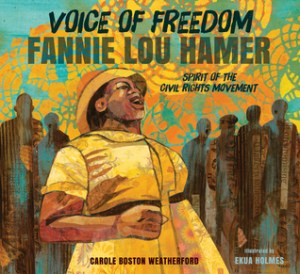
This biographical picture book is written in verse, singing the life of Fannie Lou Hamer, a woman who was at the heart of the civil rights movement. The book begins with Hamer’s childhood in Mississippi as the youngest of twenty children in a sharecropper family. She grew up working in the cotton fields, seeing it for the slavery that it was. School was only held for four months a year, because the children needed to work in the fields in order for their family to survive. Even in the early part of the 1900s, Hamer was taught that black was beautiful and that she was special. She stayed in the south rather than moving north like her siblings, taking care of her mother and getting married. The in the 1960s, voter registration became an issue and Hamer found herself standing up to the system despite the violence and the threats. She joined the movement for voter rights and starting to use her singing voice to bring people together. Soon she was seen as a leader in the movement, running for office, and speaking out for those who did not have a voice. She is an inspiration for today’s Black Lives Matter movement and youth activism in general.

Weatherford’s writing is gorgeous and the verse she uses to tell Hamer’s story is very effective. She is able to directly talk about racism and violence in her poems, never dancing away from the toughest of subjects. Each poem reads as a call to action, a reason to stand up and make sure civil rights are not being abridged. Even the poem where Hamer is beaten by police and other prisoners rings with strength and power. This is a biography of a woman who was immensely determined and strong. She stood up to the system, risked her own life for change, and used her own skills for the sake of the cause.

Alongside the powerful poetry are equally impressive illustrations. The collage art by Holmes is a mix of paper art and paintings. The illustrations are deep colored and tell the story of oppression and then accomplishment. There are illustrations that take the bright colors of Africa and the 1970s and make the pages blaze while others are dark and somber as violence and death cloud the pages.

Important and powerful, this nonfiction picture book shares the story of a woman vital to the civil rights movement. Appropriate for ages 7-10.

Reviewed from library copy.

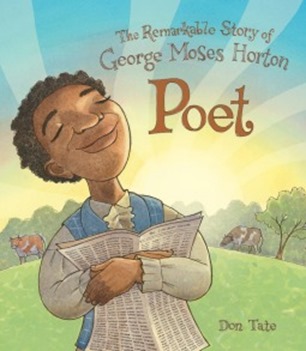
Review: Poet by Don Tate

Poet by Don Tate

Poet: The Remarkable Story of George Moses Horton by Don Tate

Released September 1, 2015.

George’s family were slaves in North Carolina. Though he loved words, George was not allowed to learn to read. But he listened when the white children did their ABCs and then got himself an old spelling book along with a book from his mother and taught himself how to read. He read everything that he could find, but loved poems most of all. He spent his workdays composing poems in his head, though he didn’t know how to write them down. Soon after, his family was split apart and he was sent to live on another farm. He worked in the fields and was sent to Chapel Hill to sell fruit and vegetables to the students. While there, he started to share his poetry aloud. The students loved his words and helped him by giving him more books to read and paying him to write poems for them. He was also taught to write his poems down and soon had his writing published in newspapers. George could then negotiate with his master to pay him for his time away from the farm where he could write. As George created the best life he could while still living a slave, the country was changing and a war for freedom was about to be fought. It was a war that would free George finally and allow him to continue writing but this time a free man.

Tate captures the life and times of this remarkable man with a tone of wonder at times. What Horton managed to do in his lifetime under slavery is amazing and a sign of the quality of the words he wielded so well. As readers watch Horton grow up and then fight for his freedom in his own way, with words, they will be devastated when he continues to be a slave despite his best efforts. Even the work of others on his behalf could not get him free.

Tate’s illustrations are exceptional. One can see the yearning for education on Horton’s face as he watches the white children learn to read. Tate also makes sure that Horton’s image shines on the page. He is regularly lit from outside lights of candles and the sun, creating a light around him. The illustrations also show North Carolina in the mid-1800s and Chapel Hill in particular. Tate also incorporates some of Horton’s poems into the illustrations, allowing them to flow past visually.

This is a choice nonfiction picture book that shows the strength of one man, his intelligence and the power of his words. Appropriate for ages 6-8.

Reviewed from digital galley received from Peachtree Publishers and Netgalley.

Review: My Wilderness by Claudia McGehee

My Wilderness by Claudia McGehee

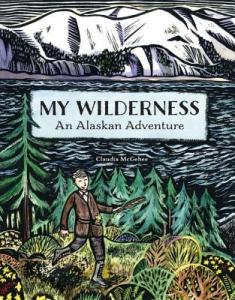
My Wilderness: An Alaskan Adventure by Claudia McGehee

This nonfiction picture book tells the story of Rocky and his father, painter Rockwell Kent, who spent a winter in 1918-1919 on Fox Island, just off the coast of Alaska. Rocky was nine years old at the time. He and his father repaired an old shed and turned it into their cabin. While his father spent time painting, Rocky drew a bit and explored the island a lot. He saw wildlife in the woods, collected shells and stones and the beach. Evenings were spent in the cabin, eating dinner and sharing stories. When the winter came, days filled with different activities like taking snow baths, making snow houses. They took trips to a larger island in their dory, rowing when the weather was good. They faced one large storm when returning home, barely making it to land. All too soon, their time in the wilderness was done. It was a time that Rocky always felt was the best in his life.

McGehee takes readers along on an epic journey to Alaska. The mountains are huge, the water freezing, the woods thick and the animals are everywhere. Told from the point of view of Rocky, the book allows young readers to see Alaska through his eyes and marvel along with him at the wonder of nature. As he walks the woods and explores the shore, he dreams that there may be monsters or pirates around, but looking again he always sees something that fits into the natural scene. The days are filled with exploration and evenings spent together, one gets the sense that there was more than enough adventure to fill their days.

The illustrations are done on scratchboard giving the feel almost of woodcut prints on the page. The result is a very organic feel with thick lines and an interplay of bright colors and deep black. The more natural feel works very well with this Alaskan subject matter, creating an old fashioned feel that enhances the book as well. McGehee captures nature with an ease that makes one want to enter the deep green woods alongside Rocky.

Explore the Alaskan wilderness in all of its wonder in this historical picture book. Appropriate for ages 5-7.

Reviewed from library copy.

Review: The House That Jane Built by Tanya Lee Stone

House That Jane Built by Tanya Lee Stone

The House That Jane Built: A Story about Jane Addams by Tanya Lee Stone, illustrated by Kathryn Brown

Jane Addams was a girl born into comfort and wealth, but even as a child she noticed that not everyone lived like that. In a time when most women were not educated, Addams went to Seminary. When traveling with her friends in Europe she saw real poverty and then also saw a unique solution in London that she brought home with her. In Chicago, she started the first settlement house, a huge house that worked to help the poor right in the most destitute part of town. Hull House helped the poor find jobs and offered them resources. Addams also created a public bath which helped convince the city that more public baths were needed. She also found a way to have children play safely by creating the first public playground. Children were often home alone as their parents worked long hours, so she created before and after school programs for them to attend and even had evening classes for older students who had to work during the day. By the 1920s, Hull House as serving 9000 people a week! It had grown to several buildings and was the precursor to community centers.

Jane Addams was a remarkable woman. While this picture book biography looks specifically at Hull House, she also was active in the peace movement and labeled by the FBI as “the most dangerous woman in America.” In 1931, she became the first American woman to win the Nobel Peace Prize. She wrote hundreds of articles and eleven books, she worked for women’s suffrage, and was a founding member of both the ACLU and the NAACP. At the turn of the century she was one of the most famous women in the world. The beauty of her story is that she saw a need and met it with her own tenacity and resources. She asked others to contribute, but did not step back and just fund the efforts, instead keeping on working and living right in that part of Chicago. Her story is a message of hope and a tale of a life well lived in service to others.

Brown’s illustrations depict the neighborhood around Hull House in all of its gritty color. Laundry flies in the breeze, litter fills the alleys, and children are in patched clothes and often barefoot. Through both the illustrations and the text, readers will see the kindness of Jane Addams shining on the page. Her gentleness shows as does her determination to make a difference.

This biography is a glimpse of an incredible woman whose legacy lives on in the United States and will serve as inspiration for those children looking to make a difference in the world around them. Appropriate for ages 6-9.

Reviewed from copy received from Henry Holt and Co.