Review: Lillian’s Right to Vote by Jonah Winter

Lillians Right to Vote by Jonah Winter

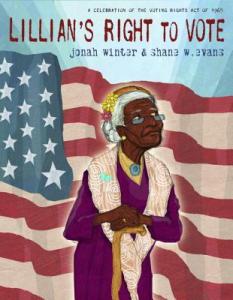
Lillian’s Right to Vote by Jonah Winter, illustrated by Shane W. Evans (InfoSoup)

This picture book celebrates the 50th anniversary of the Voting Rights Act of 1965. Lillian is a 100-year-old African-American woman who has lived through all of the problems with African Americans voting in the United States. As she climbs the steep hill to her polling place, she remembers all of the steps that led from slavery to being able to openly vote today. She thinks about her great-grandfather who labored as a slave but also lived to see the Civil War come and allow him to vote for the first time.  She remembers her grandfather being charged a poll tax and her uncle being asked unanswerable questions before would be allowed to vote. She remembers running from an angry mob of neighbors who didn’t want women voting. She will never forget the cross burning in their yard. She remembers the people who fought for civil rights, who died for civil rights, who marched for everyone’s rights. She climbs that hill, slowly and steadily, until she reaches her polling place where she can vote without fear of being attacked or turned away.

Winter’s prose is musical and passionate. He draws us all close together and then speaks to us of history and voting and America. He tells us of shameful things that must not be forgotten, of heroes who fell and those who were able to keep marching. He tells us all of our duty in subtle ways that are stirring and moving; that we must vote each and every time, even when it is difficult or there is a steep hill to climb. Winter tells a personal story of voting history in the United States, giving us rich robust story telling rather than dry facts. It is a stirring and noteworthy tale.

Evans’ illustrations are superb. His fine lined illustrations show the determination of Lillian, the horrors of slavery, the dangers of voting, and the courage of many to make changes for the better. His pages swirl with color and texture, fill with sunlight, and dazzle with blue sky. The golden page of the cross burning is disturbing in its vividness, the wash of gold not allowing anywhere to hide.

A gorgeous story accompanied by equally lovely illustrations, this historical picture book is one that should be embraced by elementary teachers during any national election. Appropriate for ages 7-10.

Reviewed from digital galley received from Schwartz & Wade and Edelweiss.

Review: Mesmerized by Mara Rockliff

Mesmerized by Mara Rockliff

Mesmerized: How Ben Franklin Solved a Mystery that Baffled All of France by Mara Rockliff, illustrated by Iacopo Bruno (InfoSoup)

When Benjamin Franklin went to France to ask them for their help in gaining freedom for the American colonies, he discovered that they were fascinated by science. Particularly, they were abuzz about Dr. Mesmer, a man who staged shows and used an unseen force that he claimed was similar to electricity to cure people of their health issues and control their thoughts. Even Marie Antoinette was taken with Dr. Mesmer and in awe of his powers. The King of France asked Ben Franklin to explore what the force was. So Franklin started the very first blind test, literally, by blindfolding people and experimenting to see if they could tell if Dr. Mesmer was using the force or not. In the end, several things were discovered like the placebo effect and the amazing power of the human mind itself.

Rockliff writes a rollicking book where science is what everyone wants to know more about but also where science is in its infancy. This look at a specific moment in history is dynamic and great fun, particularly due to the personalities involved and also the fact that it demonstrated scientific ideas that are still in use today. Rockliff relishes the fun of the entire story along with the reader, allowing this story to carry forward on its own wild pace which will delight teachers looking for a book on science that is fun to share aloud.

Bruno’s illustrations add to that wild feel with their fancy flounces when talking of Dr. Mesmer and the straight-forward but period touches when Franklin takes the page. There are full color double-page spreads mixed with other pages with more white space. The illustrations have a broad sense of humor that ties in well with the text.

A fabulous nonfiction book that is sure to surprise and enthrall history and science buffs. Appropriate for ages 6-9.

Reviewed from library copy.

Review: The Amazing Age of John Roy Lynch by Chris Barton

Amazing Age of John Roy Lynch by Chris Barton

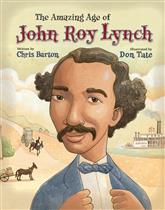
The Amazing Age of John Roy Lynch by Chris Barton, illustrated by Don Tate (InfoSoup)

John Roy Lynch grew up as a slave in Mississippi, the son of an overseer who tried to free his children from slavery. Unfortunately, his untimely death led to them continuing to be enslaved until the Emancipation Proclamation. Lynch found a job, his first paying job, on a steamer ship and worked his way up. At age 17, John Roy went to work for a photographer whose studio was right across from a school. Listening in on the classes and attending night school, John Roy was able to learn to write eloquent letters. He also started being active in politics, buying land, and speaking out. He was appointed Justice of the Peace at age 21. Soon he was elected as the Mississippi Speaker of the House and then in 1872, he became the first African-American US Congressman. Throughout, John Roy Lynch spoke to the needs of the people he represented and the importance of civil rights for all.

Barton provides just enough information for children to understand the time period and the implications of the Emancipation Proclamation. This look at the Reconstruction Period offers a view of an important time in American history, one that is often overlooked in children’s books. The amazing fortitude and resilience of John Roy Lynch keeps this book moving as his own life progresses forward in unexpected ways. Clearly it is his intelligence and gift for communication that carries Lynch forward into a very different life than others around him. More information on Lynch is offered in the final pages of the book with a complete timelines and bibliography.

The illustrations by Tate are done with a light touch, creating a book that depicts darker subjects at time but also infusing the book with a sense of hope and wonder. This makes a book covering such a heavy topic as well as such an important part of history much more appealing and approachable.

An important book focused on an important figure in a dynamic time in American history, this picture book biography will inform new audiences about the potential for both progress and defeat during the Restoration. Appropriate for ages 7-10.

Reviewed from copy received from Eerdmans Books for Young Readers.

Review: Gordon Parks by Carole Boston Weatherford

gordon parks

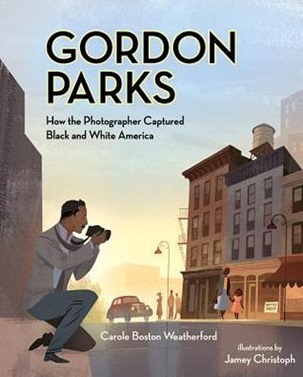
Gordon Parks: How the Photographer Captured Black and White America by Carole Boston Weatherford, illustrated by Jamey Christoph

Gordon Parks had a rough beginning to his life from being born almost stillborn to losing his mother at age 14. He was told by his white teacher that he and the rest of his all-black class would end up as either porters or waiters. Parks did do those jobs, but then he purchased a used camera and everything changed. He started photographing models and then turned his camera towards the struggling families in Chicago and Washington DC. He is pointed towards one specific subject who will create his most famous image, American Gothic, the picture of an African-American cleaning woman standing in front of the American flag with her mop in hand. Parks managed to show racism with a clarity thanks to just picking up a camera at first.

Weatherford keeps this book very friendly with a minimal amount of text in the bulk of the book. She does include an author’s note at the end that fills in more of the extensive career of Parks as a film director and Renaissance man. The focus here in this picture book biography is Parks’ photographic work and the impact he had on exposing racism and poverty in the inner city, showing hard working people who were still in poverty. Make sure to turn to the end of the book to see his photographs and their intense message.

Christoph’s illustrations are stellar. Using a subtle color palette, the images echo the photographs that Park took, but not too closely. Instead they build upon them, showing Parks taking the images and embracing the dark beauty of the back streets of urban spaces. He also beautifully captures emotions and the humanity of Parks’ subjects that also shines in his photographs.

An important picture book biography, this book shows how one person can make a difference and have a voice. Appropriate for ages 7-9.

Reviewed from library copy.

Review: March: Book Two by John Lewis

march book two

March: Book Two by John Lewis, Andrew Aydin and Nate Powell

The powerful second book in the March graphic novel series continues the true story of the Civil Rights Movement. Told by John Lewis in the first person, this book captures the dangers and violence faced by the Freedom Riders as they headed into the deep south. The nonviolent campaign for civil rights faced beatings, police brutality, bombs, imprisonment and potential death. Yet they found a way to not only keep going but to continue to press deeper and deeper into the south. This book is a harrowing read that shows how one young man became a leader of in civil rights and politics in America.

Lewis’ personal story allows readers a glimpse of what was happening behind the scenes. Historical figures like Martin Luther King, Jr. and Malcolm X make appearances in the book, and their own personal perspectives on civil rights and nonviolence is shared. The pushback on the nonviolent aspect of the movement is also shown clearly on the page when new people joined the cause. This shift towards more reactionary tactics threatens to undo the progress that had been made to that point.

Thanks to the graphic novel format, there is no turning away from the violence. Beatings are shown up close and will a frenzy that is palpable. The dangers are not minimized nor overly dramatized, they are shown honestly. There are unforgettable moments throughout the novel, some of them small like a boy being encouraged to claw out a civil rights worker’s eyes.  Other moments are larger from the mattress protests in the jail to the march of the children and the police brutality that followed.

Immensely strong and powerful, this graphic novel series allows us to see how much progress was made thanks to these civil rights heroes but also inspires young readers to make more progress against the continued racism in our society. Appropriate for ages 13-15.

Reviewed from library copy.

Review: My Name Is Truth by Ann Turner

my name is truth

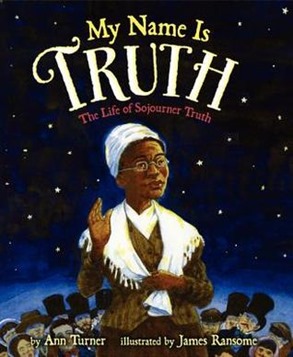
My Name Is Truth: The Life of Sojourner Truth by Ann Turner, illustrated by James Ransome

Told in her own voice, this picture book biography captures the childhood and emergence of Sojourner Truth as an orator and activist. The first pages of the book show the horror of slavery, the loss of family members when they are sold away, and the damage of loss, grief, battery and ownership. Then with her baby in her arms, Sojourner runs away, finding shelter. She eventually fought to get her son back with her, and finding her voice. Moving to New York City, she gains her new name of Sojourner Truth and begins to speak out. From wagon backs to formal lectures and then in print, her words travel and help destroy the institution of slavery across the nation.

Turner weaves Truth’s words into the text, creating poetry that is fiery and honest and burns with indignation about slavery. Using her own voice to narrate the story is a great decision, allowing readers to really see what has built the passion upon which Sojourner Truth draws again and again. The horrors of the loss of twelve members of her family never leaves her and it never leaves the book, as it begins and ends with that focus. The entire book is beautifully drawn and historically accurate. Readers can read the author’s note at the end and teachers will appreciate the book being reviewed for accuracy by experts.

Ransome’s illustrations are luscious and lovely. He shows the hard work, grueling labor of slavery and then with one page of running away, Sojourner Truth expresses freedom in the form of a large bed of her very own, something she has never experienced before. It is an image that is powerful and one that children will understand intuitively. As the book progresses, the images grow in power and strength as she comes into her own.

Strong, poetic and filled with history, this picture book biography of Sojourner Truth will be embraced by schools and public libraries alike. Appropriate for ages 6-9.

Reviewed from library copy.

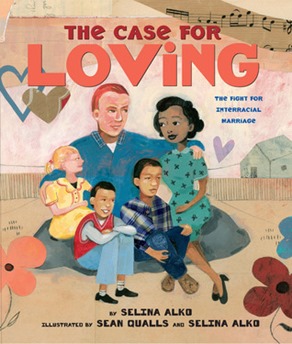
Review: The Case for Loving by Selina Alko

case for loving

The Case for Loving: The Fight for Interracial Marriage by Selina Alko, illustrations by Sean Qualls and Selina Alko

This nonfiction picture book tells of a history that will surprise modern American children. It is the story of love and one family that was brave enough to stand up to a racist law. Mildred and Richard Loving fell in love in the small town of Central Point, Virginia. They had different colored skin and so they were not allowed to get legally married in Virginia. So they crossed state lines into Washington, DC and got married there. When they returned to Virginia though, they were arrested for violating the state law against interracial marriage. The two moved to Washington DC and raised their children there. Things started to change in the 1960s and the Lovings took their case all the way to the Supreme Court to win the right to marry one another in the state of Virginia.

This book is strikingly beautiful with a rich warmth that flows directly from the story and art. The author and illustrator are a husband wife team who are also interracial. Their passion for this subject shines on the page. Alko explains that subject matter with a vibrancy, offering information on the laws in a way that is suitable for small children. The drama of the arrest is also clearly captured, exposing the ludicrous law to today’s perspective.

The art of the book was done by both Qualls and Alko. Their styles marry into a beautiful richness that fills the pages. They are filled  will playful hearts and flowers that add a lighter note to the images. At the same time they have detailed paintings filled with texture and power at their center. The combination of both has created a stunning beauty of collage and painting.

An important piece of our civil rights history as a nation, this picture book documents one family willing to take up the fight for themselves and others. Appropriate for ages 6-9.

Reviewed from copy received from Arthur A. Levine Books.

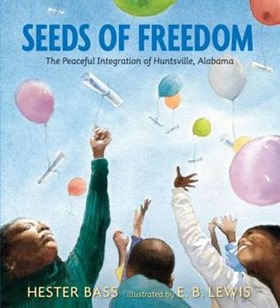
Review: Seeds of Freedom by Hester Bass

seeds of freedom

Seeds of Freedom: The Peaceful Integration of Huntsville, Alabama by Hester Bass, illustrated by E. B. Lewis

Violence was a large part of the Civil Rights Movement in the 1960s.  However in Huntsville, Alabama something quite different happened, quietly and successfully.  They managed through cooperation, quiet civil disobedience, and courage to stand up for what was right for all members of their community.  There were lunchroom protests where young black people sat at the counters they were not allowed to eat at.  There were marches with signs.  There were arrests, even one of a mother with an infant that gained national news. There were lovely protests like refusing to purchase new clothes for Easter and instead dressing in blue jeans to deny some stores their business. There were balloons with messages of coming together even as a segregationist ran for governor. There were brave children who attended schools where they were the only people of color. Yet it all happened in a community of support and with no violence at all.

Bass emphasizes throughout her book that there were challenges in the society and reasons for protest.  Time and again though just as the reader thinks things will be more rough and confrontational, it abates and progress is made. Her use of details from the other cities in Alabama as well as the national Civil Rights Movement will show children how violent the struggles often were. It is against that backdrop that the progress in Huntsville really shines.

Lewis’s paintings also shine.  He captures the strength and determination of those working for their civil rights.  On each page there is hope from the children reaching to the sky with their balloons to the one black child in the class and his smile.  It all captures both the solemnity of the struggle and the power of achieving change.

Beautifully told and illustrated, this nonfiction picture book offers a compelling story about a community’s willingness to change without violence.  Appropriate for ages 7-10.

Reviewed from library copy.

Review: Gingerbread for Liberty by Mara Rockliff

gingerbread for liberty

Gingerbread for Liberty: How a German Baker Helped Win the American Revolution by Mara Rockliff, illustrated by Vincent X. Kirsch

German-born Christopher Ludwick had come to the Colonies as a young man looking for the opportunity to create his own bakery.  He did just that, creating gorgeous gingerbread for his town.  When the Revolutionary War began, he was eager to defend his America in any way he could, so he headed off to join General George Washington.  When he got there, the soldiers were hungry and complaining about the quality of food they were getting.  Ludwick jumped into action, feeing the armies bread from his ovens.  But the dangers weren’t done yet.  The King of England pulled together armies from other countries and sent them into battle.  The soldiers came from Germany and Ludwick offered to see if he could convince them not to fight.  Once again it was food and the promise of having enough to eat that convinced the soldiers to lay down their arms.  Many battles later, the war was won, but Ludwick and General Washington had one final mammoth baking task ahead of them.

Rockliff keeps the tone of this book quite lighthearted even as Ludwick finds himself taking grave risks with his life.  The writing is jolly and merry throughout.  The tone suits this baker whose optimism shines on the page and whose patriotism seemed to know no limits.  His accomplishments exceed what is shown in this picture book.  Make sure to read the Author’s Note at the end of the book to learn more about this amazing patriot and what he did for children and education as well as liberty.

Kirsch’s illustrations are a gingery delight.  Done in the forms of elaborate gingerbread cookies, the characters are shown as flat brown cookies with plenty of icing.  From the brown outlines to the white lines of icing, there is no mistaking what they are meant to be.  They too add a sweet and optimistic feel to this jolly picture book.

An unsung hero of the Revolutionary War and beyond, this picture book celebrates the impact that one man can have in making history.  Appropriate for ages 6-8.

Reviewed from library copy.