Review: Audacity by Melanie Crowder

audacity

Audacity by Melanie Crowder

Told in masterful verse, this is the story of real-life heroine Clara Lemlich who led the largest strike by women in the history of the United States.  Born in Russia, Clara was forbidden any education because her devout Jewish father did not approve.  When her family emigrated to the United States at the turn of the twentieth century, Clara was required to go to work to support her family while her father and brothers dedicated their lives to prayer.  Clara got work in the garment industry, discovering horrific working conditions and refusing to just accept them.  Clara worked to get women workers taken seriously by the male-driven unions and for their plight to be incorporated into union strikes and negotiations.  Along the way, she also used the public library and free classes to teach herself English.  Anyone wondering if one person can truly make a difference in a larger world has only to read this book to be inspired to action.

Crowder’s poetry here is completely amazing.  From one page to the next, she captures the incredible spirit of this young woman and her desire to educate herself.  When she finds something to fight for, she is unstoppable, fearless and unbeatable.  Crowder also ties Clara to nature, even in among the tenement buildings of New York City.  She is a small hawk, a flower in the concrete, she herself is the force of nature in the city.

Just the descriptions of the horrific beatings that Clara withstood on the streets and the picket lines would make most people quit.  But Crowder makes sure to depict Clara as a person first and a hero second.  It makes what she did so much more amazing but also encourages everyone to realize that they too have this within them if they are willing to take on the fight.  This woman was a heroine in such a profound way, unsupported by her family and willing to use all of her free time to make a difference, she is exactly what the modern world needs to have us make change now.

Strong, beautiful and wonderfully defiant, this book is an incredible testament to the power of one woman to change the world.  Appropriate for ages 13-17.

Reviewed from ARC received from Philomel.

Review: Dear Mr. Washington by Lynn Cullen

dear mr washington

Dear Mr. Washington by Lynn Cullen, illustrated by Nancy Carpenter

Based on a true story, this enchanting picture book will have everyone smiling.  When George Washington comes to the Stuart house to have his official portrait painted, the children must all by on their best behavior.  But it doesn’t quite work out that way.  With each visit to the house, Charlotte has to write another letter of apology.  She has to apologize for the cat racing up his shoulder, for the baby chewing on his hair ribbon, and much more.  She shares a list of how they will be better behaved the next time.  But then there are her many examples in the following letter of how very good they had been, which was not actually true.  In each and every letter though, she is cajoling Mr. Washington to smile in his picture.  Can a very serious president handle the wild and silly Stuart clan?

A large part of the joy of this book is that it’s based on a true story.  You can read the author’s note at the end to see just how much.  The interplay between Mr. Washington and the children is lovely.  He mutters under his breath, ignores them as best he can, and yet it all ends up a mess anyway.  And the children themselves are cheery and playful, undeterred by either their parents demanding they behave or the scowling Mr. Washington.

Carpenter’s art adds to the fun.  She merrily depicts the naughty children from the baby chewing on Mr. Washington’s shoe to the entire group falling asleep all together on top of him.  It’s great to see a historical book that is playful and fun.

A great read aloud, this book is funny, silly and filled with history and art.  What more could you want?  Appropriate for ages 6-9.

Reviewed from copy received from Dial.

Review: All Different Now by Angela Johnson

all different now

All Different Now: Juneteenth the First Day of Freedom by Angela Johnson, illustrated by E. B. Lewis

Celebrate the beauty of freedom in this book dedicated to Juneteenth.  Told from the point of view of a young girl, the story is about the first Juneteenth, the day that freedom was first announced for the last of the slaves in the South.  Living in shacks on a plantation in Texas, the day is just another day for the girl and her family and the rest of the slaves.  They worked hard in the hot sun, not knowing that word of their freedom was steadily heading their way.  Then the news arrived and people reacted in different ways, but quickly they pulled their things together and left the plantation behind for freedom.  Now June 19th is celebrated as African American Emancipation Day across the United States.  It’s a joy to have such a beautiful picture book to give to children to explain Juneteenth and why it means so much.

Johnson manages somehow to show slavery in all of its bone-grinding hard work and lack of freedom but also infuse it with moments of beauty, like waking to the scent of honeysuckle.  Her words are poetry on the page, spare and important, speaking volumes in only a few phrases.  The book ends with a timeline of important events and a glossary of relevant terms, making this a very useful book as well as lovely.

Lewis’ illustrations are beautiful.  He plays with light and dark on the page, allowing the light of the hot Texas day to fill the tiny shack but also making sure that the barrenness is evident and the poverty.  The book is filled with light, the sky burned to a pale yellow.  Until darkness which has a richness and endlessness that is sumptuous.  There is such hope on these pages, almost achingly so, particularly as freedom is announced and they turn their faces to a new future.

Beautiful and timely, this book will be welcome in library collections across the country as one of the only picture books about this holiday.  Appropriate for ages 6-9.

Reviewed from copy received from Simon & Schuster Books for Young Readers.

Review: Under the Freedom Tree by Susan

under the freedom tree

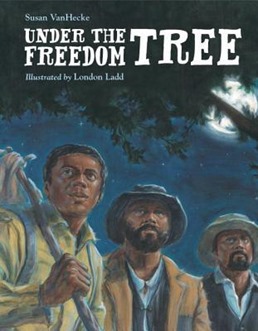
Under the Freedom Tree by Susan VanHecke, illustrated by London Ladd

Told in free verse, this picture book is the story of how the first contraband camp formed during the Civil War.  It all started with three runaway slaves who escaped across a river to a Union-held fort.  Though the Confederate Army tried to demand their return, the general at the fort declared them “contraband of war” and offered them protection and a place to live.  The three were quickly joined by a flood of people crossing the line into Union territory and they began to build a home for themselves near the fort.  The freedom tree is the Emancipation Oak which stood witness to the events that unfolded, including the Emancipation Proclamation, which set all of the residents of the camp free.

VanHecke’s verse is loose and beautiful.  She captures the danger the slaves faced in crossing the Confederate line, the risks they took asking for shelter, and the clever solution found by the general.  She offers an author’s note in prose to give more historical context to the camp and the Emancipation Oak. 

Ladd’s illustrations are lush and detailed.  His paintings capture the hope of emancipation, the darkness of escape by water and night, and the beauty of the oak.  The illustrations clearly honor the first three men who escaped to the fort, showing them as they wait for the judgment of whether they must return to slavery or not. 

A little-known part of the history of the Civil War, this book in verse pays homage to the courage of the men who created the contraband camp.  Appropriate for ages 6-10.

Reviewed from copy received from Charlesbridge.

Review: Thomas Jefferson by Maira Kalman

thomas jefferson

Thomas Jefferson: Life, Liberty and the Pursuit of Everything by Maira Kalman

The author of Looking at Lincoln takes on Thomas Jefferson in her newest picture book biography.  The focus in this biography is on the wide range of Jefferson’s interests and how he truly was a Renaissance man.  Monticello, the house Jefferson designed and built, serves as a fine background to his interests since the home itself was ever changing and also housed many of his interests as well.  The book looks at fascinating small details like the design of Jefferson’s bed, the extensive vegetable gardens, and his hours spent practicing music.  After fully exploring Jefferson personally, the book turns to the Declaration of Independence and Jefferson becoming the third President of the United States.  Then the book also explores the fact that Jefferson had slaves and fathered children with one of them, Sally Henning.  This is a complex and thorough look at a man who was brilliant in so many ways but troubled as well.

Kalman writes biographies with her own opinions right on the page.  So when she addresses the slave issue, she speaks of “our hearts are broken” and then speaks to how tragic it is that Jefferson’s children who could pass as white had to hide who they really were.  This adds a personality to the book, making it far richer than simple facts would.  It will assure young readers that it is good for them to have opinions about history and to express them too.

As always, it is Kalman’s art that sets this book apart.  Her illustrations range from more serious portraits of the historical figures to eye-popping bright colors in the vegetable gardens where paths are pink next to the bright green of the grass.  It is all entirely rich and joyful.

Another dynamic and unique biography from Kalman, this book belongs in every public library serving children.  Appropriate for ages 7-10.

Reviewed from copy received from Nancy Paulsen Books.

Review: A Home for Mr. Emerson by Barbara Kerley

home for mr emerson

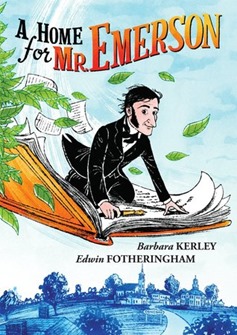
A Home for Mr. Emerson by Barbara Kerley, illustrated by Edwin Fotheringham

Ralph Waldo Emerson grew up in Boston where he moved often with his family.  He dreamed of living out in the country near fields and woods.  After college Emerson moved to the small town of Concord, Massachusetts where he bought a farmhouse.  He brought along a bride and an extensive personal library.  He quickly found that he wanted friends to fill up his house and set off throughout Concord to meet his neighbors.  Emerson now had all that he wanted, a family, woods, fields, an orchard and many books and friends.  He began to travel extensively and lecture which brought even more people to his home, people from around the world.  Then one day, Emerson’s beloved home caught on fire and it was his way of life that saves him in the end.

The creative team that did The Extraordinary Mark Twain and What to Do about Alice? return with another dynamic picture book biography.  Kerley manages to both introduce Emerson to elementary-aged children and also to delve deeply into his personal life and the way that his writings reflected that lifestyle as well.  More details about Emerson and his life are available at the end of the book along with inspiration for young people to build their own worlds around what they love. 

Fotheringham’s illustrations are fresh and whimsical.  He has created a world of vivid colors against which the black and white figure of Emerson pops out.  Nature is celebrated in the images, reflecting Emerson’s connection to it and the Concord community spirit is shown as well.

Another exceptional picture book biography from an amazing team, this is a great pick for young readers who don’t know Emerson but will appreciate his sentiments.   Appropriate for ages 6-9.

Reviewed from copy received from Scholastic.

Review: How I Discovered Poetry by Marilyn Nelson

how i discovered poetry

How I Discovered Poetry by Marilyn Nelson

A celebrated poet and author of books for children and teens, Nelson tells the story of growing up in the Civil Rights era and her connection to poetry.  In fifty poems, several of which have been previously published, Nelson reveals her growing up from age 4 through 14 during the 1950s and 1960s.  The poems show her progression from child to a self-aware teen who is directly impacted by the changes in civil rights.  Nelson also touches on the Cold War and feminism along with race in these poems.  Each poem here is a gem, carefully crafted and firmly placed in its setting in the book.  Beautiful.

In her author’s note, Nelson mentions that she prefers not to see the character in the book as herself but rather as “The Speaker.”  The first person perspective though will leave readers assuming that this is Nelson’s personal story and journey and it’s difficult to change that perception after reading the entire book.  Perhaps even more than the historical period it is The Speaker’s love of poetry and writing that makes the connection to Nelson as that person ring so true.  It is that love of poetry and words that makes each poem so beautiful, but also makes the narrator come alive.

Beautiful and worth rereading and revisiting, this collection of poems that forms a story is deep and worth submerging yourself in.  Appropriate for ages 9-12.

Reviewed from copy received from Dial Books.

Review: Salt by Helen Frost

salt

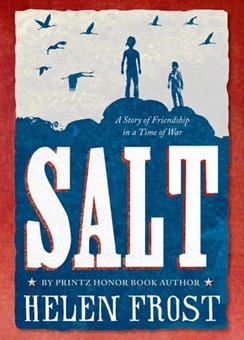
Salt: A Story of Friendship in a Time of War by Helen Frost

In 1812 in Indian Territory, two boys forge a friendship over hunting, fishing and survival of their families.  James’ family runs the trading post at Fort Wayne, living right outside the walls of the fort.  Anikwa’s family, members of the Miami tribe, has lived on this land for generations.  Now two armies are heading right to Fort Wayne to battle, the Americans and British will meet for a critical battle.  The question becomes whose side the Miami will be on when the battle occurs.  But even more deep is the question of whether the friendship between the two boys and their two families can survive this battle and the losses that it brings.

Frost has mastered the verse novel, creating a work that functions as beautiful poetry with profound depths and also as a complete novel.  Frost puts a human face on history in this novel that tells the story of a major battle in the war of 1812.  By the time the soldiers arrive, readers care deeply for both boys and their families.  So when the destruction starts, the wounds are real and the losses far beyond numbers.  The poems show readers the beauty of the landscape, the bounty of the land, and all that is possibly lost afterwards.

Frost writes from both boys’ points of view in alternating poems.  So the lifestyle and losses of both families is shown from their own points of view.  Anikwa’s poems are done in a poetic form that creates a pattern on the page.  Frost explains in her notes at the end that this is to mimic Miami ribbon work.  Without knowing this while reading, I could still see the square form of James’ poem representing the fort and the home he lived in next to the motion-filled form of Anikwa’s poems that exuded nature. 

An exquisite verse novel that fills history with real people and war with real loss.  Appropriate for ages 11-13.

Reviewed from library copy.