Review: What’s Your Favorite Animal?

whats your favorite animal

What’s Your Favorite Animal?

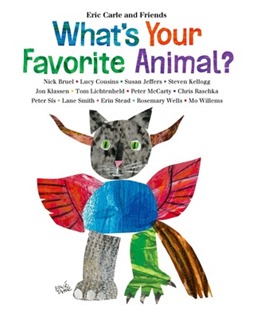
Eric Carle and many other well-known illustrators offer their personal favorite animals complete with a short piece about what animal they love and why.  Turning the pages is rather like visiting a gallery of some of the top picture book illustrators working today.  Turn the page and see Lane Smith’s choice of elephant, then Jon Klassen’s ode to his love for ducks, and Susan Jeffer’s beautiful look at horses.  This work is fantastically lovely and personal to the illustrators.  It is a pleasure to turn each page and take a journey through this book.

Readers may discover new authors and illustrators and seek out their work.  But best of all, this is a wonderful look at well-known illustrators on a personal level.  Appropriate for ages 4-6.

Reviewed from copy received from Henry Holt and Co.

Review: Tippy and the Night Parade by Lilli Carre

tippy and the night parade

Tippy and the Night Parade by Lilli Carre

Released February 11, 2014.

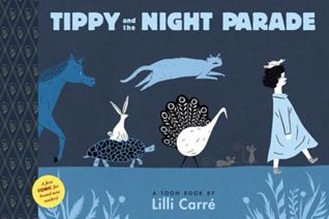
In the morning when she wakes up, Tippy’s room is a complete mess.  But all Tippy remembers is falling asleep, how did this all happen?  The next night, she goes to bed as usual after cleaning up her room.  And then readers get to see exactly what happens when Tippy goes sleepwalking along a pier, across the garden, hopping on lily pads, lost in the fog and trees, down a hole, into the desert, up a mountain and back down to her window.  Just to wake up the next morning again without knowing what happened.

Carre lets her images tell the majority of the story in her debut graphic novel.  And the images are a smart mix of modern with a vintage flair.  They have a flatness to them that adds a quirky quality to the book.  They also have a great sense of humor as the parade builds in length and more animals are included.  My particular favorite is the rotund bear.  And what a parade it is, sharp-eyed readers will enjoy looking at the mess in her room and matching the animals that had joined her walk back home.

Funny and quirky, this parade is one worth marching along with.  Appropriate for ages 4-6.

Reviewed from copy received from Toon Books.

Review: A Book of Babies by Il Sung Na

book of babies

A Book of Babies by Il Sung Na

A duck takes readers on a tour of different sorts of animal babies.  The duck heads around the world, visiting baby lions, baby lizards, baby polar bears, and baby kangaroos among many others.   A trait of each baby is mentioned to distinguish them.  Baby zebras walk right away.  Fish are born with lots of brothers and sisters.  Seahorse fathers carry their babies in a pouch.  These small details add up to a kaleidoscope of different animals and offer lots of opportunities for parents to talk more about each animals as they share the book.

This author of The Book of Sleep always fills her books with rich illustrations.  Here her gentle poem carries the duck from one place to the next, but it is the illustrations that make this such a special gem.  Done in mixed media, they feature a variety of textured papers that become ice bergs, tree trunks and even the sky.  He manages to make colors that seem to emit light, glowing on the page. 

Perfect for toddler bedtimes, this book is radiant with baby animals.  Appropriate for ages 1-3.

Reviewed from copy received from Random House Children’s Books.

Review: Wild by Emily Hughes

wild

Wild by Emily Hughes

When the baby girl was found in the woods by the animals, the entire woods took her in.  Bird taught her to talk.  Bear taught her to fish.  Fox taught her how to play.  Everything was good, until she met some people in the woods.  They took her home with them.  A famous psychiatrist took her in and tried to make her civilized.  They combed her hair, tried to teach her to speak, frowned at her table manners and didn’t appreciate the way she played.  Everything they did was wrong.  The girl was not happy at all.  But then one day, she found her wild once more. 

Told only in brief sentences, Hughes lets her art tell much of the story here.  And what a glorious story it is.  It’s the story of a child perfectly at home in the wild and with the animals.  She doesn’t long for society or civilization in any way.  She’s the opposite of many classic book characters like Curious George.  She rejects the rules and substitutes her own.

The art has a wonderful wild quality as well.  It is lush and filled with details.  The woods have a flowing green that is mesmerizing.  Once the humans enter the story, things become more angular and rigid.  The return to the woods is beautiful and completely satisfying. 

Hughes has tapped into what every child dreams of, living in the woods with the animals and thriving.  Everyone who reads this will want to be wild themselves.  Appropriate for ages 3-5.

Reviewed from library copy.

Jumping Penguins by Marije Tolman and Jesse Goossens

jumping penguins

Jumping Penguins by Marije Tolman and Jesse Goossens

This nonfiction book is filled with facts about different animals.  And not just any facts!  These are facts that are funny, amazing and memorable.  For instance, did you know a giraffe has no vocal chords?  That caterpillars throw their poop?  That crocodiles are cannibals?  That a flamingo can only swallow if its head is upside down?  Fifty animals are shown here with whimsical illustrations by the award-winning Tolman. 

Goossens masterfully selects facts that mix the incredible with the bizarre with the humorous.  The book is a wonderful mix of fictional depictions of the animals and scientific facts.  Due to the pile up of animals on the cover, I was expecting a fictional book rather than this page-turner of a book that gets you so intrigued that you have to keep on reading.

Tolman’s illustrations are beautiful.  She has such a unique style and one that works particularly well with animals and their diverse habitats.  With each, she seems to capture what makes them interesting and special.  At the same time, she mixes in furniture, hats, sun glasses and more.  So the animals look hip, silly or serious depending on the page.

Delightful, whimsical and a great choice for children who love animals, this book is appropriate for ages 4-7.

Reviewed from copy received from Lemniscaat.

Review: Fraidyzoo by Thyra Heder

fraidyzoo

Fraidyzoo by Thyra Heder

It’s the perfect day to go to the zoo and the whole family is excited.  Well, maybe not the whole family.  Little T certainly is not, in fact she is frightened of the zoo.  But she can’t remember what in the zoo scares her.  So her family set out to find out what might be scaring her.  They start out at the beginning of the alphabet and acting out the animals.  It’s not alligator, bat or camel.  As they go on, the costumes they use become more and more elaborate and they all help act them out with plenty of laughter and silliness.  They make it all the way to zebras and still Little T can’t remember why she is scared of the zoo.  So they decide to go the next day.  But there is something very frightening at the zoo, and her older sister might just find it a little too scary.

Heder does a superb job here of creating costumes out of boxes and ropes that look like they just might work in real life.  As the costumes grow more and more outrageous and complex, they also get more beautiful.  Along the way, Heder does not name any of the animals being portrayed, so the book has a guessing-game element to it as well.  The ending is funny and satisfying.

Heder’s art really is the majority of the story here.  The text is almost secondary to the full-page images that gallop and dash across the page.  They are filled with motion, color and smiles.  This is art that will inspire children to play with boxes and rope.  Expect your living room to be strewn with cardboard and ideas.

Creative and a joy to read, this is much more fun than any visit I’ve had to the zoo.  Appropriate for ages 3-5.

Reviewed from copy received from Abrams Books for Young Readers.

Review: Musk Ox Counts by Erin Cabatingan

musk ox counts

Musk Ox Counts by Erin Cabatingan, illustrated by Matthew Myers

The characters from A is for Musk Ox return for a counting book this time.  A counting book should be fairly straight forward, it’s counting after all.  But Musk Ox has different ideas.  Must to Zebra’s dismay, he doesn’t even make it to number one at the beginning of the book to be counted as one Musk Ox.  Instead he is on the page with 2 yaks.  Musk Ox offers to fix the problem on the page for number one, but still messes up the 2 yaks page.  Zebra is beside himself and a sulky Musk Ox heads back to page one on his own.  But he doesn’t stay there for long!  Expect plenty of counting chaos throughout the book though there is also some easy addition thrown in too. 

I enjoyed this book almost as much as the first one.  This one has the joy of returning to two engaging characters.  As with the first, you never know what is going to happen on the next page, making it very engaging reading.  Cabatingan writes the two characters with zingy dialogue and the book is a must for reading aloud. 

Myers’ illustrations add to the zany book.  He manages to keep crowded pages from being confusing as the number mount.  He also uses the effect of Musk Ox and Zebra peeking through from other pages very nicely. 

The result is a counting book worth sharing aloud to a group of preschoolers, and there aren’t many counting books that you can say that about!  Appropriate for ages 3-5.

Reviewed from copy received from Roaring Brook Press.

Review: A Moose That Says Moo by Jennifer Hamburg

moose that says moo

A Moose That Says Moo! by Jennifer Hamburg, illustrated by Sue Truesdell

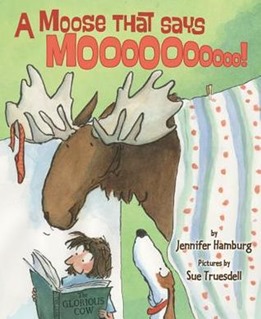
Sitting near the laundry drying on the line, a little girl is reading books about animals.  She starts to think about having a zoo of her very own and what sorts of animals it would have.  It’s guaranteed that no other zoo has animals like hers!  There is a moose that says “moo,” bears that drive cars, tigers that swing in the trees, and sharks that read books.  At night, the animals have a big pillow fight that turns into one silly brawl with awakened goats, tap-dancing pigs that startle easily, tripping turtles, and even groundhogs that protest.  It will take one smart young girl to get everything put back together again even in this imaginary zoo.

Written in a rollicking rhyme, this book really celebrates the ridiculous and the silly.  Hamburg manages to create zoo animals with wild qualities that make the book a surprise on each page.  The result is a book that dances on the edge of losing control, but the firm hand Hamburg takes with the rhyme and rhythm keeps it within control and makes for a book that begs to be shared aloud.

Truesdell does an amazing job of managing to take all of the wild chaotic silliness of the book and turn it into illustrations that help it all make sense.  At the same time, she too revels in the silliness on the page and adds to it with small touches like a reading shark accidentally eating a book, the offer of many tissues to a sneezing tiger, and goggled bears in cars. 

Pure silliness, this book could merrily be wedged into many storytime themes.  Use it as a finisher since even antsy children will sit still for this wild ride.  Appropriate for ages 3-5.

Reviewed from copy received from Farrar, Straus and Giroux.
Review: Night Sounds by Javier Sobrino

night sounds

Night Sounds by Javier Sobrino, illustrated by Emilio Urberuaga

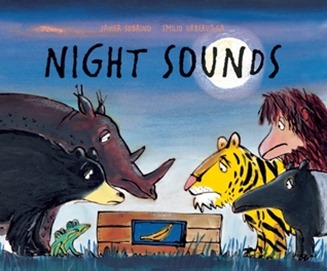
When the animals of the rain forest head to sleep, they are awakened by noises coming from a box.  The sound just goes on and on, “Wuaah, wuaah, wuaaah.”  Something is crying and won’t be easily comforted.  The animals do try to get it to be quiet, offering a blanket, water, and a doll.  But the crying only stops for a little while and then starts up again and again.  Finally Tiger heads off to find the mother.  Then the identity of the crier is revealed finally but there is more crying to come in a clever twist at the end.

Translated from the original Spanish, Sobrino does a great job of keeping readers guessing about the identity of who is crying in the box.  As each new sets of cries starts, their sounds change slightly and add variety to the book.  The structure of the book is based on repetition with some changes along the way.  It makes for a book that will work well for very small children but also has plenty of surprises for older preschoolers as well.

Urberuaga’s illustrations are filled with deep, rich colors.  They evoke the night beautifully and the animals sleepy eyes and lack of smiles show how very tired they are.  The reveal is cleverly done without any real visual hints, allowing it to be a complete surprise.

Great fun, this book could be made into reader’s theater with younger children and will also make a great bedtime story as long as a blanket, water and doll are provided ahead of time.  Appropriate for ages 2-5.

Reviewed from library copy.