Review: Xander’s Panda Party by Linda Sue Park

xanders panda party

Xander’s Panda Party by Linda Sue Park, illustrated by Matt Phelan

Xander is planning a party just for pandas, but soon realizes that he is the only panda at the zoo.  So he changes the invitation to include all sorts of the bears at the zoo.  Then Koala is left out because she’s a marsupial, not a bear.  Xander chewed some bamboo and thought a bit, then changed the party to be for all mammals at the zoo.  After going through several more versions, Xander’s party changed to invite all of the animals at the zoo.  It was almost time for the party to start, when a truck and a crate arrived at the zoo.  It was a new creature for the zoo!  But would it ruin Xander’s updated party plans?

Clever, clever, clever.  This book carefully offers information on animal taxonomy to readers who will not even realize they are learning it thanks to the party-theme of the book.  Park’s writing is so impressive.  When I opened the book to see it rhyme, I must admit that I sighed.  But Park managed to created a rhyming book that is not written in stanzas.  She instead builds whole paragraphs that read like rhyming poems and make the rhymes work throughout the sentences.  It is a smart way to approach a book that harnesses the rhyme rather than galloping away with it.

Phelan’s art is entirely brilliant.  His lines have a looseness that really works, creating whole settings in just a few lines.  All of the animals have their own unique personalities.  I particularly enjoyed the rhino glaring from behind his wall and the montage of the different types of bears.  There are small touches throughout that add humor and coziness to the story.

A book that has science mixed with a message of inclusiveness, this is one has mass appeal.  Appropriate for ages 3-5.

Reviewed from library copy.
Review: Lifetime by Lola M. Schaefer

lifetime

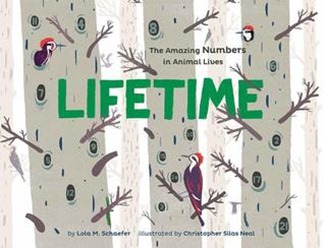
Lifetime: The Amazing Numbers in Animal Lives by Lola M. Schaefer

Take a unique look at what animals will do in a single lifetime in this book that combines counting, math and fascinating scientific facts.  The book focuses on how many times a single animal will do a behavior during their life.  The facts are based on estimations and opens with a description of how the numbers were figured out and explaining that each individual animal will be different than the estimate.  The book opens with one spider’s egg sac, the sole one she will create in a lifetime.  It then goes to the ten antlers that a caribou will grow and shed and moves on by tens.  The book ends with one thousand tiny baby seahorses, the number a single male seahorse will carry and birth. 

This is a spectacular way to introduce averages to children and estimation.  It is a celebration of the information that mathematics can provide to us about nature.  Schaefer has selected a wide variety of animals and intriguing facts about each of them.  Readers can find more in-depth information on the animals at the back of the book.  They will also find more information on averages and math there. 

Schaefer’s art adds to the appeal of this book.  Her illustrations have a boldness to them, a graphic quality that really works.  They are flat and vibrant, clearly laying items on the page for counting.  The book is a joy to page through since each page offers a new animal, a new habitat to see.

One of the most visually stimulating and smart concepts for a nonfiction picture book, this one is sure to beat the averages and be read more than once.  Appropriate for ages 4-6.

Reviewed from copy received from Chronicle Books.

Review: Jasper’s Story by Jill Robinson

jaspers story

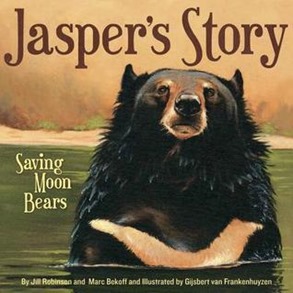
Jasper’s Story: Saving Moon Bears by Jill Robinson and Marc Bekoff, illustrated by Gijsbert van Frankenhuyzen

Held captive for years by bear “farmers” who kept him in a too-small cage and harvested bile from his body, Jasper’s story is representative of many captive moon bears.   Now Jasper has been rescued by Animals Asia, an animal welfare organization.  He is taken to their Moon Bear Rescue Center where his medical needs are attended to and he is put into the sanctuary.  There, Jasper walks on grass for the first time in his life.  Caregivers work to teach Jasper how to find food on his own, hiding food in toys and places to dig.  In time, Jasper’s life starts to change.  He begins to play more, get stronger, and make friends.  Jasper is one success story among many, a testament to what rescue can do to save animals that might have been considered too damaged to rescue.

Robinson and Bekoff write in a very engaging way in this nonfiction picture book.  They invest time in telling the story of the abuse as well as painting a beautiful picture of moon bears in the wild: “Far away in the mist-covered mountains of China, the moon sends yellow arcs of light across the hills, softly painting the forests with a luminous glow.”  They describe the way that wild animals sleep with a sense of freedom.  The prose is beautiful, clearly painting the value of these animals and the importance of their rescue and rehabilitation.

The illustrations are equally evocative.  The paintings have a wonderful sense of place, showing the workers at the sanctuary and the horror of the small cages with equal attention.  I particularly like the way that the opening image relates to that at the end, showing that Jasper is once again more like the wild moon bears than the abused ones. 

A great book on the importance of animal rehabilitation and rescue, this book will speak volumes to every child who picks it up and meets Jasper.  Appropriate for ages 7-9.

Reviewed from library copy.

Review: My Neighbor Is a Dog by Isabel Minhos Martins

my neighbor is a dog

My Neighbor Is a Dog by Isabel Minhos Martins, illustrated by Madalena Matoso

Originally published in Portugal, this book is a charming import.  It is the story of a young girl who gets a new neighbor who just happens to be a dog.  The dog is very friendly and kind, but the girl’s parents are not impressed, thinking that he would quickly start acting like the dog he was.  Soon after that, more new neighbors arrived, this time a pair of elephants.  The girl’s parents complained about them too, but the girl thought they were very nice.  Finally, a crocodile moved in.  That proved to be too much for her parents and they moved away.  But before they did, the little girl finds out that her parents are considered the odd ones in the neighborhood.  The final clever twist at the end shows exactly why.

Martins writing is just as vibrant as the bold illustrations.  She tells the story with wonderful little touches like the elephants helping with washing cars and the crocodile giving purses and shoes as Christmas gifts.  All of these details add to the world that she cleverly building and that wonderful surprise twist at the end.  Done in vibrant colors, the illustrations are created in hot pinks, deep blues and bright reds.  It is a modern world, with the pop colors adding to that feel. 

A look at acceptance and diversity through the eyes of a child, this book will speak to all children about preconceptions and tolerance.  Appropriate for ages 4-6.

Reviewed from library copy.

Review: Lulu and the Cat in the Bag by Hilary McKay

lulu and the cat in the bag

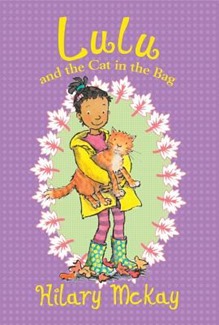
Lulu and the Cat in the Bag by Hilary McKay

This third Lulu book continues the story of Lulu’s love affair with any type of animal.  In this story, a cat is dropped off on Lulu’s doorstep in a bag.  Lulu opens the bag over her aunt’s objections.  Her aunt is watching her while her parents are on vacation and is not fond of animals at all.  When the bag is opened, the cat goes running off and disappears.  Though Lulu searches for it, she is unable to find it.  When she returns to her room later, the cat is there on her bed, having climbed in through her open window.  Steadily, the big orange cat starts to become part of the family, even changing Lulu’s aunts thoughts on cats in general.  It dominates the two dogs, scares the bird and even gathers flowers from the garden to scatter about the house.  Then the cat simply disappears, they search for it with Lulu’s aunt’s help, but no one can find it.  Until Lulu makes a surprising discovery!

I’ve enjoyed all of the Lulu books so far and this just adds to the delight that is this series.  Lulu is a wonderful protagonist.  It is a pleasure to see a child character so into animals who does her chores and takes good care of her animals with no complaining.  Lulu is also quite a scamp, so the book are filled with a natural childhood zest and Lulu’s own special take on things.  This is another great treat of a book from McKay.

A series to rival Clementine, get this into the hands of those readers and they will find a new feisty young heroine to love.  Appropriate for ages 6-8.

Reviewed from digital galley received from

Review: Wait! Wait! by Hatsue Nakawaki

wait wait

Wait! Wait! by Hatsue Nakawaki, illustrated by Komako Sakai

Translated from the Japanese, this little book is perfect for busy toddlers.  It follows some time in a toddler’s day when they move from one distraction to the next.  First, there is the butterfly fluttering past that won’t wait.  Then the lizard on the sidewalk slithers off without waiting.  Then come pigeons and next cats.  Finally, the little child is scooped up by a grown up and carried off on their shoulders with obvious delight.

This simple little book captures so nicely the speed of a toddler’s thoughts and the way that they can keep so busy with new discoveries in their day.  There is a wonderful gentleness to the book, where the animals and then the adult are just as much fun and intriguing as one another.  At the same time, there is a sense of discovery and awe as each new creature is found.

The text is very simple with the title repeated throughout and then one additional sentence added for each creature.  The illustrations shine.  They are wonderfully organic with textures while the colors remain subtle and natural. 

This book begs to be shared with one little child at a time, so that the animals can be identified and new discoveries of their own can be shared.  Appropriate for ages 1-3.

Reviewed from copy received from Enchanted Lion.

Review: Mouse Bird Snake Wolf by David Almond

mouse bird snake wolf

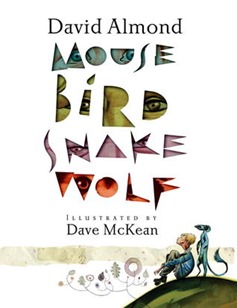
Mouse Bird Snake Wolf by David Almond, illustrated by Dave McKean

From the author and illustrator who brought us The Savage comes this new book.  Three children, Harry, Sue and Little Ben, live in a world that is calm and lovely, but also incomplete.  They look around and see gaps where objects or things could be, but are not.  Up above, the gods are sleeping.  They are quite proud of the world they have created and spend lots of time bragging about what they have already done.  None of them are interested in creating anything new or filling any of the empty spaces.  The children though do have the drive to do just that.  So they create creatures out of twigs and leaves and dirt.  Their ideas start small but quickly grow to a frightening level.  Can anything be done once a thing is created?

Almond is not afraid to head right to the strangeness that keeps others at bay.  In fact, that’s right where he takes readers: to those dark and dangerous spots that others steer from.  Here he comes at that place through a mythological tale of bored gods and sparklingly intense children.  From the title alone, you know there is danger ahead, but what a ride it is! 

McKean takes those dark ideas and makes them visible to all.  Lest we think that Almond is speaking in broad terms and using metaphors, McKean’s art makes it all completely real and tangible.  Done in sharp angles and lean faces, there is a marvelous hunger throughout these images that shows in the eyes and postures.  It’s such an ideal fit for the story. 

Dark and dangerous, this book is not for everyone.  Fans of Almond and McKean though should cheer this new book from the team.   And once you start, I dare you to be able to look away!  Appropriate for ages 8-12. 

Reviewed from library copy.

I Wish I Had… by Giovanna Zoboli

i wish i had

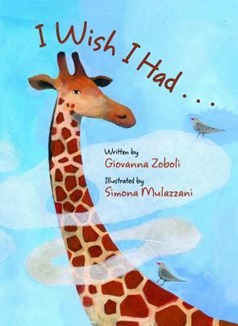
I Wish I Had… by Giovanna Zoboli, illustrated by Simona Mulazzani

Originally published in Italy, this thoughtful picture book takes children on an exploration of different types of animals, looking at some of their unique abilities.  Blackbirds can see every blade of grass with their sharp eyes.  Tigers can walk almost soundlessly through the jungle.  Lemurs have tails that let them swing through the high branches.  Whales can fill the ocean with their songs.  Done in pairs of animals with each line beginning with “I wish,” this book is poetic and rich.

Zoboli writes in verse here that has a gentle rhythm and repetitive structure that is particularly soothing and warm.  Through it all, the skills of the animals that are mentioned are all perceptive and sensory, all leading to better understand of one’s world or expressing oneself.  It is peaceful and has a great inclusive and unifying feel.

A large part of the success of this book are the incredible illustrations by Mulazzani.  Her art has a timelessness about it, thanks to the worn texture of the paint in places.  That quality plays against the modern lines of her art, creating a synthesis that is dynamic and invites readers to look more closely.

Perfect for bedtime with its quietness, this book could also be used very nicely for poetic exercises where children look for admirable qualities in animals and write their own poems of appreciation and wonder.  Appropriate for ages 4-7.

Reviewed from copy received from Eerdmans Books for Young Readers.

Review: What Will Hatch? by Jennifer Ward

what will hatch

What Will Hatch? by Jennifer Ward, illustrated by Susie Ghahremani

This simple little book builds tension through the use of a guessing game and the wonder of waiting for an egg to hatch.  On one page, the habitat and a little description of the eggs are given, with the question of “What will hatch?”  Take a guess, turn the page and find out the answer.  There are lots of surprises along the way.  The clever use of die cuts in the pages that peek through in egg-shaped holes adds to the fun.

Eight different animals are shown here with basic information.  Nicely, there is more information at the end on each of the animals as well as information on chicken egg development.  Ward’s text is particularly simple, just a few phrases with a skip of repetition.  It is the illustrations here that really make the book.  Done in gouache on wood, the images have a lovely texture to them that combines beautifully with the swirling nature of the art.  The texture also reinforces the natural subject matter in a subtle way.

A great pick for toddlers, this book  will keep them guessing as the pages turn.  Expect to have to share it again and again.  Appropriate for ages 2-4.

Reviewed from library copy.