Review: Last Laughs by J. Patrick Lewis and Jane Yolen

Last Laughs: Animal Epitaphs by J. Patrick Lewis and Jane Yolen, illustrated by Jeffrey Stewart Timmins

Perfect to pull out around Halloween time, this book features a series of very funny epitaphs for dead animals.  After the introductory poem to the pet cemetery, readers will discover short poems about specific animals.  There are farm animals like chickens and cows (the cow one happens to be one of my favorites) and more exotic fare like barracuda, iguana and eels.  All dead, for a variety of wild and domestic reasons to hilarious effect.  The poems are riddled with puns, something that I adore.  They are sure to be hits with children when shared aloud or read in person.

Timmins’ art has the same dark humor as the poems themselves.  Make sure you notice the sheep pooping into the river the dead horse just drank out of.  It’s exactly what children will find funny.

Dark and fiercely funny, these poems are not for the preschool set, but will be giggled at galore by elementary aged children.  Appropriate for ages 5-8.

Reviewed from library copy.
Review: A Strange Place to Call Home by Marilyn Singer

strange place to call home

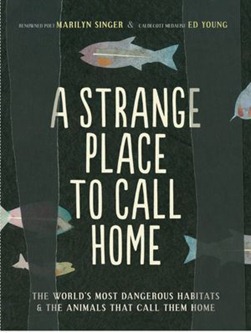
A Strange Place to Call Home: the World’s Most Dangerous Habitats & the Animals That Call Them Home by Marilyn Singer, illustrated by Ed Young

Through evocative poetry, this book explores habitats that you would never guess something could even survive in.  But they do!  There are creatures who live in places with no water, no warmth, little food.  And those are the creatures that star in this book, each of them celebrated in verse.  There are penguins, mountain goats, and camels, which may be the animals that came to mind.  But Singer looks deeper than that and introduces unlikely creatures to readers, including petroleum flies that hatch in oil, ice worms that live in glaciers, and blind cave fish from Texas and Mexico.  She takes these creatures, known and unknown, and gives us a glimpse of them and their habitat in a variety of poetry forms.  Each page is a discovery of a new animal and a new type of poetry.

Singer excels at creating poetry that is artistic and has depth and yet offers young readers an approach to verse that is welcoming.  She writes at their level yet doesn’t ever play down to them.  Since some of the haikus and other forms are quite brief, it’s nice that she offers paragraphs of information at the end of the book on each creature.  At the very end of the book, she also speaks to the variety of poetic forms she has employed in the book.

Young’s illustrations add another layer of beauty into the book.  Through his layered paper art, he creates a red forest of flamingo legs, a swirl of desert sands, foaming rivers, and an urban landscape among many others.  His work embraces the diverse habitats, recreating the harshness and the often subtle richness of these unknown worlds.

A great pick for poetry units or units on habitats, this book offers a perfect blend of verse, science and art.  Appropriate for ages 7-10.

Reviewed from copy received from publisher.

Review: Lulu and the Duck in the Park by Hilary McKay

Lulu and the Duck

Lulu and the Duck in the Park by Hilary McKay

Lulu loves animals, so she can’t understand it when people don’t love every animal, like her teacher Mrs. Holiday.  In fact, Mrs. Holiday has asked Lulu to never bring an animal to school again after an incident with her dog.  When their class is heading back through the park after swimming, something awful happens.  Two dogs run rampage through the ducks’ nests in the park, scaring the ducks, ruining their nests and smashing eggs.  So when Lulu sees the duck egg rolling down the hill, she just does what comes naturally and puts it into her pocket.  Once back at school though, it is hard to figure out how to hide an egg without smashing it.  It becomes even harder when the duckling decides to hatch!

McKay is one of my favorite British authors, capturing the unique qualities of her characters with a distinct merriment.  In this short novel perfect for beginning readers, she changes the perspective up sometimes by offering Mrs. Holiday’s point of view too.  It is done with a lot of humor and children will easily make the transition between Lulu and her teacher. 

The writing is simple but great fun to read.  There are plenty of jokes and moments of seriousness too that both help keep the book moving forward.  It is a trick to offer depth of story in such a brief book, but McKay manages it.

I look forward to the next Lulu book and the trouble that she gets into there.  Appropriate for ages 7-9.

Reviewed from library copy.

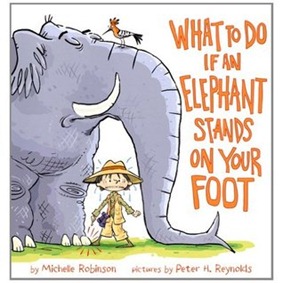
Review: What to Do If an Elephant Stands on Your Foot by Michelle Robinson

if an elephant stands

What to Do If an Elephant Stands on Your Foot by Michelle Robinson, illustrated by Peter H. Reynolds

You must stay calm, if an elephant stands on your foot.  The last thing you want to do is startle it…YEEEOOOWWW!  Now you probably want to run away from the elephant, but resist that and don’t run.  After all, running attracts tigers.  Oops.  OK, so now that you have the tiger’s attention you have to be silent.  No sudden noises, like a sneeze.  And so the romp in the jungle continues with the poor character steadily making worse and worse choices, including climbing up a tree and jumping into crocodile infested water.  Finally, thanks to the help of some friendly monkeys, you arrive home safe and sound.  All you need to do is apologize to the elephant, but remember, don’t startle him! 

I absolutely adored this wild ride of a book.  It reads aloud beautifully, though I’d practice a bit before using it with a group because the timing of the jokes is everything here.  Robinson’s writing has a great comedic feel, and the book design maximizes the humor with the page turns.  The pace is wild and almost run away, suiting the subject.  The book is one long running gag, which will delight young readers.

Reynolds’ art adds to the humor.  He manages to take sedate and even friendly animals and with one sneeze or jump turn them alarmingly grumpy.  This creates a zany energy in the art and the book as a whole.

This is a book to keep in your bag for when the kids get restless.  Pull it out with a grin and a flourish.  I’d also keep it in mind for an option when reading to older elementary children, since they will love the humor too.  Appropriate for ages 3-5.

Reviewed from copy received from Dial Books for Young Readers.

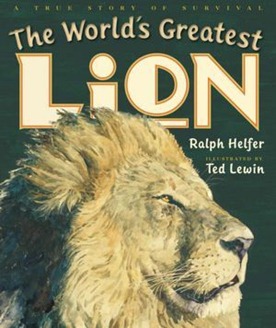
Review: The World’s Greatest Lion by Ralph Helfer

worlds greatest lion

The World’s Greatest Lion by Ralph Helfer, illustrated by Ted Lewin

This is the story of Zamba the lion, one of the most well-known animal actors in film history.  Zamba appeared as the MGM Lion as well as in many commercials and shows.  Here, the focus is on how Zamba lost his parents and his survival as an orphan cub in Africa before being found by a woman and rescued.  Zamba was allowed to roam free and grew larger and larger until she could no longer safely care for him.  Happily, she had heard about Africa USA, an organization looking for a lion.  Africa USA offered a safe haven and trained animals to not be aggressive.  Zamba arrived at the ranch owned by Ralph Helfer and slowly grew gentler.  The family’s children used him as a warm place when watching TV and his best friend was one of the dogs on the ranch.  Thanks to his rare gentle nature, Zamba worked in television and film.  Then one day, a flood hit the ranch and forced Ralph to release all of his wild animals in an attempt to save them.  Zamba led all of the animals to safety, proving himself to be the world’s greatest lion.

As author of the book, Helfer tells his own story as well as Zamba’s here.  It is the story of the organization he founded, the one that saved Zamba’s life.  Through his training, Zamba was able to live a full life, filled with danger, learning and gentleness.  The details Helfer shares add depth to the story.  His moments of adventure are exciting but it is those moments of Zamba just being a lion that really are special.

Lewin gives us gold-hued images filled with the dust of Africa.  His illustrations celebrate the connection of animal and human, especially during the chaos of the storm.  Beautifully realistic, these illustrations fully capture the love between Helfer and Zamba.

This is a picture book biography that animal-loving children will enjoy immensely.  Appropriate for ages 5-7.

Reviewed from copy received from Philomel Books.

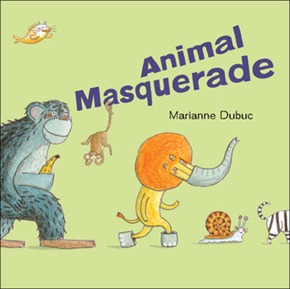
Review: Animal Masquerade by Marianne Dubuc

animal masquerade

Animal Masquerade by Marianne Dubuc

This picture book takes one long-running gag and turns it into a very funny picture book.  As the animals get ready for the masquerade, they have to dress up in costumes.  Each animal dresses up as another animal and then that animal chooses yet another animal to dress up as.  It forms a neat chain.  Much of the humor is in the depictions of the costumes themselves and also in the occasional asides that break the rhythm of the book for even more of a punch-line effect.  Fonts are also played with as the hummingbird disguised as an ostrich has its fonts hidden half underground just like its head.  In another spot, the butterfly disguised as a bat has its font upside-down.  All of the small touches add to the giggles in this picture book.

Dubuc’s art here is wonderfully whimsical and playful.  The different animals in disguise are often absurd and completely strange.  Just wait until you get to the animals that dress up like a three-headed monster, Red Riding Hood dressed as a chocolate cake, and the hen that is too dim to understand what is happening and doesn’t dress up as anything at all.   The book is longer than most picture books in terms of number of pages, but that adds to the running gag theme here. 

This picture book will do well read aloud very straight and seriously until the first big joke hits.  Then make sure to leave plenty of time for the giggles to pass before moving on.  It will work well for Halloween too, without anything scary about it.  Appropriate for ages 4-6. 

Reviewed from library copy.

Review: Kate & Pippin by Martin Springett

kate and pippin

Kate & Pippin: An Unlikely Love Story by Martin Springett, illustrated by Isobel Springett

When Pippin, a fawn, is abandoned by her mother, photographer Isobel Springett found her crying for help.  She took Pippin home and placed her by Kate their old Great Dane.  The two immediately bonded:  Pippin thought she had found a new mother and Kate started to mother her even though she had never raised any puppies of her own.  Pippin learned to drink from a bottle and when she got bigger started to adventure outside.  One evening, Pippin disappeared into the forest and didn’t return for bedtime.  Kate was very concerned, but the next morning Pippin came back just in time for breakfast.  Pippin returned to the woods every night after that, returning to the farm almost every morning to eat and play.  As she grew into an adult deer, she still continued to return to visit Kate and play.  She even still comes into the house once in awhile for a visit. 

This is one of the most lovely picture books about a relationship with a wild animal that I have seen.  I especially appreciate that Pippin was allowed to continue to be a wild deer, returning to the forest and being allowed to create a relationship on her own terms.  It’s definitely refreshing to see.  Here the human and dog were able to rescue, aid but also step back and not absorb this little creature.  The relationship that emerges is breathtakingly touching, seeped in fragility yet incredibly strong.

A large part of the success here are the photographs of this tiny deer bonding with the enormous dog.  By the end of the book, the animals are the same size.  It is clear that both of them adore one another on a deep level, and one that is delightfully separate from the humans. 

This nonfiction picture book reads like fiction, making it a great pick for a touch of nonfiction in a story time.  It’s a story that children will relate to easily and naturally.  Appropriate for ages 4-7.

Reviewed from copy received from Henry Holt and Company.

Review: North: The Amazing Story of Arctic Migration by Nick Dowson

north

North: The Amazing Story of Arctic Migration by Nick Dowson, illustrated by Patrick Benson

This poetic look at the amazing Arctic starts with the deep winter and the few animals who survive there year round.  Then spring comes to the Arctic and the sun comes back along with some warmth.  Plants start to appear from under the snow.  Soon more animals will arrive.  The first to head out on their journey are the gray whales, that swim from Mexico to the Arctic Circle.  Birds head north too in flocks.  Herds of pregnant caribou journey north, followed closely by the gray wolves looking for weakness.  Walrus, narwhal, schools of fish, all of this life crowds the Arctic summer until the weather turns cold and brutal again, and once more they head back around the world.

Dowson’s words are poetry in this book.  Not only written in verse form, they also speak to the soul of the Arctic, the beauty of the place and the glory of the creatures who live there.  At the same time, the words are scientific and filled with information about the place and the animals.  It is an elegant combination of poem and fact.

Benson’s art is striking.  He created paintings that are both natural and accurate but also have a sense of artistry.  Much of the art is about the landscape, the place itself and the grand amount of space there.  The illustrations of bitter winter are cold and bleak with dim, gray light.  Then the reader turns the page and it is spring with its lemony light and sprigs of green.  The change is striking to the reader and beautifully captured.  There are moments like this throughout the book.

A striking mix of poetry, art and science, this book will speak to a range of different children looking to understand their world a little better.  Appropriate for ages 5-7.

Reviewed from library copy.

Review: Zoo Girl by Rebecca Elliott

zoo girl

Zoo Girl by Rebecca Elliott (Link to InfoSoup)

Told in just a few words per page, this book tells the story of a little girl who doesn’t have a family.  At the orphanage she is lonely and has no friends.  Then the children visit the zoo and suddenly the little girl feels at home.  She is left behind at the zoo and the animals discover her.  They befriend her and she lives with them for awhile until the zookeepers discover her curled up with the tigers.  The little girl does not want to go, and the book ends with a happy ending where the little girl is adopted by the zookeeper couple.  The story is a simple one, told in only a few words, but the sense of belonging and being wanted remains a powerful message.

Elliott’s story is really told in the illustrations rather than the words.  Her art is a rich mix of texture, patterns, drawing and photographs.  The rather simply drawn characters and animals live in a world made dazzling.  Even the air itself seems to have its own feeling and shape.  The elephant has wonderful wrinkles, the tiger has plush fur, and the penguin’s feathers are swirled. 

Also, in the orphanage, the mood is not grim.  It is specifically this little girl who does not have friends and feels alone.  The other children are merry and playing with one another.  That changes the message quite a bit too.

Perfect for toddlers because of its brevity, this book is a very friendly way to talk about adoption.  Appropriate for ages 2-4.

Reviewed from library copy.