Book Review: Little Mouse’s Big Secret by Eric Battut

littlemousesbigsecret

Little Mouse’s Big Secret by Eric Battut

When Little Mouse discovers a juicy red apple on the ground, he decides that it will be his secret.  So he hides it in a hole in the ground.  Once it is safely hidden, his friends appear one-by-one and ask him what he’s hiding.  Little Mouse insists to each animal that he will not tell because it’s his secret.  As Mouse talks with animal after animal, his back is to the apple and the hole he hid it in.  Soon a sprout appears from the hole, then a stalk and finally a tree.  Apples appear on the tree just as Little Mouse declares that he will keep his secret forever!  Then the apples fall to the ground.  All of the animals reappear and Little Mouse discovers that some secrets are even better when shared.

Battut has created a picture book perfect for very young children.  From the simple, friendly illustrations that have plenty of whitespace to the repetition built into the animals asking what the secret is, this book has lots of child appeal.  Each double-page spread has only two lines of text on their own page, creating a book that is quite engaging and fast moving.

Children will immediately get the humor of a fast-growing apple tree that the mouse is completely oblivious to until the apples fall around him.  The book also has a high cute factor, with the animals dwarfed by the growing tree, all bright-eyed and merry.  They are on a buttery-yellow background that adds to the coziness of the title.

Add this book to your autumn and apple book lists.  The very little mouse and other animals make it more appropriate for small groups or individual sharing.   Appropriate for ages 2-3.

Reviewed from library copy.

Also reviewed by
A Garden for Pig

garden_for_pig (1)

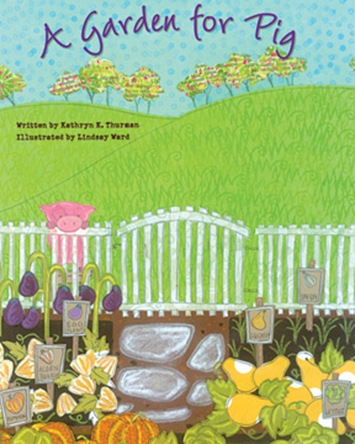
A Garden for Pig by Kathryn K. Thurman, illustrated by Lindsay Ward

Pig lives on an apple farm where they grow lots and lots of apples.  And what does Pig get to eat?  Apples, apples, and more apples.  Mrs. Pippins owns the farm and she makes all sorts of apple dishes for pig to eat, but he is sick of apples all the time.  What he really wants to eat are vegetables!  So Pig breaks into the vegetable patch and begins gulping down squash, seeds and all.  When Mrs. Pippin finds him in the garden, she is not happy.  She ties Pig up.  When she catches him trying to break the rope, she shuts him in his pen.  Though Pig tries to escape, he can’t.  But he is determined not to eat any more apples!  Pig notices the next day that his pen looks a lot like a garden.  And after digesting the squash, he has the seeds he needs to make one.

Thurman’s words are simple and have a jaunty rhythm to them.  There are wonderful sounds woven into the book that children will enjoy mimicking.  Pig’s determination and tenacity as well as his creative solution to the problem add to the appeal.

Ward’s collage and cut paper illustrations have a warmth to them.  This is accentuated by the use of fabrics that offer a texture to the images.  In the apple orchard, there are words on the paper that make up the leaves: apple recipes.  The illustrations are large enough to read to a group.  And goodness knows, the poop event at the end will be a hit!

A friendly and warm introduction to gardening in an organic way, this book is a happy addition to gardening story times.  Appropriate for ages 3-5.

Reviewed from copy received from Kane Miller.

Also reviewed by:

Apples and Pumpkins

Apples for Everyone by Jill Esbaum
Seed, Sprout, Pumpkin, Pie by Jill Esbaum

Celebrate the fall season with this pair of book from National Geographic Kids.  Both book have simple text just right for beginning readers combined with vivid photographs.  In Apples, readers follow apples from blossom to harvest to different uses.  Mouths will be watering at the caramel apples, applesauce and cider.  In Pumpkin, readers get to see the pumpkins grow on the vine, turn orange, and be made into pies, jack-o-lanterns, and even boats.  Yes, boats.  The photographs feature children of different ethnicities, which is wonderful to see in nonfiction titles.

Esbaum’s photographs steal the show here with their crisp focus, bright colors and interesting compositions.  But her text is not to be ignored.  Her words add context and detailed information that make the photographs even more interesting.

Perfect to expand your fall seasonal shelves, these books come paperback bound so buy a bushel.

Reviewed from copies received from publisher.

Also reviewed by The Well-Read Child.

Applesauce Season

Applesauce Season by Eden Ross Lipson, illustrated by Mordicai Gerstein

A perfect book to ease into autumn!  A little boy and his family make applesauce every year just around the time school starts.  They go to the farmer’s market and pick out all sorts of apples for sauce and for eating.  The little boy is in charge of washing the apples when they get home and then his mother and grandmother cut them into pieces.  Into the pot they go with just the right amount of liquid.  When they soften, the little boy gets to help put them through a food mill.  Then a bit of butter, a pinch of salt and just the right amount of cinnamon sugar are added.  The father in the family doesn’t help with the applesauce, instead he makes things to go with it and applesauce cake to use the last of it up.  Throughout the fall, the family makes applesauce together with the color and taste of it changing as the season moves on.

The details of the making of the applesauce is the bulk of this story, though it is about not only the process but a family that cooks together and enjoys it immensely.  Lipson has just the right touch with the text which is explanatory and simple, allowing children to see how it is done.  One delightful part is how much the little boy is allowed to do.  Children will see themselves as part of the action rather than observers.  Gerstein adds the beaming faces of the family as they cook together, the bright colors of the apples, and the changing faces of the applesauce.  His illustrations are just as comforting and welcome as a warm spoonful of applesauce.

This is a lovely celebration of food and family with just the right sweetness and spice.  Highly recommended for apple story times and units, especially for those classrooms and libraries that create applesauce with the children.  Appropriate for ages 4-6.

Reviewed from library copy.