Review: Windblown by Édouard Manceau

windblown

Windblown by Édouard Manceau

Scraps of paper blow across the page, first one then several appear.  But what are they and whose are they?  First the chicken insists they are his since he found them.  Then the fish says that he cut them from the paper.  Then the bird, the snail and the frog explain that they are theirs as well.  Each animal fits them to their body to demonstrate why they belong to them.  Then the wind itself speaks about blowing the pieces around and offers them to the reader, “What will you do?” 

Superbly simple and entirely engaging, readers will be playing along with the book before they even open the pages.  Manceau has cleverly selected shapes that fit together in many different ways.  He demonstrates this over and over again, then turns it all over to the reader to continue. 

This is also a book that would make a great art project for little ones.  Share the book, then give each child the pieces shown in the story to make their own picture.  An ideal way to end a creative story time.  Appropriate for ages 2-4.

Reviewed from library copy.

Review: The Vine Basket by Josanne La Valley

vine basket

The Vine Basket by Josanne La Valley

In East Turkestan, Mehrigul’s beloved brother has left the family and now her father is always angry and her mother has taken to bed.  Mehrigul is forced to leave school and help out on the family farm.  She also works the family market stall which is where her vine basket, created in the form of a cone rather than a more useful shape, is spotted by an American woman who offers to buy it for a very high sum.  But her father just drinks and wagers away the money, leaving the family still on the brink of ruin.  There are political pressures too with the Chinese pushing the Uyghur people to conform.  If Mehrigul does not return to school, she could be sent to work in a Chinese factory.  But there is one ray of hope and that is that the American woman asked for more baskets.  It will take time and determination for Mehrigul to complete the baskets for her, especially once her father forbids her to do it. 

I seriously could not believe this was a debut book.  La Valley writes with such assurance and skill, building a world that makes sense to those unfamiliar with the Uyghur and East Turkestan.  She also neatly explains very complicated politics in a way that children will understand thanks to the perspective of Mehrigul and her family.  La Valley does not shy away from the difficult family situation she has created, clearly creating a world where there are no real villains just adults dealing with impossible situations. 

Yet there are heroes.  They come in the form of more than the American buyer too.  Mehrigul’s grandfather is one of these, as he works impossibly hard and still supports her dreams and skills with baskets.  Mehrigul herself is certainly a heroine as well, creating beauty with an incredible humility, taking on tasks far beyond someone as young as she is, and holding her family together. 

La Valley never forgets to instill beauty into the world she is telling us about.  We learn about the Uyghur rugs, music and art.  We learn about the beauty of the desert, the sting of the sand, the wonder of the sudden rain, and the treasures of true friendship and family.  It is in this mix of destitution and beauty that this book truly shines.  It is a book that enters the very heart of the reader and takes up residence.  Beautiful, haunting, cruel and wondrous, this is one amazing read.  Appropriate for ages 12-15.

Reviewed from digital galley received from NetGalley.

Review: A Splash of Red by Jen Bryant

splash of red

A Splash of Red: The Life and Art of Horace Pippin by Jen Bryant, illustrated by Melissa Sweet

Born in 1888, Horace Pippin loved to draw from the time he was a small child.  He would draw on scrap paper using charcoal, he would draw for his friends, and he would even draw on his spelling tests though his teacher did not appreciate that.  As he grew, he had to quit school in 8th grade.  He worked hard with his hands in different ways, but continued to draw and paint.  Then Horace went to war and was wounded in his right arm.  Now he could no longer draw, or so he thought.  He started trying again with a poker and using his other hand to steady himself.  As he grew stronger, he drew more and more.  Eventually, he gained the attention of people like N. C. Wyeth, who helped put together his first art show.  Pippin’s life that was filled with hardships and obstacles serves as inspiration for young artists.

Bryant and Sweet  collaborated before with Caldecott Honor results.  This picture book biography of an important but lesser known African-American artist shows the power of art in one’s life and how it is impossible to stop seeing and communicating the world through art once you begin.  Bryant writes with a solidity that is lovely.  Incorporating Pippin’s own words from letters, she captures the life of this artist and how he came to be recognized for his work.

Sweet too weaves Pippin’s words into her art.  Her use of collage truly builds Pippin’s world before readers’ eyes.  My favorite image in the book is Pippin as a young boy sitting and drawing on piles of papers.  It captures the intensity with which he created art even at such a young age.  This intensity continues through his story to after he is wounded and the determination that is apparent in just his hands. 

Another very successful collaboration of these two masters, this biographical picture book should serve as its own splash of red on every library’s shelves.  Appropriate for ages 6-9.

Reviewed from copy received from Random House Children’s Books.

Review: The Bird King by Shaun Tan

bird king

The Bird King: An Artist’s Notebook by Shaun Tan

This book opens the curtain to Tan’s creative process, allowing readers to view art from stories that have not yet been full formed, art from books that have been completed, and beautiful illustrations that may not be stories at all.  The courage this book took to produce is to be applauded.  Allowing readers and other artists to see a process of creativity is raw and soul baring. 

This book is stellar.  One turns the pages slowly, lingering in worlds undreamed of, wondering at ideas, and pausing to allow a particular image to sink in more deeply.  It is a journey, specially designed for a young creative to see that mistakes can be joyous, that creation is messy, and that works in progress are breathtaking.

This is a book to get in the hands of teens who enjoy art and writing, for it is a look at the unformed and the just formed.  It is a book of pure creativity and the creative process.  Beautiful.  Haunting.  Inspiring.  Appropriate for ages 10-18.

Reviewed from copy received from Scholastic.

Review: Etched in Clay by Andrea Cheng

etched in clay

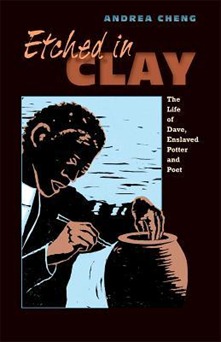
Etched in Clay: The Life of Dave, Enslaved Potter and Poet by Andrea Cheng

Told in virtuoso verse, this is the true story of the life of Dave, an enslaved potter who lived in the years before and after Emancipation.  Dave was an artist, most likely making over a thousand pieces of pottery in his lifetime of work of which only 170 survive today.  He inscribed some of his pieces with either his own name, his master’s name and also poetry that he wrote, brief verses that offer a glimpse into his world.  The amount of bravery that small act took is monumental, since Dave faced potential death because he was demonstrating his ability to read and write in a time when it was forbidden for slaves in South Carolina to do so.  Dave serves both as an example of the injustice and brutality of slavery and also as a remarkable example of the artistry and strength of human beings. 

Cheng tells Dave’s story in very short poems.  They are not all in Dave’s voice, sometimes instead being in the voice of his owners, his wife, or his children.  Cheng does not soften the harshness of slavery, offering poems that speak directly to the separation of families through selling them apart and the brutality of the punishments inflicted.  I would not call it unflinching, because one can sense Cheng flinching alongside the reader as she captures the moment but also makes it completely human and important. 

Cheng also did the woodcuts that accompany the poetry.  They are a harmonious combination with the subject matter thanks to their rough edges and hand-hewn feel.  Done only in black and white, they share the same powerful message as the poems.

This powerful book informs middle grade readers about a man who could have been one of the many lost faces of slavery but who through art and bravery had a voice.  Appropriate for ages 12-15.

Reviewed from digital galley received from Lee & Low Books.

Review: The Museum by Susan Verde

museum

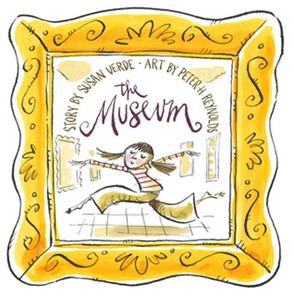
The Museum by Susan Verde, illustrated by Peter H. Reynolds

Verde captures the energizing nature of a visit to an art museum.  Told in first-person verse, the young female protagonist dances and spins through the gallery, drawing inspiration and emotion from the art around her.  As she moves to a new piece of art, it evokes a new reaction that is entirely in keeping with the art in front of her.  Finally, faced with a blank white canvas, she discovers that her own mind starts to fill in the art on its own.  As she leaves the museum at the end of the day, her world is transformed by the art she has seen that she now carries along with her.  This is an engaging story of a museum visit that is sure to inspire young readers to want to try it for themselves.

Verde’s verse is filled with motion and zing.  While some may see visiting a museum as a more sedentary and intellectual activity, Verde fills it with motion and emotion alike.  She conveys through the young girl’s physical reaction what is happening to her mentally.  It is a very successful take on the transformational quality of art and how it can speak on many levels to viewers.

Reynolds’ art adds to the feel of motion and engagement in the book.  His young figure is constantly in motion, even when she takes a short break, she is inspired by art.  Reynolds’ illustrations are done in his signature fluid style, yet he is able to capture different art periods very effectively.

Ideal to use with a class before a museum exhibit or with children before a family visit to a museum, this is also a book that will inspire reflection about art during a regular day.  Appropriate for ages 4-6.

Reviewed from copy received from Abrams.

Arte Kids Book Series

123 Si!: An Artistic Counting Book in English and Spanish Colores Everywhere!: Colors in English and Spanish Hello, Circulos!: Shapes in English and Spanish

123 Si!: An Artistic Counting Book in English and Spanish by San Antonio Museum of Art

Colores Everywhere!: Colors in English and Spanish by San Antonio Museum of Art

Hello, Circulos!: Shapes in English and Spanish by San Antonio Museum of Art

The San Antonio Museum of Art, the San Antonio Library Foundation and Trinity Press have worked together to create a new series of books for children.  The first book, 123 Si!, was published in 2011 and the next two books followed in 2012.  There are plans for a series of 9 books with two more titles being added in the spring of 2013. 

All three books combine art from the collections at the San Antonio Museum of Art with concepts that toddlers can relate to.  The result are books that are bright and colorful but that offer a wonderful depth of subject matter too.  The books are fully bilingual, giving terms for numbers, colors and shapes in both English and Spanish.  Fully embracing early literacy, the books offer ideas for questions on each page, giving parents cues as to what to talk about in each picture.  It is done in such a way that it’s simple, easy and non-threatening.  Additional information on the art is available at the end of each book.

Three very successful board books that combine bilingual content, great art and basic concepts, these books belong at any library serving a Spanish-speaking population.  Appropriate for ages 1-3.

Reviewed from copies received from Trinity University Press.

Review: Colorful Dreamer by Marjorie Blain Parker

colorful dreamer

Colorful Dreamer: The Story of Artist Henri Matisse by Marjorie Blain Parker, illustrated by Holly Berry

Matisse grew up in a French town that was industrial and gray.  Despite this, he dreamed in bright colors.  He was a boy who did not do well in school, at music, or really at much of anything except dreaming.  Matisse decided to study law in Paris, but he discovered that being a law clerk was very dull, copying legal documents word for word by hand.  Due to the stress, Matisse ended up in a hospital bed for months.  It was there that he started painting to pass the time.  Now he had found exactly what he was good at.  It wasn’t easy, there were times he lacked food and money, but he worked very hard at his art.  Years later, Matisse found himself sick and in bed again in his old age.  He could no longer stand at an easel, so he turned to making cut-out collages, and those pieces turned out to be some of his most celebrated creations.

Parker vividly tells the story of a boy who grew up as a very unlikely artist.  From his colorless surroundings to the fact that he had never discovered his artistic gift, it is amazing that Matisse became what he was.  I appreciate particularly her celebration of the creative and the imaginative.  She also makes sure though that young readers know how much work it took for Matisse to reach success and that it did not come instantaneously.  It’s a book that speaks to everyone having a gift, but also the hard work it takes to achieve it.

Berry’s art plays black-and-white against brilliant color.  The gray world of Matisse’s youth is shown in intricate pencil illustrations, but pales against the radiant color of his dreams and his art.  As the pages turn, Matisse’s world becomes the same colors as the art he creates, demonstrating that he has finally found his place in the world as a whole.

Beautifully illustrated and written as an inspiration to young people looking for their own special place in the world, this is a very special look at a famous artist.  Appropriate for ages 5-8.

Reviewed from copy received from Dial Books.

Review: Dog Loves Drawing by Louise Yates

dog loves drawing

Dog Loves Drawing by Louise Yates

The charming dog from Dog Loves Books returns in this second story.  When dog receives a blank book in the mail, he’s not sure what to do with it.  Then he sees the note from his Aunt Dora that told him it was a sketchbook and wished him wonderful adventures.  The first thing that Dog drew was a door, he walked through it and then drew a stickman and a duck.  The duck drew an owl and the owl drew a crab.  Then everyone started drawing until they wondered what else to do.  Dog then drew a train and they all hopped aboard, entering into an adventure on the page that they created themselves. 

This jaunty picture book celebrates both creativity and art.  Yates embraces the flow of consciousness story creating, merrily showing us how very freeing and fun it can be.  Doodles are celebrated and there is no erasing and perfecting, just an acceptance of the art being done.  I enjoyed the addition of the monster at the end of the book, giving that little extra jolt of energy at the end of the adventure. 

The illustrations are colorful and done mostly in simple lines.  Dog himself is sketched in black and white, but others have a looser feel of being quickly drawn.  The addition of real-seeming paintbrushes and pencils adds to the feeling of being inside a sketchbook. 

A welcome sequel to the first book, this is a lovely book that will have you doodling in your own sketchbook.  Appropriate for ages 3-5.

Reviewed from copy received from Knopf Books for Young Readers.