Review: Sky Color by Peter H. Reynolds

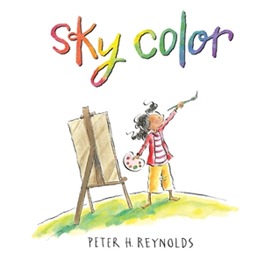
sky color

Sky Color by Peter H. Reynolds

This is another charmer of a picture book from Reynolds who wrote the popular Ish and The Dot.  Marisol considers herself an artist.  She paints lots of pictures, carries art supplies with her, and sees an artist in everyone.  So Marisol is thrilled when she learns that their next project will be a class mural.  Marisol wants to paint the sky.  The only problem is that there’s no blue paint.  How can she paint the sky without any blue?  Happily, the sky itself shows all of the colors possible to Marisol and she is inspired to paint the sky in many colors.

Reynolds uses simple text very successfully here, just as he has in his previous books.  This book is all about embracing the inner artist, expressing creativity, and finding inspiration in the world around you.  These are huge concepts that Reynolds makes tangible and possible even for young children to get inspired by.  A great idea would be to share the book with children and then have everyone paint the sky without using blue. 

Reynolds successfully turns just a few lines into great illustrations that capture emotions and full characters.  Many of the pages are black and white with bursts of color, but when artistic inspiration strikes, the colors bloom. 

Clever, colorful and filled with artistic inspiration for young readers.  Appropriate for ages 4-6.

Reviewed from library copy.

Review: The Art of Miss Chew by Patricia Polacco

art of miss chew

The Art of Miss Chew by Patricia Polacco

Polacco continues to explore her childhood in picture book form in this tribute to a teacher.  In school, young Patricia struggled with her grades, specifically when taking tests.  Luckily, she had a teacher, Mr. Donovan, who was willing to give her extra time to finish.  That little change allowed Patricia to get better grades.  Mr. Donovan was also the first teacher to recognize her artistic talent.  He connected her with an art program run by Miss Chew.  Miss Chew talked about learning to see, working with line and pressure, and taking their sketchbooks with them everywhere.  Patricia soaked all of this up like a sponge.  But then Mr. Donovan’s father died, and the substitute teacher would not give her more time to finish her tests.  She even threatened to pull Patricia out of her special art class.  Happily, Miss Chew was there to come to the rescue!

Polacco has continued to write about her challenges with school and about how a single amazing teacher changed her life again and again.  Her books are a testament to the power of teachers to make a difference in a child’s world, but in turn they are also a look at the emergence of a gifted artist who works hard and makes her own special place too.  In my eyes, it is the combination of Polacco and her teachers that is magical.

The art is done in Polacco’s signature style that is artistic, evocative and realistic too.  As she speaks about art, she demonstrates it in her art in the book.  Readers will notice how she captures shadow and light and plays with perspective too.  It is a very engaging way to create a quick art lesson in the middle of a story.

Art teachers will love this as a gift, but they will also enjoy sharing it in their classrooms.  Bravo for Miss Chew and all of the other great teachers out there who do this work every day.  Appropriate for ages 5-7.

Reviewed from copy received from G. P. Putnam’s Sons.

Review: Virginia Wolf by Kyo Maclear

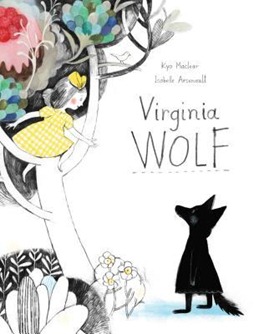
virginia wolf

Virginia Wolf by Kyo Maclear, illustrated by Isabelle Arsenault

This picture book is loosely based on the life of Virginia Wolf and her sister.  Adults will enjoy the tie-ins, but they are not necessary for children to understand in order to enjoy the book.  It is a story told from Vanessa’s point of view.  Virginia was having a “wolfish” sort of day where nothing pleased her and any sort of noise bothered her.  Vanessa tried to talk with her and discovered that Virginia was dreaming of a far-away perfect place to be.  So Vanessa snuck away and found art supplies and paper to create that world for her sister.  Soon her walls were covered in birds, butterflies, flowers and color.  There was even room for a wolf to wander.  Virginia’s mood lifted and she was ready to play once again. 

This book takes a direct look at depression but can also be used for more transient moods of children.  The author’s writing is rich and beautiful.  When Virginia first gets depressed, she explains it this way: “The whole house sank.  Up became down.  Bright became dim.  Glad became gloom.”  When Vanessa paints the garden it is described this way: “I painted leaves that said hush in the wind and fruit that squeaked and slowly I created a place called Bloomsberry.  I made it look just the way it sounded.”  This is a book that not only has art as a solution and an escape, but also has art in the writing itself.

Arsenault’s illustrations have a wonder to them that is astonishing.  Done in mixed media of ink, pencil, watercolor and gouache, the images play with darkness and light with a fearlessness.  Color is used sparingly at first, then when the art appears it is lush and vibrant.  One completely understands the way that art can lift a person.  Perhaps my favorite small detail is that the art at first when seen through Vanessa’s eyes is adult, lush and fine lined.  Later when glimpsed in retrospect, it has a childlike quality to it instead. 

This picture book is a small work of art that speaks to the power of creativity and art to lift moods.  Appropriate for ages 5-7.

Reviewed from copy received from Kids Can Press.

Review: Dying to Know You by Aidan Chambers

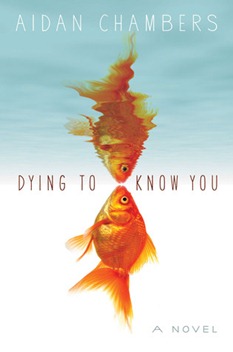
dying to know you FINAL

Dying to Know You by Aidan Chambers

When Karl’s girlfriend Fiorella asks him to write down his feelings about their relationship and answer a list of questions, he turns for help to a famous writer who lives in their town.  Karl is dyslexic which makes writing very difficult for him, as was the author who suffered as a child from minor dyslexia.  The author agrees to help Karl as much out of loneliness as a willingness to help.  He is drawn to Karl, who is similar in many ways, bright and eager.  He insists that Karl meet with him and give his own answers to the questions which the writer will in turn polish into something worthy of Fiorella’s attention.  As the two spend time together, their relationship deepens slowly into a true friendship.  When Fiorella finds out about the truth of the letters, it impacts the relationship not only of her and Karl but also of Karl and the author.

Chambers has created an amazing book here.  I found it nearly impossible to summarize because so much of the book is the growing connection between the two male characters.  It happens slowly and believably during fishing, quiet moments of driving, and conversation.  It is a look at how we choose connections in our lives and how they impact the life we lead.  While the book may be a quiet one, it also is daring in its own way, revealing the inner world of a young adult, written with truth and honesty.

The two men both face previous losses that have colored the way they face the world.  Karl lost his beloved father at a young age, and still struggles with his connection to his father and with disconnecting from that loss.  The author has recently lost his wife.  The two of them both struggled with depression and grief, sinking lower into a dangerous place with thoughts of suicide. 

Chambers also weaves in the role of art in our lives, the power of that to connect us to the world and the drive to create and be imaginative.  With Karl, who is a plumber, this connection to art is not an obvious one.  It takes time, just like their budding friendship, for the reader to come to understand Karl more deeply. 

I wish I could easily capture this book in paragraphs, since I feel like I have danced around the edges and not captured its heart here.  Let me say that this is a book that is powerful, quiet and filled with revelations about life.  It is honest, beautifully written and deep.  It is a book where you miss the characters for days after finishing it, because you too have befriended them.  Appropriate for ages 16-18.

Reviewed from ARC received from Amulet Books.

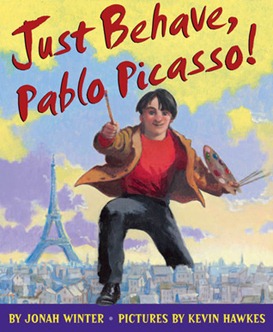
Review: Just Behave Pablo Picasso! by Jonah Winter

JUST BEHAVE, PABLO PICASSO!

Just Behave, Pablo Picasso! by Jonah Winter, illustrated by Kevin Hawkes

Pablo Picasso started out painting just like everyone else, but when he started to paint his moods in colors, things started to change.  The gallery owners wanted more pictures in just the same style, and suddenly Picasso became wealthy and well know.  But Picasso was not interested in painting the same rose colored paintings again and again.  Instead, he becomes inspired by African masks and does a new painting that breaks all of the rules.  When it is unveiled, the reaction is strongly negative and it is called “ugly” by the critics.  When the entire world starts doubting him, Picasso works even harder, coming out with another painting that is the birth of modernism.  This book displays the strength needed to stay true to yourself all through the lens of the incredible Pablo Picasso.

Winter has not written a conventional picture book biography here.  Instead, he plays with the format.  He uses comic book techniques like BLAM! and has pages that range from just a sentence or two to ones that are lengthier and provide more information and insight into Picasso.  This biography is less about the details of his life and much more about his art and its inspiration and evolving style.  We learn nothing of his family, but much about his process and his drive.

Hawkes’ illustrations carry that same playful feeling forward.  He toys with perspective, enjoys depicting the close quarters in Paris with see-through walls.  It takes a certain amount of playfulness to take on a book about Picasso and not imitate his style in the illustrations.  Hawkes’ style remains true to himself, underlining the overall message of the book by doing so.

A creative and fun picture book biography about a vibrant and rebellious artist, this book should find a place in children’s nonfiction collections.  Appropriate for ages 6-8.

Reviewed from library copy.

Review: The One and Only Ivan by Katherine Applegate

one and only ivan

The One and Only Ivan by Katherine Applegate

Ivan is the gorilla that is part of the Exit 8 Big Top Mall and Video Arcade.  The big billboard outside the mall shows Ivan as a ferocious beast, but he’s really a very easygoing guy.  He doesn’t remember anything about his life before he came to live with humans.  He was raised in Mack’s house as long as he was little and cute, but when he got bigger he was put into his domain: a glassed-in room.  He watches TV, lots of Westerns, and hangs out with his friends: an old elephant named Stella and a stray dog named Bob.  He also does art, scribbles that Mack sells in the mall gift shop.  Things change at the circus as money gets tighter until Mack purchases a baby elephant for the Big Top.  Ruby has been taken from her family and is full of lots of questions.  She makes Ivan look at his small, enclosed world more closely and inspires him to make promises that he will probably never be able to keep. 

I read this book in one long gulp, unable to get Ivan and his tiny, limited world out of my head.  The book is written from Ivan’s point of view, one that is distinctly gorilla and wonderfully familiar and foreign at the same time.  Applegate manages to give us a taste of being animal while never imbuing Ivan with human sensibilities, yet he is entirely relatable for readers.

The use of art to bridge the language gap between humans and gorillas is equally effective.  Ivan’s ruminations about art and how to capture taste and feel on paper is lovely.  Ivan’s world may be small and enclosed, but through art and his relationships with others, it grows larger and larger. 

This is a book that captivates.  It is compelling readers, bubbling with humor, yet addresses issues that are deep and complex.  It is a book that is memorable, rich and simply marvelous.  Appropriate for ages 9-12.

Reviewed from library copy.

Review: Dream Something Big by Dianna Hutts Aston

dream something big

Dream Something Big: The Story of the Watts Towers by Dianna Hutts Aston, illustrated by Susan L. Roth

Told through the voice of a fictional child, this is a look at the building of the Watts Towers, a huge art piece that is outsider art and has been named a National Landmark.  Simon Rodia, called Uncle Simon in the book, built the towers from glass, pottery shards, seashells and a vision.  Each piece on the towers was selected by hand.  The book shows the careful selection and then the transformation from garbage to art.  This is about the artistic dream and the process more than the man himself.  Because the building of the towers took decades, the story shows the girl grown into a woman with her own children.  It is a story of an artist, his skill, and the strength and vision it took to make it happen.

Aston has written so simply here that her format speaks also to the simplicity yet complexity too of the art itself.  She writes in the first person, inviting people into the story.  As she explores the process of the art, it is broken into parts and becomes jewel like too.  These are small moments and decisions that contribute to the whole.  The moments of creation are exceptionally important to the feel of the entire book.  They are moments that are celebrated and savored.

Roth’s incredible collage illustrations also elevate this book.  They are bright, filled with motion, and there is a constant feel of confetti and celebration on the page.  The shards and small treasures slowly coalesce into the towers and the gates around them.  The art is so close to reality that when the final page is turned and one sees a photograph of the towers, there is no jilt to reality.  Roth captured the spirit of the art so completely that it just feels right to see the real work at that point.

This is a powerful picture book about the process and importance of art and the act of creation.  Appropriate for ages 5-8.

Reviewed from copy received from Dial Books for Young Readers.

Also reviewed by:

Review: The Artist Who Painted a Blue Horse by Eric Carle

artist who painted a blue horse

The Artist Who Painted a Blue Horse by Eric Carle

A young artist paints a blue horse running against a yellow sky, then continues to paint animals in amazing colors.  There is a red crocodile, a yellow cow, a pink rabbit, and an orange elephant.  The book speaks powerfully and simply to the spirit of creativity, the ability to change the world through art, and the right to express yourself.  This becomes even more clear as the book ends with Carle’s own childhood experiences in Nazi Germany where he first saw the forbidden work of Franz Marc who painted Blue Rider.  This is not a picture book biography, but rather a statement of support for all artists who see the world in unique ways.

Carle’s art is really the center of the book with the words just naming the color and animal.  As I read it, I could see it being used very nicely in elementary art classes to encourage children to break away from the norm.  In toddler story times, it could also be used to learn colors and animals perhaps even with some animal noises thrown in to add to the fun. 

This is a book that will speak to many ages, adapt well to projects and conversation, or simply be used as a color and animal book.  It is infinitely flexible, wonderfully expressive, and makes a powerful statement.  Appropriate for ages 2-8.

Reviewed from copy received from Philomel Books.

You can also check out the auction of art by artists and celebrities that was inspired by this picture book.

Review: Blue Chicken by Deborah Freedman

blue chicken

Blue Chicken by Deborah Freedman

This vibrant picture book plays with color and perspective as well as characters who leave the flat page and enter the real world.  The picture is almost finished when one of the chickens in the picture pops her head out.  She then stands up and walks over to the paint pots that are waiting to finish the picture.  When the chicken peeks into the blue paint, she accidentally tips it over and ends up painting herself.  She is joined by a little duckling and then more who splash around in the new blue puddle, turning themselves and the cat who walked past blue.  Soon all of the animals are blue.  Now what can be done to turn them all back to normal?

There is a wonderful playfulness about this title.  Even the grumpy animals end up enjoying the escapade.  At the same time, there are lots of options to discuss colors, perspective, and art.  The book has real depth to it, allowing it to be read just as a cute story, or used more seriously with children. 

The words are simple and try to stay out of the way, allowing the art to really shine here.  And shine it certainly does.  It dazzles and glows, inviting young readers into the humor of the book and revealing a magical quality that is lovely.  From the freshness of the first spill of the blue to the sogginess and flatness that results, there is an exploration of the media here right on the page. 

Highly recommended, this is one of my favorite picture books of the year.  It is a charming jewel of a picture book that is fun, silly, yet offers plenty to learn.  Appropriate for ages 3-6.

Reviewed from copy received from Viking Books.

Also reviewed by Fuse #8.