Review: Henri’s Scissors by Jeanette Winter

henris scissors

Henri’s Scissors by Jeanette Winter

When Henri-Emile Matisse was a young boy, he longed to make art the way his mother did. So he drew as much as he could and then painted after receiving paints as a gift.  But when he was on old man, he had to remain in bed or a wheelchair and didn’t have the energy or ability to paint.  As he recovered, Matisse started to draw and then picked up a pair of scissors and started cutting paper.  Matisse started a second phase of his art career with assistants who painted pages for him to cut from, dreams of the shapes to cut out, and surrounded by the bright colors of his art.  He created a garden that he could visit right from his bed. 

Winter starts with Matisse as a boy finding art and quickly moves the book to his paper cutting phase in the latter part of his life.  For a picture book biography, the text is very simple yet conveys his great attachment and gift for creating art.  It also speaks to the creative process and trying new things that fit with life’s limitations. 

Winter fills her book with bright colors both in Matisse’s art itself but also as the backgrounds to her images.  When Matisse is without art, the book becomes dark yet star-filled.  As he returns to creating pieces, the book lightens and blossoms visually.

A very successful picture book biography, this book will be welcome in elementary and preschool art classes.  Appropriate for ages 4-6.

Reviewed from copy received from Beach Lane Books.

Review: Little Fish by Ramsey Beyer

little fish

Little Fish: A Memoir from a Different Kind of Year by Ramsey Beyer

This graphic novel takes real journals, collages, lists and drawings to show the author’s transitional first year of college.  Ramsey grew up in very small Paw Paw, Michigan.  She was an artist from a young age and worked very hard at it, earning a spot in one of the top art schools in the country.  This meant moving to Baltimore and making new friends for the first time since she was a young child.  It also meant that she would no longer be the best artist around, she would be challenged as an artist in her classes, and she would have to find her own way in this new setting.  Beyer’s novel shows the difficulties and triumphs of a freshman year of college, and is sure to encourage other little fish to try their luck in the big city.

Beyer’s use of her own personal real-life work that comes directly from that time in her life makes this entire novel work.  It carries a weight that it would not have without that honest voice of youth at its core.  The mixed media format also makes the entire book compulsively readable.  Since you never know what is on the next page or what format it might be in, there is a constant desire to find out more and read longer.

Beyer’s art is done entirely in black and white in the book.  She plays with light and dark throughout, capturing both the loneliness of the first days at college and also the dynamic friendships and love interests that come later.  Her work is humorous and yet poignant.

This is a very strong, dynamic look at the first year of college.  Teens will enjoy looking into their own future plans with a little laughter and lots of optimism.  Appropriate for ages 13-16.

Reviewed from library copy.

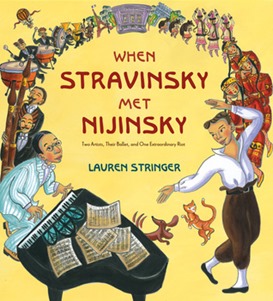
Review: When Stravinsky Met Nijinski by Lauren Stringer

when stravinsky met nijinsky

When Stravinsky Met Nijinsky: Two Artists, Their Ballet and One Extraordinary Riot by Lauren Stringer

This is the story of how two Russian artists collaborated to create a revolutionary new ballet, The Rite of Spring.  When the two artists met one another, each of them started to change.  Stravinsky’s music changed and Nijinsky’s dance changed.  They inspired one another to try something entirely new and created a ballet based on Russian folk dances and folk songs.  Even at rehearsal, some of the musicians walked out, but enough stayed so that the show could go on.  When the ballet was first performed, the crowd was split.  Some people loved the new music and dancing, others were shocked and hated it.  The crowd took to the streets to continue to express their anger and appreciation.  This is a great picture book biography that captures the magic of creativity that results when two masters collaborate on something brave and new.

Stringer’s writing takes a complicated story and distills it to the most important points.  Young readers will quickly understand that the two men brought new ideas out of one another, finding each other inspiring.  Her art also speaks to the collaboration of these two men, using flowing lines and deep yet soft colors.  She inserts elements from the art of the time, referencing movements like cubism in both her text and art.  The end of the book has photographs of the two artists and dancers in the ballet.  It also has a longer look at their collaboration. 

A great choice for art and music classes, I’d recommend listening to The Rite of Spring with the group too.  Appropriate for ages 6-8.

Reviewed from library copy.

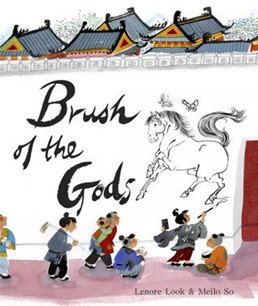
Review: Brush of the Gods by Lenore Look

brush of the gods

Brush of the Gods by Lenore Look and Meilo So

This is a picture book biography of Wu Daozi from the T’ang Dynasty, who is considered China’s greatest painter.  As a child, Daozi is taught calligraphy, but his brush does not want to just create Chinese characters.  Instead, he creates the first stroke and then turns it into an animal like a fish or a horse.  Daozi began to paint on walls, painting so fast that his sleeves opened like wings, gaining him the nickname of Flying Sleeves.  He painted every day and people began to leave coins for him that he donated to feed the poor.  As time passed, his skills grew even greater until the creatures he drew and painted became alive and left the flat surface of the walls.  He was then commissioned to paint an entire wall for the emperor, a project that took him many years.  In the end though, he created an entire world on a wall, one that you could almost walk right into.

Beautifully told and illustrated, this picture book biography takes a playful tone right from the beginning.  The sense that Daozi was not in control of his own gift makes for a wonderful insight into the drive and talent of artists and the way their talents can control them.  It is also a tribute to the skills gained by doing what you love and practicing a tremendous amount.  Daozi’s work and its lifelike quality is captured through a magical transformation to life in the story, making this feel much more like folklore than a biography.

Look’s text will work best for elementary-aged children, as she tells the story of hard work and talent combined into something spectacular.  They will also be more likely to understand the juxtaposition of biography and magical realism that is in the book.  Her writing is clear and lingers in all of the right moments and moves quickly when those moments are right too.  So’s illustrations are a tribute to Chinese art.  Done with clear brushstrokes, they also have fine details and small touches that make them shine.

This is a very impressive biography of an incredible artist that few children will be aware of before reading this book, making it perfect to share with children in art classes.  Appropriate for ages 6-8.

Reviewed from digital galley received from Random House via Edelweiss.

Review: A Splash of Red by Jen Bryant

splash of red

A Splash of Red: The Life and Art of Horace Pippin by Jen Bryant, illustrated by Melissa Sweet

Born in 1888, Horace Pippin loved to draw from the time he was a small child.  He would draw on scrap paper using charcoal, he would draw for his friends, and he would even draw on his spelling tests though his teacher did not appreciate that.  As he grew, he had to quit school in 8th grade.  He worked hard with his hands in different ways, but continued to draw and paint.  Then Horace went to war and was wounded in his right arm.  Now he could no longer draw, or so he thought.  He started trying again with a poker and using his other hand to steady himself.  As he grew stronger, he drew more and more.  Eventually, he gained the attention of people like N. C. Wyeth, who helped put together his first art show.  Pippin’s life that was filled with hardships and obstacles serves as inspiration for young artists.

Bryant and Sweet  collaborated before with Caldecott Honor results.  This picture book biography of an important but lesser known African-American artist shows the power of art in one’s life and how it is impossible to stop seeing and communicating the world through art once you begin.  Bryant writes with a solidity that is lovely.  Incorporating Pippin’s own words from letters, she captures the life of this artist and how he came to be recognized for his work.

Sweet too weaves Pippin’s words into her art.  Her use of collage truly builds Pippin’s world before readers’ eyes.  My favorite image in the book is Pippin as a young boy sitting and drawing on piles of papers.  It captures the intensity with which he created art even at such a young age.  This intensity continues through his story to after he is wounded and the determination that is apparent in just his hands. 

Another very successful collaboration of these two masters, this biographical picture book should serve as its own splash of red on every library’s shelves.  Appropriate for ages 6-9.

Reviewed from copy received from Random House Children’s Books.

Review: Colorful Dreamer by Marjorie Blain Parker

colorful dreamer

Colorful Dreamer: The Story of Artist Henri Matisse by Marjorie Blain Parker, illustrated by Holly Berry

Matisse grew up in a French town that was industrial and gray.  Despite this, he dreamed in bright colors.  He was a boy who did not do well in school, at music, or really at much of anything except dreaming.  Matisse decided to study law in Paris, but he discovered that being a law clerk was very dull, copying legal documents word for word by hand.  Due to the stress, Matisse ended up in a hospital bed for months.  It was there that he started painting to pass the time.  Now he had found exactly what he was good at.  It wasn’t easy, there were times he lacked food and money, but he worked very hard at his art.  Years later, Matisse found himself sick and in bed again in his old age.  He could no longer stand at an easel, so he turned to making cut-out collages, and those pieces turned out to be some of his most celebrated creations.

Parker vividly tells the story of a boy who grew up as a very unlikely artist.  From his colorless surroundings to the fact that he had never discovered his artistic gift, it is amazing that Matisse became what he was.  I appreciate particularly her celebration of the creative and the imaginative.  She also makes sure though that young readers know how much work it took for Matisse to reach success and that it did not come instantaneously.  It’s a book that speaks to everyone having a gift, but also the hard work it takes to achieve it.

Berry’s art plays black-and-white against brilliant color.  The gray world of Matisse’s youth is shown in intricate pencil illustrations, but pales against the radiant color of his dreams and his art.  As the pages turn, Matisse’s world becomes the same colors as the art he creates, demonstrating that he has finally found his place in the world as a whole.

Beautifully illustrated and written as an inspiration to young people looking for their own special place in the world, this is a very special look at a famous artist.  Appropriate for ages 5-8.

Reviewed from copy received from Dial Books.

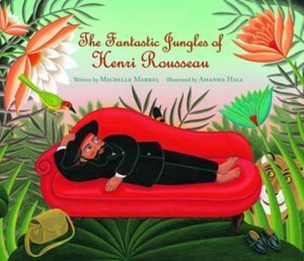
Review: The Fantastic Jungles of Henri Rousseau by Michelle Markel

fantastic jungles

The Fantastic Jungles of Henri Rousseau by Michelle Markel, illustrated by Amanda Hall

This striking picture book is a biography of the artist, Henri Rousseau.  It tells the story of this man as he started to do art at forty years old. Rousseau dreamt of being an artist because he saw so much beauty and color everywhere. He couldn’t afford lessons, so he read many books to learn techniques and structure.  At age 41, Rousseau entered an art exhibition for the first time.  The art experts said mean things about his art, but Rousseau kept painting.  Inspired by the World’s Fair in Paris, he began to draw jungles.  Rousseau kept entering exhibitions and kept getting rude things written about his art.  He kept on painting, eventually getting accepted by the younger artists in Paris, like Pablo Picasso.  By the end of his life, no one was laughing or scorning his art.  Rousseau had not just proven himself to the critics, but to the entire world.

Markel has chosen to write this book in the present tense and also to call Rousseau by his first name throughout.  Both of these make the book feel welcoming and immediate.  The prose here is never dense and at times is almost playful as Rousseau (or Henri) starts to discover his talent and inspirations.  It is like you are discovering things alongside Rousseau.

Hall’s art pays beautiful homage to Rousseau’s own work.  Reading her Illustrator’s Note, one finds that she has changed her medium for this book, using watercolor and acrylics to achieve Rousseau’s characteristic look and feel.  She also used some of his original work as direct inspiration, adding his breaking of scale and perspective rules as well.

This is a superb picture book biography of an artist who came late to finding his passion in life.  Both his life and work are inspirations for children and adults to dream big and ignore the critics.  Appropriate for ages 6-9.

Reviewed from copy received from Eerdmans Books for Young Readers.

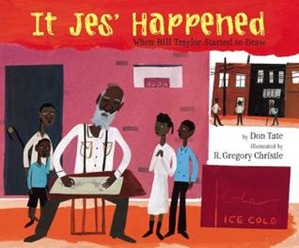
Review: It Jes’ Happened by Don Tate

it jes happened

It Jes’ Happened: When Bill Traylor Started to Draw by Don Tate, illustrated by R. Gregory Christie

This picture book is a beautiful tribute to a legendary folk artist.  Bill Traylor grew up a slave in Alabama.  Born in 1854, he worked in the fields as a child.  When the slaves were freed at the end of the Civil War, his family stayed on working as sharecroppers on the same land they worked as slaves.  As things happened to him throughout his life, from hunger to parties, Bill Traylor remembered it all.  When he finally left the farm and headed to the big city of Montgomery, it was those memories that he drew and painted.  At age 85, he started drawing and kept on.  He got attention for it too, eventually getting a gallery show in 1940.  Bill Traylor showed his life and his heart through his simple yet powerful art.

Tate does not shy away from truly embracing Traylor in this picture book.  The book has more words than many picture books, but they are necessary to truly recreate both the memories of Bill Traylor and the amazing transformation to artist that happened so late in his life.  The writing is solid and smooth, building a full life before your eyes.

Christie’s art hearkens back to that of Traylor’s in its rough simplicity.  It speaks to the deep colors and the power of plain paint and strong lines.  There is also a wonderful dynamic quality to the art that offers motion and storytelling.

A lovely look at the life of a folk artist, this book is a great example of a picture book biography.  Appropriate for ages 6-9.

Reviewed from library copy.

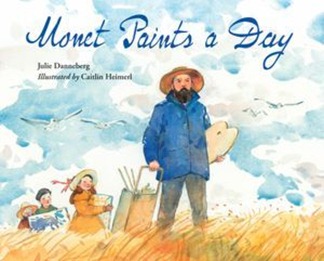
Review: Monet Paints a Day by Julie Danneberg

monet paints a day

Monet Paints a Day by Julie Danneberg, illustrated by Caitlin Heimerl

Told in the first person by Monet, this book explores his painting process when he was on holiday in Etretat, France.  Children waited for him when he leaves his hotel, wanting to help carry his canvasses to the seaside.  When they reached the strip of sand at the bottom of the cliffs, the canvasses were placed against the cliff.  Monet was unique in painting right in the middle of the landscape rather than sketching and then finishing the painting in his studio.  Because of his unique approach, he had many canvasses in process at the same time.  On this day, he got so involved in painting that he didn’t realize how quickly the tide was coming in.  Everything was taken out by the sea, so he had to begin again on a new day.

Danneberg manages to tell two levels of story here.  There is the day that Monet is painting which is explored in exquisite detail.  Then in small boxes that are offset from the rest of the story, there is historical context offered about how Monet differs from other artists of his time and how he was creating an entirely new style of painting.  The Author’s Note at the end offers even more detail as well as a copy of Monet’s Waves at the Manneporte so that readers can see an example of Monet’s work.

Heimerl has the challenge of doing a picture book based on a famous artist.  In her illustrations she manages to create illustrations that both are their own style and yet pay homage to impressionism.  She achieves this with small touches, daubs of watercolor, here and there, lightening and brightening the illustrations.

A very successful picture book biography of Monet, this will be enjoyed by elementary art teachers and students.  Appropriate for ages 6-9.

Reviewed from copy received from Charlesbridge.