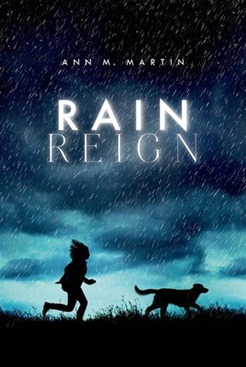
Review: Rain Reign by Ann M. Martin

rain reign

Rain Reign by Ann M. Martin

Rose loves homonyms.  She spends her days looking for new ones to add to her list, and then once she gets home adding them or rewriting the entire list if she runs out of space.  Her dog Rain has a name that has two homonyms: reign and rein, which is why she picked it.  Her father also gave her Rain on a rainy night.  He found Rain wandering around after he left the bar one night.  Rain is one of the best things in Rose’s life, since her father spends most evenings drinking at the bar and Rose spends them alone.  Luckily, she also has her uncle in her life.  He takes her to school, helps her find new homonyms, and protects her when necessary from her father when he loses patience with Rose.  Then a fierce storm hits their town and Rose’s father lets Rain out into the storm and she disappears.  Rose’s father refuses to explain why he let Rain out in a storm and also refuses to help Rose find her dog.  It is up to Rose to find Rain so she devises her own plan and calls on her uncle for help.  But when she finds Rain, she also discovers that Rain has other owners and Rose has to make a heartbreaking choice about right and wrong and love.

Martin captures a truly dysfunctional family on the page here.  Rose’s father is brutal, cruel and a constant threat in her life.  At the same time, the book glimmers with hope all of the time.  Rose herself is not one to dwell on the shortcomings of her life, preferring to immerse herself in her words, her dog and her time with her uncle.  Martin manages to balance both the forces of love and fear in this book, providing hope for children living with parents like this but also not offering a saccharine take on what is happening. 

Rose is an amazing character.  She talks about having Asperger’s syndrome and OCD.  She is the only child in her class with a full-time aide and it is clear from her behaviors in class that she needs help.  Yet again Martin balances this.  She shows how Rose attempts to reach out to her classmates and then how Rain helps make that possible and how Rose manages to use her own disability as a bridge to help others cope in times of loss.  It’s a beautiful and important piece of the story.

A dark book in many ways, this book shines with strong writing, a heroic young female protagonist and always hope.  Appropriate for ages 9-12.

Reviewed from copy received from Feiwel and Friends.

Mockingbird

Mockingbird by Kathryn Erskine

Released April 15, 2010.

In this small novel, Erskine has combined the tragedy of a school shooting with the unique voice of Asperger’s syndrome.  Caitlin’s older brother, Devon, has been killed in a school shooting along with others.  As Caitlin struggles to understand the emotions around her and the feelings she herself has, she has to do it for the first time without her brother helping her.  She tries to do it without flapping her hands, without burying herself in her father’s sweater, but she does retreat to her safe places like under the dresser in Devon’s room.  Her world is black and white, just like her award-winning drawings, color only confuses things.  But as the days go by, Caitlin begins to connect with other people in new ways and perhaps through her own literal understanding of things she just might find closure and help others find it too.

I don’t feel that I can encapsulate this book in a paragraph.  It is so much larger than I can describe, so much more profound and uplifting.  Erskine has taken two ideas that seem very divergent and created something amazing from them.  The two become more vital and important joined into a single book than they would have been separately.  Caitlin’s own grief is explored in such a literal and detached way that it becomes even more painful to witness.  Her inability to speak her emotions hands them over to the reader to feel for her.  We all become a part of her syndrome and feel it to our bones.

Through the lens of Caitlin readers also get to witness the grief of others.  Get to wince when Caitlin puts something too bluntly.  Cry when she is unable to understand.  Rejoice when connection is made, no matter how small.  Through Caitlin we get to see difference as a sliding scale that we too fit on somewhere.

This is a book about one family, one tragedy, one girl, but it reaches far beyond that.  It is a book about surviving, about scrambling for connections, about living life in color.  It is about fear, about being alone, and about reaching out despite how very hard it is.

I think we are going to hear a lot about this book with its large scope of ideas offered in a small package through the eyes of a brilliant girl.  I hope we do hear a lot about it.  It should be read in classrooms, discussed and embraced. 

Beautifully written, this book has the power to unite.  Appropriate for ages 10-13.

Reviewed from Advanced Reader Copy provided by Philomel.