Review: The Baby Swap by Jan Ormerod

Baby Swap by Jan Ormerod

The Baby Swap by Jan Ormerod, illustrated by Andrew Joyner (InfoSoup)

Caroline is not happy to have a baby brother. Her mother adores him despite his dribbling mouth. She talks all of the time about his yellow eyes and green skin and how very cute he is. When her mother goes into town to exchange her hat for one that is just right, Caroline gets an idea and heads to the baby store to trade her baby brother in for one that is just right too. The baby panda with yellow eyes like her mother likes eats the bamboo furniture. The baby elephant is too squirty and ends up breaking a fountain. The two baby tigers are too active and too much of a handful for her. By the time she goes through all of the available babies, the store only has one left, her original baby brother. But after all of that, he looks pretty perfect to her!

Ormerod takes a humorous look at sibling rivalry in this picture book. Caroline is clearly jealous of the time that her mother spends with her little brother, but that is transferred to disliking his drool and activities. The idea of exchanging an infant for one who fits and suits you better is a clever one, and an idea that children will understand. The ending where Caroline takes her own brother back works very well and doesn’t feel forced or overplayed. Instead it feels like the natural extension of the experience that the character has had.

Joyner’s illustrations add to the humor of the book. Filling his pages with a community of different animals, Joyner makes sure that it is a modern world with cell phones, portable music, and cars. Yet it also has a distinct vintage feel in the way that the characters dress and touches like the price tags on the babies and their cloth diapers. It’s a distinctive mix of the two, one that is modern and yet warm.

A great addition to the crowded shelves of sibling rivalry books and one that takes a more lighthearted and humorous approach to the situation. Appropriate for ages 4-6.

Reviewed from copy received from Simon and Schuster.
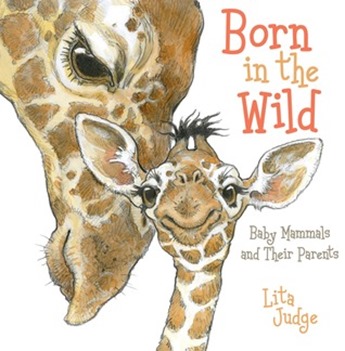
Review: Born in the Wild by Lita Judge

born in the wild

Born in the Wild: Baby Mammals and Their Parents by Lita Judge

Explore different baby mammals from around the world in this nonfiction picture book.  Learn about how different animals function when they are born, polar bear babies are tiny and are kept safe for months before going outside while giraffes are born ready to run right away.  Baby animals eat in different ways too.  Baby bears nurse, baby wolves learn to eat meat quickly, and other animals eat grass and drink their mother’s milk.  Other subjects like protection and shelter are examined as well as grooming, moving from place to place, and what their families look like.  This book is a celebration of the diversity of mammals on the earth and all of the ways in which they are loved and cared for as they grow. 

Judge offers just enough information on each animal to make the book readable.  She gives intriguing glimpses of each animal before moving on to the next.  It’s a fast paced book that merrily jumps from one animal to the next.  More in-depth information on each of the featured mammals can be found at the end of the book. 

Judge’s art is exceptional.  Her animals are filled with personality.  The baby mammals look straight out at the reader at times, their parents’ eyes are filled with love, and there is a tangible joy to each of the images.  The cuteness factor could have been unbearable, but instead it’s perfect, just the right amount of cute and wild mixed together.

A great choice for smaller children who love animals, this book is gorgeous as well as informative.  Appropriate for ages 4-6.

Reviewed from copy received from Roaring Brook Press.

Review: The Twins’ Little Sister by Hyewon Yum

twins little sister

The Twins’ Little Sister by Hyewon Yum

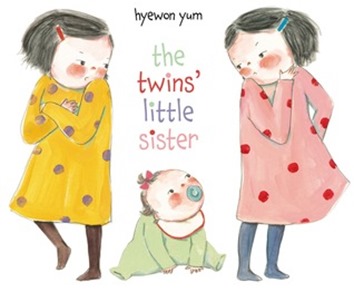
This follow-up to The Twins’ Blanket features the same twin girls.  The book is told from their shared perspective.  In this book, the issue is that there are two of them, but they only have one mother that they have to share.  During nap time, both girls want their mother to look at them, but she can only look in one direction at a time.  Being pushed on the swings is also a problem, since their mother can only push one of them at a time.  Now they have a little sister arriving soon too and there will be even more demand for their mother’s time.  When the baby arrives, the girls are not impressed.  They can no longer be in the big bed with their mother because the baby is there.  Their mother can’t push the swings at all anymore, because her arms are full.  Then the girls discover that they get lots of attention for helping with the baby.  Soon the girls are adoring big sisters, but there’s still one problem, they need another little sister so they don’t have to share!

This is a clever twist on sibling rivalry that shows the closeness and competitive nature of being sisters and twins.  It is particularly good to see that the rivalry existed before the younger sibling arrived and that it was just another factor in the family dynamic.  The voice of the two girls together is clear and bright, they are strong-willed little girls but that is not a bad thing.  I appreciate a book that shows children being less than perfect on the page. 

Yum’s illustrations are done in pencil, watercolor and cut paper.  The girls are distinguished by their dresses and barrettes but are otherwise identical.  Emotions are clear on their faces, their eyes shining with feelings above their rosy cheeks. 

A great choice for new siblings, this picture book shows human children grappling with being siblings and sharing.  Appropriate for ages 3-5.

Reviewed from library copy.

Review: Sweetest Kulu by Celina Kalluk

sweetest kulu

Sweetest Kulu by Celina Kalluk, illustrated by Alexandria Neonakis

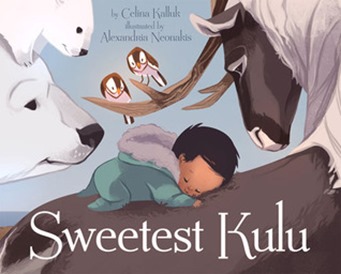
Kulu has just been born and is being welcomed by the world.  Kulu is Inuit and as the world comes to welcome the baby, traditional Inuit beliefs are shown in the story.  It is the Arctic summer, so the first to welcome Kulu is Smiling Sun, who stays bright all through the night.  The Wind arrives and teaches Kulu the importance of listening closely.  Then the animals start arriving.  These are not your normal animals, but ones that are specifically from the Arctic and of importance to the Inuit.  With each animal comes a blessing:  the Snow Bunting reminds Kulu to always believe in himself, Fox tells Kulu to get out of bed as soon as you wake and to help anyone who needs it.  The entire book sings with a connection to nature, to this specific region of the earth, and for the love of a baby.

Kalluk, who is an Inuit throat singer, has beautifully captured the values of her people in this picture book.  It is done so organically and naturally that many will not realize that this is more than a sweet picture book.  The fact that it also weaves in traditions and values of the Inuit makes the book all the more special and noteworthy.  Kalluk writes very lyrically, creating moments for each of the animals that are unique to them which keeps the book from becoming repetitious.

The illustrations have a lovely cartoon quality to them, one can almost see them leaping to life from the page.  The large animals dwarf little Kulu by their bulk, but the tenderness they all feel for this tiny baby shines on the page.  There is a respect between human and animal that is warm and tangible too.

A gorgeous and meaningful book welcoming a baby to the world, this picture book is unique and special.  Appropriate for ages 1-3.

Reviewed from ARC received from Inhabit and Myrick Marketing.

Review: Tickly Toes by Susan Hood

tickly toes

Tickly Toes by Susan Hood, illustrated by Stephane Barroux

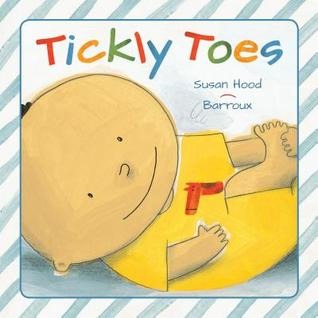
This playful board book looks at infants’ interest in their own toes, whether it is when they are being tickled by someone else, or when they see them in the bubbly bath water.  Written as if a parent is addressing the baby directly, this book will read aloud well to the smallest of listeners.  With illustrations that invite counting, this book is also an invitation to count baby’s own toes right now.

Hood avoids being too sing-songy in her rhyme, instead keeping it jaunty.  Even when baby pulls of his booties and flings them away, the tone remains entirely positive and encouraging as baby finds his feet all on his own.  The illustrations by Barroux are bright and large.  They show the ten toes on many pages as well as a loving family environment around him.

Get your toes wiggling with this bright and bouncy board book.  Appropriate for ages birth to 2.

Reviewed from digital galley received from Kids Can Press and NetGalley.

Review: The Baby Tree by Sophie Blackall

baby tree

The Baby Tree by Sophie Blackall

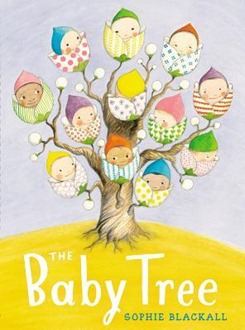
A young boy is told at breakfast that a new baby is coming.  He has a lot of questions, but the biggest one is “Where are we going to get the baby?”  So he starts asking different people.  His babysitter Olive who walks him to school in the morning says that you plant a seed and it grows into a baby tree.  At school, he asks his teacher where babies come from and she says “from the hospital” but he can’t ask any more questions because it’s time to clean up.  That afternoon he asks his grandpa about babies, because he is the only person that the boy knows who has been to the hospital, and Grandpa says that a stork brings the baby in the night and leaves it on your doorstep.  The mailman says that babies come from eggs.  The boy is very confused, so that night he asks his parents and they explain about babies growing inside their mom, about seeds and eggs and the hospital.  Now all the boy has to do is explain it to Grandpa who is clearly uninformed!

Blackall weaves an age-appropriate look at reproduction in this picture book.  I particularly appreciated that when the older characters explained it to the boy, there were touches of honesty in each of their answers that come together cleverly in the end, except for Grandpa’s of course!  It is a book that explains just enough of the details to answer preschool questions, without going into details that they are not interested in at that age. 

As always, Blackall’s illustrations are fresh and unique.  Her illustrations are friendly and lovely, focusing on the relationships in this boy’s life beyond his parents.  They demonstrate a richness of connections that is a delight.

A great addition to library collections, this is an ideal level of information for preschoolers expecting a new sibling soon.  Appropriate for ages 3-5.

Reviewed from copy received from Nancy Paulsen Books.

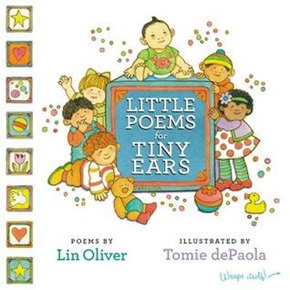
Review: Little Poems for Tiny Ears by Lin Oliver

little poems for tiny ears

Little Poems for Tiny Ears by Lin Oliver, illustrated by Tomie dePaola

Celebrate the wonder of babyhood and toddlerhood with this collection of poems ideal for the youngest listeners.  These poems document the small moments of a child’s early years, seeing these little things as exactly what they are: the foundation of the future.  So each moment is given a gravity by the poems but they are also entirely playful and fun.  There are poems about body parts like noses and tongues, poems about peekaboo and high chairs, poems about naps, others about baths.  Each is short, clever and just right for sharing aloud.

DePaola has illustrated the poems with his signature style, depicting children of all colors and nationalities.  His illustrations embrace the gentleness of the entire book with their soft and bright colors and clear demonstrations of love.

Get this on the shelves right next to Mother Goose, because what you have here is a new classic set of poetry for the little ones.  Appropriate for ages 1-3.

Reviewed from library copy.

Review: A Book of Babies by Il Sung Na

book of babies

A Book of Babies by Il Sung Na

A duck takes readers on a tour of different sorts of animal babies.  The duck heads around the world, visiting baby lions, baby lizards, baby polar bears, and baby kangaroos among many others.   A trait of each baby is mentioned to distinguish them.  Baby zebras walk right away.  Fish are born with lots of brothers and sisters.  Seahorse fathers carry their babies in a pouch.  These small details add up to a kaleidoscope of different animals and offer lots of opportunities for parents to talk more about each animals as they share the book.

This author of The Book of Sleep always fills her books with rich illustrations.  Here her gentle poem carries the duck from one place to the next, but it is the illustrations that make this such a special gem.  Done in mixed media, they feature a variety of textured papers that become ice bergs, tree trunks and even the sky.  He manages to make colors that seem to emit light, glowing on the page. 

Perfect for toddler bedtimes, this book is radiant with baby animals.  Appropriate for ages 1-3.

Reviewed from copy received from Random House Children’s Books.

Review: Shhh! by Valeri Gorbachev

shhh

Shhh! by Valeri Gorbachev

When his baby brother is sleeping, the older brother is very quiet.  He walks on his tippy-toes and doesn’t make any noise.  Of course, this involves getting even the toys to be quiet.  So he has to tell the clown to stop laughing, the knights to stop battling, the tiger to stop growling, the pilot to stop flying, the train to stop rolling, and the pirates to stop firing their cannons.  Happily, when his baby brother wakes up, he can run around, play with his toys, and make plenty of noise.  Until… baby goes to sleep again.

There is no resentment in this book from the older sibling to his baby brother.  Instead the book embraces the differences between awake and nap time in a playful way.  The older brother sees being kind to his little brother as a way to demonstrate how much he loves him.  While parents are present in the book, this is much more about the self-control of a child and his own willingness to help by being quiet.  There are no lectures from parents or even reminders to be quiet.

Gorbachev’s art is colorful and fine-lined.  He sets a playful tone in the book that works well.  When readers are first shown the toys that have to be quiet, they are presented as if they are fully alive and life-sized.  Once the baby is awake, they are shown in their true forms, as toys. 

A positive book about being an older sibling and having to be quiet.  Appropriate for ages 3-5.

Reviewed from copy received from Philomel Books.

Also reviewed by A Picture Book a Day.