The Tree House: Wordless and Wonderful

treehouse

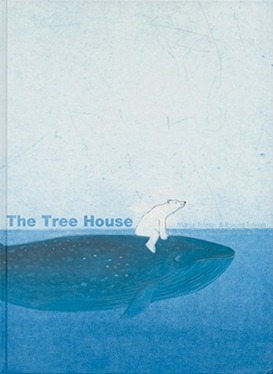
The Tree House by Marije Tolman and Ronald Tolman

This is a wordless picture book by a father/daughter team who have created a magical immersive experience.  A polar bear swims towards a tree house that stands alone in the water.  Later, a brown bear arrives in a boat.  The two bears stay together in the tree house, reading books as the sea below turns pink with a flock of flamingos.  As the flamingos pass, more animals arrive, including a rhino who bashes the trunk of the tree, two pandas, some owls, a hippo, and a peacock.  Another bear arrives via balloon and takes the peacock away.  The other animals head off, leaving the two original bears together in the tree house.

My synopsis doesn’t capture the beauty of this picture book at all, as is often the case with wordless picture books, the story is so much more about the pictures than anything that can be summarized in words.  The illustrations are simple and beautiful.  The tree house itself is unchanging, printed in exactly the same way from page to page.  It offers a consistency while the world changes around it.  The level of the water rises and falls, the sky changes colors, the seasons move.  The tree house stands, staying constant through it all, even as it supports so many animals.

There is a lovely gentle mood throughout the book.  A sense of playfulness and unexpectedness fills the story as well.  The surprise of the suddenly pink page when the flamingos arrive is visually arresting and very effective.  The colors are deep, from a blue that is almost black and perfect captures late evening to a canary yellow that sings. 

This is a book of wonder, a beautiful place to spend some moments with someone in a tree house out in the water.  Appropriate for ages 3-5.

Reviewed from copy received from Lemniscaat.

Also reviewed by:

Tell Me the Day Backwards: A Bedtime Charmer

tellmebackwards

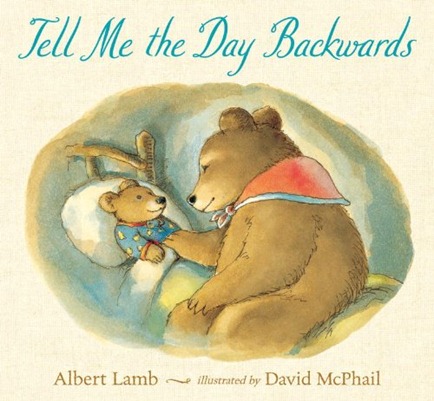
Tell Me the Day Backwards by Albert Lamb, illustrated by David McPhail

Released March 22, 2011

Timmy Bear and Mama play a game before he goes to sleep.  They tell each other their day backwards.  The story they tell one another is filled with special moments together like watching the sunset and having a picnic.  Then there are moments of fear, and told backwards they make it even more of an event.  The story builds nicely as readers discover exactly what led to Timmy Bear jumping from a high rock into the river.  The story ends as it began, with Timmy Bear in bed and Mama at his side, creating a beautiful circle of a story. 

Lamb’s writing here has such a gentle feel, it is perfect for a bedtime story.  The adventure portion in the middle keeps this from being too soft and gentle, adding a great story arc to the book that is sure to have young readers listening intently.  The exchanges between Mama and Timmy in the book have a touch of humor and a great deal of love. 

McPhail’s art captures the story with his usual style.  His illustrations are soft watercolors that work for both the active portions of the book and the slower parts.  He manages to capture so much emotion, action and movement in only a few lines.  The illustrations are simple and lovely.

This book belongs in every library and will make a wonderful gift book for toddlers who just may have similar adventures in a given day.  After reading the book it is impossible not to want to tell your day backwards, so if sharing with a group, you may have to have an activity of writing or drawing their day backwards.  Appropriate for ages 2-4.

Reviewed from ARC received from Candlewick.

Me and You: A Glorious Goldilocks

518fiHZWXbL

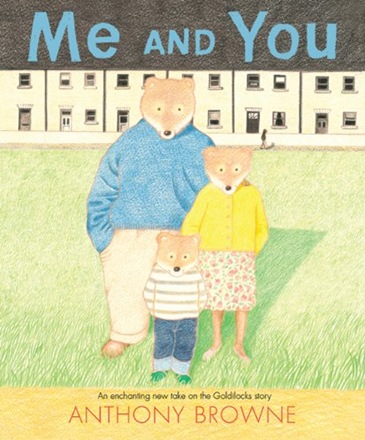
Me and You by Anthony Browne

This is a version of Goldilocks that is sure to make readers think.  The story of Goldilocks is told opposite that of the Bear family.  Goldilocks comes from a rough part of town, complete with broken windows and graffiti.  After chasing a balloon that gets away, she finds herself in front of the Bears’ home.  It’s a pretty yellow home, obviously comfortably middle class.  The Bears have headed out for a walk in the neighboring park, chatting about work, the home and the car.  When they return, they find that their house has been disturbed.  From here the story continues in the traditional way.  Goldilocks flees the house, finding her way home to the arms of her mother.  This is a Goldilocks tale that will have readers thinking.

Browne has created a book that emphasizes the differences between Goldilocks and the Bears.  The Goldilocks story is told in wordless format with a very realistic feel and muted colors.  In many of the images the only bright color is Goldilocks’ hair.  Contrasted with that are the images of the Bears.  Shown in pastels done in a much softer line, the images are comfortable and bright.  But readers’ eyes are sure to wander back to the darker side of the page and Goldilocks.

Is Goldilocks the villain that has been portrayed in the past?  Is she a greedy little girl who wants the items of some poor bears?  Not here.  Here Goldilocks may be homeless, is definitely in need of warmth, and is lost.  This book turns the tale on its head, creating a heroine out of a lost girl and questioning the motives of the comfortable bears.

This is an important look at a fairy tale that asks modern questions.  I’d recommend using it with other versions of the same story and saving this one for last.  It is certainly a book that will have young listeners talking.  Appropriate for ages 4-6.

Reviewed from copy received from Farrar Straus & Giroux.


Moon Bear

Moon Bear by Brenda Z. Guiberson, illlustrated by Ed Young

Follow a moon bear through a year from one spring to the next.  Each page begins with a question that is then answered through a short verse.  So much of the book, just as with the bear’s life, is taken up with the search for food.  Food that will make children squirm and food that they too would love to find.  Guiberson’s text is more poetry than scientific information, offering readers a beautiful look at a rare creature.  Adding to the beauty of the book are the amazing collage illustrations by Ed Young.

The question and answer format of the text in this book make the book very intriguing and inviting.  The fact that it is verse works very well here, brief condensed verse.  This is certainly a nature picture book but never becomes dry with facts, rather it is an ode to an endangered creature.

Young’s illustrations add an exciting element to the book.  Done in collage, they contain photographs and patterns that keep the eye fascinated.  The illustrations also capture textures, combining them to great effect.  As the book comes full circle, it offers children a treat at the end of the book.  The author’s note at the end contains facts about moon bears as well as photographs of the bears.  To my eye, the ones built out of Young’s collage look even more real and true. 

Highly recommended, this is a celebration of a unique bear that we should all get to know with this unique treatment.  Appropriate for ages 4-8.

Reviewed from copy received from Henry Holt.

Bunny Days

Bunny Days by Tao Nyeu

The author of the marvelous Wonder Bear returns with a picture book that once again features the big white Bear.  This book however takes a different approach than the loosely plotted first book. 

The book is in three chapters, each featuring an scrape the bunnies get into which is resolved by Bear.  In the first story, Mr. Goat is driving past the bunnies on his tractor and splashes them all with mud.  They head to Bear for help and he fixes everything by putting them all in the washing machine.  On delicate cycle of course.  Then they are hung to dry.  In the second story, Mrs. Goat is vacuuming and accidentally sucks the bunnies right out of their burrow.  Mrs. Goat takes her broken vacuum to Bear who discovers the bunnies inside.  He blows the dust off of the bunnies and repairs the vacuum too.  The final story has the bunnies playing hide-and-seek in a white flowered hedge while Mr. Goat is pruning it.  He accidentally cuts the tails off of the bunnies.  But no worries, Bear once again rescues the situation by carefully sewing the tails back on.

These stories are entirely silly and whimsical.  The solutions are sure to generate giggles as children will immediately realize how nonsensical they are.  Nyeu’s art has a strength and simplicity that adds to the appeal here.  His use of thick lines and a limited color palette work very well, especially the use of one dominant color for each story.

Ideal for toddlers, this book will have plenty of appeal with its fresh-feeling art and simple story lines.  Appropriate for ages 3-5.

Reviewed from copy received from publisher.

Waiting for Winter

Waiting for Winter by Sebastian Meschenmoser

As my son waited for the bus this morning, he asked when the snow was going to come.  Here in Wisconsin in mid-November that is a very good question and the answer is “very soon.” 

In this charmer of a picture book, Squirrel is told by Deer that it is going to snow.  Squirrel hasn’t seen snow before, so he decides to wait for it.  Deer explains that snow is “White and wet and cold and soft.”  But it is very hard to stay awake, so Squirrel runs up and down the tree trunk.  The noise wakes Hedgehog who agrees that he wants to see snow too.  The two of them stay awake by singing – sea shanties.  This wakes up Bear who waits with them for the snow.  But what is snow has already arrived and they haven’t recognized it?  So the three look around for items that match Deer’s description of snow with very funny results.  In the end, they learn exactly what snow looks like.

Meschenmoser excels at telling a story through few words and wonderfully evocative illustrations.  Just the appearance of the animals themselves shows how very tired they are.  The close-up of Bear’s face after he is woken up perfectly captures the grumpiness and bleariness of that moment.  All of the animals are wonderfully scruffy and real.  Hedgehog always has leaves and other objects stuck in his spines, and Squirrels wild fur carries a lot of his frantic pace even when still. 

The voice of the book is also right on the mark.  Told with great excitement and delight, the tone conveys their wonder at being able to see snow even before they have caught a single glimpse of it.  Meschenmoser’s pacing also works very well, filled with just enough tension but also forward movement.

A perfect choice for this time of year when snow would be met with cheers and joy by all of us who are waiting for winter.  Appropriate for ages 4-7.

Reviewed from copy received from publisher.

Also reviewed by Fuse #8 and Through the Looking Glass.

When You Meet a Bear on Broadway

When You Meet a Bear on Broadway by Amy Hest, illustrated by Elivia Savadier

When you meet a bear on Broadway, you stick out your hand and ask them to stop.  Then you politely ask what his business is there.  He bursts into tears saying that he has lost his mother.  The two of you think of how to find her together.  Then you look uptown.  And downtown.  Along the river.  Until you find a forest where the bear climbs a tall tree and shouts for his mother.  But will a mama bear be able to hear him in the middle of a bustling city?

Though the styles are very different, this has the feel of Laura Numeroff’s If You Give a Mouse a Cookie feel.  It is the short lines and the repeating phrase of “When you meet a bear on Broadway.”  Hest takes this form and creates a book about being lost, being helped, and being found.  There is never any sense of panic about the child helping the bear.  It is far more of a problem solving book about what to do when you find a bear on a city street. 

The book has a nice bit of old-fashioned whimsy about it though the setting is modern.  Savadier’s illustrations contribute to this with their gentle lines and watercolor washes.  The little girl and the bear are often the only bright color on the page, magnifying their relationship rather than the largeness of the city itself.

Funny, quiet and very satisfying, this book would be nice paired with any of Numeroff’s If You titles.  It also offers a nice change of pace for any bear-themed stories.  Appropriate for ages 3-6.

Reviewed from library copy.

Also reviewed by A Patchwork of Books.

A Birthday for Bear

A Birthday for Bear by Bonny Becker, illustrated by Kady MacDonald Denton

The creators of A Visitor for Bear return with an easy reader featuring Mouse and Bear!  It is Bear’s birthday, but Bear is much to busy to celebrate.  Bear does not like birthdays.  He doesn’t like parties, balloons, cakes or presents.  But Mouse has different ideas about how Bear should spend his birthday, and they don’t include scrubbing the house from top to bottom.  Mouse tries again and again to get Bear into a birthday mood and in the end you know he will win!

This easy reader retains the feel of the original with great humor and charm.  Becker’s writing does not feel constrained by the new format at all.  She embraces the limitations of an easy reader and turns out a delightful tale.  The illustrations are still soft-hued and domestic, a great foil for the silliness of Mouse.  This is a great odd couple for the younger set.

Highly recommended, this is an easy reader that should be in every library collection.  It is a great easy reader, but an equally good read aloud.  Appropriate for ages 4-7. 

Reviewed from library copy.

Also reviewed by BooksTogether.

Grizzly Dad

Grizzly Dad by Joanna Harrison

Dad wakes up in a bad mood, so he returns to bed to sleep some more.  When Mom and his little siblings head out, a little boy goes to wake his father.  He discovers that his Dad has turned into an enormous grizzly bear!  The little boy gets the bear all ready for the day and feeds him breakfast too.  But when the bear makes a horrible mess of the kitchen, the little boy scolds him soundly.  So the two of them head out and have adventures through the day.  They see a movie together, climb trees in the park, do nothing at all, and then return home for a lunch of honey sandwiches.  Dad is a bear the whole day, until the little boy thanks him for a grand time and suddenly when they hug, he returns to normal, just as Mom is returning home. 

We all have grizzly, grumpy days and this book captures that nicely without ever showing real anger toward a child.  It is nicely handled throughout the book.  Harrison’s text is wonderful, offering just enough information to keep the story moving and never remarking on the wonder of the dad turned bear.  Her illustrations are equally nice, with hints towards the transformation ahead of time, and the nice touch of the bear wearing glasses.  There is also a nice twist at the end.

This is a great dad book that will brighten even the more grumpy days, especially if your children or class are getting grizzly on you.  Add this to a story time on bears, but also any story time on emotions.  Appropriate for ages 3-6.

Also reviewed by Young Readers.