Review: Bird & Squirrel on the Run by James Burks

bird and squirrel on the run

Bird & Squirrel on the Run by James Burks

Bird and Squirrel don’t exactly get along.  Bird just wants to have a good time and never worries about a thing.  Squirrel is obsessive about gathering nuts for the winter and worries constantly.  But when Squirrel’s hoard of nuts is destroyed, the two of them realize they need one another to head south for the winter.  Unfortunately, the cat has a different idea and that is having both Squirrel and Bird for lunch!  This zany graphic novel is filled with twists and turns that will have even the most reluctant readers eagerly turning the pages.

Burks takes two polar-opposite characters and in a brief story manages to bring them together as friends in a very believable way.  Throughout the book, there is silly humor, plenty of puns, and a wonderful sense of camaraderie.  The pacing is particularly well done, with small places to catch your breath before the pursuit continues.  There are always surprises waiting for the characters and the reader too.  It makes the reading all the more fun to get caught up in the unexpected.

In my advanced reader copy, the art was only completed for the first few pages in full color.  From those pages, the colors are deep and bright.  The feeling is nicely autumnal and the bright colors add to the zing of the book.  The art has a classic cartoon feel that will have readers feeling right at home.

Perfect for young reluctant readers looking for graphic novels, this book will find an eager audience.  Appropriate for ages 7-9.

Reviewed from ARC received from Scholastic.

Review: Rocket Writes a Story by Tad Hills

rocket writes a story

Rocket Writes a Story by Tad Hills

This sequel to How Rocket Learned to Read has the same irresistible charm of the first.  While the first book inspired new readers on their way to proficiency, this book will inspire young writers to try their hand at the craft.  Rocket loved books like they were his friends.  He loved words too and used his nose to find new words to add to his collection.  Eventually, Rocket had so many words, he just had to do something with them.  So he decided to write his own story.  But when he was faced with the blank page, he couldn’t think of a thing to write.  The little yellow bird who was his teacher advised him to write about something that inspired him, that excited him.  Now Rocket just needs to find that perfect inspiration for a story.  It just might be much closer than he’d ever have expected.

Hills has taken the wonderful cheer of his original Rocket book and his Duck & Goose stories and transformed it into a book that will lead young authors through the thicket of writing their first story.  This is a shining example of a book that will inspire rather than lecture young artists as they strive to create.  Rocket has a wonderful combination of confidence and openness that makes him a great protagonist.  Children will be happy to learn to write a book alongside Rocket.

The art in the book is done in Hills’ signature style.  It is simple, bright colored, and joyful.  Hills plays with perspective, turns the idea of a classroom inside out, and rejoices in reading and writing. 

A must-have book for all public libraries, this will also find a welcome home in school libraries and classrooms.  Appropriate for ages 4-6.

Reviewed from copy received from Random House Children’s Books.

Review: Don’t Copy Me by Jonathan Allen

dont copy me

Don’t Copy Me by Jonathan Allen

When Little Puffin heads off on a walk all by himself, he is followed by three little gulls who all copy him.  How annoying!  He tried to scare Small Gull, Tiny Gull and Baby Gull away, but they all just repeated what he said to one another.  Little Puffin tried shouting at them and that didn’t work either.  He sat down to think how he could end the game, and all three little gulls sat down too.  Little Puffin tried running and that didn’t work.  So he tried sitting very still so they would get bored.  You will have to try out the book to see whether that worked or not.

Allen is the author of I’m Not Cute! which charmed readers in 2005.  This book gives us a new lead character who is having a great day until he gets teased by the little gulls.  Allen’s writing maximizes the humor of the situation.  I particularly enjoyed the smallest gull and his baby-speak interpretations of what Little Puffin is saying.  Children will get this humor immediately, enjoying both the teasing and the eventual solution.

Allen’s art continues his use of cloud-like feathers and thick black lines.  The expressions are vivid and great fun, with the obvious frustration of Little Puffin growing and growing just as the satisfaction of the little gulls does. 

Grab this one for a bird-themed story time for toddlers!  Appropriate for ages 2-4.

Reviewed from library copy.

Review: Bird Talk by Lita Judge

bird talk

Bird Talk: What Birds Are Saying and Why by Lita Judge

Incredible displays of feathers, bright-colors and complex songs are all ways that birds communicate and try to find a mate.  Some birds puff and strut, others have large wattles, and still others drum on a branch with a stick.  Once birds have found that mate, they communicate their pairing to others using dances, clattering bills, or by providing food for one another.  When eggs and baby birds arrive, the parents use flashing wing colors, trickery or pretending to be wounded to lead predators away from their young.  The parents teach their babies to eat, fly and more with clucks, demonstrations, and plenty of talk.  Celebrate the birds that live around your house as well as exotic birds that have amazing ways of communicating.

Judge has written a very detailed but also very readable book about birds.  It has a wide range of species that are all intriguing in the way they communicate with one another.  This makes the book engaging and great fun to read.  At the end of the book are even more facts about the birds, that share their habitat and range.   Judge’s illustrations have a wonderful playfulness to them, but also display the beauty of the birds with accuracy and skill. 

A great pick for children’s nonfiction collections, this is an inviting book about wildlife that will give new and intriguing information to young nature lovers.  Appropriate for ages 8-10.

Reviewed from copy received from Roaring Brook Press.

Review: A Home For Bird by Philip C. Stead

home for bird

A Home for Bird by Philip C. Stead

Vernon, the toad, was out finding interesting things when he met Bird.  Bird wasn’t much for talking, not responding to anything that Vernon said, not even when he introduced Bird to his friends, Skunk and Porcupine.  Despite his silence (and his stiffness and button eyes) Vernon proceeded to show Bird around the river and forest.  But when Bird didn’t react even to watching clouds together, Vernon started to worry that Bird was depressed.  So Vernon and Bird set out to help Bird find his home.  They  looked at all sorts of homes, but none of them were right for Bird.  Then they came to a small blue house where they decided to stop for the night.  In the house was another small house, a cuckoo clock, up on the wall.  And that was where Bird and Vernon spent the night.  Until in the morning, Bird finally found his voice.

Stead writes and illustrates with a wonderful charm.  His writing is so solid that it is a joy to read aloud.  The story is carefully crafted and then playfully told, making for a book that is a pleasure to share.  Vernon is a character that children will relate easily and happily to.  Bird will immediately be recognized for the toy he is, but the story is less about that mistake by Vernon and more about the journey to find where Bird belongs.

The illustrations have a wonderful freedom to them, filled with swirls of color, that fill the air and cover the walls.  Stead draws the main characters with detailed fine lines, but their world is a more childlike, looser scrawl that reveals trees, flowers and dirt.   The way the detail plays against the less structured backgrounds adds to the cheer of the title.

Finding ones home, friendship and a grand quest fill this picture book to the brim and combine wonderfully with the charm of the illustrations.  Appropriate for ages 4-6.

Reviewed from copy received from Roaring Brook Press.

Review: The Conductor by Laetitia Devernay

conductor

The Conductor by Laetitia Devernay

This wordless picture book is tall and narrow, just like the trees featured within.  A man enters a forest of trees that are shaped like lollipops with long trunks and round tops.  He climbs to the very top of one tree and raises his hands.  Suddenly, birds start to appear, formed from the leaves of the trees.  They fly off leaving holes in the tree leaves shaped like them.  The leaf patterns are on their wings and they fly above the conductor in a variety of formations.  Until eventually they are gone, and all that are left are the blank trees.  The man climbs down and plants a seed that quickly grows into a tree.  As he is planting, the birds return to the trees, covering them once again in leaves.  The man leaves the forest just as he has found it, but with one more small trees.  It’s a beautiful look at the environment and the impact humans can have if they choose.

The art here is wonderfully done.  It has a limited palette of just yellow, green, black and white.  The juxtaposition of tree leaves and flying birds is spectacular visually and surprising at first.  It lifts the book to a more surreal place, a world where you are unsure what could possibly happen next.  The fine lined art, the scale of the book and the gentle theme all work well together, creating a memorable whole.

A surprising wordless picture book that is a work of art, this book would work well in art curriculum or as a quiet, beautiful book to share.  Appropriate for ages 3-5.

Reviewed from copy received from Chronicle Books.

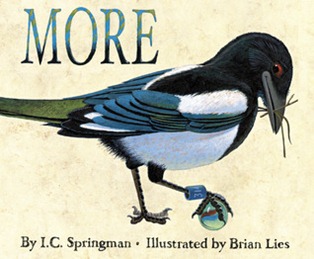
Review: More by I. C. Springman

more

More by I. C. Springman, illustrated by Brian Lies

The book opens with a dejected magpie who has nothing at all.  Then a mouse gives him a marble that he takes to his nest.  Soon the marble is joined by a few other toys.  Then more and more, until there are so many things that the magpie has filled all sorts of nests in the tree with them.  Finally, the magpie adds one little penny to a nest and the branch cracks.  He has much too much now!  Everything tumbles to the ground, burying the poor magpie in his treasures.  The mice appear to dig him free and the pile becomes less and less as they work.  In the end, the magpie selects a few items to keep and lets the rest go, leaving with just enough.

This book is written in very spare language with only a few words per page.  They are all concept words, moving from nothing to everything to enough.  In between, there are terms like more, much, and less.  The dynamic illustrations really carry the story.  The magpie’s facial expressions range from greed to shock to satisfaction, all playing out nicely just in the shine of an eye and the curve of a bill.  Space is also played with in the images, speaking to the freedom of having just enough and the clutter of having too much.

This picture book deals directly with the idea of downsizing or having just enough toys and not too many, something that many children struggle with.  It is also a creative concept book that will work to teach those concepts through humor.  Appropriate for ages 2-4.

Reviewed from library copy.

Review: Falcon by Tim Jessell

falcon

Falcon by Tim Jessell

Told in lush illustrations and verse, this picture book follows the daydreams of a young boy.  A boy in a summer field dreams of being a falcon.  He would fly high in the mountains, along the coast, and roost in the cliffs where he could hear the crashing waves.  He would journey to the city, where he could perch far above the noise and bustle and watch the city from above.  Then he would dive down, faster and faster, towards the sidewalks and the people.  At the very last moment, he would spread his wings and fly above their heads.  The fun he could have, if only he were a falcon.

Told in verse that is spare and lovely, this poetry will work well for a young audience.   The imagery in the poem is directed at that audience.  For example, towards the beginning of the book, this symbolism is used:

With the sound

of tearing paper,

my wings would

slice through

the air.

Immediately, children will hear the sound and realize just how fast that falcon is flying.  It is beautifully, clearly written to great effect.

Combined with this poetry are incredible illustrations that are deep colored and striking.  They range from close-ups of the falcon to long-distance images of the coastline at night.  They are immensely beautiful and captivating as they capture this imaginary life of a falcon.

A radiant picture book about imagination and flight, this book will have young readers dreaming their own daydreams of gliding high above the earth.  Appropriate for ages 4-6.

Reviewed from copy received from Random House.

Review: Seed Magic by Jane Buchanan

seed magic

Seed Magic by Jane Buchanan, illustrated by Charlotte Riley-Webb

Rose and her brothers make fun of the old man who feeds the pigeons all day long from his wheelchair.  When Rose asks him why he likes pigeons so much, he tells her how beautiful they are.  But Rose can’t see it at all; she thinks that gardens are much more lovely than birds.  So Birdman gives her some seeds to put outside her window and grow a garden on her windowsill.  Rose knows that it won’t work, since there’s no dirt for them to grow in, but Birdman is insistent that they will grow a garden on her bare windowsill.  Her brothers make fun of her for even trying, but Rose starts to dream of the incredible flowers that could sprout there.  Then one day, something magical does happen, much to her surprise and delight.

Buchanan’s writing is poetic.  It has a strong rhythmic quality that beats to the heart of the urban setting perfectly.  She plays with imagery, describing the sunflower seeds as “black as tar, slick as oil” as Birdman share them with Rose.  This is a book that speaks to the power of making connections, rather than dismissing those around us.  It is also about beauty and seeing it in the most unlikely places.

The illustrations have a wonderful texture and thickness to them, the paint layered and deep.  Riley-Webb uses plenty of color to depict the urban park: greens, blues, and rich browns.  There is movement to her illustrations from the people, the birds and the gardens.  It is a fresh way to show a city, rather than the cold of concrete.

This book celebrates nature in an urban setting and the sharing of beauty.  Thanks to the rhythm of its writing, it’s a great read-aloud as well.  Appropriate for ages 4-7.

Reviewed from copy received from Peachtree Publishers.