Review: Little Bird by Germano Zullo

little bird

Little Bird by Germano Zullo, illustrated by Albertine

Released April 1, 2012.

Winner of the 2011 Prix Sorcieres for illustration, the French Caldecott medal, this book is an impressive example of the magic of illustration and only a few select words.  A man drives his red truck up to the edge of a cliff and opens the back, releasing several amazing birds.  When he glances into the truck, he sees one bird left behind.  The man tries to tell the bird where to head and that it should fly, but the bird just looks at him.  The two sit together and the man shares his sandwich with the little bird.  The man shows the bird again where to head and how to fly, landing on his face.  The bird spreads its wings and flies away, joining the other birds the man had let go.  The man watches the bird fly off, heads back into his truck and drives off.  What seems like the end of the story is actually just the beginning.

Zullo has chosen his words carefully, letting the story really be told via the illustrations.  The words offer a touch of guidance to the depth of the work, the deeper meaning of the simple story.  They speak to the importance of noticing small things and how those small things are the true treasures in life.  It’s a message that will speak to children and adults alike, in very different ways.

Albertine’s art is wonderfully bright and filled with playful moments.  From the sunny yellow ground, the robin’s egg blue sky and the red truck, there is plenty of zing in these pictures.  As the story is told in the illustrations, the relationship between bird and man is also shown just in pictures.  The looks, the moments of connection, the departure, all add up to moments that lead to the magical conclusion.

An impressive picture book that is modern, fresh and will have readers looking for tiny treasures in their lives too.  Appropriate for ages 5-adult.

Reviewed from copy received from Enchanted Lion Books.

Review: Up, Tall and High by Ethan Long

up tall and high

Up, Tall and High by Ethan Long

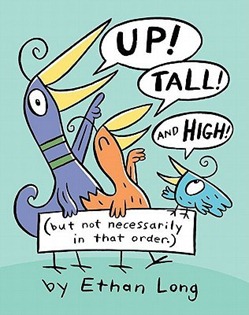
A group of birds talk about who is tall, who is high in the air, and who is up in a tree in a series of very short chapters.  Birds compare their height by insisting that they are the tall one.  The ending of that story comes with a short bird who is definitely not small.  The high in the air story is about a bird who can fly and a penguin who can’t, but a solution is found.  Up in a tree is a story about a little bird who is up in a tree and a larger bird who decides to join him there.  Each of the stories is short, clever and has a lot of humor.

The book is endearingly simple with bold lines and bright colors.  There are only a few words per page and many pages have no words at all.  Definitely designed with toddlers in mind, these three short stories are filled with a cheerful attitude.

Ideal for small children, these are stories that have the color, friendliness and humor to be a hit.  Appropriate for ages 1-3.

Reviewed from copy received from Penguin Group.

Review: George Flies South by Simon James

george flies south

George Flies South by Simon James

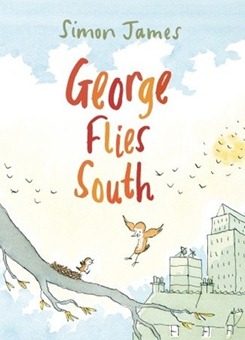
Winter was coming, but George was not quite ready to try to fly yet.  George waited for his mother to return with some worms, when a gust of wind picked up his nest and carried the nest and George into the air!  The nest landed softly on the top of a car, which promptly started driving with George’s mother chasing behind.  The nest flew off the car and then landed on a boat.  From there, George and the nest were lifted high up into a tall building that was being constructed.  George slept safely up in the building until he was awoken by a pouncing cat.  Now George was falling without his nest and without knowing how to fly! 

James has written a story that feels very familiar but has its own personal twists.  The combination of the baby bird and his nest traveling through a city together makes this all the more charming.  Add in the appeal of different kinds of transportation, the thrill of the chase, and the daring high building, and you have a book that will appeal to the wiggliest of preschoolers.  The need to learn a new skill under pressure will also be something that will appeal to this age group.

James’ illustrations are done in ink and watercolor.  They have fine lines, washes of color, and a wonderful feel of motion throughout.  They add much to the cheery story.

A great pick for autumn story times, this book will have children cheering George along and seeing that they too are capable of much more than they may think they are.  Appropriate for ages 3-5.

Reviewed from library copy.

Review: Tom’s Tweet by Jill Esbaum

toms tweet

Tom’s Tweet by Jill Esbaum, illustrated by Dan Santat

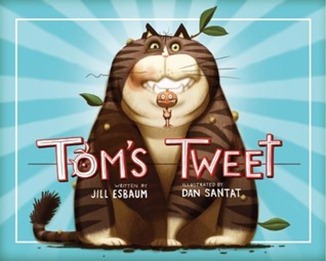
Tom the cat is on the hunt after a storm when he spots a baby bird on the ground.  But the Tweet is so little and scrawny that it won’t amount to much, so Tom turns away.  But the little bird looks so helpless and alone, that Tom decides to help despite his misgivings.  Tom heads up the tree to return the Tweet to its nest, carrying it in his mouth.  But then the mother bird sees him and she attacks!  Tom has to flee with the Tweet.  After that, he has to figure out how to give it a home.  And (gulp) feed it too.  Tom finally finds a way to get the Tweet back to its nest, but he can’t get it out of his head.   What is a cat to do when he misses a bird?!

Esbaum’s rhymes romp along, and they work well for the most part.  The rhythm is even better, galloping along and creating a brisk pace for the story.  The infectious rhythm makes reading the book aloud great fun.  In fact, I think it reads aloud better than it reads silently.  The story is filled with humor, from Tom’s expressions of “tarnation” and “dadburn it” to the scene where he feeds the little Tweet.

Santat’s illustrations are what take this book to another level.  While the story is funny on its own, it becomes wildly silly with his art.  With its computer smooth feel, it looks as if it was taken right off of a Pixar movie screen.  Children will respond naturally to the style and then enjoy it even more thanks to the humor embedded in it.

Very funny, this picture book will be enjoyed by children looking for a silly read with plenty of heart.  Appropriate for ages 4-7.

Reviewed from copy received from Alfred A. Knopf.

Review: The Parrot Tico Tango by Anna Witte

parrot tico tango

The Parrot Tico Tango by Anna Witte

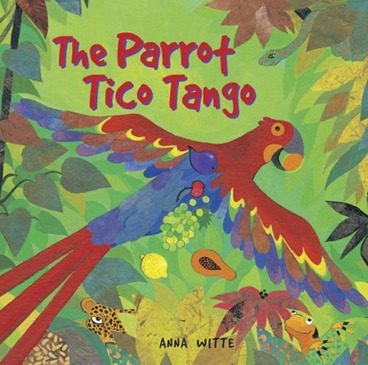
Parrot Tico Tango is a naughty bird!  He has his own mango, but as he soars through the jungle, he steals fruit from other animals.  There is the sloth’s lemon, the monkey’s fig, the snake’s cherry, the frog’s grapes and more.  Eventually, it gets to be too much to carry and he crashes.  Now Tico Tango is left with nothing, not even his own mango.  But the others offered him a slice of mango in exchange for him dancing the tango.  And dance he did!

This is a colorful book that merrily teaches colors and fruits along the way.  The rhyme is jazzy and great fun to read aloud.  The text is written in a cumulative style, so each new fruit is added to the list that is repeated with each new addition.  This adds a lot of style and emphasizes the greed of Tico Tango.  While the book teaches colors, what it would work best for in a classroom is a discussion of adjectives.  Each new fruit is talked about in detailed adjectives that are used in different sentence structures.  It would make a very approachable and fun lesson.

Witte’s art is bright and bold, a winning combination of collage and paint.  The animals themselves are bright colored, especially Tico Tango who lights up each page in his own rainbow of colors.  The fruit also adds a lot of color and then it all pops against the green of jungle and the varying colors of the sky.

This is a simple book that will be enjoyed by toddlers learning their colors on one level and then by elementary students learning adjectives on another.  Appropriate for ages 2-6.

Reviewed from copy received from Barefoot Books.

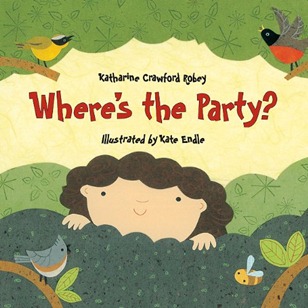
Review: Where’s the Party? by Katharine Crawford Robey

wheres the party

Where’s the Party? by Katharine Crawford Robey, illustrated by Kate Endle

When Kate wakes up, a robin is sitting on her windowsill and sings about “news!”  Then a cardinal whistles about a party.  Kate definitely wants to go!  So she heads outside and follows one bird to the next as they lead her along a path, to the wild strawberries, along the brook, and to the duck’s nest.  Finally, she arrives at the party, and it’s a very special one!  The birds in the story include a titmouse, meadowlark, yellowthroat, oriole, bluebird, heron, ducks, and killdeer.  

Robey’s text is just enough to keep the story moving.  The calls of the birds are translated into words that help Kate find the party.  Nicely, the birds are not humanized except for their calls being heard as words.  They are described with their markings and some of their habits.  The end pages include some more details on the species in the book.

Endle’s illustrations are done in collage and are filled with texture, pattern, and color.  The cut paper gives clean lines that work well with the natural setting and birds.  There is a simplicity thanks to the medium used that keeps this book very friendly to the youngest readers.

A great pick for young birdwatchers or for units about birds.  The illustrations are clear and crisp and will work well with a group, so this will also make a good choice for summer story times.  Appropriate for ages 3-5.

Reviewed from copy received from Charlesbridge.

Arctic Board Books

ArcticLand ArcticSea ArcticSky

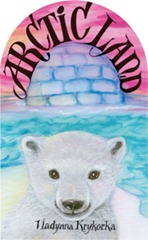
Arctic Land

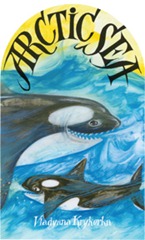
Arctic Sea

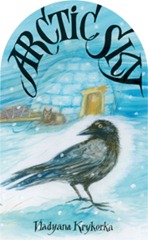
Arctic Sky

Author Vladyana Krykorka has created three board books that each look at a different aspect of wildlife in the Arctic.  The books are done in accordion style, so they spread out across laps or tables, creating even more of a vista of the Arctic landscape.  Arctic Land features caribou, wolves, musk ox, Arctic hare and polar bears.  Arctic Sea has whales, seals, narwhal, and walrus.  Arctic sky is filled with swan, crane, raven, ptarmigan, loons, and owls. 

There is a short verse that ties the animals together, but the real beauty here are the illustrations.  Done in watercolor, they have a movement that is captivating.  The long line of animals when the book is fully open is beautiful, filled with color and creatures.

While this book’s format may not survive long in public libraries, it will make a charming and education gift for a tiny naturalist.  Appropriate for ages 1-3.

Reviewed from copies received from Annick Press.

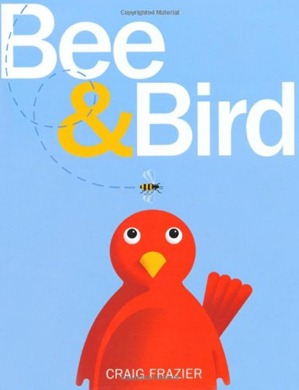
Book Review: Bee & Bird by Craig Frazier

beebird

Bee & Bird by Craig Frazier

A simple wordless story is made remarkable by bright, graphic illustrations.  This is the story of a bee and a bird and their journey, but what journey are they on?  They are in a tree, the tree is on a truck, and then could the truck be driving on the back of a cow?  Then there’s a boat on an ocean, that is actually a toy boat.  As perspectives shift, the epic adventure becomes more of a neighborhood jaunt.  It’s a trip that readers will happily make with the pair, finding surprises at almost every page turn.

Frazier, author of the wonderful Lots of Dots, has created another great book for children.  His vibrant illustrations use bold colors, strong shapes, and inventive perspectives to turn a normal day into a series of surprising twists.

Art teachers will embrace this book for its clear depiction of perspective.  At the same time, it is also a rocking picture book that young readers will equally enjoy.  Appropriate for ages 3-6, older when used to discuss perspective.

Reviewed from copy received from Roaring Brook Press.

Also reviewed by

Check out the book trailer for some of those perspective shifts:

Book Review: Loon Baby by Molly Beth Griffin

loonbaby

Loon Baby by Molly Beth Griffin, illustrated by Anne Hunter

Loon Baby lives happily with his mother in the northern woods.  His mother dives under the water for Baby’s dinner but he is too little to follow her underwater.  Loon Baby waited, floating and paddling.  At first he is sure that his mother will return just as she always had.  But she stays away and he begins to wonder if something has happened to her.  He tries to dive down into the water, but keeps bobbing back to the surface.  After diving so many times, Loon Baby can’t remember where home is anymore.  Everything looks the same to him on the banks of the pond.  Loon Baby has had enough and wails a cry that wavers and sinks.  His mother pops up by his side, his dinner in her mouth.  In his happiness, Loon Baby dives deep into the water, discovering that he can indeed dive just like his mother.

Griffin tells this story in prose that reads like poetry.  It is spare, simple and ideal for young children.  The story speaks to the panic a lost child can feel when their mother disappears, gently guiding children to the parallels between Loon Baby and themselves. 

Hunter’s illustrations are a lovely mix of watercolors and lines that crosshatch and offer details.  The green and blue colors evoke the northern woods.  Pulling back to a larger view, they emphasize the lone Loon Baby as he seeks his mother. 

A lovely book for preschoolers about being lost and being found again.  Appropriate for ages 3-5.

Reviewed from library copy.

Also reviewed by Katie’s (Little Ones) Learning Lounge.