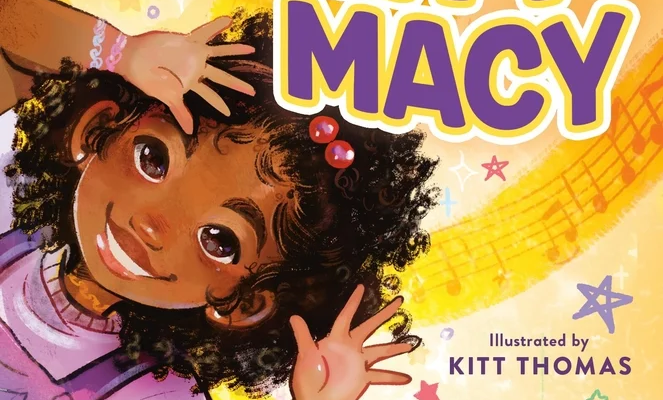
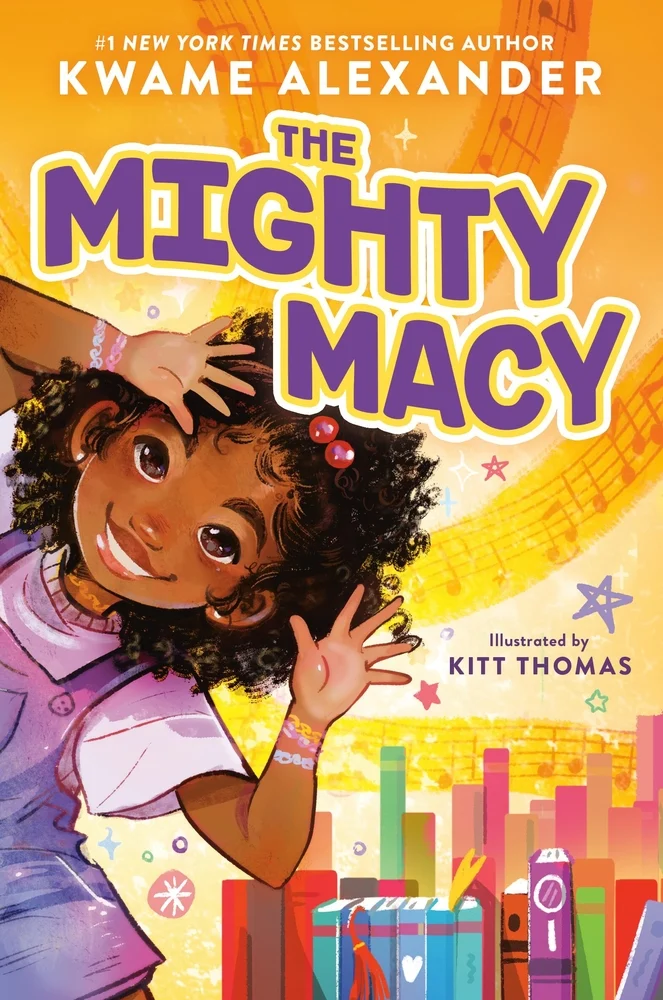
The Mighty Macy by Kwame Alexander, illustrated by Kitt Thomas
Publisher: Little, Brown Books for Young Readers
Publication Date: February 3, 2026
Reviewed from library copy
ISBN: 9780316442169
When Macy gets the first book in the Mighty Zora series for her birthday, she stays up late reading. The next day, she rushes to the school library to get the second book in the series. But the school library is closed due to budget cuts. Now the school library will only be open two days a week instead of all week long. Macy has to figure out how to save the school library while also learning her minuet for her violin concert. It’s all happening at once, but with help from her poet father, her pancake-providing mother and her friends she might just get it all done.
Alexander is a virtuoso of children’s literature. He writes with such warmth here of Macy, a little girl filled with the drive to speak up and finding the courage to do so. Alexander demonstrates that children have a place in social justice work and giving them a voice in processes is vital to making change happen. Written primarily in verse, this book is approachable for readers newer to chapter books. The illustrations add to the joy of the book, sharing Macy’s life and family.
A great new chapter book that speaks up about taking action.
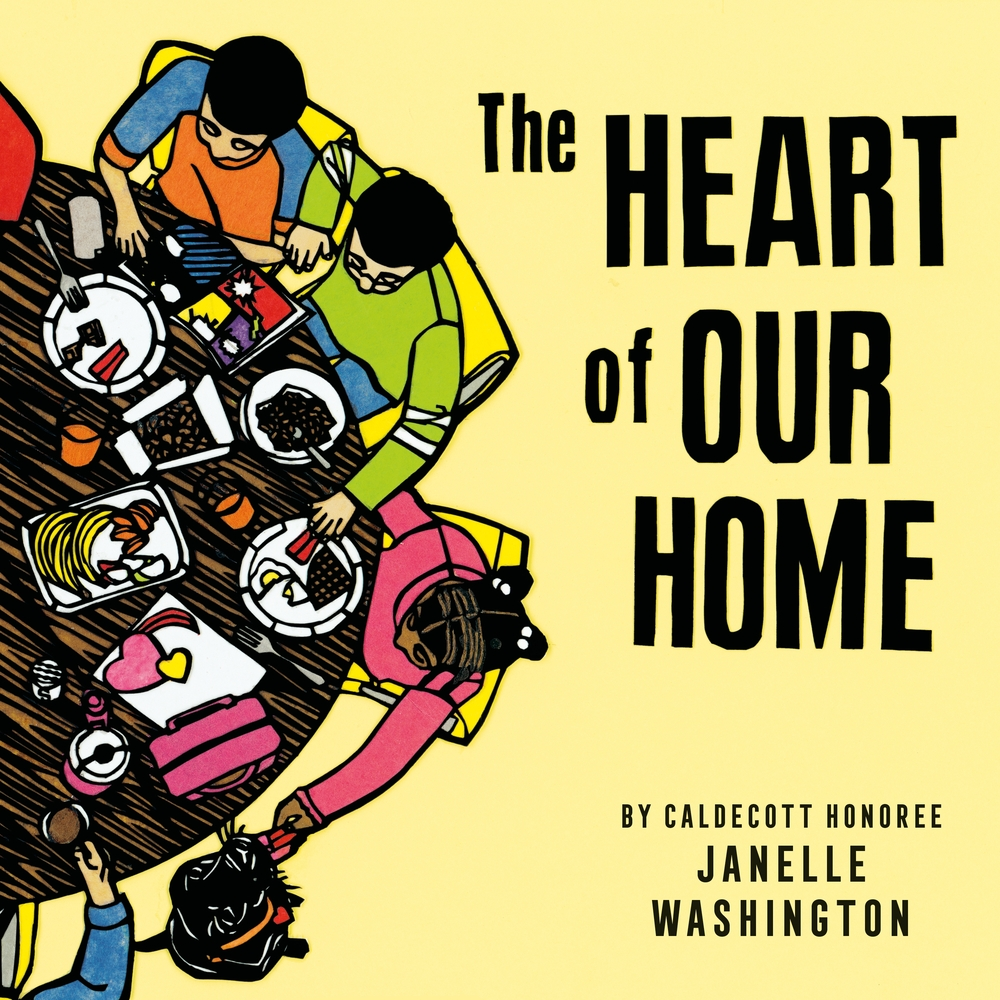
Gather around the kitchen table in this tribute to the room that is at the center of a Black American family. Morning starts with breakfast at the table. After school it is card games and baking treats. Dinnertime comes with setting the table more formally. It’s a place to spend time and be creative. A place to clean fish for the weekly fish fry. It’s a place for serious talks if someone gets in trouble. Friends are welcome at the table and many family celebrations happen there. On wash day, the table holds hair clips and bands right at hand. It’s a place to listen to grandparents and celebrate ancestors. A place to grieve when needed. A kitchen table is so many things to a family.
Washington offers a poetic look at a specific family gathering around their kitchen table. I love how she incorporates elements that are specific to the Black experience, such as wash day and Kwanzaa while also offering many experiences that are universal: meals, celebrations, grief. Her poetic lines capture the dance of the days and the full lives of families. As a Caldecott honoree, her art is exceptional. Using cut paper, she creates art that feels almost like stained glass. Yet the lines also manage to beautifully capture the emotions on her character’s faces.
Welcome to the kitchen table. Appropriate for ages 4-7.
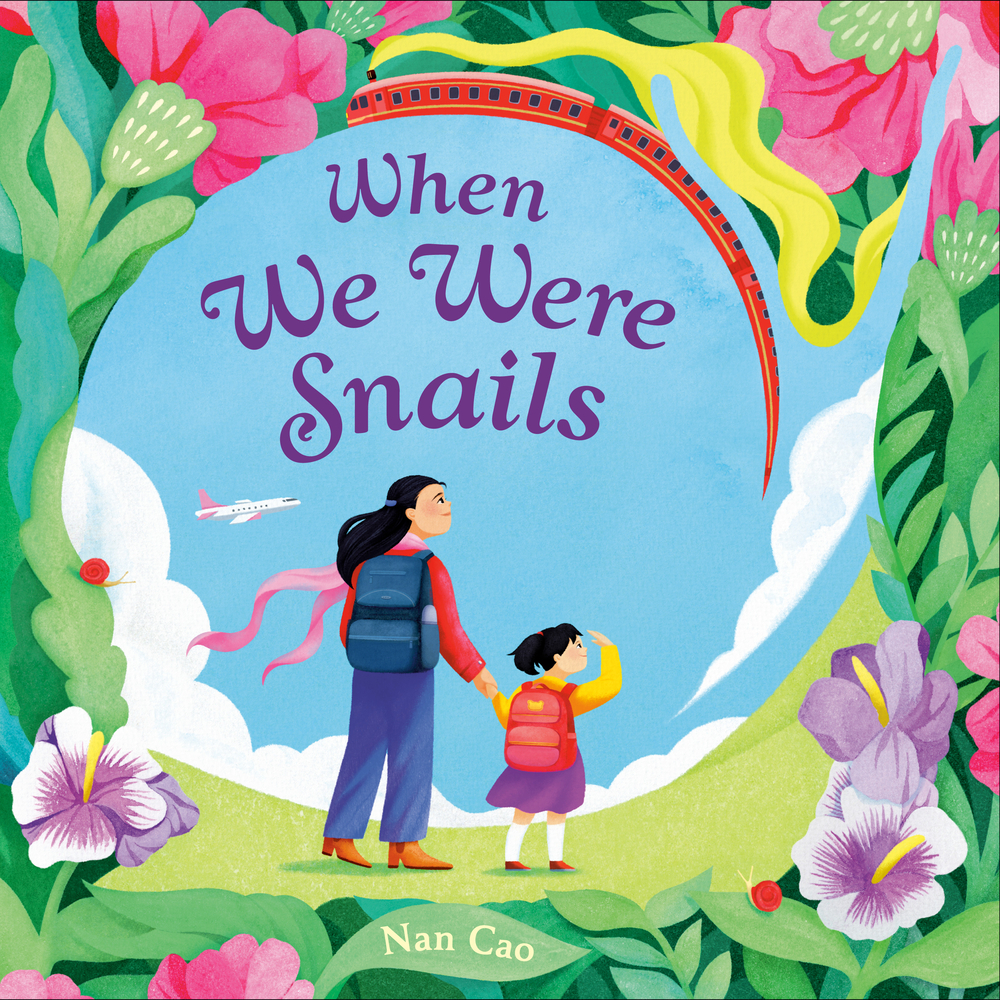
A little girl has grown up traveling with her mother from place to place. They were like snails, carrying their homes on their backs through their adventures. But then one day, her mother has to take a job in a bigger city and leaves the girl with her grandparents. The little girl missed her mother terribly, especially when she wasn’t able to come home as she had promised. When her mother finally came home again, it was wonderful. But then her mother had to go away for another job. This time though, the girl got to come too. They continued moving from place to place, new school to new school, together.
Cao captures the emotions of a child having to be left behind by a beloved single parent. Though her grandparents are loving and kind, it’s not the same. The emotions that Cao shares so beautifully on the page will resonate with children who may not have cried even though their feelings were deep and tragic. Children who have grown up in families that move a lot will find themselves reflected here with warmth. The illustrations are filled with art and family, sharing the coldness of being left and the flexibility of moving often through lines and structure.
A charming look at an adventurous life. Appropriate for ages 4-6.
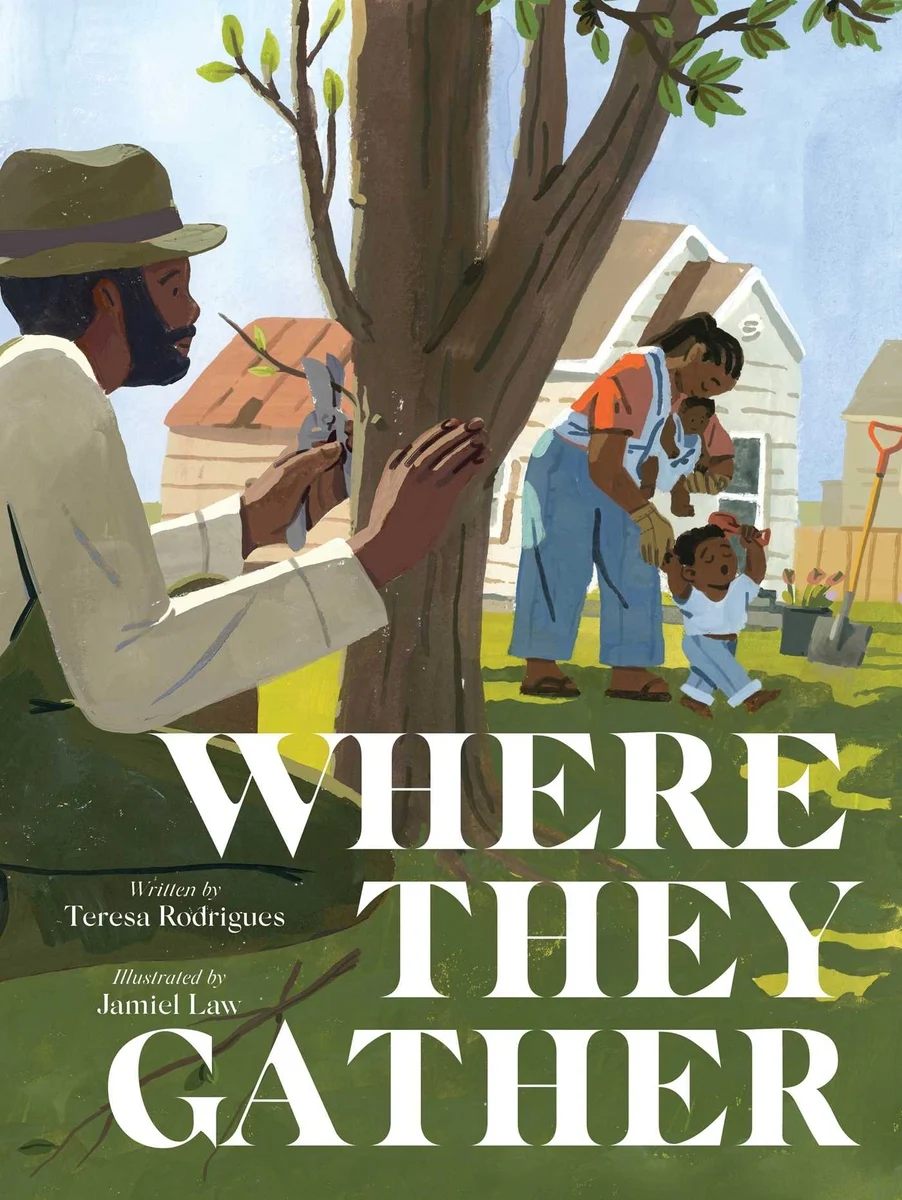
This is the poetic story of a family that built a home after Emancipation. On that land they planted roots themselves and also planted a pecan tree. That tree was the place they gathered in times of joy like playing together as children and at weddings. In autumn, the tree provided pecans to eat and sell. But times were not always happy. The tree was damaged, just like the family it sheltered. And just like that family, the tree regrew. The house was rebuilt and the family spoke up for change. They still gather under that tree, the symbol of them rising again.
Rodriguez and Law use both poetry and illustrations to fully tell the story of the family and its tree. The poetry is kept spare and clear, sharing a focus on seasons and resilience against them. Meanwhile, as the seasons change in the illustrations so do the lives of the family. Winter in the illustrations comes with a fire set on purpose and the loss of the grandfather in the family as well as the house. Then comes political action, marching for civil rights and new hope for the land and its people. Very powerfully posed together.
A powerful look at resilience, civil rights and the Black American experience.
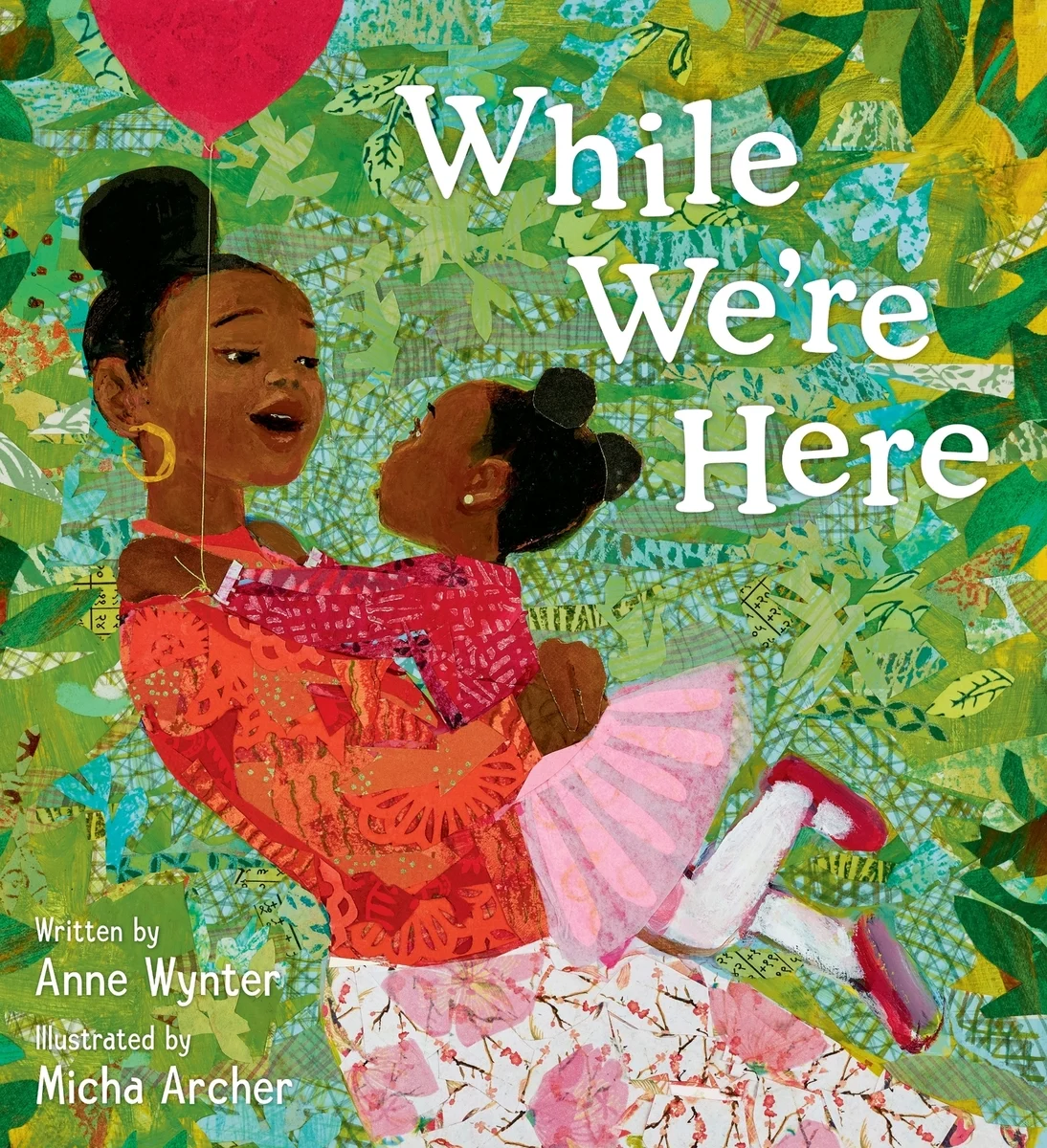
A mother and daughter hurry to get their jackets on and catch the train. Along the way a shoe is lost and found again. They reach a large park and head to where they need to be. But when they get there, the party was yesterday! Now they have lots of time, and while they are in the park why not roll down some hills, stroll past the pond, walk the trails, and sit under the trees together. They have nowhere else to be.
Written in brief and bouncy pairs of lines, this picture book is incredibly inviting for the youngest readers. I love the mistake at the center of the book and while it is disappointing to miss a party, the book emphasizes that this sudden treasure of time is not to be wasted but savored together. The illustrations by Archer are done in inks, layered paper and handstamped papers. She uses paper like paint, offering detailed textures that invite readers to slow down and look more closely.
A book worth spending extra time with. Appropriate for ages 2-4.
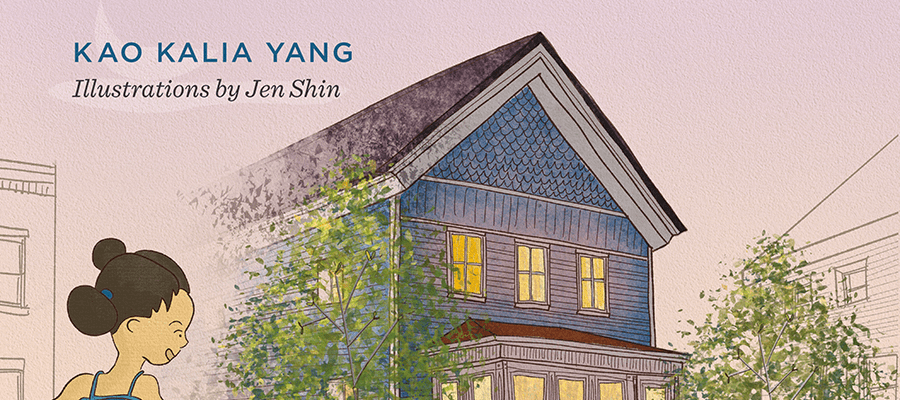
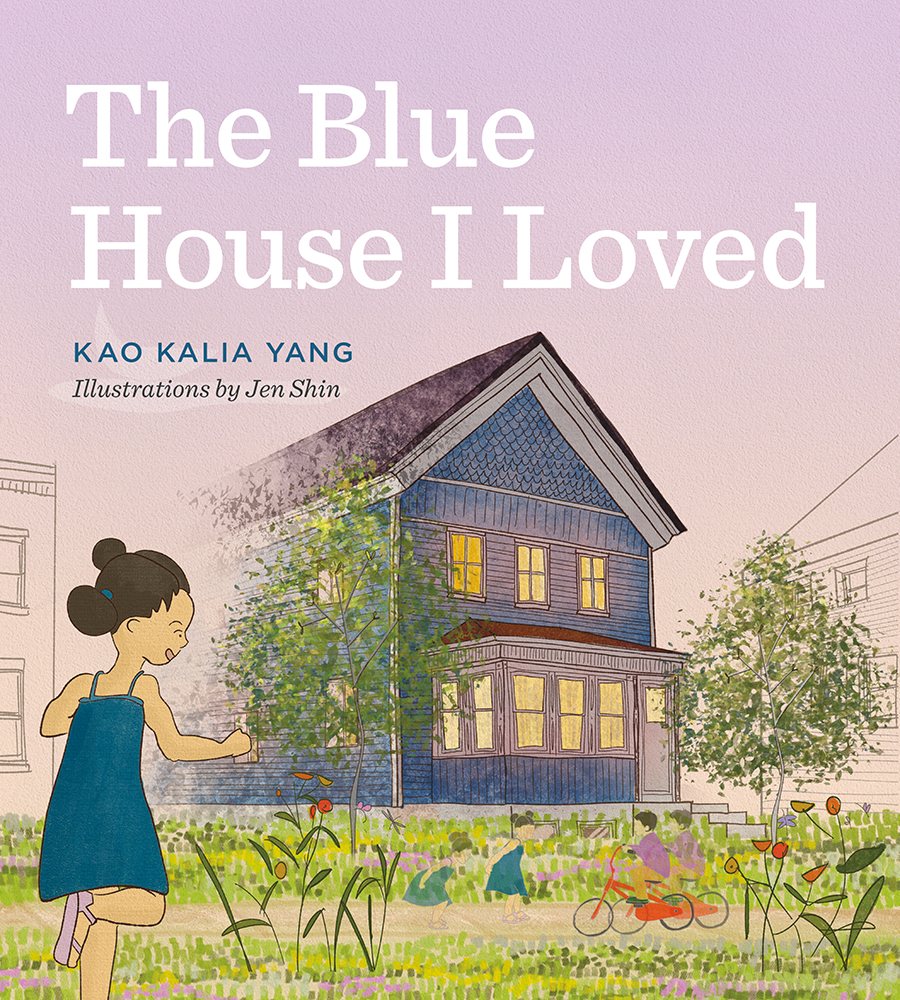
In St. Paul, Minnesota, there was a blue house that was loved. The two-story house was a duplex where the first floor was rented to Hmong refugees. The house was rented by the narrator’s aunt and uncle and was not big enough for their family. Two cousins had to sleep on the unheated porch where their wet hair froze in the winter. The bedrooms were filled with others, sleeping three and four to a room. The narrator’s favorite place was the back porch where her aunt breastfed the baby and the cousins played and fought. It was the place they learned about their new country while also keeping Hmong traditions close. It was a special house filled with memories.
As always, Yang’s writing is a gorgeous combination of frankness and found beauty. Her ability to paint a vivid picture of the house using small details bring the entire book to life. It’s those small moments that make a life, a house and a family and the book shows that so touchingly. Yang also speaks to the importance of a home for a refugee family newly in America and what it meant to have the space however crowded and cramped. Shin’s art is a lovely mix of architecture and people, showing both the house and the family with clarity and joy.
A journey into refugee memory. Appropriate for ages 4-8.
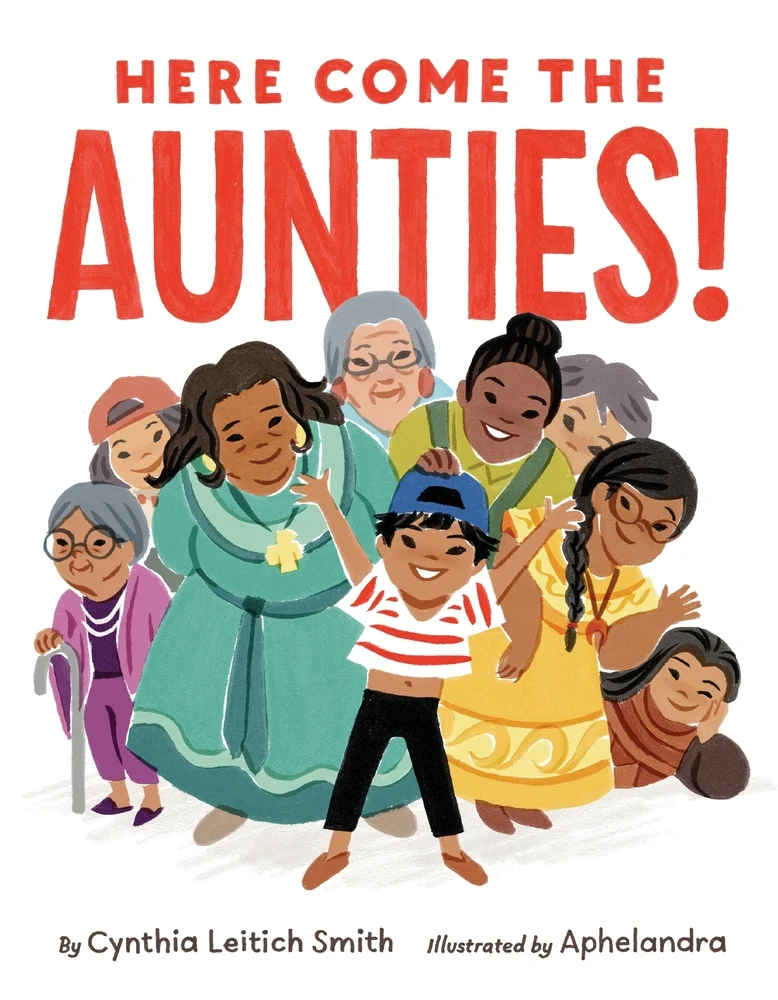
River is Muscogee and lives on a reservation in Oklahoma. He has many aunties who appear throughout the year. Using repeating language to introduce each auntie, the book celebrates the skills and efforts of each of them. Auntie Abby helps with planting the garden. Auntie Meg takes River fishing for catfish. Auntie Dana brings pumpkins in the fall. Auntie Patrice teaches beading. Other aunties share Muscogee history and traditions or teach in school. As River welcomes his new little sister, he knows first that the aunties are coming!
Smith captures the beauty of community in this picture book about living on a reservation where not only Native people live but others of different backgrounds, all of whom can be aunties. In her Author Note, she explains that aunties can be relatives but don’t have to be. Aphelandra’s illustrations are done in ink, gouache and PhotoShop. They are a delightful mix of deep rich paint, cleverly drawn faces and incredible warmth.
A joyous look at Muscogee community. Appropriate for ages 3-6.
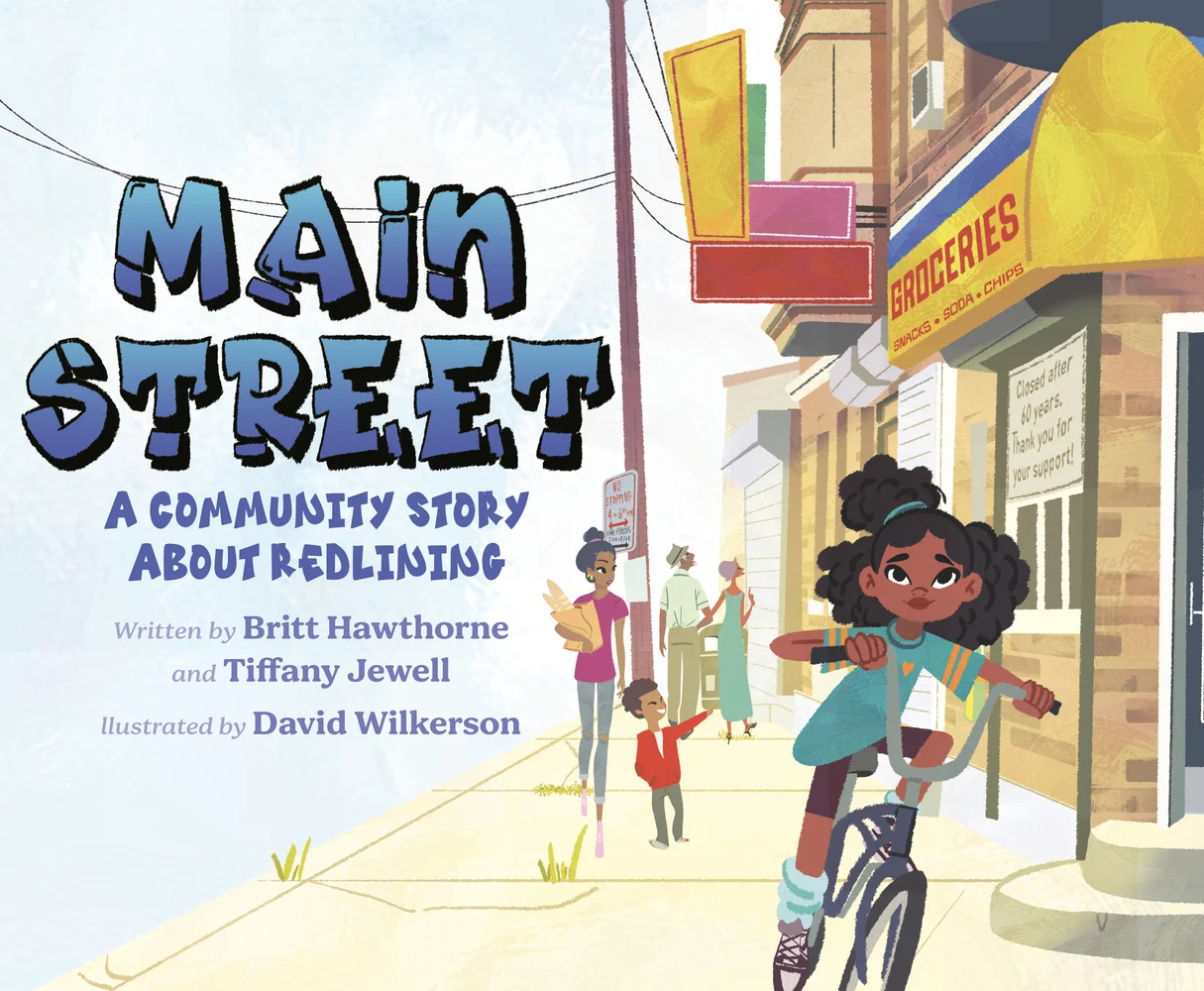
Olivia tries to invite her friends to her neighborhood block party, but one girl explains that her mother doesn’t think Main Street is safe. Olivia tells her mother about what happened and then watches as the neighborhood they are driving through changes from large homes to the tighter urban Main Street neighborhood. When she explains to a neighbor that she doesn’t want to live there any more, Ms. Effie tells her that the first time she heard that Main Street wasn’t a good neighborhood was when the bank refused their mortgage. The Black neighborhood banded together, people got second jobs, and everyone learned how to save. Ms. Effie shared a map of the city with red lines around the “rough” neighborhoods and blue and green in the wealthier white neighborhoods. Through the conversation Olivia learned that it’s important not to believe what people say and to celebrate her community.
I haven’t seen any other picture book take on the subject of redlining, a process that devalues Black neighborhoods and impacts overall investment in them. Here the subject is explained in a way that young children will understand, both in fear of the dangers of those neighborhoods and in a celebration of the community that continues. The facts about redlining are shared openly and clearly. The illustrations help emphasize what lack of investment does and also how vibrant a community can be despite those systemic abuses.
A look at a complex socio-economic process in a way children can comprehend. Appropriate for ages 5-8.
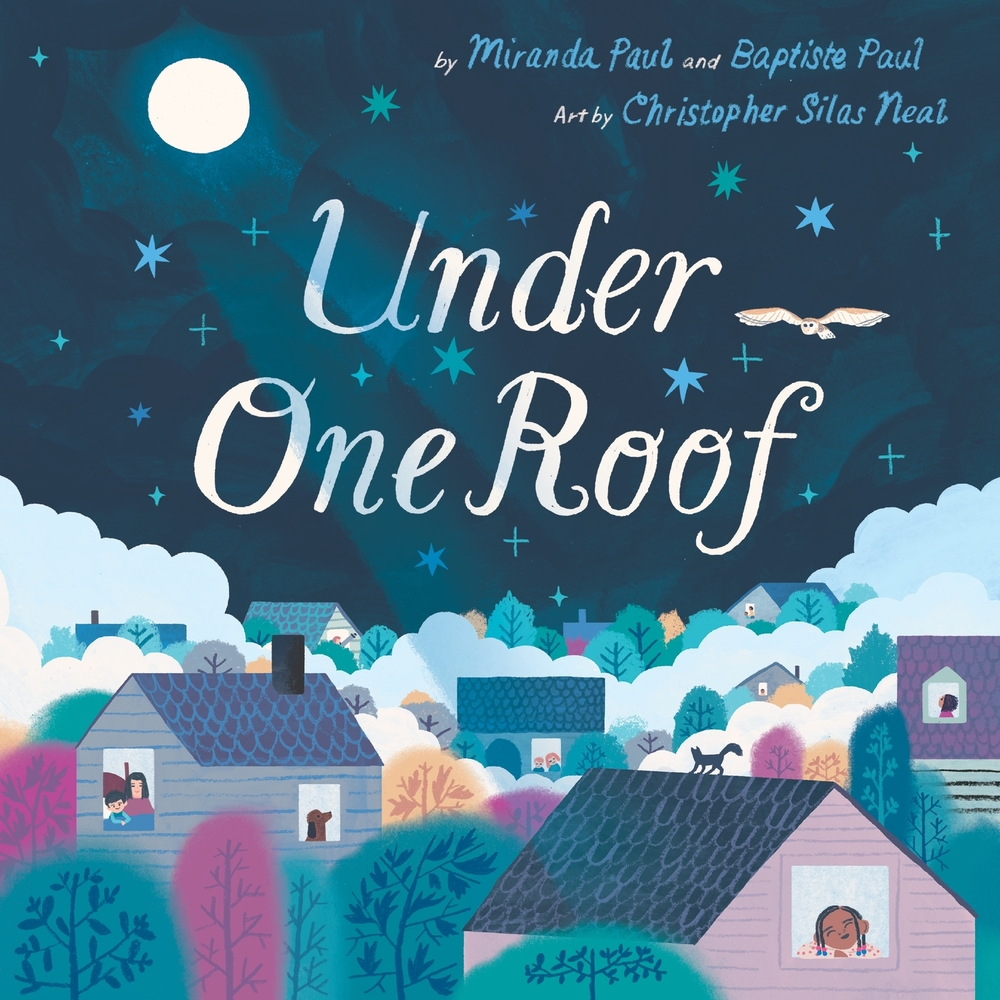
Under One Roof by Miranda Paul and Baptiste Paul, illustrated by Christopher Silas Neal
Publisher: Clarion Books
Publication Date: February 3, 2026
Reviewed from Edelweiss e-galley
ISBN: 9780358576594
Told in rhyming couplets, this picture book celebrates all sorts of families and how they get ready for bedtime. Everyone falls asleep under the same roof of night sky, stars and moon. Some families are all together, others are snuggling in pillow forts at grandma’s, some live far apart or have family members who have died. Some stay connected via phones, others via letters. Some had to leave their homes because of storms, others camp outdoors. Some greet new babies, others sleep in their cars. Through it all, the sky remains the roof they are all beneath.
The writing is very inviting with the rhymes serving as a way to tie all the diverse families together into one story. The use of the image of the sky as a comforting roof above all is also very nicely kept as a focus throughout the story. The result is a book filled with warmth and inclusivity. The illustrations echo that same feel as they show diverse families, large and small, nuclear and otherwise experiencing a variety of homes and beds. In their author’s and illustrator’s notes, the creators share their own life experiences moving and changing where they sleep.
The perfect bedtime read for those who travel and those who stay. Appropriate for ages 2-5.
Naomi has been returned to her biological family after living until recently with the woman she thought was her mother but who actually abducted her. Her family calls her by a different name and adjustment has been rocky. That’s why they decide to take a long summer vacation together in the Shenandoah Valley. However, the town they are near used to be a Sundown town and still holds some of the same beliefs about Black people living there. Naomi starts seeing a young Black girl outside her window who suddenly bursts into flames. As Naomi learns more about the history of the region, she realizes that it may not just be girls from the past who are in danger there.
Incredibly gripping and tense, this is a layered thriller for teens that speaks directly to the Black experience in sundown towns across the country. It also looks at how girls are exploited and ignored on multiple levels, becoming missing girls. Naomi is a great protagonist, strong and resilient while still struggling with her past and her current situation. Her messy relationship with her family is shown with empathy and honesty, adding to the questions of what is due to previous trauma and what is real.
A dark thriller full of personal trauma, history and ghosts.
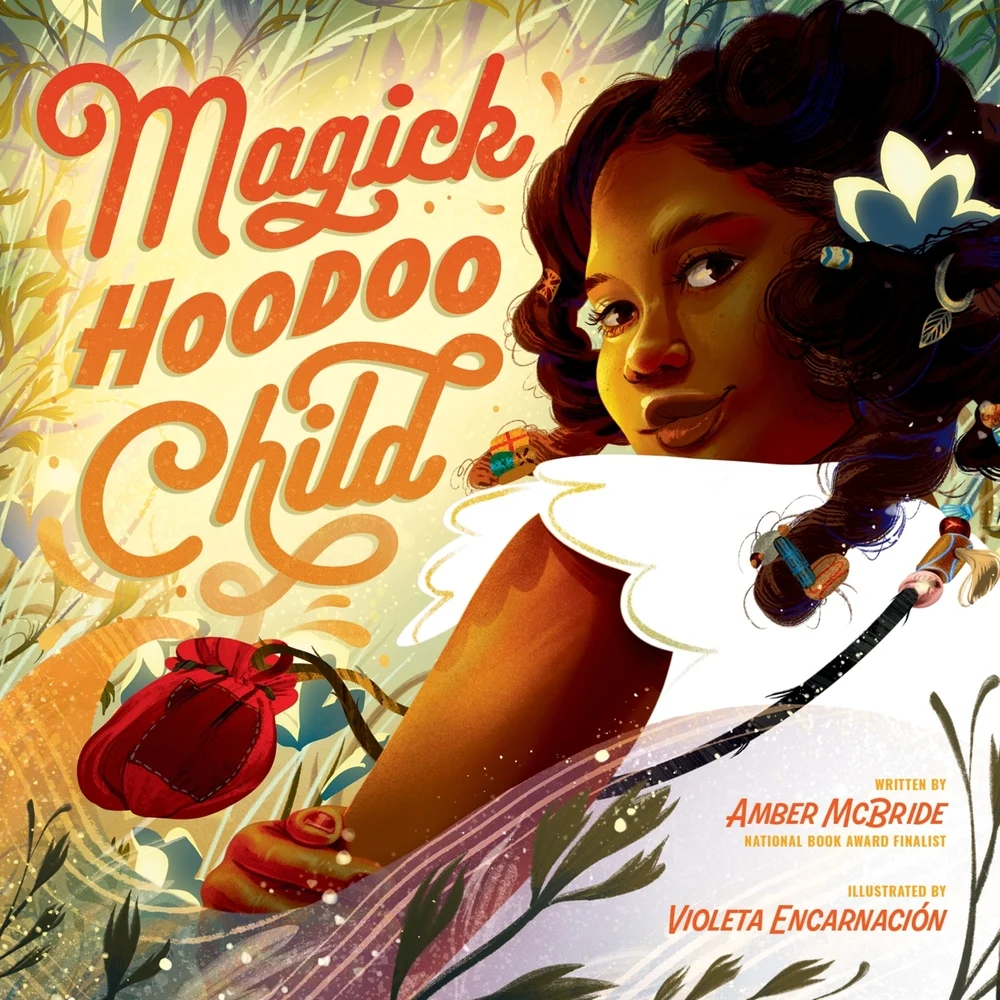
At school, she is bullied, called names. Luckily, in the summer she can journey to her grandmother’s home. She brings empty mason jars collected through the year and flip-flops though she will be barefoot all summer. When they arrive, she announces to her grandmother that they have to fix her mojo bag. Her grandmother is thrilled. As they have lunch, her grandmother tells her about magick and how hoodoo came from Africa through the enslaved people. The two work together all summer, doing rootwork together, making mojo bags stuffed with herbs, working in the garden, going for long walks. At the end of the summer, the mason jars are full and her mojo bag is replenished stronger than before.
This is award-winning McBride’s first picture book and it’s lovely. Working within the restraint required for picture books, she manages to create an entire world of hoodoo and magick that celebrates ancestral knowledge and connection with nature. Her text is inviting and powerful and at the end of the book she offers small ways that readers can connect with nature themselves. The illustrations are dynamic and beautiful, celebrating connection just as much as the text does with closeness, pages filled with plants, and familial love.
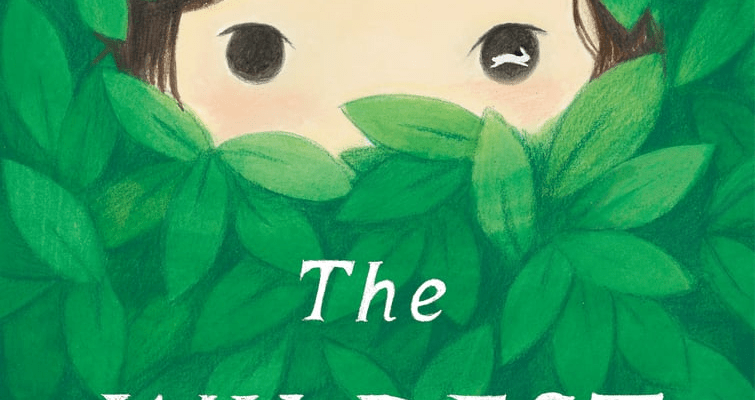
Eleanor loves wild things, all sorts of animals and plants. One night when she goes to bed, she awakens to discover that the wildness has entered her house. Amid the animals, she continues to live her regular life. She has breakfast from her favorite bowl has squirrels and rabbits fill the kitchen. She eats at the couch, which is actually a slumbering bear. She draws on the walls and floor, filling the blankness with butterflies, flowers and more. With her new friends, they play together until Eleanor sees herself as a wild thing too.
There is such a gentleness to this picture book with its fine-lined illustrations that show a small girl letting herself be as wild as she wants to be. The connection with nature is palpable as Eleanor spends time outside. When that is brought into the house it is merry and often silly, giving space to that sort of wildness in indoor life too. In what might be a dream of wildness, the book embraces nature and animals and how being with them can be inspiring too.
A dreamy look at letting loose and connecting with nature. Appropriate for ages 3-6.
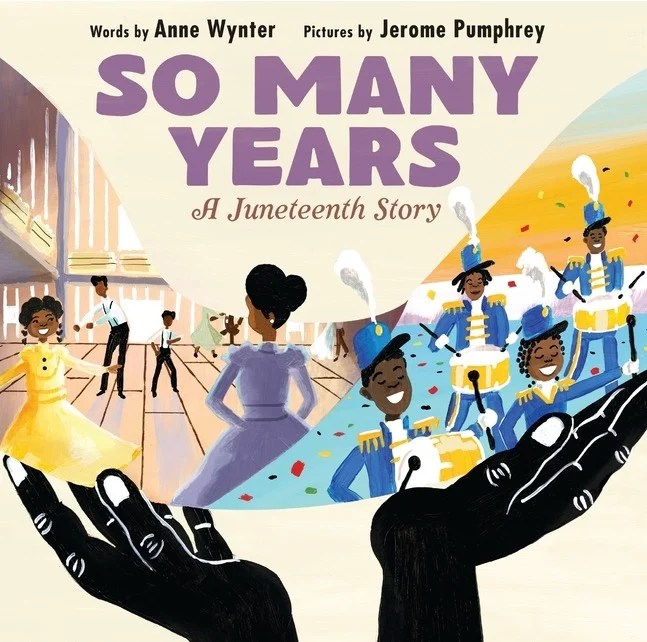
This joyous and lyrical picture book celebrates the Juneteenth holiday by looking back at the enslavement of the Black-American people and the expression that came afterwards. What would you wear if you’d only been able to wear rags? How would you sing if you had only been able to sing in code? How would you eat if you’d only had scraps? The questions show the devastation and deprivation of those enslaved, the lasting impact of that on the generations that followed. And somehow, out of that came fashion and music and feasts and more. That transformative spirit is what is embraced here in such simple words.
So many Juneteenth books are for older children and cannot be shared aloud easily. This picture book calls to be read aloud to celebrate the holiday, inviting joy in what has been overcome and delighting in the new expression that came out of it. Wynter does an incredible job of taking complex issues and transforming them into something that children can understand and talk more about. She doesn’t oversimplify and lose the darkness either. It’s an incredibly difficult line to walk and she does it with such confidence and skill. The illustrations are done in acrylic on boards and Photoshop, hearkening to the past with black and white pieces that contrast with bright colors in other parts of the page.
A great Juneteenth read that belongs in every library. Appropriate for ages 4-7.
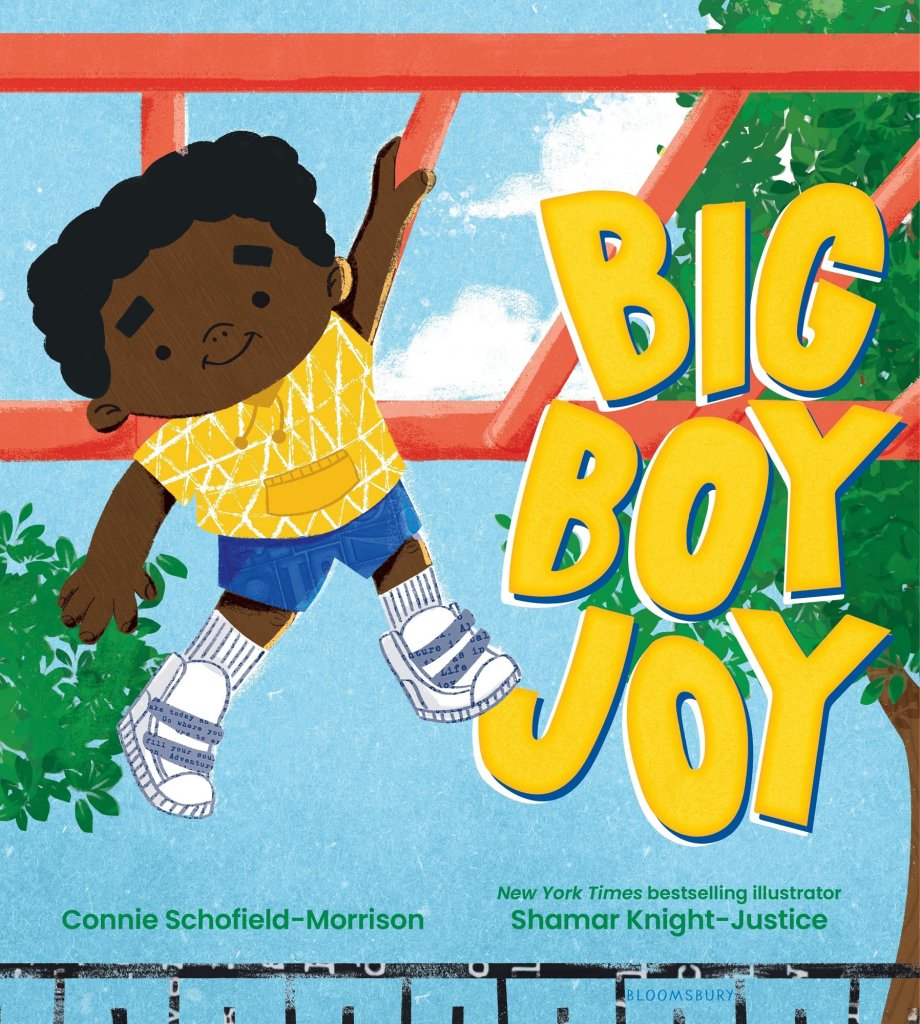
Big Boy Joy by Connie Schofield-Morrison, illustrated by Shamar Knight-Justice (9781547611515)
A little boy visits a park and has a great time playing. Told with plenty of action words, he climbs and slides on the equipment. Then crashes into another child. Soon the two are sharing toys and playing with dinosaurs together. There’s another crash when the boy heads to the sandbox and a tire falls off a toy truck. But no worries, he can fix it himself. A snack is next, then some playing on the swings, some water play. It’s time to go home. A look at what a small child can expect when heading to a park told in a merry noisy and action-filled way that is sure to please. The Black characters and creators lean into the joy of a day of play.
Appropriate for ages 2-4.
Reviewed from e-galley provided by Bloomsbury Children’s Books.
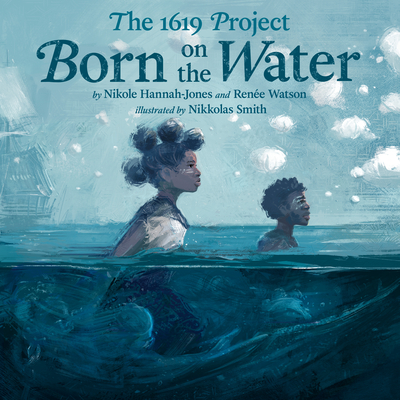
This picture book forms a way for younger children to benefit from the information shared in The 1619 Project. In this story, a Black girl is given an assignment in class to trace her family history. She can only trace three generations back and tells her grandmother that she is ashamed. So her grandmother shares the history of her family before slavery when they lived in West Central Africa. Her family spoke Kimbundu and were good with their hands and used them for growing things, inventing, mixing herbs, building tools, and caring for babies. They danced to offer worship, to share joy, and to mourn. Then they were stolen, taken from their families and lands, stamped with new names. They fought back, some refused to eat and chose to die on the journey, others survived. They had to learn a new language, form a new people, and survive the brutality of slavery. From that history have come generations of Black Americans who have changed our nation for the better. There is nothing to be ashamed of, take pride in this history of resilience and hope.
The focus of this picture book is to share the history of Black Americans in this country, showing how a deep history in the cultures of Africa are their origins. The book doesn’t flinch from the darkness of the Middle Passage or the horrors of slavery. These are also sources of pride for children reading the book, who may have been made to feel ashamed of where they came from. Written with a poetic touch, the entire book is filled with hope even in its darkest points. Throughout there is a sense of resilience and power, a knowledge that ancestors survived.
The illustrations carry readers through history. They show the rich cultures in Africa and the beauty of what was lost. They show slavery but not without hope shining in the sky above. They share connections, new families forming, and children who are a promise for the future. They show resistance, an insistence on change, a focus on the future continuing to carry us forward.
Powerful and important, this book belongs in every library. Appropriate for ages 6-9.
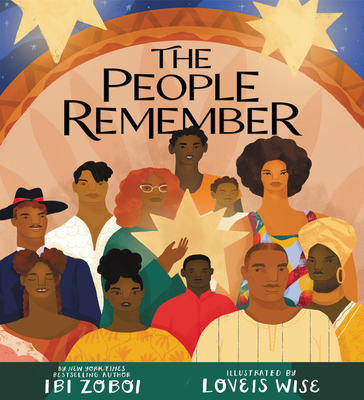
The People Remember by Ibi Zoboi, illustrated by Loveis Wise (9780062915641)
This nonfiction picture book explores African American history by connecting it to the seven principles of Kwanzaa. The book starts with Africa during a time of war when people disappeared or were sold. The history continues as they are taken into slavery, landing in places like South Carolina, Hispaniola and Brazil. Some escaped while those who could not escape found a common language and unity. People today remember the days of slavery, seeing that they have self-determination to change the nation. When slavery ended, the Great Migration came along with music on the streets and in churches, showing their collective work and responsibility. The history continues with examples of places that Black people created themselves and Black people who were successful, showing the principle of cooperative economics. Purpose came with voting rights, marches for civil rights, and the grief and hate of lynching. Creativity is shown again and again with music, dance, writing and more. The book ends with faith, a commitment not to forget and to carry forward with hope for change.
This Zoboi’s picture book debut. Her writing is exceptional, an ode to African Americans and their collective impact on the world. Using the Kwanzaa principles to guide the structure of the book works well, as the book naturally forms into seven sections. Zoboi uses a repeating structure of the various African tribes who were taken to America as slaves. In these sections and throughout, there is a call to Black pride, to seeing oneself as survivors and removing any shame from the narrative. Zoboi works to clearly draw the connection between history and today, showing the continuum that reaches backward and forward.
Wise’s illustrations are filled with lush colors, depicting connections between modern times and history. Their art is flat and graphic, almost poster like in its powerful simplicity. Each one could be framed and used to call out a movement or moment in history.
Powerful, unflinching and important. Appropriate for ages 6-9.



 Waking Brain Cells