Wanda Hears the Stars by Amy S. Hansen with Wanda Díaz Merced – Book Review

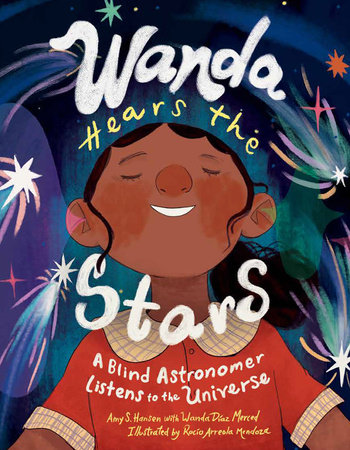
Wanda Hears the Stars: A Blind Astronomer Listens to the Universe by Amy S. Hansen with Wanda Díaz Merced, illustrated by Rocio Arreola Mendoza (9781623544874)

When Wanda was growing up in Puerto Rico’s rainforest, she couldn’t see the stars because of all the trees. She first truly saw the stars on a family fishing trip and she was entirely amazed by them. Wanda was a child who didn’t like school all that much and certainly didn’t like the shots she had to take for her diabetes. Eventually, she found out what she liked at school and decided to study physics in college. But at college, she started losing her eyesight due to her diabetes and eventually became blind. How could a blind person study the stars? Happily, she had friends around her to encourage her and one friend who was using sounds to study the stars. Now Wanda could listen to the stars and hear them. Wanda moved to the United States and continued to study the stars, making discoveries that only someone listening to the noises could have found. 

An amazing story of overcoming a disability in a field where it seemed impossible to go on, this nonfiction picture book shows Wanda’s perseverance, skill and also her willingness to accept help in order to find her way forward. The story itself is wonderfully written for young readers and the ending where the star noises are shared on the page is amazing in an entirely additional way. The illustrations are friendly and invite readers to engage with the material. 

A fascinating and inspiring true story. Appropriate for ages 6-9.

Reviewed from e-galley provided by Charlesbridge.
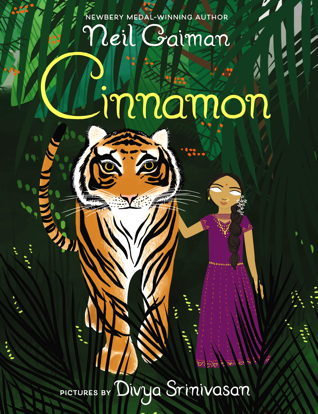
Cinnamon by Neil Gaiman

Cinnamon by Neil Gaiman

Cinnamon by Neil Gaiman, illustrated by Divya Srinivasan (9780062399618, Amazon)

A princess who is blind also doesn’t speak. Her parents, the Rajah and the Rani, offer a place in the palace and other rewards to anyone who can get Cinnamon to talk. Though the kingdom is remote, people journey there to try but no one was successful. The one day a talking tiger came to the palace and offered to help. Though everyone was frightened, Cinnamon’s parents allowed the tiger to try. Using a series of experiences like pain, fear and love, the tiger proceeded to tell Cinnamon stories. The next morning, the princess was able to talk but things don’t quite go according to plan.

Gaiman excels at writing books with a deep ambiguity and no pressure to have a moral or lesson at the end. This book has exactly that and it is why the book works to very well. He embraces the questions, allows the wonder to simply be there, and twists the story away from where traditional tales would end and towards a more shifting place that allows more dreaming.

The illustrations firmly place this book of a mythical India. Filled with rich colors, they have a distinct flatness to them that works well with a folktale subject like this. They are also filled with small details that adds a delicacy and luxuriance to the images.

Great illustrations bring this book previously only available on audio into the world of children and stories. Appropriate for ages 6-9.

Reviewed from library copy.

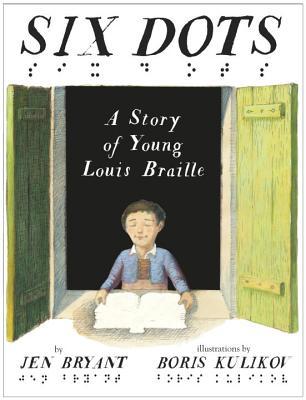
Six Dots by Jen Bryant

six-dots-by-jen-bryant

Six Dots: A Story of Young Louis Braille by Jen Bryant, illustrated by Boris Kulikov (InfoSoup)

Louis Braille lost his sight at age five from an accident and a resulting infection. His family helped him learn to cope, making him a cane that he could use to explore a little farther from home each day. His brothers taught him to whistle and his sisters made him letters out of straw. He could play dominoes, knew trees by touch, flowers by their smell and could listen to books being read aloud. But there were no books for blind children like him. Even when he got into a school for the blind in Paris he had to work very hard and become one of the best students to be able to access their books. When Louis achieved that though, he found that the books were done in large raised wax letters so thick books were actually quite short. Then there was news that a French army captain had created a way to send secret messages that was read by touch. Louis worked to make the system readable by the blind, creating his own alphabet system as a teenager!

Bryant writes in first person from Braille’s point of view. She explains how Louis lost his sight with just enough detail to make it understandable how tragic it was but doesn’t overly linger there. When Louis’ sight is gone, the text changes to become filled with noises and other senses than sight. Bryant moves the story forward using Braille’s desire to read for himself, that drives both the story and Braille’s own life. As each opportunity proves to be disappointing, Braille does not give up hope, instead developing throughout his life a tenacity to find a solution.

Kulikov’s illustrations play light against dark. When Braille loses his sight, the pages go black with shadowy furniture forms only. Color is gone entirely. The reader is not left there, but moves back into the world of color unless the story is speaking about Braille’s blindness specifically, so when Braille finally gets to try reading the wax lettering, the page goes dark again, also showing his disappointment in the solution.

Intelligently designed and depicted, this is a warm and inspiring look at the life and achievements of Louis Braille. Appropriate for ages 6-9.

Reviewed from copy received from Knopf Books for Young Readers.


Maxi’s Secrets by Lynn Plourde

Maxis Secrets by Lynn Plourde

Maxi’s Secrets by Lynn Plourde

Timminy is not looking forward to starting a new school, particularly one where his father is Assistant Principal. Now he won’t be able to disguise from his parents how bullied he has been at school due to his small size. But his parents try to make the move more palatable by giving him a puppy, Maxi, who is a huge white furry ball of energy and love. Eventually, they discover that Maxi is deaf and have to figure out how to keep her safe in their woodsy new home. Meanwhile Timminy is busy worrying about school, dodging bullies who put him in lockers. When he meets his neighbor, Abby, she doesn’t put up with his whining about his size. After all, she doesn’t let her blindness slow her down at all. It is up to Timminy to realize that his size doesn’t define him any more than Abby’s or Maxi’s disabilities do. It’s time for them all to stand tall.

Plourde has created one of those dog books. You know, the ones where the dog dies. But at least she admits it right up front, warning readers that Maxi is one to be adored and loved but that she will be gone before the story is done. The book happily is about much more than that. It is about bullying and the ability to keep strong in the face of being different and unique. It is also about everyone being more than they seem on the surface, even those who may appear to be bullies at first.

The writing here is heartfelt and fast. Timminy is a great protagonist and though he can whine at times, it is always justified. The fact that he learns a lot from those around him is to his credit. He is also someone who offers second chances to others and seeks them himself when he does something wrong. This is a book about friendships and allowing people into your lives even if they are different in ways other than hearing and sight and size.

A tearjerker of a book, this is one with a huge heart to go along with the huge white dog. Appropriate for ages 8-12.

Reviewed from ARC received from Nancy Paulsen Books.


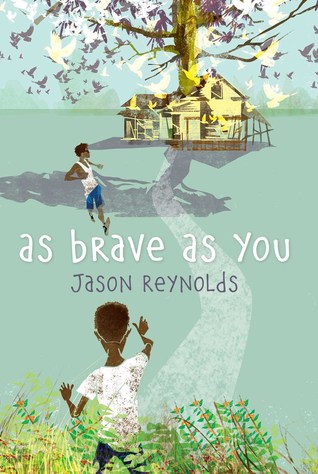
As Brave As You by Jason Reynolds

As Brave As You by Jason Reynolds

As Brave As You by Jason Reynolds (InfoSoup)

Genie and Ernie are heading to Virginia to stay with their paternal grandparents for the very first time. Though they have met their grandmother before, this is the first time that Genie has met him. The difference between their lives in Brooklyn and their grandparents’ home in rural Virginia are huge. But that’s not the only thing that surprises Genie. He is shocked to find out that his grandfather is blind. Genie is a kid who is full of questions to ask all of the time and so he immediately asks his grandfather questions about his blindness. Genie knows that his older brother Ernie is braver than he is, always taking up fights for Genie and protecting him. He also knows that his grandfather is immensely brave too. When something goes wrong though, Genie will have to rethink what it means to be brave.

Reynolds is so amazingly gifted as a writer. He astounded me with this departure from his more urban writing. He captures the rural world with a beautiful clarity, using the natural world around as symbols for what is happening to the humans who live there. It is done both subtly and overtly, creating a book that is multi-layered and gorgeous to read. Throughout Reynolds speaks to real issues such as guns and disabilities. They are dealt in their complexity with no clear point of view stated, giving young readers a chance to think things through on their own.

Reynolds has created a fabulous protagonist in Genie, a boy filled with so many questions to ask that he has to write them down to keep track of them. He is smart, verbose and caring. Yet at the same time, he agonizes over mistakes, trying to fix them on his own and thus creating a lot of the tension of the book. The depiction of the grandparents is also beautifully done, allowing them to be far more than elderly figures. They are often raw, sometimes wise, and also dealing with life.

A brilliant read for the middle grades, this book is filled with magnificent writing and great diverse characters. Appropriate for ages 9-12.

Reviewed from copy received from Atheneum.


Review: My Three Best Friends and Me, Zulay by Cari Best

my three best friends and me Zulay

My Three Best Friends and Me, Zulay by Cari Best, illustrated by Vanessa Brantley-Newton

Zulay is in first grade along with her three best friends.  She starts the day by linking arms with them and singing in the hallways and then waiting in line to hug their teacher hello.  When she finds her desk, she feels with her legs to make sure she is sitting right and then readers see her cane, which she pushes to the back of her desk.  It is at this point that it becomes clear that Zulay is blind.  She still studies what everyone else does, but she also has extra classes to learn to use her cane.  When Field Day is announced, Zulay surprises everyone by declaring that she wants to run in a race.  Will Zulay be able to make her dream come true?

Best introduces Zulay as a person first and then reveals her disability.  It offers readers a chance to meet Zulay as a first grade girl and see how she is just like her friends first and then realize that she is still just like the others in her class but with the added component of blindness in her life.  Best also incorporates all of the details that children will want to know.  How does Zulay find her desk?  How does she do class work?  What is her red and white cane for?  The result is a very friendly book that celebrates diversity in a number of ways.

Brantley-Newton’s illustrations add to that friendly feel.  They feature children of many different races together in school.  She clearly shows the emotions of her characters too from worry to pride to joy.  The illustrations are bright and cheery.

This is a book about diversity and meeting challenges head on.  It’s a great addition to public libraries of all sizes.  Appropriate for ages 5-7.

Reviewed from copy received from Farrar, Straus and Giroux.

Review: Colors of the Wind by J. L. Powers

Layout 1

Colors of the Wind: The Story of Blind Artist and Champion Runner George Mendoza by J.L. Powers, illustrated by George Mendoza and Hayley Morgan-Sanders

George loved to move, so he decided to be a basketball player.  Then one day the world outside looked red to him and he started to see other colorful squiggles in the air and suffer from constant headaches.  The doctor told him that he was going blind, but George didn’t lose all of his sight, instead he continued to see bright colors and flashing lights.  He had to stop playing basketball because he could no longer see the basket.  Eventually, George took up running, mostly because it made him so tired that he could forget being blind.  He could run very fast, so fast that he went to the Olympics, twice.  But George continued to see a world of colors that no one else could see.  It wasn’t until a friend was killed that he started to ask himself why he was there, and George started to talk about being blind to groups and also to paint the world that he sees.

A truly inspirational story, Mendoza is an example of someone being incredible resilient in the face of a life-changing disability.  The fact that he began to run after losing his sight is amazing and also inspiring.  But it is his visions and his art that shine on the page, a world painted in colors that only he can see.  The process of George becoming an artist is shown in all of its slow progression which also gives the sense that there is time to find your path, time to be the person you are meant to be.

Seeing his paintings on the page is immensely powerful.  They are bold and bright, done in thick lines.  They have a voice to them that shouts on the page and they tell the story of what George sees more clearly than any words can. 

Highly recommended, this picture book biography is a powerful tale of resilience and overcoming barriers.  Appropriate for ages 7-10.

Reviewed from pdf received from J.L. Powers.

Review: Blind by Rachel DeWoskin

blind

Blind by Rachel DeWoskin

When Emma was 14 watching fireworks with her family, a rocket backfired and hit the crowd, burning Emma across her eyes and leaving her blind.  Emma has to learn how to live as a blind person, pitied by everyone but mostly by herself.  She learns to walk with a cane after months of sitting on the family couch not doing anything at all.  She is sent to a special school where she learns to read braille and yearns to be back with her best friend at normal high school.  After working hard for a year, Emma manages to progress enough to be allowed to return to normal high school, but everything has changed.  Not only is it difficult being blind there, but a classmate has been found dead.  Now Emma has to figure out how to process the girl’s death without becoming the PBK – Poor Blind Kid again.

DeWoskin has written a complex book here.  The heart of it, Emma’s blindness is brilliantly captured.  Readers will learn about the limitations of being blind, but also how it makes to listen differently and with more attention than before.  The small coping mechanisms are fascinating, such as always wearing a tan bra so that you know it won’t show through any of your shirts and the fact that blind girls still wear makeup, but theirs has to be labeled in a way you can touch. 

Emma is a great heroine.  Her grieving process is clearly shown as is her determination to return to normal.  She is strong but not too strong, so that she is fully human on the page.  When Emma creates a group of students who meet secretly to deal with the girl’s death, the book slows.  While it is an interesting device to show how teens can come together to help one another grieve and heal, it is far less compelling than Emma’s own journey. 

A book that will reach beyond those interested in visual impairment, this teen novel shows the resilience of a girl suddenly blinded but who discovers an inner strength she had never realized she had.  Appropriate for ages 13-17.

Reviewed from ARC received from Viking.

Review: She Is Not Invisible by Marcus Sedgwick

she is not invisible

She Is Not Invisible by Marcus Sedgwick

Released April 22, 2014.

Laureth keeps tabs on her famous father’s emails, making sure that his fans are responded to in a kind and timely way.  But one day, she gets an email from someone claiming to have her father’s writing journal.  The problem is, her father is supposed to be in Europe, but this person is in New York City.  Laureth’s mother doesn’t seem to care about her father being missing, so it is up to Laureth to figure out how to reach him and find out what happened.  But Laureth has an additional obstacle to her rescue mission: she is blind.  So she must fool her 7-year-old brother into joining her on a flight across the Atlantic Ocean to a huge city to find her father.  This is a quest unlike any other, written by a master.

Sedgwick’s writing is beautiful and effortless.  He has created a truly incredible character in Laureth, a girl who doesn’t even realize how brave she is.  Her blindness is both a huge factor in the novel but also never a factor in Laureth’s self perception.  She tries to pass as sighted throughout the novel, managing it at times and failing at others.  There are frightening encounters, moments of disorientation, and other times where blindness is the reason she survives. 

Sedgwick’s book is about far more than a girl who is blind making a quest.  It is about moments of coincidence too.  Sedgwick works this theme in by pulling quotes from Laureth’s father and his research into coincidence.  But it is also a large theme of the book itself, those breathtaking moments where the universe seems to be speaking just to you.  And it is those moments that make the connections we have with others stand out clearly.

A remarkable protagonist in a magical book, this is another winner for Sedgwick.  Appropriate for ages 13-15.

Reviewed from digital copy received from NetGalley and Roaring Brook Press.