Review: Helen’s Big World by Doreen Rappaport

helens big world

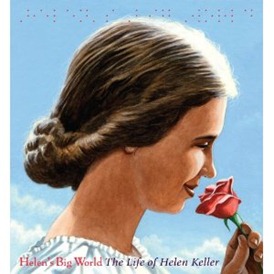
Helen’s Big World: The Life of Helen Keller by Doreen Rappaport, illustrated by Matt Tavares

This picture book biography of Helen Keller celebrates both the accomplishments of Helen Keller in overcoming her world of darkness and silence and those of her teacher Annie Sullivan.  The book begins with Helen as a small baby, before she had an unknown illness at 19 months that took her sight and hearing away.  It then moves through her attempts to continue to communicate, the frustration that caused her tantrums, and the slow progression of learning that led to the seminal moment at the water pump that connected the letters in her hand to the outside world.  Readers will see how Helen learned to write, read in Braille, and put her hands on people’s faces to feel their lips move so she could understand their speech.  The book continues to show how Helen Keller spoke up for social injustices that she felt were wrong.  This is a testament to what a brilliant mind and a great teacher can create.

Rappaport has somehow condensed the complicated story of Keller’s life into a very readable picture book that has a brisk pace and invites readers to find out more about this remarkable woman.  Throughout the book, Keller’s own words are used to illustrate points in the story.  Shown in their own font that is colorful and set apart from the rest of the text in size too, her words shine.

Tavares’ illustrations reveal the marvel of Helen Keller’s learning and education.  There is a light to the images once the learning begins that contrasts with the darkness of her earlier life.  Throughout Keller is shown experiencing the senses she does have, from the scent of a rose to the feel of the breeze on her face. 

An inspirational figure, Helen Keller continues to be a beacon for overcoming obstacles and using one’s mind.  This book is a beautiful tribute to her.  Appropriate for ages 8-11.

Reviewed from library copy.

Blindsided

Blindsided by Priscilla Cummings

Natalie has been losing her sight since she was eight.  She is still able to see in a tunneled form, but then receives the news that she will lose her sight completely in a short period of time.  Natalie is sent to a school for the blind to learn the skills she will need to have when she is blind.  She is taught Braille and how to walk with a cane. But she doesn’t consider herself in the same situation as the other teens at the school.  They are blind and she is not.  She does learn the skills, but inwardly refuses to accept the situation, hoping for a miracle to happen.  Eventually her sight does leave completely and now Natalie has to choose between using the skills she learned and becoming independent or remaining scared and protected at home.

This book is a mix of positive and negative for me.  Natalie was a fine character with intelligence, lots of doubts, and complex reactions to her situation.  She was well drawn and interesting.  The information on the school for the blind and her skills were also interesting, though they could have been woven more into the story itself so that they read more effortlessly. 

Unfortunately, the book suffered from heavy-handed writing that was often didactic in tone.  There was a sense that the author had a lot to say about overcoming obstacles and disabilities.  Her need to inform others intruded on the story itself, which would have been much stronger without the tone.  Additionally, there were often moments when Natalie grew to new understanding which the author underlined and pointed out, lessening their impact instead of strengthening it as intended.

I must also quibble with the foreshadowing of the action-filled ending, which would have been surprising except that it was built into the story too clearly with events leading directly to it.  Again, a more even-handed writing style would have raised it to another level.

Appropriate for ages 13-16.

Reviewed from copy received from Dutton.