Review: Hold Fast by Blue Balliett

hold fast

Hold Fast by Blue Balliett

Early lives in a warm and loving family.  Her father Dash is a lover of words and word games.  Her mother Sum and little brother Jubie make up the total of four in their family.  But when Dash gets involved in something shady, their loving family becomes three.  Then people raid their home, breaking down the door and they are forced to head to a shelter without knowing where Dash is or how he will find them again in the big city of Chicago.  Early finds she has to be the strong one as her mother begins to falter and her brother is so little.  Shelter life is difficult and it takes Early some time to realize that she is in the middle of a mystery that she can help solve. 

Balliett demonstrates her own love of words and wordplay throughout this novel.  Told in beautiful prose, she writes poetically about the city she loves, the beauty of snow, and the power of family.  She incorporates wordplay through her protagonist, who looks at words the way her father taught her to.  Many times words sound like what they are, points out Balliett, and just reading this book will have readers seeing words in a new way.

Balliett also introduces young readers to the poetry of Langston Hughes.  One of his books is at the heart of not only the mystery of the book but at the heart of the family.  As Hughes muses on dreams and their importance, both Early and the reader are able to see his words and understand them deeply. 

The aspect of the homeless shelter and the difficulties the family and Early face there is an important one.  Balliett is obviously making a point with her book, sometimes too obviously.  There are also some issues with plotting, with the book dragging at points and struggling to move forward.  That aside, the writing is stellar and the characters strong. 

Another fine offering from Balliett, get this one into the hands of her fans.  It will also be great choice for reading aloud in classrooms with its wordplay and strong African-American characters and family.  Appropriate for ages 9-12.

Reviewed from ARC received from Scholastic.
Review: Open This Little Book by Jesse Klausmeier

open this little book

Open This Little Book by Jesse Klausmeier, illustrated by Suzy Lee

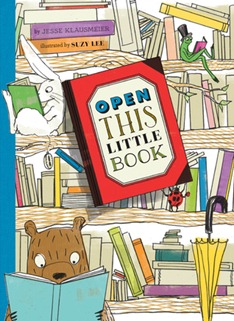
Open the full-sized picture book and inside you find a series of nesting books, each smaller than the one before.  The stories in the books also nest with one another.  First the reader opens the Little Red Book and discovers ladybug who is opening the Little Green Book where frog is the character.  On and on it goes, until the story reaches a little twist in the little books.  Then the stories unwind as the books are closed one by one.  It’s impossible to not be charmed by the design and concept.

Debut author, Klausmeier has created a seamless partnership with illustrator Lee.  The book is so much a marriage of their work that one might think it was done entirely by one artist.  The story is simple yet fully engaging.  The problem you may have with little listeners is having them slow down opening the next book in time to read the words on the page.  Lee’s illustrations add to the charm, hearkening back to vintage picture books but still carrying a modern vibe.  The scale of the books is perfection, like opening a Russian nesting doll.

Engaging, interactive and oh so much fun, this book looks at colors, sequence and a love of reading.  Appropriate for ages 3-5.

Reviewed from library copy.

Review: From the Good Mountain by James Rumford

from the good mountain

From the Good Mountain: How Gutenberg Changed the World by James Rumford

A mysterious object appeared in Germany in the 15th Century.  “It was made of rags and bones, soot and seeds. It wore a dark brown coat and was filled with gold.  It took lead and tin, strong oak, and a mountain to make it.”  To find out the answer to this clever riddle that appears on the first page of this book, readers will visit the 15th century and meet Johannes Gutenberg, who has invented a way to print books with movable type.  The riddle is not left at the first page, but is the center of the entire book.  Each piece of the printing press is explored from the very elements it is made from to the final culmination in a printed document.  Each page is also illustrated like an illuminated manuscript. 

Come visit the world of Gutenberg in this picture book biography that takes a very unique and intriguing approach to its subject matter.  This is much more a biography of the press itself than Gutenberg the man.  It is about the ingenuity and foresight it took to see such a construct in raw materials.  Readers are sure to learn much about the process of printing and what materials were used to create books.

Rumford’s art is just as wonderful as his writing.  The illuminated manuscript feel of the book is captured in its use of golds that seem to shine on the page like gold leaf.  He also uses the deep blues and other rich hues to create a feel of timeless beauty.

This is an intriguing read that will appeal to students who enjoy puzzles and riddles.  It is a book that unwraps and explains in a clever, engaging way.  Appropriate for ages 7-9.

Reviewed from library copy.

Review: The Reader by Amy Hest

reader

The Reader by Amy Hest, illustrated by Lauren Castillo

A young boy walks through the snow with his dog and a suitcase in his hand.  He gets his red sled with runners and heads out.  They climb a large hill, leaving straight lines in the snow from the sled as the dog bounds ahead.  Once at the top, they stop for a snack of toast and warm drinks.  Around them the snow continues to fall.  Finally, the suitcase is opened.  The boy pulls out a book to share with his dog, about friendship.  He reads it aloud, the two of them together at the top of a snowy hill.  When they are done, they pack everything back up and climb on the sled for the ride back down the hill.  Together.

Hest has written a book that is filled with falling snow but also warmed by the friendship of a boy and his dog.  Though the title gives a hint at what is in the case, readers will still be surprised to have them read it out in the falling snow.  Hest incorporates beautiful little details: the sound of crunching and sipping, the sound of the boy reading at the top of the hill, the hard work of getting up the high hill.  These all create a feeling of time, moments that are to be treasured because they are so beautiful.

Castillo’s illustrations are done in pen and ink and watercolor.  Against the white of the snow, all of the colors pop.  The brown of the dog, the red boots, the smears of color on the suitcase: all are cheery bright against the white countryside.  The illustrations have a wonderful jaunty feel to them, celebrating this close friendship and reading books.

A wonderful mix of snow and story, this book is a rich winter delight.  Appropriate for ages 3-5.

Reviewed from library copy.

Review: The Bear in the Book by Kate Banks

bear in the book

The Bear in the Book by Kate Banks, illustrated by Georg Hallensleben

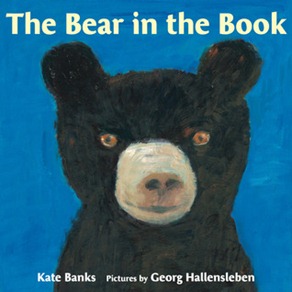
A little boy sits in bed reading a book with his mother.  It’s a book about a bear getting ready to sleep for the winter.  The boy and his mother share the story together, talking about the pictures and the bear.  The bear eats and eats, getting ready to hibernate until he finally curls up and falls asleep.  Then the snow comes, and the little boy can almost feel the cold from the page of the book.  He looks closely at the pictures and finds hidden animals in the snowy landscape.  The snow continues and the boy snuggles in closer, the bear sleeps on.  As spring nears, the boy gets sleepy.  Just as the bear is about to wake up, the boy falls asleep for the night.  Now it’s his turn to sleep long and deep in a cozy bed.

This book is pure joy.  It celebrates both the written word and the art of the picture book.  Even more so though, it celebrates the connection built by sharing a book right before bed.  Just as the boy could feel the winter emanating from the page, here you can feel the warmth and coziness.  With my librarian hat on, I am delighted to see a book that models what reading aloud to a small child should look like.  There should be conversations about the pictures, questions and answers about what is happening in the story, looking at the colors on the page, finding hidden animals, and much more activity than simply reading a story aloud. 

Hallensleben’s illustrations have a gorgeous rough texture to them.  The paint is lovely and thick, resulting in rich colors that add to that feeling of warmth and home.  They also bridge the connection between the book and the family reading together, flowing seamlessly back and forth, uniting as an entire story.

Highly recommended, this is a book that will have you curled up and sharing it with your own little one immediately.  Appropriate for ages 3-5.

Reviewed from library copy.

Review: The Lonely Book by Kate Bernheimer

lonely book

The Lonely Book by Kate Bernheimer, illustrated by Chris Sheban

When the book first arrived at the library, it was shiny and new.  It was placed on display and a long list of children waited to read it.  Then the book was moved to the regular children’s shelves with other books that were not so new too.  It was still happy, since it got checked out often.  But as the book grew older, it got checked out less and less.  It had a tear and was missing its last page.  Then one day, a girl found the book, read it and loved it.  She took it home, carried it to school with her, and even shared it at show and tell.  The book felt loved again.  But the next story time, the girl chose a different book and forgot the special book.  She remembered when she got home, but the library was already closed.  Then when she got to the library a week later, the book was gone, withdrawn and meant for the book sale.  This is a sentimental but gorgeous book that every person who has ever loved a book will enjoy.

When I started this book, I was not a fan.  I worried that it would tip into the saccharine and overly sweet.  It is sentimental, as I mentioned above, but it never tips too far into that mode.  Instead I found myself reading a book that brought me back to the joy of discovering books as a child and finding myself closely attached to them.  I still can’t have a logical discussion of the Little House on the Prairie series, since I read them to tatters as a little girl.  I love this book for bringing me back to that.

Sheban’s art is soft and dreamy.  There are often books that glow with the wonder inside of them, something that book lovers will really appreciate.  This is a quiet book, and the art supports that, depicting quiet time reading and bonding with a story.

A great gift for any book-loving child, I think this book will speak most to adults who look fondly back on the books of their childhood.  Perhaps a holiday gift for your favorite librarian or reading teacher.  Appropriate for ages 4-6.

Reviewed from copy received from Schwartz & Wade.

Review: Chloe and the Lion by Mac Barnett

chloe and the lion

Chloe and the Lion by Mac Barnett, illustrated by Adam Rex

You know this book is going to be unique when you get introduced to the author and illustrator before the book begins.  Then you meet Chloe, a little girl, who is the main character in the book.  The story begins and Chloe is collecting loose change that she would use to ride the merry-go-round in the park as many times as she could.  When she headed home, dizzy from the ride, she got lost in the forest.  Then a huge lion jumped out at her!  Except Adam Rex, the illustrator, did not draw a lion.  He thought a dragon would be a much better choice.  Mac Barnett, the author, doesn’t like that idea at all and insists that this is HIS book because he is the author.  The fight goes on from there, until Mac feeds Adam to the lion that a new stand-in illustrator drew for him.  Unfortunately, he doesn’t really like the art of the new illustrator and also finds that he can’t draw well enough himself to fill in for Adam.  What is an author to do?!

I love books that break that fourth wall and take a look at the inner workings of the author/illustrator or involve the audience in an interesting way.  The book’s art and writing are so closely integrated together that it is almost impossible to review them separately.  The tone here is clean and clear until the fight scene where it becomes comically fraught with emotion.  There are running gags, funny comments and lots of humor throughout the story that make it all the more fun to read.

The illustrations are inventive and add real dimension to the book.  There are several elements at play.  There are the figures done in clay that represent the author and illustrator.  There are the flat drawings of Chloe and the lion.  Then there is a stage where the book story takes place.  It’s a wonderful mix of theater, reading, and art.

The silliness doesn’t stop at the end of the book, make sure to check out the author blurb at the back, along with the very short illustrator blurb.  This book will thrill children with its silliness, dynamic illustrations, and its clever look behind the curtain of making a picture book.  Appropriate for ages 5-7.

Reviewed from library copy.

Review: Waiting for the Biblioburro by Monica Brown

WaitingForTheBiblioBurro

Waiting for the Biblioburro by Monica Brown, illustrated by John Parra

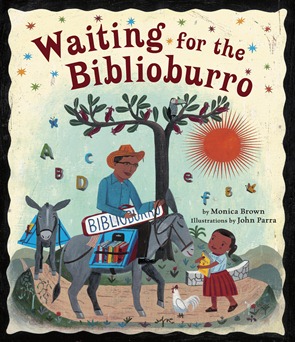
Inspired by a true story, this picture book shows the power of books and reading.  Ana is a small girl who lives in Colombia and adores books.  Her village is very remote though, so there is no library to go to.  Ana has just one book, given to her by her teacher, and she has read it over and over again.  Ana makes up her own stories that she tells her little brother at bedtime.  Then one day a man with two burros comes to their village.  The burros carry a library of books and he invites all of the children to select books to keep until he returns.  As she waits for the librarian to return, Ana creates her own book about him, his burros and his books.

Brown has created a book that is gentle and beautifully written.  Ana’s life is shown as loving and filled with blessings.  It will contrast vividly for American children with their own lifestyle.  Brown also focuses clearly on books and the power of reading and stories.  The story here is told clearly and warmly with sprinklings of Spanish throughout.

Parra’s illustrations have a lovely folk art feel to them.  Done in acrylics on board, they have a texture adds another dimension to the book.  The colors are bright, the storytelling portions filled with wild and amazing creatures, and the entire work makes a complete and unified package.

The entire book sings, revealing a different culture and the power of words (and librarians.)  Appropriate for ages 4-6.

Reviewed from copy received from Tricycle Press.

Also reviewed by:

You can also check out the book trailer:

Board Book Reviews

i feel happy yoon little book

I Feel Happy by Salina Yoon

Explore emotions in this board book.  The book comes with one puzzle piece that has a rotating wheel.  The piece is the face of the child and children can rotate the mouth so that the face shows different reactions.  Turn pages in the book, and different situations are explained.  The child can then show the emotion that they would feel in that situation.  The puzzle piece is attached to the book with yellow ribbon.  It’s a novelty book that would work well in public libraries thanks to the durability of the piece and the pages.

It’s a Little Book by Lane Smith

A version of It’s a Book that is perfect for the toddler set.  Here you have the donkey and gorilla in diapers, exploring what a book is.  Is it for chewing?  Is it for wearing?  Is it for flying?  Each time the donkey comes up with an idea, the gorilla gives it a “no.”  Until the end, “It’s a book, silly.”  None of the controversy of the first book but all of the charm.  And yes, it did take a lot of effort to call the character “donkey” here.