The Seed of Compassion by His Holiness The Dalai Lama

The Seed of Compassion by His Holiness The Dalai Lama

The Seed of Compassion by His Holiness The Dalai Lama, illustrated by Bao Luu (9780525555148)

His Holiness addresses children directly for the first time in one of his books, this time in picture book format. The book tells the story of his childhood in Tibet, filled with mountains, streams, blue sky and lots of animals. His farming family meant that there was always work to do, so as a child, he helped his beloved mother. Through her, he learned his first lessons about compassion. He saw the way she fed those who were hungry and less fortunate. She treated everyone with warmth and tried to give them aid. When he was almost three years old, he was identified as the reincarnation of the Dalai Lama and traveled to Llasa to begin his studies. His focus has been compassion and how to spread compassion throughout the world, bringing joy to more people.

Told in the Dalai Lama’s own voice, the picture book looks deeply at how compassion begins when one is very young, watching others demonstrate it, just like with any other skill. The glimpse of the Dalai Lama’s early days are interesting and the setting in Tibet is beautiful and isolated. Just having scorpions for company is something that will amaze readers, but there is much more on these pages that is impressive and that will get young listeners thinking about how they themselves can be compassionate.

The illustrations were done digitally and have an appealing warmth that carries from page to page. The tones of browns and reds are enlivened by the greenery around them, providing images of life in Tibet.

A must-purchase for all public libraries, this book will be of interest to many. Appropriate for ages 6-9.

Reviewed from e-galley provided by Kokila.
Review: Zen Socks by Jon J. Muth

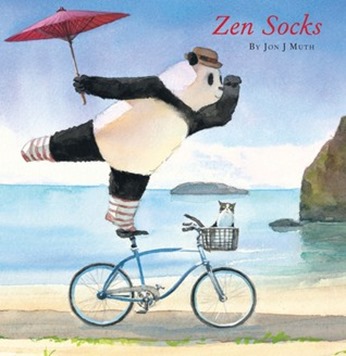
Zen Socks by Jon J Muth

Zen Socks by Jon J. Muth (InfoSoup)

Stillwater, the giant panda, returns for another picture book filled with Buddhist wisdom. The book takes a look at different ways to reach wisdom. The first section of the book looks to sharing a story as a way to learn. It’s a story about learning too, about the importance of patience, practice and hard work. The next story focuses more on action as a learning tool, about being a bad guy and being a good person, and more positive ways to manage conflict. The final part of the picture book is about taking action to help even if you think your small action won’t make any difference to the world.

The entire book shines with Stillwater’s quiet and wise presence. His guidance is done with subtlety and kindness, modeling the way that parents can inspire different ways of thinking in their children. The stories while based on old tales are also effortlessly modern in their presentation here. These are lessons that transcend any age and remain all the more true in our current world.

Muth’s illustrations are luminous and lovely. They are filled with light and humor, inviting children outdoors to play and explore without ever mentioning it as a goal. As in all of his Zen books, Stillwater is a major presence that demonstrates the importance of having a child’s mind in his playfulness and also being engaged in his community as he teaches the children new ways to see the world.

Another brilliant Zen book, this picture book will be embraced by Buddhists and others looking for some quiet wisdom in our busy world. Appropriate for ages 4-6.

Reviewed from copy received from Scholastic.

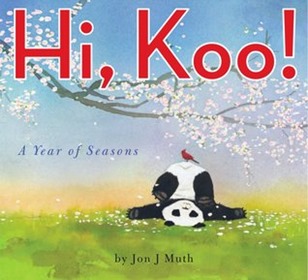
Review: Hi, Koo! by Jon J. Muth

hi koo

Hi, Koo!: A Year of Seasons by Jon J. Muth

Join Koo, a panda, on an exploration of the seasons through haiku poems.  The book begins with fall and haikus about fall leaves, wind, and rain.  Winter comes next with poetry about snow and ice.  Spring is bridged into with a glimpse of crocuses and then grass, insects, and birds.  Summer arrives with fireflies, flowers and water.  In 26 poems, this is a lovely celebration of the small things that make each season special.

Muth has created haikus that are beautifully written.  They capture small moments in time and also point to the larger importance of these moments.  They continue Muth’s Buddhist focus in his picture books, offering children a way to see these times of mindfulness as important and worthy of exploration. 

Muth’s watercolor illustrations have a wonderful spirit to them.  The palette changes colors as the seasons change with spring bouncing in green especially after the white cold of winter.  He captures the seasons so well that your attitude changes with each season as well.

A stellar collection of haiku, this book will invite young readers to see nature and seasons in a fresh new way.  Appropriate for ages 5-9.

Reviewed from copy received from Scholastic.

Zen Ghosts

55155984

Zen Ghosts by Jon J. Muth

The wonderful Stillwater the panda returns for a third time with another picture book filled with Zen.  In this book, Stillwater spends time with the children as they prepare to go trick-or-treating.  Then after they are finished, he brings them to a place where a panda tells them the story of Senjo.  In the story, Senjo is in love with her best friend from childhood.  But when her father gets ills, she is forced to marry a wealthy man.  Ochu, the man she loves, leaves the village because he cannot bear to see her marry someone else.  But as he is leaving, he sees Senjo on the bank and they run off together.  Years later, Senjo feels she must try to reunite with her father.  When they return to the village, Ochu speaks to her father and then discovers that Senjo has been ill in bed since the night Ochu left years ago.  The two Senjos meet and merge together into one.  So the question asked is which Senjo is the true one?  It is a marvelous Koan that is not meant to be solved.  Modern children may be frustrated by this type of story, but all the more reason for them to hear it.

Muth takes the setting of Halloween, combines it with a ghost story of sorts, and turns the holiday into something new.  The children in the story are always talking about their candy and their costumes.  Just as in the other Zen books by Muth, the children remain children completely.  They ponder new ideas and discover new ways of thinking, but they are children still.  Muth’s water colors are rich and autumnal here until the story within the story begins and the colors fade to whites and grays.  Muth offers several great double-page spreads that really capture autumn and Halloween.

This is a very different Halloween story, but one that really has a place in every library.  It is beautifully written, illustrated with elegance and offers a new perspective for readers.  What more could one want?  Appropriate for ages 5-9.

Reviewed from copy received from Scholastic.