The shortlists for the 2025-2026 First Nation Communities READ have been announced. The awards are given for the best Indigenous literature from Canada and voted on by First Nation librarians from Ontario. The awards will be given during First Nation Public Library Week (October 6-10).
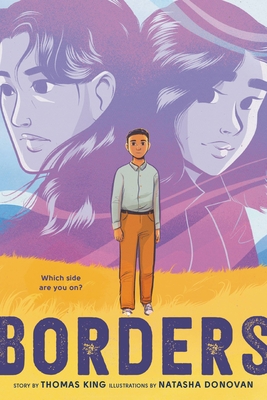
Borders by Thomas King, illustrated by Natasha Donovan (9780316593069)
When his older sister decides to move to Salt Lake City, a boy and his mother take her to the border between Canada and the U.S. His mother decided one day to make the trip to Utah to visit. They got dressed up and ready to leave the Blackfoot reserve. When they reached the border though, his mother refused to say that she was Canadian, giving her citizenship as Blackfoot. Caught between two countries, refusing to deny her true citizenship, the boy is caught with her as they demonstrate the power of their identity and family.
Written by an award-winning author of Cherokee and Greek descent, the graphic novel is illustrated by a well-known Métis illustrator. The book insists that readers see Native identity and recognize it as valid in a way that neither country is willing to. The story is immensely uncomfortable as readers wait for a resolution to come along with the boy and his mother. There is a brilliance to this discomfort, allowing readers to sit with it and learn.
The illustrations honest and simple, portraying the love among the family, even when his sister leaves for the United States. The focus on the people allows the illustrations to move beyond the desolate border and into the people being impacted.
An important middle-grade graphic novel that will inspire thought and discussion. Appropriate for ages 9-12.
On the Trapline by David A. Robertson, illustrated by Julie Flett (9780735266681)
A boy travels with his grandpa, Moshom, to his trapline up north. Moshom hasn’t returned to the trapline since he was a boy himself. The trapline is where people hunted animals and lived off the land, Moshom explains to his grandson. Once the small plane lands, the two meet one of Moshom’s old friends. They pull up to a small house near a big lake, but that is not the trapline. It’s where Moshom lived after they left the trapline. In the winter, everyone slept together in the room with the wood stove to keep warm. Moshom shows his grandson the ruins of the school he went to, where he was required to speak in English and not Cree. They head out on the water in a slow boat, until they finally reach the trapline. Moshom shows him where they trapped muskrats, where their tent was, and how they lived on the trapline. As they leave, the two of them can continue to envision the trapline as it is now and as it once was.
The Governor General Award winning team returns with a book about connection to the land, deep memories, family ties and generations sharing stories. The warm relationship between Moshom and his grandson, who narrates the book, is clear and central to the book. The grandson regularly asks whether this place is the trapline, until they reach the real trapline and it is clear. The book examines memories, both dark and happy, alongside physical discovery of the places. It’s a powerful look at experiences and connection.
As always, Flett’s illustrations are exceptional. Done in pastel and then manipulated digitally, they have a muted natural palette that works for both memories and current times. The greens are deep and rich, the blues offer clear skies and rich water.
A look at grandfathers, memories and the importance of place. Appropriate for ages 4-6.
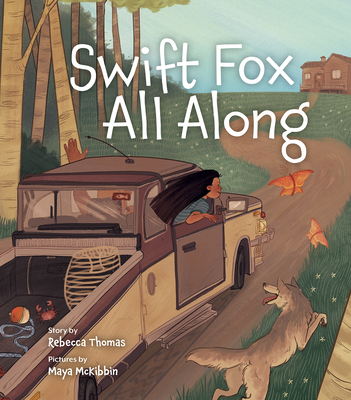
Swift Fox All Along by Rebecca Lea Thomas, illustrated by Maya McKibbin (9781773214481)
Swift Fox is nervous. Her father is taking her on a long drive to meet her aunties, uncles and cousins. She will learn more about being Mi’kmaq. Her father assures her on the drive that she has all she needs already inside her; she is already Mi’kmaq. It’s how she walks, talks and thinks. Swift Fox just gets even more nervous. Swift Fox is greeted warmly by her family. They unwrap a red bundle, preparing to smudge, but she doesn’t know how to. They assure her that she does know, since it’s part of who she is. But it’s all overwhelming for Swift Fox, who bursts into tears and runs outside to hide. She keeps hidden until she starts to smell the familiar smell of the bread her father makes. Then another cousin arrives, he is just as scared as Swift Fox is. Suddenly Swift Fox can help someone else, and it gets her to go back inside with her cousin and show him things as she learns too.
Thomas has written a very personal book that reflects her own upbringing off of the reservation. In her Author’s Note, she explains the impact of the residential schools on Native cultures and languages. Still, their identity survived. Just like Swift Fox, Thomas continues to learn about her Mi’kmaq identity. Readers of all backgrounds will be inspired by Swift Fox and her transformation of her fear into an energy to help someone else.
McKibbin’s illustrations center on the warmth of Swift Fox’s two families, both her mother and sister and then her large extended family through her father. She captures the characters’ complex emotions on the page, allowing readers to really feel Swift Fox’s butterflies, her fear, and then her inspiration to move ahead.
A powerful book about identity and family. Appropriate for ages 4-6.
In a graphic novel format, this book tells the story of 150 years of indigenous history in Canada. The book begins with the story of Annie Bannatyne, the daughter of a wealthy store owner and a Metis-Saulteaux woman. Angered by racist comments published by Charles Mair, Annie literally horsewhips him in public, inspiring a young Louis Riel. There are stories of First Nation chiefs continuing their tribes’ traditional ways, despite them being forbidden by Canadian law. Other stories tell of the damage of residential schools. There is the story of Francis Pegahmagabow, the best sniper in North American history, and how his heroism in World War I was not enough to get the Canadian government to treat him as a human being. There are stories of children taken away, of families broken, of great heroism and deep connection to traditions and to the land itself. The book ends with a science fiction look at native people in space and a message of hope for change.
Told by various First Nation authors and illustrators, this book is simply incredible. At the beginning of each story, the author speaks about their inspiration and then a timeline is given that shows how little progress was made in Canada. Information is shared in the timeline that allows the stories to be more focused but for readers to learn about more historical points. As the history grows shockingly modern, the events remain just as searingly racist as those before the turn of the century. Still, the message here is one of strength, resilience and resistance. It is about standing up, insisting on being seen, and demanding to be heard. There is hope here in each of these heroes.
One of the top graphic novels of the year, this may be Canadian focused, but it speaks to everyone in all nations. Appropriate for ages 12-15.
When Miriam meets Weldon at her bookstore job, she doesn’t realize at first who he is. The grandson of the creator of the TomorrowMen comic book empire, he is wealthy and lives is California. Miriam on the other hand comes from a family without a lot of money and is trying to figure out how to leave her small town to go to college. The two of them have a connection though since it was Miriam’s grandfather who drew the first TomorrowMen comics. As the two of them navigate the perils of two families who have battled one another in court, Miriam becomes more sure of what she wants from her life. Weldon, stuck in rural Canada to get his life back on track, tries his best to be more stable and less impulsive. The two teenagers drift in and out of connection with one another but can’t seem to quite leave one another entirely. It’s Romeo and Juliet reworked to focus on modern comic geeks.
This is Hicks’ first novel, having created several comic books for children and teens. Readers who themselves identify as being “geeks” and in particular comic book geeks, will thoroughly enjoy the banter about comics, the obsessive nature of geek love, and the beauty of two geeks finding one another despite the world trying to keep them apart. The book is filled with humor and yet still offers deep emotions and a look at how one generation’s decisions echo forward to their offspring.
The book takes a look at growing up in rural Canada and has quite a few nods to Canadian life throughout the text. The desire to get out of a rural setting and move to a new place where you don’t know everyone is also an emotion that a lot of rural teens will relate to easily. Add in the appeal of comic books and a visit to Comic-Con and this is a book with a large audience who will root for the two teens.
A funny and warm look at geek love, this is a charming teen novel. Appropriate for ages 12-15.
Reviewed from copy provided by Roaring Brook Press.
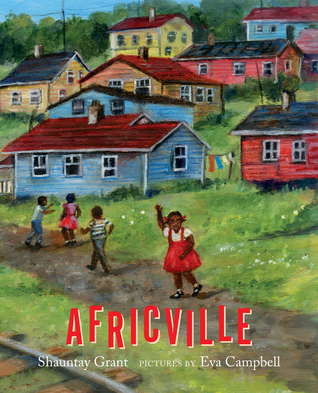
Africville by Shauntay Grant, illustrated by Eva Campbell (9781773060439)
A girl visits the historical site of Africville, in Halifax, Nova Scotia. She imagines what the community was once like, how the children would play together. She imagines lunch on the tables, picking blueberries over the hill. She imagines playing games, going rafting, and bonfires by the water. Her great-grandmother had lived in Africville before it was destroyed in the 1960s after surviving for over 150 years. But the black community of Africville never received the same services as the rest of Halifax despite paying taxes. The community was eventually relocated from the site and moved to public housing. Africville is now a park where former residents and their descendants return to remember the community that had once stood there.
Grant gives us a glimpse of what Africville once was. The picture book keeps descriptions short and the focus on children and their lives in the community. There is an author’s note at the end of the book that offers more context for what Africville was and what happened to its residents. The use of a modern child to dream about what might have been in Africville is a great lens through which to look at life there. The peacefulness and sense of community pervade the entire read.
Campbell’s illustrations are filled with deep colors. The bonfire pages glow with reds of fire and sunset. There is lush green everywhere and the houses pop with bright paint colors. She creates the warmth of a real community on the pages, illustrations that seem to have sunlight shining from them.
A gorgeous tribute to a piece of Canadian history. Appropriate for ages 4-6.
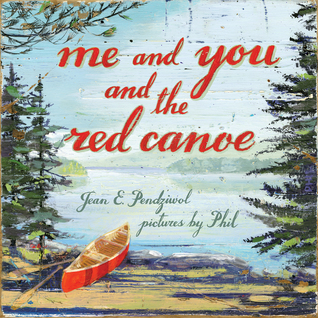
In this incredible poetic picture book, two children wake up in their tents on the shore of a Canadian lake. Quietly, after drinking some hot chocolate, they head out onto the water with their fishing tackle and rods in a red canoe. Paddling quietly through the water, they see a moose in the shallows, a beaver repairing its home, and hear a chattering squirrel. As the sun rises the light changes and they see an eagle flying and an eagle’s nest. The children start to fish, battling and landing a trout before heading back to the campsite. The morning continued with fish for breakfast for everyone.
Pendziwol is a gifted writer. Her verse bring the Canadian wilderness to life with all of the creatures going about their morning business, the silence of the lake and the wonder of it all. The fishing is a dynamic contrast to the quiet of the morning, the battle with the trout and the final win. It punctuates the book much like the appearance of the animals do, in little bits of delight. Her poetry flows much like the water on the lake, clean and clear, quiet but not ever dull. It invites readers into exploration of their own in canoes and on lakes.
The illustrations by Phil are rough and rustic. They are painted on wood with nail holes and cracks running straight through the pictures. These illustrations suit the entire book perfectly, creating a feeling of natural warmth and timelessness.
A winning picture book for those spending their summers on lakes or those who only dream of it. Appropriate for ages 4-7.
Based on the true story of the author’s grandmother, this picture book captures the experience of First Nations people in Canada being sent to boarding schools. Under threat of fines and jail time, First Nation parents were forced to give their children up to the government. When Irene is taken to her new home, she tries to never forget her real home, her parents and their way of life. Irene is called only by a number at the school and told to scrub the brown off of her skin. Her hair is cut off. She is punished when she speaks her native language by a nun burning her hands. Irene is eventually allowed to return home for the summer, where she continues to have nightmares of her time at school. Finally, her parents decide to hide the children rather than sending them back.
This is not a picture book for preschoolers, rather it is ideal for elementary-aged children closer in age to 8-year-old Irene in the story. The horrific treatment of First Nation children is shown with real clarity. The use of Irene’s own voice to tell the story makes it personal and much more painful. While there is a lot of text on the pages, the book reads well and the text is straightforward and necessary to explain the loss of culture and the darkness of the boarding schools.
The illustrations by Newland are almost like painted photographs. They show the family losing their children, the stern nuns, and the punishment scene is carefully captured afterwards in terms of pain and emotion rather than depicting the punishment itself. There is a feeling of constraint and loss in the images of the boarding school and then freedom when the children return home.
A powerful look at Canadian history and First Nation children, this book would work well paired with When I Was Eight by Christy Jordan-Fenton. Appropriate for ages 7-10.






 Waking Brain Cells