Review: Minette’s Feast by Susanna Reich

minettes feast

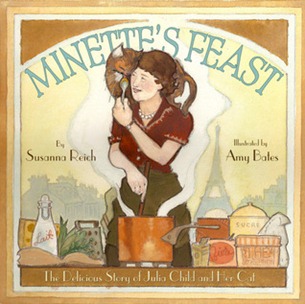
Minette’s Feast: The Delicious Story of Julia Child and Her Cat by Susanna Reich, illustrated by Amy Bates

Minette was most likely the luckiest cat in the world, since she was owned by Julia Child.  Adopted by Julia Child and her husband during their time in Paris, she was just as discerning about her food as her owner was.  She spurned canned food, eating only fresh mice and bird.  Julia would bring home marvelous fish heads just for Minette and also give her leftovers from her cooking.  Still, Minette preferred her own hunted food.  Julia began to cook more and more, taking classes as Le Cordon Bleu.  Minette honed her own hunting skills at the same time, practicing on her toys.  It would take something very special to lure Minette away from the mice.  But then again, her owner was Julia Child who was certainly up to that challenge.

Taking on a famous cook and personality through her finicky cat is a wonderful approach.  We get to see a younger Julia Child, figuring out how to cook French food in her own small kitchen.  We are there to see her arrive in Paris, find her footing in the culture, and then through her learning process until her cooking inspires even her cat to turn away from mice.  It’s a genuine way to approach the subject that has a real child-appeal.

Bates’ illustrations are done in pencil and watercolor.  There is a seriousness and also a playfulness in her illustrations that remind me of Julia herself.  The lanky woman is shown at her full height throughout the book as she is celebrated in both image and text.  Minette appears early in the book, long before Julia adopts her.  It’s a nice touch for sharp-eyed children.

A warm and energetic glimpse of Julia Child that celebrates her on the year of her 100th birthday.  Simply delicious!  Appropriate for ages 6-8.

Reviewed from copy received from Abrams.

Review: Bird & Squirrel on the Run by James Burks

bird and squirrel on the run

Bird & Squirrel on the Run by James Burks

Bird and Squirrel don’t exactly get along.  Bird just wants to have a good time and never worries about a thing.  Squirrel is obsessive about gathering nuts for the winter and worries constantly.  But when Squirrel’s hoard of nuts is destroyed, the two of them realize they need one another to head south for the winter.  Unfortunately, the cat has a different idea and that is having both Squirrel and Bird for lunch!  This zany graphic novel is filled with twists and turns that will have even the most reluctant readers eagerly turning the pages.

Burks takes two polar-opposite characters and in a brief story manages to bring them together as friends in a very believable way.  Throughout the book, there is silly humor, plenty of puns, and a wonderful sense of camaraderie.  The pacing is particularly well done, with small places to catch your breath before the pursuit continues.  There are always surprises waiting for the characters and the reader too.  It makes the reading all the more fun to get caught up in the unexpected.

In my advanced reader copy, the art was only completed for the first few pages in full color.  From those pages, the colors are deep and bright.  The feeling is nicely autumnal and the bright colors add to the zing of the book.  The art has a classic cartoon feel that will have readers feeling right at home.

Perfect for young reluctant readers looking for graphic novels, this book will find an eager audience.  Appropriate for ages 7-9.

Reviewed from ARC received from Scholastic.

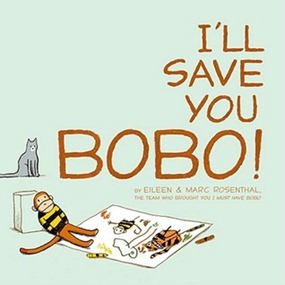
Review: I’ll Save You Bobo! by Eileen & Marc Rosenthal

ill save you bobo

I’ll Save You Bobo! by Eileen & Marc Rosenthal

Willy and Bobo return for their second book, following I Must Have Bobo!  Willy is trying to read a book with Bobo, his stuffed monkey, but Earl the cat keeps trying to steal Bobo away.  The rivalry established in the first book continues here as Willy starts to write his own story instead of reading one.  It is all about him and Bobo at first, with them in the jungle with plenty of snakes and living in a tent.  But again, Earl keeps on sneaking in and trying to take Bobo away.  So Willy adds Earl to the story, changing it to one of revenge!  In the end, Earl though is the one who takes a tiny bit of revenge.

Reading the first book is fairly critical here, since it explains the strained relationship between Willy and Earl.  The mood carries from one book to the next seamlessly and makes for great fun. Those new to the series though may not understand what Earl is trying to do.  This is a book that shows a kid who has real feelings, does not get sweeter as the book goes on, and one knows that this is not the end of his rivalry with the cat.  That adds to my enjoyment of the book, since Willy seems so much like a real child, rather than a picture book example of one.

This book also shows the creative process and will get children interested in writing their own picture books whether they have lots of snakes in jungles or not.  It’s a delight of creativity that is anchored well by the illustrations which have a frenzy and vibrancy that matches the story well.

Get this into the hands of fans of the first book, or hand them to children as a pair.  Appropriate for ages 3-5.

Reviewed from library copy.

Review: Dog in Charge by K. L. Going

dog in charge

Dog in Charge by K. L. Going, illustrated by Dan Santat

Dog had been busy all day.  He had sat, stayed and even danced dressed in a pink ribbon and tutu.  But his entire day changed when he was left in charge of the cats when the humans left.  Dog knew just what to do.  He would have the cats sit and stay.  But before he could order the cats around, all five of them had completely disappeared.  One-by-one dog found the cats.  They were lapping milk on the kitchen counter, hiding in the fireplace, in the clothes hamper, in bed, and putting on makeup.  Dog had to think of something quick!  Then he had a great idea: cat treats!  Unfortunately, they smelled so delicious that he couldn’t help himself and ate the entire bag.  Then, exhausted and full, he fell asleep.  When the cats found him, you will never guess what they did next!

Going has a wonderful tone and patter for slapstick comedy.  Her timing is right on and makes the book a delight to read aloud.  She also puts on an unexpected ending that will warm the heart and makes the book all the more wonderful to share. 

Santat’s illustrations are done in a mixture of different types of frames that add a dynamic touch to the book.  At the same time, they bring to mind vintage cartoon characters and have all of their charm and wit. 

This jolly picture book would make a great addition to storytimes about either cats or dogs.  It’s one of those that you can hold until the end to make the little bodies stay still.  Appropriate for ages 4-6.

Reviewed from copy received from Dial Books for Young Readers.

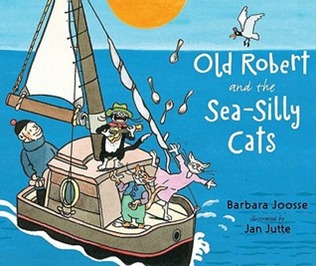
Review: Old Robert and the Sea-Silly Cats by Barbara Joosse

old robert

Old Robert and the Sea-Silly Cats by Barbara Joosse, illustrated by Jan Jutte

Old Robert sailed his ship at sea during the day and docked it at night because it was so dark.  At night, he prepared his dinner of toast in buttered milk and ran through his list of things that were all in their proper place, including clean socks, a clock, one dish and one spoon, and the moon.  He was all alone until one night when a dancing cat asked to come aboard.  Old Robert hesitated because there wasn’t much room aboard, but in the end he agreed.  So he made dinner of toast in buttered milk for both of them and when he went to bed, he noticed the moon was bigger.  Now his list included the cat in its hammock as he went to sleep.  On subsequent days, another two talking cats joined him on board, for dinner, and on his list.  And the moon got bigger still.  Finally, a cat that didn’t talk at all arrived and Old Robert let it on board too.  There was no room for a hammock, for Old Robert let it sleep on his chest.  Finally, the moon was full and Old Robert sailed off into the moonlit night with all of the cats. 

I expected quite a different book when I saw the cover.  I thought it was going to be silly, zany, and rather wild.  Instead, this book has a beautiful quietness to it, a thoughtfulness, and makes for a perfect bedtime read.  Joosse incorporates repetition so well here that it becomes a lullaby.  His listing of his belongings doesn’t change much, except for the size of the moon and the number of cats.  It speaks to the simplicity of his life, but also to how lonely he is.  This is shown rather than told, giving the book a lovely little ache that heads right for the heart.

Jutte’s illustrations too have a mix of silly and quiet.  They have a vintage feel, of old comic books that will make readers feel right at home.  They have great color with explosions of pinks, blues and yellows that pop and glow. 

A great read aloud, this would make a great bedtime pick but it is also a good one to turn into reader’s theater for children.  Appropriate for ages 3-5.

Reviewed from copy received from Philomel Books

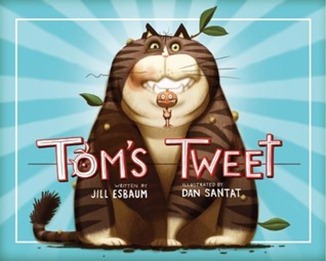
Review: Tom’s Tweet by Jill Esbaum

toms tweet

Tom’s Tweet by Jill Esbaum, illustrated by Dan Santat

Tom the cat is on the hunt after a storm when he spots a baby bird on the ground.  But the Tweet is so little and scrawny that it won’t amount to much, so Tom turns away.  But the little bird looks so helpless and alone, that Tom decides to help despite his misgivings.  Tom heads up the tree to return the Tweet to its nest, carrying it in his mouth.  But then the mother bird sees him and she attacks!  Tom has to flee with the Tweet.  After that, he has to figure out how to give it a home.  And (gulp) feed it too.  Tom finally finds a way to get the Tweet back to its nest, but he can’t get it out of his head.   What is a cat to do when he misses a bird?!

Esbaum’s rhymes romp along, and they work well for the most part.  The rhythm is even better, galloping along and creating a brisk pace for the story.  The infectious rhythm makes reading the book aloud great fun.  In fact, I think it reads aloud better than it reads silently.  The story is filled with humor, from Tom’s expressions of “tarnation” and “dadburn it” to the scene where he feeds the little Tweet.

Santat’s illustrations are what take this book to another level.  While the story is funny on its own, it becomes wildly silly with his art.  With its computer smooth feel, it looks as if it was taken right off of a Pixar movie screen.  Children will respond naturally to the style and then enjoy it even more thanks to the humor embedded in it.

Very funny, this picture book will be enjoyed by children looking for a silly read with plenty of heart.  Appropriate for ages 4-7.

Reviewed from copy received from Alfred A. Knopf.

Review: The Cats in the Doll Shop by Yona Zeldis McDonough

cats in the doll shop

The Cats in the Doll Shop by Yona Zeldis McDonough, illustrated by Heather Maione

I was a big fan of The Doll Shop Downstairs when it came out in 2009.  Here in the sequel, Anna is two years older at  age 11.  She and her family still live above the doll shop, but their work has changed from that of a doll hospital to building their own dolls.  Anna finds a pregnant cat behind their house and wants to adopt it, but her father insists that they do not need a cat inside.   So Anna and her sisters give the cat food.  Anna is also looking forward to the arrival of her cousin from Russia, who is coming to live with them.  Anna wants to be best friends with her cousin, but Tania arrives and is very shy and has odd traits.  Anna has to figure out how to invite not only a new cousin into her family but maybe some cats too.

Once again, McDonough has captured the lives of a Jewish family at the turn of the century with great detail that brings the time period to life.  It is also a captivating picture of a loving family with three sisters who do not get along all the time.  The writing is simple and honest, creating a world of safety but also exploring more serious issues too.

In both lines of the story, the issue of acceptance and finding one’s place is a focus.  There are the cats who are wild outdoors, cold and even injured.  That parallels very clearly with the storyline of Tania, the cousin from Russia, who is also an outsider, stand-offish and needs nurturing to blossom. 

A great pick for any fan of the first book, these are books that read like classics.  Appropriate for ages 7-10, this book is also gentle enough to work for advanced younger readers looking for appropriate books to read. 

Reviewed from copy received from Viking.

Review: Mr. Putter and Tabby Ring the Bell by Cynthia Rylant

ring the bell

Mr. Putter and Tabby Ring the Bell by Cynthia Rylant, illustrated by Arthur Howard

When autumn arrives with apples, falling leaves and cool wind, Mr. Putter finds that he is missing school.  He wishes that he could return if only for one day.  Then he comes up with a solution:  visit a classroom along with Mrs. Teaberry and have Tabby and Zeke do tricks!  The only problem is that Tabby and Zeke really don’t do tricks.  But Mr. Putter is sure that they can be taught in time.  Unfortunately, it doesn’t all work out as Mr. Putter thinks it will.  It’s a complete disaster: but also completely funny. 

I have been a fan of Mr. Putter and Tabby for years.  They are at that reading level that is so hard, where the children are reaching towards chapter books but not quite there yet.  Rylant has taken a very unlikely character in Mr. Putter and turned him into a man that children will happily relate to.  Tabby on the other hand is easily beloved by young readers.

Howard’s illustrations are equally appealing, filled with plenty of color, lots of action, and more than a touch of silliness.  Readers from a broad range of ages will enjoy this new edition to the popular series. 

A great pick for when children are back at school, this book reads aloud well but works best when young readers tackle it themselves.  Look for the whole series and enjoy them all!  Appropriate for ages 4-6.

Reviewed from library copy.

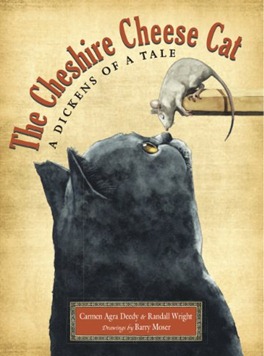
Review: The Cheshire Cheese Cat by Carmen Agra Deedy

cheshire cheese cat

The Cheshire Cheese Cat: A Dickens of a Tale by Carmen Agra Deedy & Randall Wright, illustrated by Barry Moser

Skilley is an alley cat who is down on his luck, he has a broken tail, tattered ears, and has grown used to dodging brooms and wheels.  So when he hears that Ye Olde Cheshire Cheese, a local inn, needs a mouser, he concocts a plan to become that cat.  But Skilley has a horrible, shameful secret that he carries with him: he doesn’t eat mice.  Instead he prefers a good nibble of cheese.  Discovering this, a mouse named Pip strikes up a deal.  The mice of The Cheese will provide Skilley with the cheese he needs in exchange for him pretending to nab them and eat them.  The plan is perfection for a short time, until an evil cat named Pinch enters the inn and more secrets start coming out.  Add some historical British figures and you have an engaging romp of a novel for middle readers.

The authors have created a historical fiction novel that is also an animal novel.  It has figures like Charles Dickens and Thackeray, but mostly focuses on the animals themselves.  It is a novel that explores friendship and accepting yourself even if there are things that you might be ashamed of.  These messages are woven skillfully throughout the story and never become overbearing.

The pacing of the novel is also skillfully done.  There are quieter moments in the novel, but the foreshadowing makes even those uneasy ones.  Once the story really gets going, it reads quickly.  I couldn’t put it down in the last few chapters because I was so caught up in the story.

I’m not a huge animal story fan.  It seems that they tend to be tearful, overly emotive, and generally tragic.  That is not the case here.  Instead readers will cheer on the heroes, worry for their safety, and find themselves in the midst of a grand adventure in Elizabethan England.

Highly recommended, this book is one delicious read with a pleasing mix of sweet and savory.  Appropriate for ages 9-12.

Reviewed from copy received from Peachtree Publishers.

Also reviewed by: