3 New Nonfiction Picture Books That Take Risks

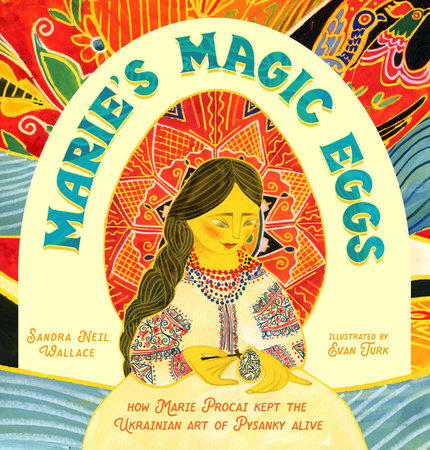
Book cover for Marie’s Magic Eggs: How Marie Procai Kept the Ukrainian Art of Pysanky Alive by Sandra Neil Wallace, illustrated by Evan Turk. Features Marie Procai in the middle of the cover creating a design on an egg with a large red Ukrainian egg behind her.

Marie’s Magic Eggs: How Marie Procai Kept the Ukrainian Art of Pysanky Alive by Sandra Neil Wallace, illustrated by Evan Turk

  • Publisher: Calkins Creek
  • Publication Date: February 10, 2026
  • Reviewed from Edelweiss e-galley
  • ISBN: 9781662680694

Marie learned to make Ukrainian decorated eggs with the Baba in Ukraine. They used beeswax and sketched stories on the eggs which were then painted in colors created from local plants. Marie followed her brothers when they moved to North America. Marie lived in Minneapolis after discovering her favorite uncle was there. When spring came, Marie longed to make pysanky and slowly found a way to create the colors and tools she needed. Marie married and her tools grew better thanks to her husband. Eventually, Marie started to sell tools and teach people how to create this art. Her Ukrainian Gift Shop became the largest supplier of pysanky kits in the world and her eggs were displayed at the White House. All a tribute to her heritage and her Baba.

This dynamic tale mixes tradition with new opportunities. Throughout the book, Marie is shown as a woman with her own ideas, her own way of approaching things and an undying connection to her Ukrainian heritage and culture. The book shares just enough information about creating pysanky to give young readers a sense of the detail and skill that go into each one. The art by Turk is amazing given that it uses resist, just like pysanky does, for the art. The result is an Easter egg of a book that has a rustic and colorful feel. 

A bright inspiring look at a female entrepreneur who used her heritage to create a business that speaks on behalf of Ukrainian heritage. Appropriate for ages 5-8.

Book cover for Seven Million Steps: The True Story of Dick Gregory’s Run for the Hungry by Derrick Barnes and Christian Gregory, illustrated by Frank Morrison. Featuring Dick Gregory running past red rock formations.

Seven Million Steps: The True Story of Dick Gregory’s Run for the Hungry by Derrick Barnes and Christian Gregory, illustrated by Frank Morrison

  • Publisher: Amistad Books for Young Readers
  • Publication Date: February 3, 2026
  • Reviewed from Edelweiss e-galley
  • ISBN: 9780063357525

To raise awareness of the problem of hunger in America, Dick Gregory pledged to run 3,500 miles across the United States from Los Angeles to New York City in two and a half months. At first, there were journalists, famous people and others cheering. But soon there was just the quiet of the road. He ran 50 miles a day, seeing America in a new way. At every stop Gregory spoke about why he was running. Running farther, Gregory was joined by local people who met him to run with him for a bit, supporting his cause, even Muhammad Ali came along. There was pain, so much effort and finally success as he entered New York on the Fourth of July. 

Told in second person, this book invites you to experience the decisions that went into Gregory’s run as well as the run itself. The text is near poetry, flowing across the page in stanzas that have rhythm that begs to be read aloud. It shares information clearly and with a particular point of view that insists that you look and think about what was accomplished. The art by Morrison is marvelous, filled with the long legs of runners, the vibrancy of brown and Black skin, and playing with perspectives to make the art sing along with the words.

A thrilling and inspiring look at activism in action. Appropriate for ages 5-8.
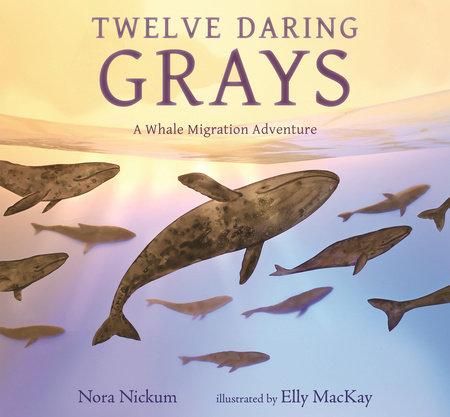
Book cover for Twelve Daring Grays: A Whale Migration Adventure by Nora Nickum, illustrated by Elly MacKay. Features a pod of whales near the surface of the water.

Twelve Daring Grays: A Whale Migration Adventure by Nora Nickum, illustrated by Elly MacKay

  • Publisher: Candlewick
  • Publication Date: February 10, 2026
  • Reviewed from Edelweiss e-galley
  • ISBN: 9781536234701

Every February, gray whales travel from Baja California to the Arctic. The trip is 6,000 miles and takes them 2 months. In their midst are 12 whales with a different plan. All of them eat almost nothing along the trip and some die along the way. When they reach Washington State, the 12 whales change course and head to the Salish Sea. The whales must wait for the tide to rise so they can reach the mudflat safely. Still, the water is very shallow where they must forage for the ghost shrimp to help them survive their journey. They stay for days, devouring the shrimp and leaving whale-sized divots in the sand. They set out on their trip north again, heading to the rich Arctic waters and then traveling back to California again to have their calves. Perhaps those calves too will take the dangerous detour to the Salish Sea.

Nickum has created a nonfiction picture book that reads beautifully, welcoming children to the story of these brave animals as they find a new way to survive a dangerous migration. The prose is presented almost like poetry on the page, offering beautiful moments of wonder at what the whales can do when they turn off and then eat in such shallow waters. MacKay’s art is incredible. She uses paper, ink, colored filters and light to create images that shine on the page. Each of the images is amazing, but I’ve never seen anything like what she has created to show the whales in shallow water. Incredible.

Breathtaking story and illustrations make this a journey worth taking. Appropriate for ages 4-8.
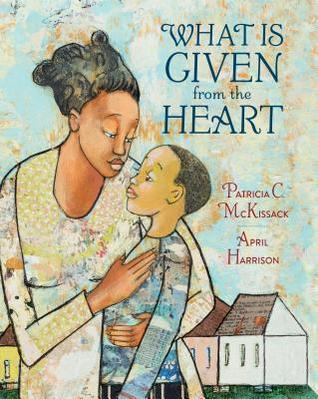
Review: What Is Given from the Heart by Patricia C. McKissack

What Is Given from the Heart by Patricia C. McKissack

What Is Given from the Heart by Patricia C. McKissack, illustrated by April Harrison (9780375936159)

After his father died, James Otis and his mother got even more poor than before. They lost their farm and had to move into a small house in the Bottoms. Things kept getting worse as his dog disappeared and everything flooded. Christmas was sparse but they made their way through until spring. That’s when their church gave out love boxes to those in need. This year, one family had lost everything in a fire. James Otis was encouraged to give something to the little girl in the family, but what could he give? He had a few possessions, but he didn’t think she would like any of them. Finally, he had an idea, something that would speak to her heart. At church on the Sunday before Valentine’s Day, James Otis gave her the book he had made for her, and she was delighted with it. When he returned home with his mother, they discovered that they too had been given a love box to help them through.

McKissack died over a year ago; it is a distinct treat to have another one of her picture books published. Here she focuses on resilience in the face of hardship and adversity as well as the power of giving to others. For the young character of James Otis, thinking of another lifts his spirits and when he creates something for her, you can feel his pride on the page. The text of the book is uplifting and powerful, calling for everyone to step forward and help one another from the heart.

Harrison’s illustrations are done in mixed media with acrylics and collage. They have a deep texture to them in places and in others the patterns are layered and beautifully subtle, almost like complex batik. The light in the images glows with a honeyed color, creating a warmth in the face of poverty and a hope that encases the entire book.

A beautiful final book for McKissack that calls for heartfelt help for those in need. Appropriate for ages 4-7.

Reviewed from e-galley provided by Schwartz & Wade.

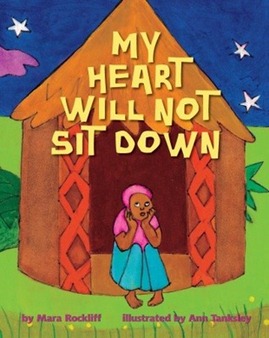
Review: My Heart Will Not Sit Down by Mara Rockliff

my heart will not sit down

My Heart Will Not Sit Down by Mara Rockliff, illustrated by Ann Tanksley

Inspired by the true story of a village in Cameroon donating $3.77 in 1931 to the city of New York to help feed the hungry during the Great Depression.  In this picture book version of the story, the main character is Kedi, a girl who learns from her American teacher that people in his hometown of New York City were going hungry due to the Depression.  Kedi could not stop thinking of the hungry children in America, even though they lived so far away.  Her heart would not sit down until she did something.  So she talked with the grownups in her village and all of them told her at first that nothing could be done, they had no money to spare.  But then, one by one, all of the adults gave coins to help the hungry children. 

The author’s note at the end of the book, tells more about the Depression and about the donation too.  It explains that even in the Depression, this small amount of money would not have had a large impact.  But for the villagers who sent the funds, it would have been a fortune.  This book is a lesson in following your heart, finding compassion for others, and making an important difference in the world, even if it is just $3.77. Children will easily understand both the sacrifice made by the villagers and the meager amount that was raised.  It makes the story all the more haunting.

Tanksley’s illustrations have a roughness and organic quality that really grounds this story in reality.  Done in watercolor, pen and ink, and oils, they are filled with rich color and show the poverty and the beauty of Cameroon.

Throughout the book, the phrase “my heart would not sit down” is used.  It evokes a yearning, a calling, an inner distress that could only be quieted by doing something to help.  It’s that feeling that we need to cherish in both ourselves and our children.  It would also make a very good discussion book about what makes children’s hearts “not sit down.”

Based on a true story, this book is a call to follow our unquiet hearts.  Appropriate for ages 5-8.

Reviewed from copy received from Alfred A. Knopf.

The Tooth: A Big-Hearted Book

415iNr4q2mL._SS500_

The Tooth by Avi Slodovnick, illustrated by Manon Gauthier

First published in Canada, this book speaks to the issues of plenty and need.  Marissa has to go to the dentist because her tooth hurts from eating too much candy.  On the way through the city streets, she notices a man sitting on a grate on the sidewalk to keep warm.  Once inside the waiting room, Marissa heads to the window and watches the people passing the man.  Some leave coins but most completely ignore him.  When Marissa goes in to the dentist, her tooth has to be removed.  So she gets it to take home with her, ready for the Toothfairy to get it from under her pillow.  But Marissa has another idea and she gives her tooth to the man on the sidewalk so that he can get the coins from the Toothfairy.  She also acknowledges that it is just a beginning because he doesn’t have a pillow to put the tooth under.

Slodovnick’s book emphasizes not only the divide between the haves and have nots, but also the way that we ignore needs right under our own feet.  Marissa is a naïve character which allows her to ask questions that will interest other children and offer a solution that is simple but also complex.  This is a book that gently opens the door to discussion about what a single person can do to make a difference.

Gauthier’s illustrations have a modern edge to them.  The city is depicted as a gray towering presence while the main characters pop in color against the gray.  The homeless man is also shown in color though the other people on the street are the same gray as the city itself. 

A book sure to get children talking, this would work well in a unit about kindness, charity or helping.  Appropriate for ages 4-6.

Reviewed from copy received from Kane Miller.