2 New Chinese-American Picture Books Featuring Families

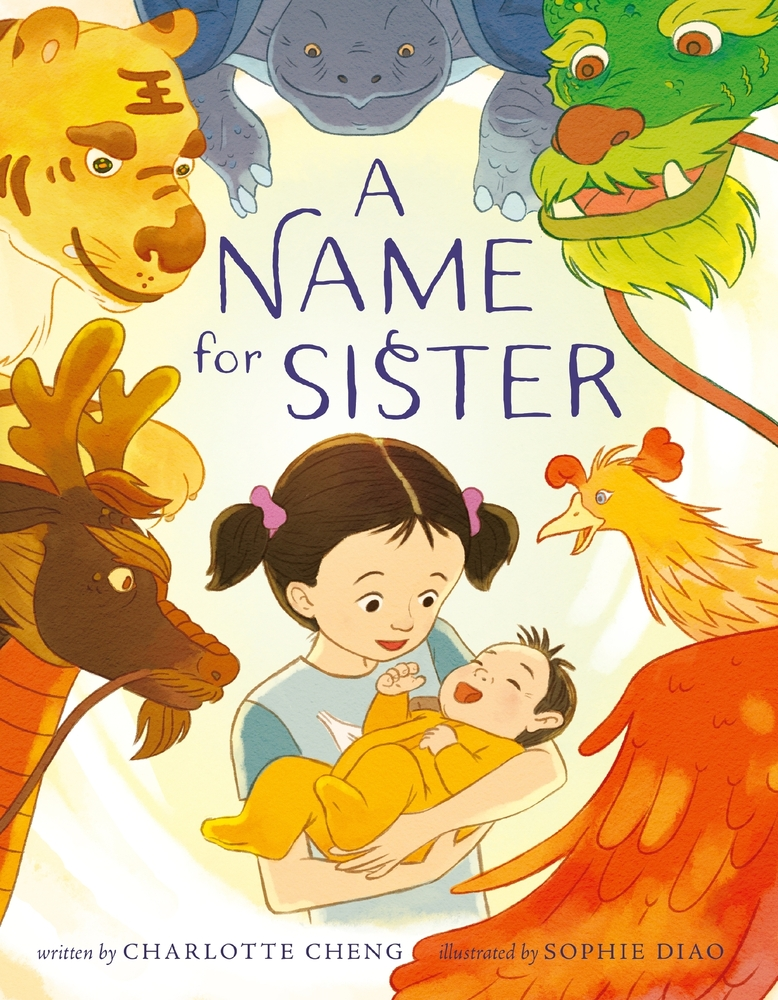
Cover image for A Name for Sister by Charlotte Cheng, illustrated by Sophie Diao. Features a girl holding her new baby sister with a variety of Chinese spirits around her.

A Name for Sister by Charlotte Cheng, illustrated by Sophie Diao

  • Publisher: HarperCollins
  • Publication Date: March 3, 2026
  • Reviewed from Edelweiss e-galley
  • ISBN: 9780063244979

Sister was born and didn’t have a name until the teller arrived. She was an older woman and counted the hours and minutes of Sister’s first day. Then she listened to the family’s hopes and dreams for Sister. The teller said that five spirits would visit and Sister would have a name after that. Fire spirit offered passion and grace filled with train rumbles and fireworks. Earth spirit offered honesty and stability with warm dirt, dog hair and potato snacks. Gold spirit gave clinking coins and a chain, offering strength and ambition. Water came that night with soup and bubbles, offering brightness and wisdom. Finally, Wood spirit arrived with papaya and leaves, offering creativity and prosperity. Out of those gifts, a name was formed in Chinese characters, one you will have to read the book to discover.

Cheng’s text invites readers to experience a playful look at how Chinese names are created with the help of a fortune teller. While families may not actually be visited by spirits who resemble tortoises, dragons and tigers, they do participate in a longer ritual to decide Chinese names and how they are written. This picture book is filled with the joy of a new baby and the beauty of deciding on a fitting name. Diao’s illustrations capture the family’s awe at the spirits, the gifts they bring, and offer a dynamic look at the various elements at play. 

A creative approach to Chinese naming rituals that all readers will love. Appropriate for ages 3-5.

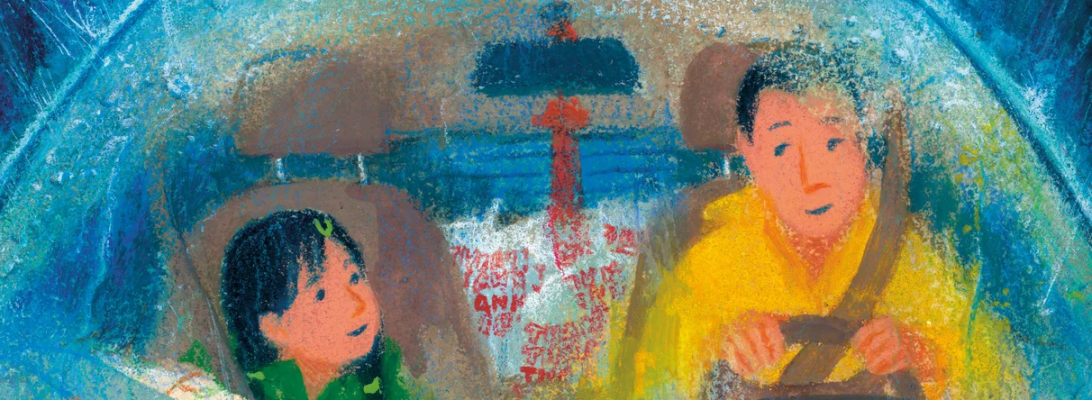
Cover image for Navigating Night by Julie Leung, illustrated by Angie Kang. Features a little girl riding in a car next to her father at night.

Navigating Night by Julie Leung, illustrated by Angie Kang

  • Publisher: Anne Schwartz Books
  • Publication Date: March 10, 2026
  • Reviewed from Edelweiss e-galley
  • ISBN: 9780593897690

A little girl helps her father deliver takeout from their family restaurant. The entire car steams up and smells like sauces. Baba drives while she looks up addresses and uses a map to navigate. They make their way through the rainy night. First they stop at a regular customer, an older woman who needs her food cooked soft. Baba offers her oil for her pain as well as the food. At the next house, a girl her age is waiting, but she doesn’t want to interact and show her face. It’s weird being out at night delivering food. Baba notices and shares a story of a night of his childhood where he was selected as the one person in the family who could travel to New York City. As his journey years ago shadows theirs today, the deliveries are all made. Finally they can go home to their family and eat together, the night navigated once more. 

Leung perfectly depicts the fear of a child of being strange due to their family expectations and needs. Told in the first person, this picture book draws readers into the car along with the father and daughter. The tale is drawn from the author’s childhood and is resonant with empathy for children of immigrants navigating their own paths. The illustrations take a rainy night and make it both beautiful and haunting. The car becomes their own small world, the windows marked and lit with the water. 

A powerful look at families, language and the roles of children. Appropriate for ages 4-7.

The Legend of Auntie Po by Shing Yin Khor

Cover image for The Legend of Auntie Po.

The Legend of Auntie Po by Shing Yin Khor (9780525554882)

The Paul Bunyan myth gets transformed by a young Chinese-American girl growing up in the logging camps in this graphic novel. Mei shares her stories about Auntie Po just as freely as she shares her stellar pies. She is the daughter of the camp cook and helps out her father in the kitchen. The manager of the camp loves her pies and is friends with her father, but that only goes so far. The Chinese men logging are fed separately. When her father is fired, Mei is left behind at the camp with her best friend. Mei uses her stories of Po Pan Yin, Auntie Po, to give all of the children in the camp a heroine they can believe in. Mei must find a way through the politics of race and privilege to find a future for herself and her father in America.

Khor offers a mix of tall tale and riveting real life in this graphic novel. She weaves in LGBT elements as Mei has feelings for Bee, her best friend. The use of sharing tales to provide comfort combines seamlessly with also offering food. Mei is a girl with a future that seems out of reach much of the time, but comes into focus by the end of the book. The book looks directly at racism in the years after the Chinese Exclusion Act and offers a mixture of characters that are racist and allies for Mei to encounter and deal with.

The art focuses on the characters themselves, sometimes offering glimpses of the Sierra Nevada scenery too. Chapters begin with different logging tools being featured and described. The art is full of bold colors, the huge Auntie Po, and the busyness of a logging camp and its kitchen.

A fascinating look at logging from a Chinese-American point of view combined with some really tall tales. Appropriate for ages 9-12.

Reviewed from library copy.

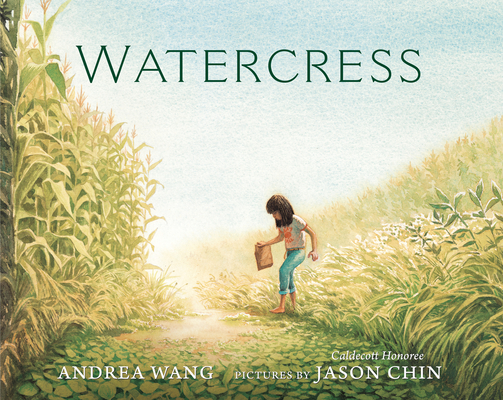
Watercress by Andrea Wang

Cover image.

Watercress by Andrea Wang, illustrated by Jason Chin (9780823446247)

Riding in their old car along a rural Ohio road, a young girl’s parents come to a stop when her mother spots something growing in the ditch. It’s watercress, so the entire family gets out and starts to harvest it into a paper bag. The girl finds it embarrassing to be in the ditch gathering free food, while her parents are remembering their time in China. The water in the ditch is cold and muddy, the watercress has snails among its roots. The girl finds herself partially hoping that the bottom of the paper bag falls through and this can just be over. That night, the family has the watercress for dinner, but the girl refuses to even try it. She wants food from the grocery store, not free food from a ditch that reminds her of furniture taken from the side of the road and hand-me-down clothes. Then her mother shares a story from China about her younger brother who died from not having enough to eat. The girl is inspired by her family’s history and ashamed of how she has been acting, so she tastes the watercress for the first time, a taste that builds new memories.

The writing in this picture book is exceptional. With delicate poetic words, Wang creates layers in her story. She weaves both the experience of shame for the young girl and the melancholy memories of China for her parents together into a story of generations in a Chinese-American family. From the previously unshared stories of her parents time in China to learning not to be ashamed of the way they live, this book will resonate for so many children.

Caldecott Honor winner, Chin pulls together images of China and Ohio in this book. By putting tall cornstalks against tall bamboo, the images are gateways to one another. The use of yellow to light the pages, works both in sunshine in Ohio and the sepia of memory in China. It is all so beautifully done, so well designed.

One of the best picture books of the year, this book reaches across generations and finds hope. Appropriate for ages 5-7.

Reviewed from e-galley provided by Holiday House.

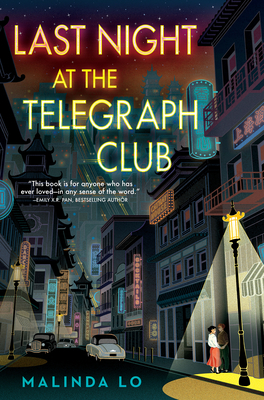
Last Night at the Telegraph Club by Malinda Lo

Cover image.

Last Night at the Telegraph Club by Malinda Lo (9780525555254)

Growing up in 1950s San Francisco isn’t simple for a Chinese-American girl who loves to dream of working on math that will send people into space. Even her best friend isn’t interested in the same things as Lily is. As Lily becomes more aware of her sexuality, she soon realizes that she is queer. She’s particularly intrigued by a male impersonator in San Francisco. As her love of math draws her closer to a white classmate at school, she realizes they may have even more in common. Soon the two teens are heading out to a club together to watch that same male impersonator that Lily was dreaming about. But remember, it is the 1950s and Chinese girls are not allowed to be gay, so Lily is risking a lot. It’s the time of McCarthyism too, so Lily’s family is threatened by the fear of Communism when her father’s papers are taken away. Lily must find a way to navigate the many dangers of being Chinese, queer and young.

Lo’s writing is so incredible. She creates a historical novel that makes the historical elements so crucial to the story that they flow effortlessly along. She avoids long sections of exposition about history by building it into the story in a natural and thoughtful way. That allows readers to feel Lily’s story all the more deeply while realizing the risks the Lily is taking with her family and friends. Lo also beautifully incorporates San Francisco into the book, allowing readers to walk Chinatown and visit other iconic parts and features of the city.

As well as telling Lily’s story, Lo shares the stories of Lily’s aunt and mother. They took different paths to the present time, making critical decisions about their careers and marriages. These experiences while straight and more historical speak to Lily’s own budding romance and finding of people who support her as she discovers who she is. They remove the simple look at who her mother could be been assumed to be and make her a more complex character.

Layered and remarkable, this book speaks to new, queer love and shows that intersectionality has been around forever. Appropriate for ages 15-18.

Reviewed from library copy.

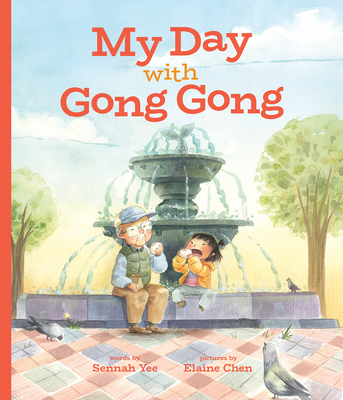
My Day with Gong Gong by Sennah Yee

My Day with Gong Gong cover image

My Day with Gong Gong by Sennah Yee, illustrated by Elaine Chen (9781773214290)

May has been left with her grandfather, Gong Gong, to spend the day. But she doesn’t speak any Chinese and Gong Gong doesn’t speak much English. They go on a walk together through Gong Gong’s Chinatown neighborhood. Her grandfather knows everyone as they walk by, but May can’t understand what they are saying or why they are laughing. May gets hungry and asks for something to eat, but her grandpa just pats her head. They go to a Dim Sum restaurant next, but Gong Gong spends the time chatting, not eating. Then they head to the grocery store and shop. May thinks they may be heading home to eat, but instead they play cards with Gong Gong’s friends in the park. When a pigeon poops on May’s jacket, she bursts into tears. But it turns out that Gong Gong has been paying attention all along and has just the right toy and dumpling to help.

This picture book celebrates the generations spending time together, particularly those from immigrant families who have language barriers. Told entirely from May’s point of view with little asides to the reader of her confusion and hunger, the book captures May’s unease with her grandfather and her belief that he doesn’t understand her at all. That is then flipped around, as the book resolves into a grandfather who has been paying close attention all along.

The illustrations beautifully depict Chinatown streets with many people out and about and colorful shops and signs. The scenes shine with sunlight, showing readers the warmth and friendliness of the community long before May truly feels it herself.

A lovely look at grandparents and finding connection across generations. Appropriate for ages 3-5.

Reviewed from e-galley provided by Annick Press.

Prairie Lotus by Linda Sue Park

Prairie Lotus by Linda Sue Park

Prairie Lotus by Linda Sue Park (9781328781505)

Hanna and her father travel by wagon in 1880 to a small town in the Midwest where they plan to sell dress goods. Hanna though has another plan, one that her father doesn’t support, to design, sew and sell dresses for the women in town rather than just selling the materials. Hanna also wants to graduate from school, but that is not without a lot of controversy in the town. Hanna is half Chinese, her Chinese mother died in California, and her father is white. While her father is entirely accepted by the town, Hanna faces prejudice on a daily basis. In fact, most of the other students drop out of school when it is clear that Hanna will be allowed to attend. Meanwhile, their family shop is being built and stocked. Hanna and her teacher work on a plan to get her to graduate by the end of the year, though it seems less like a solution for Hanna and more of a way around the controversy she creates. As the opening of the shop nears, Hanna will face one of the most daunting and frightening moments of her life and must figure out how to keep it from ruining their future.

In her afterword, Park explains her connection as a child to the Little House on the Prairie book series by Laura Ingalls Wilder. Her book clearly pays homage to the best of that series, set in a similar community with characters who echo some of the most iconic from the series. But Park takes the opportunity to right a lot of what is wrong with that series. She carefully includes Native Americans in the book, paying attention to all they have lost by this time in American history and to their language and way of life. This is beautifully done.

Park also creates a space for Americans of color on the prairie, showing that the settlement of America was done by more than the white people we usually see depicted. She works with the prejudice, stereotypes and aggression that people of color faced then and continue to face today. This is a book that un-erases people from history.

Marvelous, timeless and important. Appropriate for ages 10-13.

Reviewed from e-galley provided by Clarion Books.

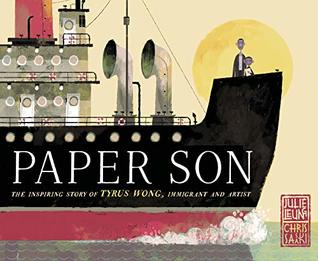
Review: Paper Son by Julie Leung

Paper Son The Inspiring Story of Tyrus Wong, Immigrant and Artist by Julie Leung

Paper Son: The Inspiring Story of Tyrus Wong, Immigrant and Artist by Julie Leung, illustrated by Chris Sasaki (9781524771874)

Released on September 24, 2019.

Tyrus Wong entered the United States by using papers that belonged to another Chinese boy. In 1919, Chinese people entering the U.S. had to prove that they were of high status. Tyrus and his father both traveled under other people’s identities, making him a paper son. He had to memorize details of the other boy’s life and village, knowing that he would be tested to see if his identity was real. When they reached immigration, his father was let through easily but Tyrus was held for weeks until he was finally released after being interrogated about his identity. Tyrus didn’t like school much and his father was often away for work. Tyrus loved art, studying both western and eastern art styles. After he graduated from art school, he worked for Disney Studios, doing painstaking work. Then he heard of a new movie, Bambi, that the studio was working on. He began to create backgrounds for the film and Walt Disney loved them. Fired from Disney after a worker’s strike, Tyrus continued to make art throughout the rest of his life.

Leung tells Wong’s story with a lovely clarity. From his entry into the country through his career, Wong’s tale is not linear but rather a series of opportunities that he seized upon. The beginning of the book shows a family trapped in the red tape of immigration and that harrowing experience blossoms into a book about art and opportunity to express one’s self. That again narrows when Wong finds himself doing grunt work for Disney Studios and once again opportunities appear to move him forward. Throughout there is a sense of grace and resilience when faced with real obstacles.

The art work is clearly done with Wong in mind, with its ethereal backgrounds. The images are powerful, often showing things from a unique perspective from a look at a line of people on a long pier to directly gazing into Wong’s window to looking down at an image painted with a mop. The result is dramatic and beautiful.

A picture book biography that celebrates a lesser-known artist whose work we have all seen. Appropriate for ages 6-9.

Reviewed from e-galley provided by Schwartz & Wade.

Review: Stargazing by Jen Wang

Stargazing by Jen Wang

Stargazing by Jen Wang (9781250183880)

Moon and Christine could not be more different even though they both have grown up in the same Chinese-American neighborhood. Christine has strict parents who don’t let her wear nail polish, much less makeup. Moon’s single-parent mother is accepting and gentle. Christine tends to be more concerned with fitting in than Moon who is rather dreamy and loves dancing and music. The two girls decide to enter the school’s talent contest as a dance team, bringing out Christine’s performing side that she never knew existed. Just as the girls start to gel as friends though, Moon reveals that she has visions sometimes. When the true cause of the visions turns out to be seizures, Christine must figure out what sort of friend she really is.

Award-winning graphic novelist Wang invites readers into a personal story about growing up Chinese-American. She draws from her own medical past with seizures and brain surgery to create a graphic novel that is wrenching and real. She entirely leaves her heart on the pages, giving us two girls who are different from one another but clearly meant to be friends. The books’ premise may be personal, but the result is a book that is universal. Wang’s art is accessible and friendly, inviting readers to explore and learn along the way. There are wonderful moments that are distinctly Chinese-American that resonate across cultures.

A warm and rich graphic novel about friendship and so much more. Appropriate for ages 9-12.

Reviewed from library copy.


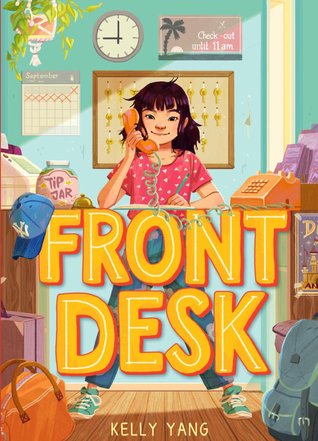
Review: Front Desk by Kelly Yang

Front Desk by Kelly Yang

Front Desk by Kelly Yang (9781338157802)

When Mia and her family first moved to the United States from China, she expected to live in a big house with a car and have plenty of money. But her parents have struggled from the beginning to find jobs. When they become caretakers of a motel, the job gives them free rent, but requires one of them to be on duty at all times and Mia’s parents to spend all of their time doing laundry and cleaning the rooms. Mia steps up to help by manning the front desk. She gets to know the “weeklies” who are the people who stay at the motel long term. Her family quickly realizes that the man who owns the motel is dishonest but Mia has a plan to help her parents get off of the roller coaster of poverty. All she needs is to write a perfect letter in English and somehow find $300.

Based on her own childhood growing up as a family managing motels, Yang tells a vibrant story of hope in the face of crushing poverty. It is a book that shows how communities develop, how one girl can make a big difference in everyone’s life and how dreams happen, just not in the way you plan. Yang’s writing is fresh, telling the tale of Chinese immigrants looking for the American dream and not finding it easily due to prejudice. She valiantly takes on serious issues of racism and poverty in this book.

Mia is a great protagonist. She never gives up, always optimistic and looking for a new way to problem solve. Her own desire to be a writer plays out organically in the novel, showing how someone learning a new language can master it. The examples of her editing and correcting her own writing are cleverly done, showing the troubles with American expressions and verb tenses.

A great read that embraces diversity and gives voice to immigrant children. Appropriate for ages 9-12.

Reviewed from ARC provided by Scholastic.